B.J.P.S Samiti’s
M.V.HERWADKAR ENGLISH MEDIUM HIGH SCHOOL
local self government
STD 8TH
Staff Name:Rashmi Pandit
The need for local self government
• Local self government provides a link between
the government and the masses. It helps the
people of the locality to voice their problems.
• It helps to solve local problems at the local
level with the co-operation and involvement
of the people.
• It also provides opportunities to the citizens to
participate in the process of governance and
thereby strengthen the democratic system.
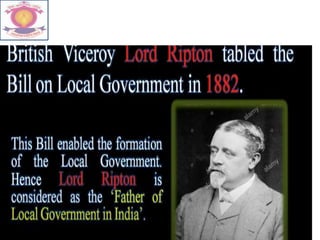
• Lord Ripon is considered as the ‘Father of local
government’ in India.
• The 73rd and 74th Constitutional Amendments
which came into effect in 1993 gave
constitutional status to civic administration.
Hence it is considered a milestone in the
history of Panchayat Raj System.
Objectives of local self governments
• To involve the local people in solving the
problems of their own locality.
• To provide the knowledge of administration to
common people.
• To help in decentralizing powers and make the
administration more efficient.
• To train or develop leadership qualities among
the people at the grass-root level.
The functions of local self
governments
• To maintain and protect Panchayat property.
• To prepare the annual budget of the local
body.
• To undertake health and family welfare
programmes.
• To plan and undertake developmental works
such as laying of roads, electrification, supply
of water, etc.
• To maintain cleanliness and sanitation in the
area.
• To ensure prompt registration of births and
deaths.
• To collect taxes, fees and penalties.
• To identify the beneficiaries for the various
welfare programmes of the government.
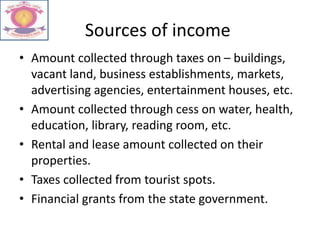
Sources of income
• Amount collected through taxes on – buildings,
vacant land, business establishments, markets,
advertising agencies, entertainment houses, etc.
• Amount collected through cess on water, health,
education, library, reading room, etc.
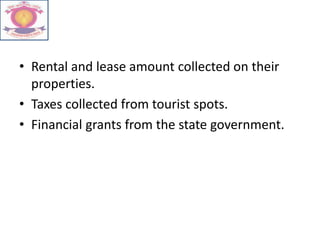
• Rental and lease amount collected on their
properties.
• Taxes collected from tourist spots.
• Financial grants from the state government.
• Rental and lease amount collected on their
properties.
• Taxes collected from tourist spots.
• Financial grants from the state government.
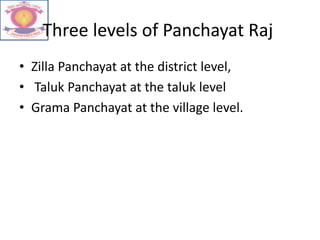
Three levels of Panchayat Raj
• Zilla Panchayat at the district level,
• Taluk Panchayat at the taluk level
• Grama Panchayat at the village level.
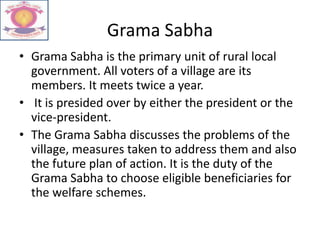
Grama Sabha
• Grama Sabha is the primary unit of rural local
government. All voters of a village are its
members. It meets twice a year.
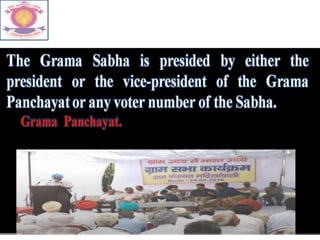
• It is presided over by either the president or the
vice-president.
• The Grama Sabha discusses the problems of the
village, measures taken to address them and also
the future plan of action. It is the duty of the
Grama Sabha to choose eligible beneficiaries for
the welfare schemes.
Grama Panchayats.
• Grama Panchayats are formed at the village level
on the basis of population.
• A village or a group of villages with population
between 5000 and 7000 form a Gram Panchayat.
• The members of the grama panchayat are
elected by the adult population of the panchayat
area.
• There will be one representative for every 400
voters.
• The term of the Grama Panchayat is five years.
Meetings of the Panchayat are held once in
two months.
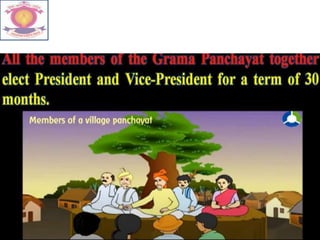
• The members elect the President and Vice-
President for a term of 30 months.
• Standing committees are formed for efficient
administration.
• The Panchayat Development Officer is the
executive head of Grama Panchayat.
Grama Panchayats formed
• Grama Panchayats are formed on the basis of
population.
• A village or a group of villages with a
population between 5,000 and 7,000 form a
Grama Panchayat.
• If the population is less, then two or three
villages together will form a Grama Panchayat.
Members of the Panchayat are elected by the
adult population of the panchayat area.
• one member is elected to represent 400
people.
• The term of the Panchayat is five years. The
elected members in turn elect one among
them as President and another as Vice
President.
• The Panchayat Development Officer is the
executive head of Grama Panchayat.
Structure of Taluk Panchayats.
• The Taluk Panchayat comprises members directly
elected by the eligible voters. The number of
members in the Taluk Panchayat is based on the
population of the taluk.
• There is one elected representative for every
12,500 to 15,000 voters.
• Besides, one-fifth of the presidents of Grama
Panchayats serve as the members of Taluk
Panchayat.
• The presidents are chosen through lottery
system. They are nominated on rotation basis
for a period of one year. The term of Taluk
Panchayats is five years. MLAs, MLCs and MPs
of the taluk are also members of the Taluk
Panchayat.
Functions of the Taluk Panchayat
• The Taluk Panchayats, in addition to the
functions of local bodies, perform certain
other functions too.
• They consolidate the annual plan proposals of
the Grama Panchayats and submit them to the
Zilla Panchayat.
• They also implement the welfare programmes
suggested or ordered by the Zilla Panchayat
and the state government.
structure of the Zilla Panchayats.
• Zilla Panchayats are constituted at the district
level. The members of the Zilla Panchayat are
elected directly by the people of the district.
• The total number of members varies from
district to district based on the population.
• In addition, Presidents of Taluk Panchayats,
MLAs, MLCs and MPs of that district are
members of the Zilla Panchayats.
• The term of the members is five years. Five
standing committees are formed for efficient
administration.
• A Chief Executive Officer equal to the rank of
District Commissioner is appointed by the
state government to look after the executive
work of the panchayat.
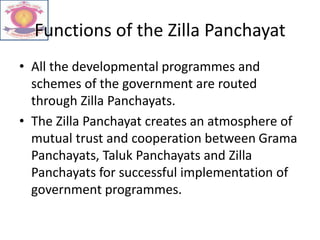
Functions of the Zilla Panchayat
• All the developmental programmes and
schemes of the government are routed
through Zilla Panchayats.
• The Zilla Panchayat creates an atmosphere of
mutual trust and cooperation between Grama
Panchayats, Taluk Panchayats and Zilla
Panchayats for successful implementation of
government programmes.
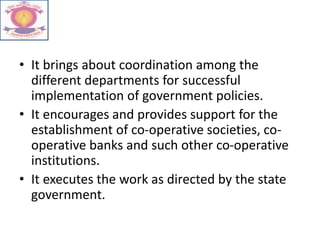
• It brings about coordination among the
different departments for successful
implementation of government policies.
• It encourages and provides support for the
establishment of co-operative societies, co-
operative banks and such other co-operative
institutions.
• It executes the work as directed by the state
government.
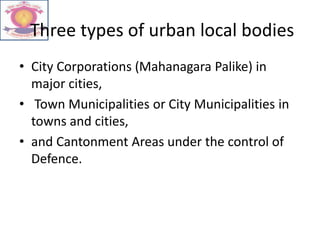
Three types of urban local bodies
• City Corporations (Mahanagara Palike) in
major cities,
• Town Municipalities or City Municipalities in
towns and cities,
• and Cantonment Areas under the control of
Defence.
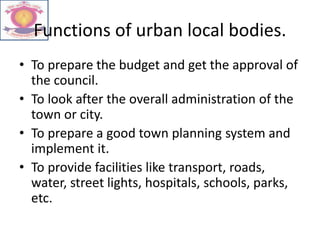
Functions of urban local bodies.
• To prepare the budget and get the approval of
the council.
• To look after the overall administration of the
town or city.
• To prepare a good town planning system and
implement it.
• To provide facilities like transport, roads,
water, street lights, hospitals, schools, parks,
etc.
Functions of urban local bodies
• To maintain cleanliness by providing good
drainage system and disposal of urban waste.
• Registration of births and deaths.
• To establish orphanages, old age homes,
beggar colonies, juvenile homes and child
welfare centres.
• To undertake the construction of
swimming pools, stadiums, museums,
bus stands, public libraries, veterinary
hospitals, wholesale market yards and
crematoriums.
sources of income of the urban local
bodies
• The main sources of income of urban local bodies
are the taxes levied and collected on buildings,
vacant sites, shops and vending carts, etc.
• In addition, they collect rent from the buildings
owned by the local bodies and rented out to
offices, markets, etc.
• Water cess, market cess and cess on
entertainment houses also yield revenue. In
addition, the state government also
Municipal Corporations and Town
Municipalities
• An urban area is classified as a town or a city
on the basis of the population. An area with a
population between 20,000 and 50,000 is
considered a town.
• Town municipality is the governing body of
that area.
• An area with a population of 50,000 to 3 lakhs
is considered a city. City municipality is the
governing body of that area.
Composition of City
municipalities/Town Municipalities.
• There is not much of a difference between
town municipalities and city municipalities.
• The number of members in both depends on
the population.
• The governing bodies of both have elected
representatives called Councillors.
• They are elected directly by the people of that
town or city. The number of councillors varies
from place to place depending on the
population.
• Besides, the government nominates five
members who are experienced and have good
knowledge of municipal administration.
• The term of the elected members is five years.
The elected councillors in turn elect the
President and Vice President of the
Corporation.
• Four standing committees are
constituted for the smooth functioning of
the local bodies. The government
appoints a Chief Officer to look after the
administration of the corporation.
City Corporation structure.
• City Corporations are formed in areas with
more than two lakh population and income of
more than Rs. one crore.
• The members of the City Corporation are
called Corporators.
• The number of Corporators in a corporation is
decided on the basis of population. Normally,
it is between 30 and 100.
• The city is divided into wards and people of
each ward elect one corporator.
• Apart from these the state government can
also nominate five members, but they do not
have the right to vote.
• The term of corporators is five years. The
head of the corporation is called Mayor. There
is a Deputy Mayor as well.
• They are elected by the corporators from
among themselves for a term of one year.
• The Commissioner is the executive head and
is appointed by the government for a term of
three years

STD 8TH LOCAL SELF GOVERNMENT.pptx

  • 1.
    B.J.P.S Samiti’s M.V.HERWADKAR ENGLISHMEDIUM HIGH SCHOOL local self government STD 8TH Staff Name:Rashmi Pandit
  • 4.
    The need forlocal self government • Local self government provides a link between the government and the masses. It helps the people of the locality to voice their problems. • It helps to solve local problems at the local level with the co-operation and involvement of the people. • It also provides opportunities to the citizens to participate in the process of governance and thereby strengthen the democratic system.
  • 5.
    • Lord Riponis considered as the ‘Father of local government’ in India. • The 73rd and 74th Constitutional Amendments which came into effect in 1993 gave constitutional status to civic administration. Hence it is considered a milestone in the history of Panchayat Raj System.
  • 6.
    Objectives of localself governments • To involve the local people in solving the problems of their own locality. • To provide the knowledge of administration to common people. • To help in decentralizing powers and make the administration more efficient. • To train or develop leadership qualities among the people at the grass-root level.
  • 7.
    The functions oflocal self governments • To maintain and protect Panchayat property. • To prepare the annual budget of the local body. • To undertake health and family welfare programmes. • To plan and undertake developmental works such as laying of roads, electrification, supply of water, etc.
  • 8.
    • To maintaincleanliness and sanitation in the area. • To ensure prompt registration of births and deaths. • To collect taxes, fees and penalties. • To identify the beneficiaries for the various welfare programmes of the government.
  • 9.
    Sources of income •Amount collected through taxes on – buildings, vacant land, business establishments, markets, advertising agencies, entertainment houses, etc. • Amount collected through cess on water, health, education, library, reading room, etc. • Rental and lease amount collected on their properties. • Taxes collected from tourist spots. • Financial grants from the state government.
  • 10.
    • Rental andlease amount collected on their properties. • Taxes collected from tourist spots. • Financial grants from the state government.
  • 11.
    Three levels ofPanchayat Raj • Zilla Panchayat at the district level, • Taluk Panchayat at the taluk level • Grama Panchayat at the village level.
  • 12.
    Grama Sabha • GramaSabha is the primary unit of rural local government. All voters of a village are its members. It meets twice a year. • It is presided over by either the president or the vice-president. • The Grama Sabha discusses the problems of the village, measures taken to address them and also the future plan of action. It is the duty of the Grama Sabha to choose eligible beneficiaries for the welfare schemes.
  • 14.
    Grama Panchayats. • GramaPanchayats are formed at the village level on the basis of population. • A village or a group of villages with population between 5000 and 7000 form a Gram Panchayat. • The members of the grama panchayat are elected by the adult population of the panchayat area. • There will be one representative for every 400 voters.
  • 15.
    • The termof the Grama Panchayat is five years. Meetings of the Panchayat are held once in two months. • The members elect the President and Vice- President for a term of 30 months. • Standing committees are formed for efficient administration. • The Panchayat Development Officer is the executive head of Grama Panchayat.
  • 18.
    Grama Panchayats formed •Grama Panchayats are formed on the basis of population. • A village or a group of villages with a population between 5,000 and 7,000 form a Grama Panchayat. • If the population is less, then two or three villages together will form a Grama Panchayat. Members of the Panchayat are elected by the adult population of the panchayat area.
  • 19.
    • one memberis elected to represent 400 people. • The term of the Panchayat is five years. The elected members in turn elect one among them as President and another as Vice President. • The Panchayat Development Officer is the executive head of Grama Panchayat.
  • 20.
    Structure of TalukPanchayats. • The Taluk Panchayat comprises members directly elected by the eligible voters. The number of members in the Taluk Panchayat is based on the population of the taluk. • There is one elected representative for every 12,500 to 15,000 voters. • Besides, one-fifth of the presidents of Grama Panchayats serve as the members of Taluk Panchayat.
  • 21.
    • The presidentsare chosen through lottery system. They are nominated on rotation basis for a period of one year. The term of Taluk Panchayats is five years. MLAs, MLCs and MPs of the taluk are also members of the Taluk Panchayat.
  • 22.
    Functions of theTaluk Panchayat • The Taluk Panchayats, in addition to the functions of local bodies, perform certain other functions too. • They consolidate the annual plan proposals of the Grama Panchayats and submit them to the Zilla Panchayat. • They also implement the welfare programmes suggested or ordered by the Zilla Panchayat and the state government.
  • 23.
    structure of theZilla Panchayats. • Zilla Panchayats are constituted at the district level. The members of the Zilla Panchayat are elected directly by the people of the district. • The total number of members varies from district to district based on the population. • In addition, Presidents of Taluk Panchayats, MLAs, MLCs and MPs of that district are members of the Zilla Panchayats.
  • 24.
    • The termof the members is five years. Five standing committees are formed for efficient administration. • A Chief Executive Officer equal to the rank of District Commissioner is appointed by the state government to look after the executive work of the panchayat.
  • 25.
    Functions of theZilla Panchayat • All the developmental programmes and schemes of the government are routed through Zilla Panchayats. • The Zilla Panchayat creates an atmosphere of mutual trust and cooperation between Grama Panchayats, Taluk Panchayats and Zilla Panchayats for successful implementation of government programmes.
  • 26.
    • It bringsabout coordination among the different departments for successful implementation of government policies. • It encourages and provides support for the establishment of co-operative societies, co- operative banks and such other co-operative institutions. • It executes the work as directed by the state government.
  • 27.
    Three types ofurban local bodies • City Corporations (Mahanagara Palike) in major cities, • Town Municipalities or City Municipalities in towns and cities, • and Cantonment Areas under the control of Defence.
  • 28.
    Functions of urbanlocal bodies. • To prepare the budget and get the approval of the council. • To look after the overall administration of the town or city. • To prepare a good town planning system and implement it. • To provide facilities like transport, roads, water, street lights, hospitals, schools, parks, etc.
  • 29.
    Functions of urbanlocal bodies • To maintain cleanliness by providing good drainage system and disposal of urban waste. • Registration of births and deaths. • To establish orphanages, old age homes, beggar colonies, juvenile homes and child welfare centres.
  • 30.
    • To undertakethe construction of swimming pools, stadiums, museums, bus stands, public libraries, veterinary hospitals, wholesale market yards and crematoriums.
  • 31.
    sources of incomeof the urban local bodies • The main sources of income of urban local bodies are the taxes levied and collected on buildings, vacant sites, shops and vending carts, etc. • In addition, they collect rent from the buildings owned by the local bodies and rented out to offices, markets, etc. • Water cess, market cess and cess on entertainment houses also yield revenue. In addition, the state government also
  • 32.
    Municipal Corporations andTown Municipalities • An urban area is classified as a town or a city on the basis of the population. An area with a population between 20,000 and 50,000 is considered a town. • Town municipality is the governing body of that area. • An area with a population of 50,000 to 3 lakhs is considered a city. City municipality is the governing body of that area.
  • 33.
    Composition of City municipalities/TownMunicipalities. • There is not much of a difference between town municipalities and city municipalities. • The number of members in both depends on the population. • The governing bodies of both have elected representatives called Councillors. • They are elected directly by the people of that town or city. The number of councillors varies from place to place depending on the population.
  • 34.
    • Besides, thegovernment nominates five members who are experienced and have good knowledge of municipal administration. • The term of the elected members is five years. The elected councillors in turn elect the President and Vice President of the Corporation.
  • 35.
    • Four standingcommittees are constituted for the smooth functioning of the local bodies. The government appoints a Chief Officer to look after the administration of the corporation.
  • 36.
    City Corporation structure. •City Corporations are formed in areas with more than two lakh population and income of more than Rs. one crore. • The members of the City Corporation are called Corporators. • The number of Corporators in a corporation is decided on the basis of population. Normally, it is between 30 and 100.
  • 37.
    • The cityis divided into wards and people of each ward elect one corporator. • Apart from these the state government can also nominate five members, but they do not have the right to vote. • The term of corporators is five years. The head of the corporation is called Mayor. There is a Deputy Mayor as well.
  • 38.
    • They areelected by the corporators from among themselves for a term of one year. • The Commissioner is the executive head and is appointed by the government for a term of three years