FISCAL ECONOMICS
Dr. A. SATHEESH BABU
Assistant Professor, Department of Economics
VIVEKANANDA COLLEGE
(Residential & Autonomous –A Gurukula Institute of Life Training)
TIRUVEDAKAM WEST, MADURAI DIST– 625 234, TAMIL NADU
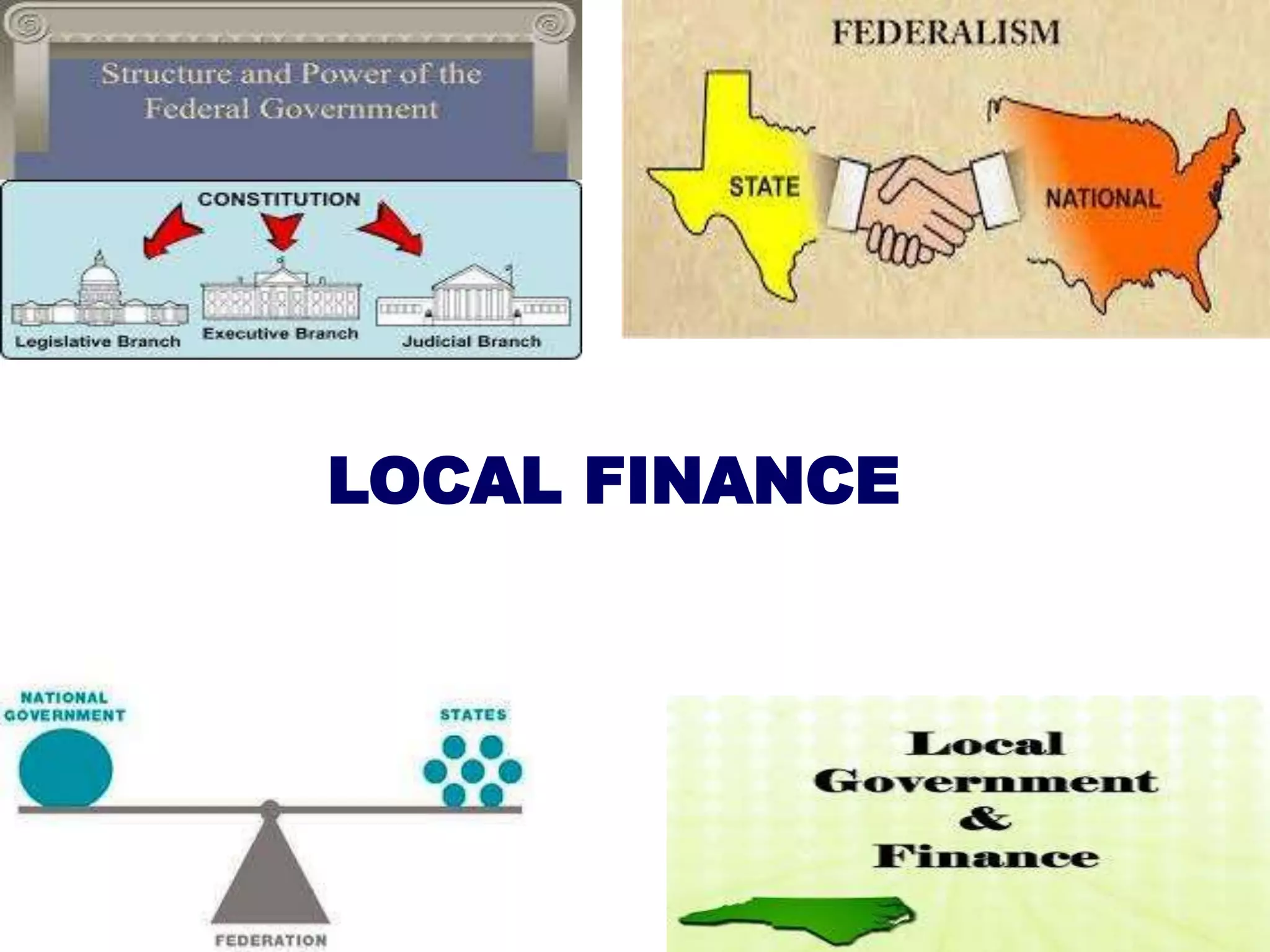
LOCAL FINANCE
LOCAL FINANCE
• Local Government / Body
• The Bottom level administration of
villages, towns, cities and districts are
called as Local Governments or Local
Bodies.
• The administration of such
administration is called as Local
Administration.
• Local finance deals with the income
and expenditure of local governments.
Differences Between National
Finance and Local Finance
S.No. Basis National Finance Local Finance
1 Needs of
Citizens
Satisfies the higher level
needs of the people.
Satisfies the local level
needs of the local
people.
2 Taxation
Basis
Taxation of Central
Government is broad in
basis.
Taxation of Local
Government is narrow
in basis.
3 Principle of
Taxation
The taxation is based on
the principle of ability to
pay.
The taxation is based
on the principle of
benefit.
4 Area of
Operation
The Central Government
has wide area of
operation.
The Local
Governments have
limited area of
operation.
S.No. Basis National Finance Local Finance
5 Use of Tax
Collections
The taxes collected by
the Central Government
are used for welfare of
the people of the Nation
as a whole.
The taxes collected by
the Local Government
are used for welfare of
the people of the
particular area only.
6 Nature of
Taxes
The taxes of the Central
Government is uniform
in nature for all over the
country.
The taxes of the Local
Government is not
uniform in nature.
7 Borrowing The Central Government
can borrow loans both
internally and externally.
The Local Government
can not borrow loans.
• Local Governments / Bodies
Village Panchayat
Panchayat Union /Samiti
Zilla Parishad /District Board
Municipality
Municipal Corporation
Village Panchayat
• The Village Panchayat System was
found from olden days.
• A Village Panchayat is for one village or
a small number of villages.
• The members and President of the
Panchayat are elected by the people
directly.
• Functions of Village Panchayat
Obligatory Functions Discretionary Functions
• Construction, repair and maintenance of all
village panchayat roads
• Lighting of public roads and public places in
built up area
• Cleaning the streets, removal of rubbish
heaps, provision and maintenance of public
letrines
• Opening and maintenance of burial and
burning grounds
• Provision and maintenance of water supply for
washing and bathing purpose
• Such other duties as the Government by
notification impose.
A) Obligatory Functions
Functions of Village Panchayat
• Planting and preservation of trees on the
sides of the all public roads in the panchayat
area.
• Lighting of public roads and public places
other than built up areas.
• Opening and maintenance of public markets
• Control of fairs and festivals classified as
panchayat’s fairs and festivals
• Opening and maintenance of public landing
places, halting places, cart stands and public
cattle sheds
• Opening and maintenance of public slaughter
houses
B) Discretionary Functions
• Opening and maintenance of reading rooms
• Establishment and maintenance of wireless
receiving sets, play grounds, parks, sports
clubs and centres of physical culture
• Opening and maintenance of literacy centres
and centres for imparting social education
• Construction of works of public utility and
provisions of other facilities for the safety,
health, comfort, convenience, culture or
recreation of the inhabitance of the village
B) Discretionary Functions
1. Taxes and Duties: It includes tax on
properties, cess on land, professional tax,
vehicle tax, service tax, theatre and show tax,
cess on use of rivers, tanks, wells etc., and
Octroi duty
2. Fees and Licences: It includes Animal licence,
exhibition licence, rest house fee, drainage
fee, library fee, lighting rate, water rate and
tolls come under this category
3. Income from Properties: It consists of rents
from panchayat properties, markets, buildings,
sale of trees in public places
4. Grants-in-Aid: The Central or State
Governments of Panchayat Unions give Grants-
in-Aid to Village Panchayats.
Revenue Resources of Village Panchayat
Panchayat Union / Samiti
• It was introduced on 02-10-1952
• The Panchayat Union covers many
village panchayats.
• The Head of the Union, called Chairman
was elected by the Presidents of the
Village Panchayats
• At Present, the Chairman of the
Panchayat Union has been elected by
the Union Council of Members.
• The Block Development Officer was the
Head of the Administration
Functions of Panchayat Union / Samiti
• Community Development Programmes
• Samiti level plan activities
• Rural self-sufficiency programmes
• Integrated Rural Development Programme, etc.,
• Establishing and maintaining of
• Primary Educational Institutions
• Primary Health Centres,
• Maternity and Child Welfare Clinics
• Water Supply and Sanitation
• Analysing and Approving of Budgets of Panchayats, etc.,
Development Functions
Specific Functions
1. Taxes: It includes tax on properties, cess on
land, professional tax, vehicle tax, service tax,
theatre and show tax, cess on use of rivers,
tanks, wells etc., and Octroi duty
2. Fees and Licences: It includes Animal licence,
exhibition licence, rest house fee, drainage fee,
library fee, lighting rate, water rate and tolls
come under this category
3. Grants-in-Aid: The State Governments give
Grants-in-Aid to Panchayat Union. Funds are
available from Community Development
Projects, IRDP, etc.,
4. Loans: For Specific purposes, the loans are
received from the State Governments
Revenue Resources of Panchayat Union
Zilla Parishad / District Board
• Under Panchayat Raj System, it is the
Highest Organisation.
• For each Revenue District, there will be
One Zilla Parishad.
• The Head of the Zilla Parishad or
District Board or District Panchayat,
called Chairman was elected by the
District Council Members.
• The Collector was the Head of the
Administration
• In Tamil Nadu, Zilla Parishad is called
as District Panchayat
Functions of Zilla Parishad
• It prepares the District Development Plans
• It supervises the working of Panchayat
Unions/Samitis of the District
• It serves as a co-ordinating agency between
State and the Panchayat Union
• It advises the State Government on
implementation of development plans in the
jurisdiction
• It approves the budgets for Panchayat Union and
periodically reviews it’s functions
• It undertakes specific executive functions like
establishing and maintaining secondary,
vocational and industrial schools, public roads,
libraries, parks, fairs, village planning etc.,
1. Taxes: It includes property tax and other taxes
approved by the State Government, cess on
land tax, etc.,
2. Fees : It includes tolls, share in various fees
collected by the Unions, fees collected in fairs,
markets, exhibition come under this category.
3. Grants-in-Aid: It includes grants received from
the State Government, State help in non-plan
expenditure, grants from the Central
Government for implementing schemes
relating to local development works.
Revenue Resources of Zilla Parishad
Municipality
• The Municipality is the organ to look
after the administration of a town.
• The Council Members are elected by
the people.
• The Head of the Municipality, called
Chairman was elected by the Council
Members.
• The Commissioner was the Head of the
Administration
Functions of Municipality
• Providing essential services like street lighting,
water supply, drainage system, etc.,
• Maintaining hospitals, dispensaries, veterinary
hospitals and other health and sanitation
measures
• Providing primary and secondary education
facilities
• Construction and maintenance of local roads,
parks, gardens, playgrounds, burial grounds,
slaughter houses and other municipal buildings
• Registration of Births and Deaths
• Establishing reading rooms and libraries
• Looking after town planning, street cleaning,
markets etc.,
1. Direct Taxes: It includes Property tax,
Professional tax, Pilgrims tax, Conservancy tax
and Tax on vehicles and animals etc.,
2. Indirect Taxes: It includes Octroi, Show tax or
Theatre Tax etc.,
3. Revenue from Commercial Undertakings: It
includes the revenue from the supply of water
service, lighting service, rent for municipal
buildings etc.,
4. Grants-in-Aid: The State Governments give
Grants-in-Aid to Municipalities inorder to
execute the development service-oriented
functions etc.,
5. Loans: The Municipalities get loans mainly from
the State Government.
Revenue Resources of Municipality
Municipal Corporation
• Very big cities have Municipal
Corporation.
• The members called Councilors are
elected by the people directly.
• The Head of the Municipality, called
Mayor was elected by the Councilors.
• The Commissioner was the Head of the
Administration
Functions of Municipal Corporation
• Maintaining hospitals, dispensaries, veterinary
hospitals and other health and sanitation
measures
• Providing primary and secondary education
facilities and housing facilities
• Providing essential services like street lighting,
water supply, drainage system, etc.,
• Construction and maintenance of local roads,
parks, gardens, playgrounds, burial grounds,
slaughter houses and other municipal buildings
• Establishing reading rooms and libraries
• Looking after town planning, street cleaning,
markets etc.,
• Registration of Births and Deaths
Revenue Resources of Municipal Corporation
1. Direct Taxes: It includes Property tax,
Professional tax, Pilgrims tax, Conservancy tax
and Tax on vehicles and animals etc.,
2. Indirect Taxes: It includes Octroi, Show tax or
Theatre Tax, Advertisement tax etc.,
3. Revenue from Commercial Undertakings: It
includes the revenue from the supply of water
service, lighting service, rent for municipal
buildings, Business Complexes, Markets etc.,
4. Grants-in-Aid: The State Governments give
Grants-in-Aid to Municipalities inorder to fill up
the revenue gap and execute the functions etc.,
5. Loans: The Municipalities get loans mainly from
the State Government and IBRD etc.,
Problems of Local Finance
• Uneconomical Service Area
• More Functions
• Inadequate Financial Resources
• Benefit Principle of Taxation
• Change of Functions and Resources
• No scope for new Sources of Revenue
• Inadequate Grants-in-Aid
• No Autonomy
Suggestions to Solve the
Problems of Local Finance
• Viable Service Area to be created
• Increasing Revenue Resources
• Grants-in-Aid to be liberal
• Panchayat Raj Corporation to be established
• Minor Local Enterprises to be started
• Periodically revenue adjustments to be done
through Central/State Finance Commission

Local Finance_Fiscal Economics.ppt

  • 1.
    FISCAL ECONOMICS Dr. A.SATHEESH BABU Assistant Professor, Department of Economics VIVEKANANDA COLLEGE (Residential & Autonomous –A Gurukula Institute of Life Training) TIRUVEDAKAM WEST, MADURAI DIST– 625 234, TAMIL NADU
  • 2.
  • 3.
    LOCAL FINANCE • LocalGovernment / Body • The Bottom level administration of villages, towns, cities and districts are called as Local Governments or Local Bodies. • The administration of such administration is called as Local Administration. • Local finance deals with the income and expenditure of local governments.
  • 4.
    Differences Between National Financeand Local Finance S.No. Basis National Finance Local Finance 1 Needs of Citizens Satisfies the higher level needs of the people. Satisfies the local level needs of the local people. 2 Taxation Basis Taxation of Central Government is broad in basis. Taxation of Local Government is narrow in basis. 3 Principle of Taxation The taxation is based on the principle of ability to pay. The taxation is based on the principle of benefit. 4 Area of Operation The Central Government has wide area of operation. The Local Governments have limited area of operation.
  • 5.
    S.No. Basis NationalFinance Local Finance 5 Use of Tax Collections The taxes collected by the Central Government are used for welfare of the people of the Nation as a whole. The taxes collected by the Local Government are used for welfare of the people of the particular area only. 6 Nature of Taxes The taxes of the Central Government is uniform in nature for all over the country. The taxes of the Local Government is not uniform in nature. 7 Borrowing The Central Government can borrow loans both internally and externally. The Local Government can not borrow loans.
  • 6.
    • Local Governments/ Bodies Village Panchayat Panchayat Union /Samiti Zilla Parishad /District Board Municipality Municipal Corporation
  • 7.
    Village Panchayat • TheVillage Panchayat System was found from olden days. • A Village Panchayat is for one village or a small number of villages. • The members and President of the Panchayat are elected by the people directly. • Functions of Village Panchayat Obligatory Functions Discretionary Functions
  • 8.
    • Construction, repairand maintenance of all village panchayat roads • Lighting of public roads and public places in built up area • Cleaning the streets, removal of rubbish heaps, provision and maintenance of public letrines • Opening and maintenance of burial and burning grounds • Provision and maintenance of water supply for washing and bathing purpose • Such other duties as the Government by notification impose. A) Obligatory Functions Functions of Village Panchayat
  • 9.
    • Planting andpreservation of trees on the sides of the all public roads in the panchayat area. • Lighting of public roads and public places other than built up areas. • Opening and maintenance of public markets • Control of fairs and festivals classified as panchayat’s fairs and festivals • Opening and maintenance of public landing places, halting places, cart stands and public cattle sheds • Opening and maintenance of public slaughter houses B) Discretionary Functions
  • 10.
    • Opening andmaintenance of reading rooms • Establishment and maintenance of wireless receiving sets, play grounds, parks, sports clubs and centres of physical culture • Opening and maintenance of literacy centres and centres for imparting social education • Construction of works of public utility and provisions of other facilities for the safety, health, comfort, convenience, culture or recreation of the inhabitance of the village B) Discretionary Functions
  • 11.
    1. Taxes andDuties: It includes tax on properties, cess on land, professional tax, vehicle tax, service tax, theatre and show tax, cess on use of rivers, tanks, wells etc., and Octroi duty 2. Fees and Licences: It includes Animal licence, exhibition licence, rest house fee, drainage fee, library fee, lighting rate, water rate and tolls come under this category 3. Income from Properties: It consists of rents from panchayat properties, markets, buildings, sale of trees in public places 4. Grants-in-Aid: The Central or State Governments of Panchayat Unions give Grants- in-Aid to Village Panchayats. Revenue Resources of Village Panchayat
  • 12.
    Panchayat Union /Samiti • It was introduced on 02-10-1952 • The Panchayat Union covers many village panchayats. • The Head of the Union, called Chairman was elected by the Presidents of the Village Panchayats • At Present, the Chairman of the Panchayat Union has been elected by the Union Council of Members. • The Block Development Officer was the Head of the Administration
  • 13.
    Functions of PanchayatUnion / Samiti • Community Development Programmes • Samiti level plan activities • Rural self-sufficiency programmes • Integrated Rural Development Programme, etc., • Establishing and maintaining of • Primary Educational Institutions • Primary Health Centres, • Maternity and Child Welfare Clinics • Water Supply and Sanitation • Analysing and Approving of Budgets of Panchayats, etc., Development Functions Specific Functions
  • 14.
    1. Taxes: Itincludes tax on properties, cess on land, professional tax, vehicle tax, service tax, theatre and show tax, cess on use of rivers, tanks, wells etc., and Octroi duty 2. Fees and Licences: It includes Animal licence, exhibition licence, rest house fee, drainage fee, library fee, lighting rate, water rate and tolls come under this category 3. Grants-in-Aid: The State Governments give Grants-in-Aid to Panchayat Union. Funds are available from Community Development Projects, IRDP, etc., 4. Loans: For Specific purposes, the loans are received from the State Governments Revenue Resources of Panchayat Union
  • 15.
    Zilla Parishad /District Board • Under Panchayat Raj System, it is the Highest Organisation. • For each Revenue District, there will be One Zilla Parishad. • The Head of the Zilla Parishad or District Board or District Panchayat, called Chairman was elected by the District Council Members. • The Collector was the Head of the Administration • In Tamil Nadu, Zilla Parishad is called as District Panchayat
  • 16.
    Functions of ZillaParishad • It prepares the District Development Plans • It supervises the working of Panchayat Unions/Samitis of the District • It serves as a co-ordinating agency between State and the Panchayat Union • It advises the State Government on implementation of development plans in the jurisdiction • It approves the budgets for Panchayat Union and periodically reviews it’s functions • It undertakes specific executive functions like establishing and maintaining secondary, vocational and industrial schools, public roads, libraries, parks, fairs, village planning etc.,
  • 17.
    1. Taxes: Itincludes property tax and other taxes approved by the State Government, cess on land tax, etc., 2. Fees : It includes tolls, share in various fees collected by the Unions, fees collected in fairs, markets, exhibition come under this category. 3. Grants-in-Aid: It includes grants received from the State Government, State help in non-plan expenditure, grants from the Central Government for implementing schemes relating to local development works. Revenue Resources of Zilla Parishad
  • 18.
    Municipality • The Municipalityis the organ to look after the administration of a town. • The Council Members are elected by the people. • The Head of the Municipality, called Chairman was elected by the Council Members. • The Commissioner was the Head of the Administration
  • 19.
    Functions of Municipality •Providing essential services like street lighting, water supply, drainage system, etc., • Maintaining hospitals, dispensaries, veterinary hospitals and other health and sanitation measures • Providing primary and secondary education facilities • Construction and maintenance of local roads, parks, gardens, playgrounds, burial grounds, slaughter houses and other municipal buildings • Registration of Births and Deaths • Establishing reading rooms and libraries • Looking after town planning, street cleaning, markets etc.,
  • 20.
    1. Direct Taxes:It includes Property tax, Professional tax, Pilgrims tax, Conservancy tax and Tax on vehicles and animals etc., 2. Indirect Taxes: It includes Octroi, Show tax or Theatre Tax etc., 3. Revenue from Commercial Undertakings: It includes the revenue from the supply of water service, lighting service, rent for municipal buildings etc., 4. Grants-in-Aid: The State Governments give Grants-in-Aid to Municipalities inorder to execute the development service-oriented functions etc., 5. Loans: The Municipalities get loans mainly from the State Government. Revenue Resources of Municipality
  • 21.
    Municipal Corporation • Verybig cities have Municipal Corporation. • The members called Councilors are elected by the people directly. • The Head of the Municipality, called Mayor was elected by the Councilors. • The Commissioner was the Head of the Administration
  • 22.
    Functions of MunicipalCorporation • Maintaining hospitals, dispensaries, veterinary hospitals and other health and sanitation measures • Providing primary and secondary education facilities and housing facilities • Providing essential services like street lighting, water supply, drainage system, etc., • Construction and maintenance of local roads, parks, gardens, playgrounds, burial grounds, slaughter houses and other municipal buildings • Establishing reading rooms and libraries • Looking after town planning, street cleaning, markets etc., • Registration of Births and Deaths
  • 23.
    Revenue Resources ofMunicipal Corporation 1. Direct Taxes: It includes Property tax, Professional tax, Pilgrims tax, Conservancy tax and Tax on vehicles and animals etc., 2. Indirect Taxes: It includes Octroi, Show tax or Theatre Tax, Advertisement tax etc., 3. Revenue from Commercial Undertakings: It includes the revenue from the supply of water service, lighting service, rent for municipal buildings, Business Complexes, Markets etc., 4. Grants-in-Aid: The State Governments give Grants-in-Aid to Municipalities inorder to fill up the revenue gap and execute the functions etc., 5. Loans: The Municipalities get loans mainly from the State Government and IBRD etc.,
  • 24.
    Problems of LocalFinance • Uneconomical Service Area • More Functions • Inadequate Financial Resources • Benefit Principle of Taxation • Change of Functions and Resources • No scope for new Sources of Revenue • Inadequate Grants-in-Aid • No Autonomy
  • 25.
    Suggestions to Solvethe Problems of Local Finance • Viable Service Area to be created • Increasing Revenue Resources • Grants-in-Aid to be liberal • Panchayat Raj Corporation to be established • Minor Local Enterprises to be started • Periodically revenue adjustments to be done through Central/State Finance Commission