MEL751: 5-S
This is a part of a course on
“Industrial Engineering &
Systems”
Good Housekeeping (5-S)
 A place for everything
 Everything in its place
 Everything Visible
 Everyone involved in cleaning,
checking & anticipating Problems
Philosophy of 5-S
 Based on Japanese words that
begin with ‘S’, the 5S Philosophy
focuses on effective work place
organization and standardized
work procedures. 5S simplifies
work environment, reduces
waste and non-value activity
while improving quality
efficiency and safety
5-S : Housekeeping Practices
 Sort means to separate needed tools, parts, and
instructions from unneeded materials and to
remove the latter.
 Systematize means to neatly arrange and identify
parts and tools for ease of use.
 Sweep means to conduct a cleanup campaign.
 Standardize means to conduct Sort, Simplify, and
Scrub at frequent, indeed daily, intervals to
maintain a workplace in perfect condition
 Self-discipline means to form the habit of always
following the first four Ss.
Observations..
 Once fully implemented, the 5S process
can increase morale,
 create positive impressions on
customers, and
 increase efficiency and organization.
 Not only will employees feel better about
where they work, the effect on continuous
improvement can lead to less waste, better
quality and faster lead times. Any of which
will make your organization more profitable
and competitive in the market place.
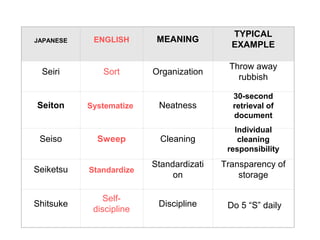
JAPANESE ENGLISH MEANING
TYPICAL
EXAMPLE
Seiri Sort Organization
Throw away
rubbish
Seiton Systematize Neatness
30-second
retrieval of
document
Seiso Sweep Cleaning
Individual
cleaning
responsibility
Seiketsu Standardize
Standardizati
on
Transparency of
storage
Shitsuke
Self-
discipline
Discipline Do 5 “S” daily
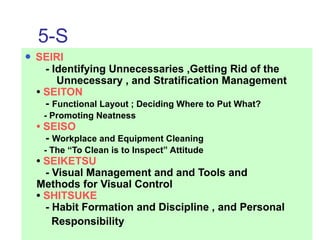
5-S
• SEIRI
- Identifying Unnecessaries ,Getting Rid of the
Unnecessary , and Stratification Management
• SEITON
- Functional Layout ; Deciding Where to Put What?
- Promoting Neatness
• SEISO
- Workplace and Equipment Cleaning
- The “To Clean is to Inspect” Attitude
• SEIKETSU
- Visual Management and and Tools and
Methods for Visual Control
• SHITSUKE
- Habit Formation and Discipline , and Personal
Responsibility
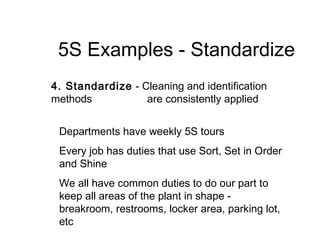
5S Examples - Standardize
4. Standardize - Cleaning and identification
methods are consistently applied
Departments have weekly 5S tours
Every job has duties that use Sort, Set in Order
and Shine
We all have common duties to do our part to
keep all areas of the plant in shape -
breakroom, restrooms, locker area, parking lot,
etc
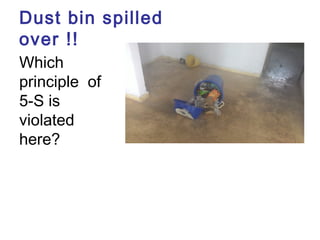
Dust bin spilled
over !!
Which
principle of
5-S is
violated
here?
5S Examples - Sustain
5. Sustain - 5S is a habit and is continually improved
5S is a simple concept with powerful results.
.
the more we do 5S the better the work environment
becomes: cleaner, safer, more organized, the work is
easier, less confusion and less stress.
Bad and the Ugly
 Give examples from your daily life of
Bad and ugly :
 Hostel, Hospital, Railway Station,
airport etc.
 Your own hostel room or your residence
!
The Good
 Now give examples of Good !
 What is the basic concept?
 How is it followed?
What is Waste (Muda)?
Some of the main forms of waste are:
Overproduction
Waiting for materials, machines, or instruction
Transportation or movement
Excessive inventory
Inefficient machine processing and/or operation
Producing defects
Part or line changeover or machine setup
Inadequate housekeeping
Miscommunication or inadequate instruction
Improvement (Kaizen)
Principles
Get rid of all old (false) assumptions.
Don't look for excuses, look for ways to make
it happen . .
“start NOW”! It
does not cost money to do KAIZEN.
If something is wrong “Fix it NOW”.
Good ideas flow when we start questioning !!
Ask "WHY" five times - get to the root cause.
Look for wisdom from Ten people rather than one.
Never stop doing KAIZEN.
Visual Controls - Andon
 Inidcators for tools, parts, and
production activities
 Placed in plain sight of all workers so
everyone can understand status of
system at a glance
 If a machine goes down, or a part is
defective or delayed, immediate action
can be taken
5-S on Youtube
 https://www.youtube.com/watch?
v=f2HB4YMipcw
 Learn how to apply 5-S
 https://www.youtube.com/watch?v=c0Q-
xaYior0
 How 5-s fron office to factory (lean
principles)
 https://www.youtube.com/watch?
v=BqIOnpJ_crI
Benefits of 5S
 Reduce waste hidden
 Improve quality and safety
 Reduce lead time and cost
 Increase profit
Summary
5-S is for every organization
Clean-up and organize work area every day so that
each new day is easier and safer than the day before
Take a good look around...Imagine zero waste/zero
confusion!
.
Additional information
 Get exposure to Initiatives of QCFI
(Quality Circle Forum of India) on 5-S
 http://www.qcfi.in/mainhtml/5s.html

Mel751 basics-of-5-s

  • 1.
    MEL751: 5-S This isa part of a course on “Industrial Engineering & Systems”
  • 2.
    Good Housekeeping (5-S) A place for everything  Everything in its place  Everything Visible  Everyone involved in cleaning, checking & anticipating Problems
  • 3.
    Philosophy of 5-S Based on Japanese words that begin with ‘S’, the 5S Philosophy focuses on effective work place organization and standardized work procedures. 5S simplifies work environment, reduces waste and non-value activity while improving quality efficiency and safety
  • 4.
    5-S : HousekeepingPractices  Sort means to separate needed tools, parts, and instructions from unneeded materials and to remove the latter.  Systematize means to neatly arrange and identify parts and tools for ease of use.  Sweep means to conduct a cleanup campaign.  Standardize means to conduct Sort, Simplify, and Scrub at frequent, indeed daily, intervals to maintain a workplace in perfect condition  Self-discipline means to form the habit of always following the first four Ss.
  • 5.
    Observations..  Once fullyimplemented, the 5S process can increase morale,  create positive impressions on customers, and  increase efficiency and organization.  Not only will employees feel better about where they work, the effect on continuous improvement can lead to less waste, better quality and faster lead times. Any of which will make your organization more profitable and competitive in the market place.
  • 6.
    JAPANESE ENGLISH MEANING TYPICAL EXAMPLE SeiriSort Organization Throw away rubbish Seiton Systematize Neatness 30-second retrieval of document Seiso Sweep Cleaning Individual cleaning responsibility Seiketsu Standardize Standardizati on Transparency of storage Shitsuke Self- discipline Discipline Do 5 “S” daily
  • 7.
    5-S • SEIRI - IdentifyingUnnecessaries ,Getting Rid of the Unnecessary , and Stratification Management • SEITON - Functional Layout ; Deciding Where to Put What? - Promoting Neatness • SEISO - Workplace and Equipment Cleaning - The “To Clean is to Inspect” Attitude • SEIKETSU - Visual Management and and Tools and Methods for Visual Control • SHITSUKE - Habit Formation and Discipline , and Personal Responsibility
  • 8.
    5S Examples -Standardize 4. Standardize - Cleaning and identification methods are consistently applied Departments have weekly 5S tours Every job has duties that use Sort, Set in Order and Shine We all have common duties to do our part to keep all areas of the plant in shape - breakroom, restrooms, locker area, parking lot, etc
  • 9.
    Dust bin spilled over!! Which principle of 5-S is violated here?
  • 10.
    5S Examples -Sustain 5. Sustain - 5S is a habit and is continually improved 5S is a simple concept with powerful results. . the more we do 5S the better the work environment becomes: cleaner, safer, more organized, the work is easier, less confusion and less stress.
  • 11.
    Bad and theUgly  Give examples from your daily life of Bad and ugly :  Hostel, Hospital, Railway Station, airport etc.  Your own hostel room or your residence !
  • 12.
    The Good  Nowgive examples of Good !  What is the basic concept?  How is it followed?
  • 13.
    What is Waste(Muda)? Some of the main forms of waste are: Overproduction Waiting for materials, machines, or instruction Transportation or movement Excessive inventory Inefficient machine processing and/or operation Producing defects Part or line changeover or machine setup Inadequate housekeeping Miscommunication or inadequate instruction
  • 14.
    Improvement (Kaizen) Principles Get ridof all old (false) assumptions. Don't look for excuses, look for ways to make it happen . . “start NOW”! It does not cost money to do KAIZEN. If something is wrong “Fix it NOW”. Good ideas flow when we start questioning !! Ask "WHY" five times - get to the root cause. Look for wisdom from Ten people rather than one. Never stop doing KAIZEN.
  • 15.
    Visual Controls -Andon  Inidcators for tools, parts, and production activities  Placed in plain sight of all workers so everyone can understand status of system at a glance  If a machine goes down, or a part is defective or delayed, immediate action can be taken
  • 16.
    5-S on Youtube https://www.youtube.com/watch? v=f2HB4YMipcw  Learn how to apply 5-S  https://www.youtube.com/watch?v=c0Q- xaYior0  How 5-s fron office to factory (lean principles)  https://www.youtube.com/watch? v=BqIOnpJ_crI
  • 17.
    Benefits of 5S Reduce waste hidden  Improve quality and safety  Reduce lead time and cost  Increase profit
  • 18.
    Summary 5-S is forevery organization Clean-up and organize work area every day so that each new day is easier and safer than the day before Take a good look around...Imagine zero waste/zero confusion! .
  • 19.
    Additional information  Getexposure to Initiatives of QCFI (Quality Circle Forum of India) on 5-S  http://www.qcfi.in/mainhtml/5s.html