Prof. Shital Patel
Content
1. History and contribution
2. Industrial engineering approach
3. Techniques of industrial engineering
4. Objectives of industrial engineering
5. System approach to industrial engineering
6. Definition and concept of productivity
7. Productivity measurements
8. Factors influencing productivity
9. Productivity improvement techniques.
2
Introduction to Industrial Engg.
Prof. Shital Patel
Course Outcome
1. Illustrate the need for optimization of resources and its significance
2. Develop ability in integrating knowledge of design along with other
aspects of value addition in the conceptualization and manufacturing
stage of various products.
3. Demonstrate the concept of value analysis and its relevance.
4. Manage and implement different concepts involved in method study
and understanding of work content in different situations.
5. Describe different aspects of work system design and facilities design
pertinent to manufacturing industries.
6. Illustrate concepts of Agile manufacturing, Lean manufacturing and
Flexible manufacturing
3
Introduction to Industrial Engg.
Prof. Shital Patel
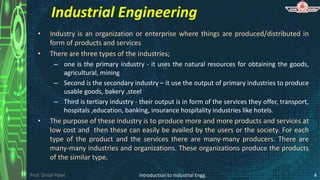
Industrial Engineering
• Industry is an organization or enterprise where things are produced/distributed in
form of products and services
• There are three types of the industries;
– one is the primary industry - it uses the natural resources for obtaining the goods,
agricultural, mining
– Second is the secondary industry – it use the output of primary industries to produce
usable goods, bakery ,steel
– Third is tertiary industry - their output is in form of the services they offer, transport,
hospitals ,education, banking, insurance hospitality industries like hotels.
• The purpose of these industry is to produce more and more products and services at
low cost and then these can easily be availed by the users or the society. For each
type of the product and the services there are many-many producers. There are
many-many industries and organizations. These organizations produce the products
of the similar type.
Introduction to Industrial Engg. 4
Prof. Shital Patel
Industrial Engineering
• Any industry involved in production or providing the goods
or the services must be in position to provide the required
output in the desired quantity, desired quality at the low
cost and that too on time, so that the customers or the
users of the product and services can effectively avail.
• Industrial engineering plays a central role in facilitating the
production of the goods and services and their
distribution so that the required quantity, quality, cost and
the on time delivery of the goods and services can be
facilitated
Introduction to Industrial Engg. 5
Prof. Shital Patel
Industrial Engineering
• So what industrial engineering does basically for any organization
or industry, which are having the different processes, procedures
using the different resources in form of man, material, machine?
• IE - Analyze, Improve method/procedure to reduce waste and
increase utilization of resources through optimization of processes
by developing, improving and implementing an integrated system
of resources, man, material, machines, money, energy, knowledge
and information
• It is a Multi-disciplinary approach as it uses the science, maths,
management, manufacturing, production, ergonomics, work-study
and value analysis, engineering economy, financial analysis.
Introduction to Industrial Engg. 6
Prof. Shital Patel
History and Contribution
• A. Smith [1776]- Book on Wealth of Nations highlights the
scientific manufacturing through
– Division of labour - The people are having the different kinds of
expertise, is to take the work more effectively so development
of expertise as per the need of the work
– Skill Development - so that the people are able to take up the
variety of jobs which are needed
– Time saving - How to reduce the wastages and ineffective times
– Specialized machines - Need of developing these which can give
the more output at a high rate
• James Watt [1864] - Developed the steam engine
– Mechanical power can effectively be used to increase the
productivity
Introduction to Industrial Engg. 7
Prof. Shital Patel
History and Contribution
• F. Taylor [1859-1945] – Initiated study on the work method and
he proposed
– Data collection - About the way by which work is being done so
that it can be analyzed, analyzed for possible improvements in the
process.
– Standard for workers - standard output and wages for the better
output with respect to the set standards . Also accordingly their
efforts were acknowledged for the better, average and the poor
performances.
– Scientific training to the workers - so that they understand what
is the importance of the scientific approach in undertaking the
variety of jobs and the wastage of the resources in terms of the
material, machine and the time can be reduced
Introduction to Industrial Engg. 8
Prof. Shital Patel
History and Contribution
• F. Taylor [1859-1945] – Continue…
– Cooperation between the management and workers -
management takes care of the interest of the workers and
the labour, and the workers do the jobs expected so that the
more effective output can be realized and they work
together for realizing the objectives and the goals of the
organization
– Divide the work of between the management and labour –
For reducing the conflicts if there is a proper deviation of
the work between the management and the labour.
– Assignment of the work as for the competence- considering
the ability of the workers, suitable work is assigned, so that
they can really give the output effectively
Introduction to Industrial Engg. 9
Prof. Shital Patel
History and Contribution
• H.L. Gantt [1893] -
– Development of bonus plans - for those which those workers who
were performing good.
– Gantt chart - to see the kind of for effectively scheduling or giving
the load to the different machines and workers for the utilization
index of the resources (man and machine) and to know what is
the status of any work, at any moment of time.
– Social responsibilities of the businesses and in industries – To take
care of the responsibilities of the things which are to be done by
the society and for the society by the business and industrial
entities
– Advocated the need of training to the workers by the
management - Time to time training of the worker is important to
update their knowledge and their trainings are too updated with
the development of the technology in different fields
Introduction to Industrial Engg. 10
Prof. Shital Patel
History and Contribution
• Frank and Al Gilbreth [1917] - Especially
worked on the work study related aspects
– Method study – The method of working can be
improved by work analysis so that if there is any
ineffective element of work involved in existing
procedure, then this can be eliminated.
– Micro motion studies - Therbligs - Which help in
breaking down the job into the very-very small
elements to identify the presence of the
productive and non-productive elements
Introduction to Industrial Engg. 11
Prof. Shital Patel
History and Contribution
• H. Emerson [1913] –
– Emerson's efficiency plan (bonus plan and incentive plan ) - Those which are doing
good, their efforts are acknowledged in form of the additional payments, while
guaranteeing some basic payments to the workers
• Then L Tippet [1937] –
– Work sampling method- This is basically the random sampling approach to identify
the percentage utilization of the manpower or machine to set the performance
standards for the workers and the machines.
• Once the performance standard is set, it would be possible to see that how much time
a job will take and it can be used for capacity assessment. We know that in a one day or
in one month, what is the volume that can be produced in a given setup. It can also be
used it to see the kind of estimating the manpower or the machine requirement to
satisfy a given target. So, once the capacity assessment is done, then if there is a
fluctuating demands then to estimate what kind of manpower and machines will be
needed in light of the set standard of performance.
Introduction to Industrial Engg. 12
Prof. Shital Patel
Industrial Engineering Approach
• In general the idea of the industrial engineering to reduce the
wastage of resources and increase the effective utilization
• And the purpose of both these is to
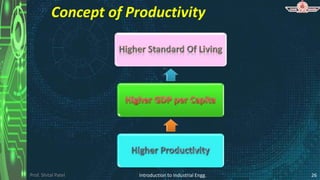
– increase the productivity, so that the less resources, more output
can be realized and
– that in turn will be helping in to make the things increased
quantity at low cost and hence the more and more the goods and
services can be made available to the society, to the public
– so that their standard of living can be enhanced
• But how these wastage can be reduced and the utilization can
be enhanced so that there is the improvement of the
productivity.
• For that there is a general approach which is used
Introduction to Industrial Engg. 13
Prof. Shital Patel
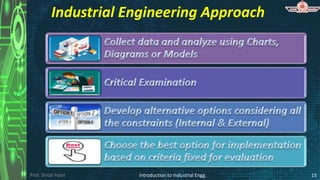
Industrial Engineering Approach
• First, we collect the factual information about the existing
things which are being done.
• We analyze and present the data in graphical form or in chart
and form of charts and the models, and
• Then critical analysis is done to find out the productive and
non-productive activities and which can be used to simplify the
methods, to come up the new method or to modify the existing
methods so that the non- productive elements and activities
can be eliminated.
• And then we develop, out of the developed options in light of
the constraints present, we try to choose the best option
available so that it can improve the situation in more effective
manner.
Introduction to Industrial Engg. 14
Prof. Shital Patel
Industrial Engineering Approach
Introduction to Industrial Engg. 15
Prof. Shital Patel
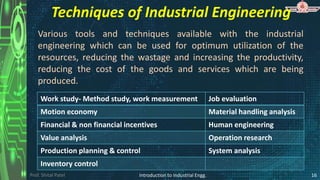
Techniques of Industrial Engineering
Various tools and techniques available with the industrial
engineering which can be used for optimum utilization of the
resources, reducing the wastage and increasing the productivity,
reducing the cost of the goods and services which are being
produced.
Introduction to Industrial Engg. 16
Work study- Method study, work measurement Job evaluation
Motion economy Material handling analysis
Financial & non financial incentives Human engineering
Value analysis Operation research
Production planning & control System analysis
Inventory control
Prof. Shital Patel
Objectives of Industrial Engineering
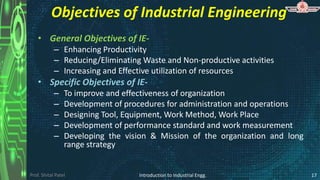
• General Objectives of IE-
– Enhancing Productivity
– Reducing/Eliminating Waste and Non-productive activities
– Increasing and Effective utilization of resources
• Specific Objectives of IE-
– To improve and effectiveness of organization
– Development of procedures for administration and operations
– Designing Tool, Equipment, Work Method, Work Place
– Development of performance standard and work measurement
– Developing the vision & Mission of the organization and long
range strategy
Introduction to Industrial Engg. 17
Prof. Shital Patel
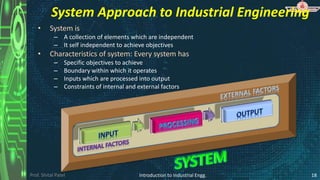
• System is
– A collection of elements which are independent
– It self independent to achieve objectives
• Characteristics of system: Every system has
– Specific objectives to achieve
– Boundary within which it operates
– Inputs which are processed into output
– Constraints of internal and external factors
Introduction to Industrial Engg. 18
System Approach to Industrial Engineering
Prof. Shital Patel
System Approach to Industrial Engineering
• The industrial engineering, the most significant department in the
industry, is generally compared to as the brain that directs the
methods of working to nervous systems for the human being.
• IE, relies on system approach and therefore in solving the problems,
instead of analyzing problem in isolation, at the subsystem level, an
integrated view is considered including influencing factors, internal
and external
• Industrial engineering system seen as a whole is composed of many
subsystems.
• The subsystems are mutually interactive and closely connected to one
another with their relations.
• The subsystems in the Industrial Engineering System are
– Work Measurement (Time Study) Subsystem
– Method Study Subsystem
Introduction to Industrial Engg. 19
Prof. Shital Patel Introduction to Industrial Engg. 20
Prof. Shital Patel
Definition of Productivity
• Productivity = Output of work /Input of resources
• Productivity is an attribute of mind
• It is being able to do better than yesterday and
continuously
• It is an effort to apply new techniques and methods for
continuous PROGRESS
• It is the concept that guides the production system
• It is an indicator of how well the factors of production
that is land, capital, labour and energy are utilized to
convert the raw materials into the final product
Introduction to Industrial Engg. 21
Prof. Shital Patel
Productivity and Performance
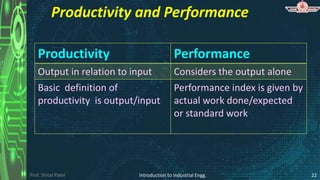
Productivity Performance
Output in relation to input Considers the output alone
Basic definition of
productivity is output/input
Performance index is given by
actual work done/expected
or standard work
Introduction to Industrial Engg. 22
Prof. Shital Patel
Concept of Productivity
• How production is different from productivity:
– Production is related to the activity of producing
goods and services. It is the process of converting
input to value added output
– Productivity is related to the efficient utilization of
input resources to produce output in the form of
value-added goods or services.
Introduction to Industrial Engg. 23
Prof. Shital Patel
Concept of Productivity
• Productivity & Engineering:
– Engineering: Effective utilization of resources
• Better standard of living
• Availability of materialistic items
• Standard of living:
– Needs:
• Individual’s responsibility
– Food- energy requirement to do work
– Cloth- to protect body
– Shelter- stay comfortably
• Government’s responsibility- (Against paying)

– Security- protection against ill health, old age, robbery, poverty
– Essentials- medical care, drinking water, public transport etc.
Introduction to Industrial Engg. 24
Prof. Shital Patel
Concept of Productivity
• Goods and Life:
– Greater the availability of consumable goods better the
standard of living
– It can be achieved by:
• Increasing employment
• Increasing productivity
• Goods and Society:
– Productivity and Agriculture- more quantity , cheaper food
– Productivity of industry- more quantity, cheaper cloths
and shelter
– Overall increase in productivity- more security & essential
services for public
Introduction to Industrial Engg. 25
Prof. Shital Patel
Concept of Productivity
Introduction to Industrial Engg. 26
Prof. Shital Patel
Productivity Measurements
Objectives of productivity measurement:
• To compare an organization with its competitors in the
market
• To find out the relative performance of different
employees, units and as well as department
• To compare relative benefits of different types of input
according to their output
• To compare planned productivity with actual
productivity
Introduction to Industrial Engg. 27
Prof. Shital Patel
Productivity Measurements
1. Partial Productivity Measures (PPM)
2. Total Productivity Measures (TPM)
3. Total Factor Productivity Measures (TFP)
4. Multi Factor Productivity Measures (MFP)
Introduction to Industrial Engg. 28
Prof. Shital Patel
Productivity Measurements: PPM
Partial Productivity Measures (PPM)
• Depending upon the individual input, Partial productivity measures
are expressed as :
– Partial productivity = (output)/(Individual input)
– Labour productivity = (output)/(Labour input)
– Capital productivity = (output)/(Capital input)
– Material productivity = (output)/(Material input)
– Energy productivity = Output / Energy input
• The major disadvantage of partial productivity measures is that there is an
over emphasis on one input factor only to the extent that other inputs are
underestimated
• partial productivity measure cannot represent the overall productivity of
the firm
Introduction to Industrial Engg. 29
Prof. Shital Patel
Productivity Measurements: TPM
Total Productivity Measures (TPM)
• Based on all input this model can be applied to any
manufacturing organization or service sector company
• Total productivity = (Total Tangible Output)/(Total
Tangible Input)
• 𝐓𝐨𝐭𝐚𝐥 𝐓𝐚𝐧𝐠𝐢𝐛𝐥𝐞 𝐎𝐮𝐭𝐩𝐮𝐭 = Value of finished goods
produced + value of partial units produced + dividends
from securities + interest+ other income
• 𝐓𝐨𝐭𝐚𝐥 𝐓𝐚𝐧𝐠𝐢𝐛𝐥𝐞 𝐈𝐧𝐩𝐮𝐭 = value of human + material
+capital + energy + other inputs
• Note: Tangible here refers to measurable
Introduction to Industrial Engg. 30
Prof. Shital Patel
Productivity Measurements: TPM
• Gives both firm level and detailed unit level index
• Helps to find out the performance and productivity of the
organization or the operational unit
• Helps to plan, evaluate and control
• An important information to strategic planners regarding
expansion or phasing out decisions
Introduction to Industrial Engg. 31
Prof. Shital Patel
Productivity Measurements
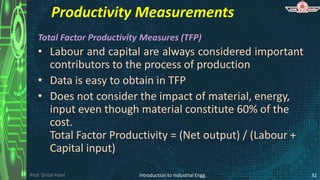
Total Factor Productivity Measures (TFP)
• Labour and capital are always considered important
contributors to the process of production
• Data is easy to obtain in TFP
• Does not consider the impact of material, energy,
input even though material constitute 60% of the
cost.
Total Factor Productivity = (Net output) / (Labour +
Capital input)
Introduction to Industrial Engg. 32
Prof. Shital Patel
Productivity Measurements
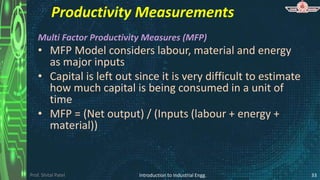
Multi Factor Productivity Measures (MFP)
• MFP Model considers labour, material and energy
as major inputs
• Capital is left out since it is very difficult to estimate
how much capital is being consumed in a unit of
time
• MFP = (Net output) / (Inputs (labour + energy +
material))
Introduction to Industrial Engg. 33
Prof. Shital Patel
Advantages & Limitations of Productivity
Measures
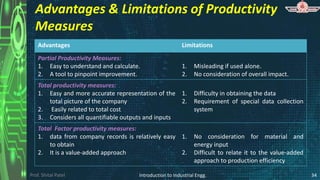
Advantages Limitations
Partial Productivity Measures:
1. Easy to understand and calculate.
2. A tool to pinpoint improvement.
1. Misleading if used alone.
2. No consideration of overall impact.
Total productivity measures:
1. Easy and more accurate representation of the
total picture of the company
2. Easily related to total cost
3. Considers all quantifiable outputs and inputs
1. Difficulty in obtaining the data
2. Requirement of special data collection
system
Total Factor productivity measures:
1. data from company records is relatively easy
to obtain
2. It is a value-added approach
1. No consideration for material and
energy input
2. Difficult to relate it to the value-added
approach to production efficiency
Introduction to Industrial Engg. 34
Prof. Shital Patel
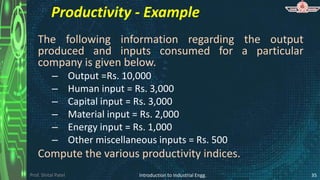
Productivity - Example
The following information regarding the output
produced and inputs consumed for a particular
company is given below.
– Output =Rs. 10,000
– Human input = Rs. 3,000
– Capital input = Rs. 3,000
– Material input = Rs. 2,000
– Energy input = Rs. 1,000
– Other miscellaneous inputs = Rs. 500
Compute the various productivity indices.
Introduction to Industrial Engg. 35
Prof. Shital Patel
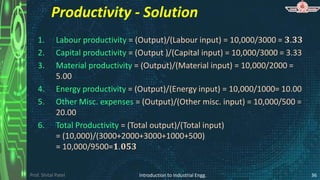
Productivity - Solution
1. Labour productivity = (Output)/(Labour input) = 10,000/3000 = 𝟑.𝟑𝟑
2. Capital productivity = (Output )/(Capital input) = 10,000/3000 = 3.33
3. Material productivity = (Output)/(Material input) = 10,000/2000 =
5.00
4. Energy productivity = (Output)/(Energy input) = 10,000/1000= 10.00
5. Other Misc. expenses = (Output)/(Other misc. input) = 10,000/500 =
20.00
6. Total Productivity = (Total output)/(Total input)
= (10,000)/(3000+2000+3000+1000+500)
= 10,000/9500=𝟏.𝟎𝟓𝟑
Introduction to Industrial Engg. 36
Prof. Shital Patel
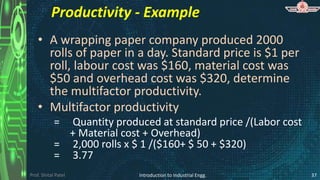
Productivity - Example
• A wrapping paper company produced 2000
rolls of paper in a day. Standard price is $1 per
roll, labour cost was $160, material cost was
$50 and overhead cost was $320, determine
the multifactor productivity.
• Multifactor productivity
= Quantity produced at standard price /(Labor cost
+ Material cost + Overhead)
= 2,000 rolls x $ 1 /($160+ $ 50 + $320)
= 3.77
Introduction to Industrial Engg. 37
Prof. Shital Patel
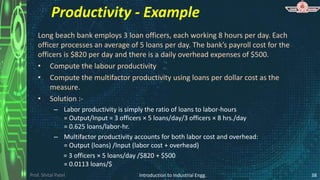
Productivity - Example
Long beach bank employs 3 loan officers, each working 8 hours per day. Each
officer processes an average of 5 loans per day. The bank’s payroll cost for the
officers is $820 per day and there is a daily overhead expenses of $500.
• Compute the labour productivity
• Compute the multifactor productivity using loans per dollar cost as the
measure.
• Solution :-
– Labor productivity is simply the ratio of loans to labor-hours
= Output/Input = 3 officers × 5 loans/day/3 officers × 8 hrs./day
= 0.625 loans/labor-hr.
– Multifactor productivity accounts for both labor cost and overhead:
= Output (loans) /Input (labor cost + overhead)
= 3 officers × 5 loans/day /$820 + $500
= 0.0113 loans/$
Introduction to Industrial Engg. 38
Prof. Shital Patel
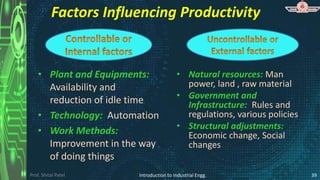
Factors Influencing Productivity
• Plant and Equipments:
Availability and
reduction of idle time
• Technology: Automation
• Work Methods:
Improvement in the way
of doing things
Introduction to Industrial Engg. 39
• Natural resources: Man
power, land , raw material
• Government and
Infrastructure: Rules and
regulations, various policies
• Structural adjustments:
Economic change, Social
changes
Prof. Shital Patel
Productivity Improvement Techniques
 Technology Based
 Employee Based
 Material Based
 Process Based
 Product Based
 Management Based
Introduction to Industrial Engg. 40
Prof. Shital Patel
Productivity Improvement Techniques
Introduction to Industrial Engg. 41
Prof. Shital Patel
Productivity Improvement Techniques
Technology Based
• Computer Aided Design (CAD) , Computer Aided
Manufacturing (CAM) And Computer Integrated
Manufacturing (CIM)
• Robotics
• Laser technology
• Modern maintenance techniques
• Energy technology
• Flexible technology
• Etc…
Introduction to Industrial Engg. 42
Prof. Shital Patel
Productivity Improvement Techniques
Employee Based
• Financial and non-financial incentives
• Employees promotion
• Job design, job enrichment, job enlargement
and job rotation
• Worker participation in decision making
• Quality circles (QC)
• Small group activities (SGA)
Introduction to Industrial Engg. 43
Prof. Shital Patel
Productivity Improvement Techniques
Material Based
• Materials planning and control
• Purchasing
• Logistics of material flow
• Material storage and retrieval
• Source selection and procurement of good
quality material
• Eliminate of waste
Introduction to Industrial Engg. 44
Prof. Shital Patel
Productivity Improvement Techniques
Process Based
• Methods engineering and work
simplification
• Job design, job evaluation, job safety
• Human factors in engineering (Ergonomics)
Introduction to Industrial Engg. 45
Prof. Shital Patel
Productivity Improvement Techniques
Product Based
• Value analysis and value engineering
• Product diversification
• Standardization and simplification
• Reliability engineering
• Product mix and promotions
Introduction to Industrial Engg. 46
Prof. Shital Patel
Productivity Improvement Techniques
Management Based
• Style of management
• Communication Channel in organization
• Work culture within the organisation
• Motivation
• Promoting group activity
Introduction to Industrial Engg. 47
Prof. Shital Patel
Productivity Improvement
Role of Government:
Govt. can create conditions favourable to
raise productivity as follows:
– Balanced program of economic development
– Necessary steps to maintain employment
– Creating opportunities for employment
Introduction to Industrial Engg. 48
Prof. Shital Patel
Productivity Improvement
Role of Employer (Management):
Employer can increase productivity as follows:
– Balanced use of one resources against another
– Motivating workers through incentive schemes
– Maintaining good relation with workers to seek
their co-operation
– Keeping equipment and machinery in good
working condition
– Effective utilization of available resources
Introduction to Industrial Engg. 49
Prof. Shital Patel
Productivity Improvement
Role of workers:
Workers fear that raising productivity will lead
to unemployment
They will support only against the assurance of
meeting their problems
Trade unions and workers representatives
should actively encourage the workers to
extend their whole hearted co-operation to
management in raising productivity
Introduction to Industrial Engg. 50

Introduction to Industrial Engineering.pptx

  • 2.
    Prof. Shital Patel Content 1.History and contribution 2. Industrial engineering approach 3. Techniques of industrial engineering 4. Objectives of industrial engineering 5. System approach to industrial engineering 6. Definition and concept of productivity 7. Productivity measurements 8. Factors influencing productivity 9. Productivity improvement techniques. 2 Introduction to Industrial Engg.
  • 3.
    Prof. Shital Patel CourseOutcome 1. Illustrate the need for optimization of resources and its significance 2. Develop ability in integrating knowledge of design along with other aspects of value addition in the conceptualization and manufacturing stage of various products. 3. Demonstrate the concept of value analysis and its relevance. 4. Manage and implement different concepts involved in method study and understanding of work content in different situations. 5. Describe different aspects of work system design and facilities design pertinent to manufacturing industries. 6. Illustrate concepts of Agile manufacturing, Lean manufacturing and Flexible manufacturing 3 Introduction to Industrial Engg.
  • 4.
    Prof. Shital Patel IndustrialEngineering • Industry is an organization or enterprise where things are produced/distributed in form of products and services • There are three types of the industries; – one is the primary industry - it uses the natural resources for obtaining the goods, agricultural, mining – Second is the secondary industry – it use the output of primary industries to produce usable goods, bakery ,steel – Third is tertiary industry - their output is in form of the services they offer, transport, hospitals ,education, banking, insurance hospitality industries like hotels. • The purpose of these industry is to produce more and more products and services at low cost and then these can easily be availed by the users or the society. For each type of the product and the services there are many-many producers. There are many-many industries and organizations. These organizations produce the products of the similar type. Introduction to Industrial Engg. 4
  • 5.
    Prof. Shital Patel IndustrialEngineering • Any industry involved in production or providing the goods or the services must be in position to provide the required output in the desired quantity, desired quality at the low cost and that too on time, so that the customers or the users of the product and services can effectively avail. • Industrial engineering plays a central role in facilitating the production of the goods and services and their distribution so that the required quantity, quality, cost and the on time delivery of the goods and services can be facilitated Introduction to Industrial Engg. 5
  • 6.
    Prof. Shital Patel IndustrialEngineering • So what industrial engineering does basically for any organization or industry, which are having the different processes, procedures using the different resources in form of man, material, machine? • IE - Analyze, Improve method/procedure to reduce waste and increase utilization of resources through optimization of processes by developing, improving and implementing an integrated system of resources, man, material, machines, money, energy, knowledge and information • It is a Multi-disciplinary approach as it uses the science, maths, management, manufacturing, production, ergonomics, work-study and value analysis, engineering economy, financial analysis. Introduction to Industrial Engg. 6
  • 7.
    Prof. Shital Patel Historyand Contribution • A. Smith [1776]- Book on Wealth of Nations highlights the scientific manufacturing through – Division of labour - The people are having the different kinds of expertise, is to take the work more effectively so development of expertise as per the need of the work – Skill Development - so that the people are able to take up the variety of jobs which are needed – Time saving - How to reduce the wastages and ineffective times – Specialized machines - Need of developing these which can give the more output at a high rate • James Watt [1864] - Developed the steam engine – Mechanical power can effectively be used to increase the productivity Introduction to Industrial Engg. 7
  • 8.
    Prof. Shital Patel Historyand Contribution • F. Taylor [1859-1945] – Initiated study on the work method and he proposed – Data collection - About the way by which work is being done so that it can be analyzed, analyzed for possible improvements in the process. – Standard for workers - standard output and wages for the better output with respect to the set standards . Also accordingly their efforts were acknowledged for the better, average and the poor performances. – Scientific training to the workers - so that they understand what is the importance of the scientific approach in undertaking the variety of jobs and the wastage of the resources in terms of the material, machine and the time can be reduced Introduction to Industrial Engg. 8
  • 9.
    Prof. Shital Patel Historyand Contribution • F. Taylor [1859-1945] – Continue… – Cooperation between the management and workers - management takes care of the interest of the workers and the labour, and the workers do the jobs expected so that the more effective output can be realized and they work together for realizing the objectives and the goals of the organization – Divide the work of between the management and labour – For reducing the conflicts if there is a proper deviation of the work between the management and the labour. – Assignment of the work as for the competence- considering the ability of the workers, suitable work is assigned, so that they can really give the output effectively Introduction to Industrial Engg. 9
  • 10.
    Prof. Shital Patel Historyand Contribution • H.L. Gantt [1893] - – Development of bonus plans - for those which those workers who were performing good. – Gantt chart - to see the kind of for effectively scheduling or giving the load to the different machines and workers for the utilization index of the resources (man and machine) and to know what is the status of any work, at any moment of time. – Social responsibilities of the businesses and in industries – To take care of the responsibilities of the things which are to be done by the society and for the society by the business and industrial entities – Advocated the need of training to the workers by the management - Time to time training of the worker is important to update their knowledge and their trainings are too updated with the development of the technology in different fields Introduction to Industrial Engg. 10
  • 11.
    Prof. Shital Patel Historyand Contribution • Frank and Al Gilbreth [1917] - Especially worked on the work study related aspects – Method study – The method of working can be improved by work analysis so that if there is any ineffective element of work involved in existing procedure, then this can be eliminated. – Micro motion studies - Therbligs - Which help in breaking down the job into the very-very small elements to identify the presence of the productive and non-productive elements Introduction to Industrial Engg. 11
  • 12.
    Prof. Shital Patel Historyand Contribution • H. Emerson [1913] – – Emerson's efficiency plan (bonus plan and incentive plan ) - Those which are doing good, their efforts are acknowledged in form of the additional payments, while guaranteeing some basic payments to the workers • Then L Tippet [1937] – – Work sampling method- This is basically the random sampling approach to identify the percentage utilization of the manpower or machine to set the performance standards for the workers and the machines. • Once the performance standard is set, it would be possible to see that how much time a job will take and it can be used for capacity assessment. We know that in a one day or in one month, what is the volume that can be produced in a given setup. It can also be used it to see the kind of estimating the manpower or the machine requirement to satisfy a given target. So, once the capacity assessment is done, then if there is a fluctuating demands then to estimate what kind of manpower and machines will be needed in light of the set standard of performance. Introduction to Industrial Engg. 12
  • 13.
    Prof. Shital Patel IndustrialEngineering Approach • In general the idea of the industrial engineering to reduce the wastage of resources and increase the effective utilization • And the purpose of both these is to – increase the productivity, so that the less resources, more output can be realized and – that in turn will be helping in to make the things increased quantity at low cost and hence the more and more the goods and services can be made available to the society, to the public – so that their standard of living can be enhanced • But how these wastage can be reduced and the utilization can be enhanced so that there is the improvement of the productivity. • For that there is a general approach which is used Introduction to Industrial Engg. 13
  • 14.
    Prof. Shital Patel IndustrialEngineering Approach • First, we collect the factual information about the existing things which are being done. • We analyze and present the data in graphical form or in chart and form of charts and the models, and • Then critical analysis is done to find out the productive and non-productive activities and which can be used to simplify the methods, to come up the new method or to modify the existing methods so that the non- productive elements and activities can be eliminated. • And then we develop, out of the developed options in light of the constraints present, we try to choose the best option available so that it can improve the situation in more effective manner. Introduction to Industrial Engg. 14
  • 15.
    Prof. Shital Patel IndustrialEngineering Approach Introduction to Industrial Engg. 15
  • 16.
    Prof. Shital Patel Techniquesof Industrial Engineering Various tools and techniques available with the industrial engineering which can be used for optimum utilization of the resources, reducing the wastage and increasing the productivity, reducing the cost of the goods and services which are being produced. Introduction to Industrial Engg. 16 Work study- Method study, work measurement Job evaluation Motion economy Material handling analysis Financial & non financial incentives Human engineering Value analysis Operation research Production planning & control System analysis Inventory control
  • 17.
    Prof. Shital Patel Objectivesof Industrial Engineering • General Objectives of IE- – Enhancing Productivity – Reducing/Eliminating Waste and Non-productive activities – Increasing and Effective utilization of resources • Specific Objectives of IE- – To improve and effectiveness of organization – Development of procedures for administration and operations – Designing Tool, Equipment, Work Method, Work Place – Development of performance standard and work measurement – Developing the vision & Mission of the organization and long range strategy Introduction to Industrial Engg. 17
  • 18.
    Prof. Shital Patel •System is – A collection of elements which are independent – It self independent to achieve objectives • Characteristics of system: Every system has – Specific objectives to achieve – Boundary within which it operates – Inputs which are processed into output – Constraints of internal and external factors Introduction to Industrial Engg. 18 System Approach to Industrial Engineering
  • 19.
    Prof. Shital Patel SystemApproach to Industrial Engineering • The industrial engineering, the most significant department in the industry, is generally compared to as the brain that directs the methods of working to nervous systems for the human being. • IE, relies on system approach and therefore in solving the problems, instead of analyzing problem in isolation, at the subsystem level, an integrated view is considered including influencing factors, internal and external • Industrial engineering system seen as a whole is composed of many subsystems. • The subsystems are mutually interactive and closely connected to one another with their relations. • The subsystems in the Industrial Engineering System are – Work Measurement (Time Study) Subsystem – Method Study Subsystem Introduction to Industrial Engg. 19
  • 20.
    Prof. Shital PatelIntroduction to Industrial Engg. 20
  • 21.
    Prof. Shital Patel Definitionof Productivity • Productivity = Output of work /Input of resources • Productivity is an attribute of mind • It is being able to do better than yesterday and continuously • It is an effort to apply new techniques and methods for continuous PROGRESS • It is the concept that guides the production system • It is an indicator of how well the factors of production that is land, capital, labour and energy are utilized to convert the raw materials into the final product Introduction to Industrial Engg. 21
  • 22.
    Prof. Shital Patel Productivityand Performance Productivity Performance Output in relation to input Considers the output alone Basic definition of productivity is output/input Performance index is given by actual work done/expected or standard work Introduction to Industrial Engg. 22
  • 23.
    Prof. Shital Patel Conceptof Productivity • How production is different from productivity: – Production is related to the activity of producing goods and services. It is the process of converting input to value added output – Productivity is related to the efficient utilization of input resources to produce output in the form of value-added goods or services. Introduction to Industrial Engg. 23
  • 24.
    Prof. Shital Patel Conceptof Productivity • Productivity & Engineering: – Engineering: Effective utilization of resources • Better standard of living • Availability of materialistic items • Standard of living: – Needs: • Individual’s responsibility – Food- energy requirement to do work – Cloth- to protect body – Shelter- stay comfortably • Government’s responsibility- (Against paying) – Security- protection against ill health, old age, robbery, poverty – Essentials- medical care, drinking water, public transport etc. Introduction to Industrial Engg. 24
  • 25.
    Prof. Shital Patel Conceptof Productivity • Goods and Life: – Greater the availability of consumable goods better the standard of living – It can be achieved by: • Increasing employment • Increasing productivity • Goods and Society: – Productivity and Agriculture- more quantity , cheaper food – Productivity of industry- more quantity, cheaper cloths and shelter – Overall increase in productivity- more security & essential services for public Introduction to Industrial Engg. 25
  • 26.
    Prof. Shital Patel Conceptof Productivity Introduction to Industrial Engg. 26
  • 27.
    Prof. Shital Patel ProductivityMeasurements Objectives of productivity measurement: • To compare an organization with its competitors in the market • To find out the relative performance of different employees, units and as well as department • To compare relative benefits of different types of input according to their output • To compare planned productivity with actual productivity Introduction to Industrial Engg. 27
  • 28.
    Prof. Shital Patel ProductivityMeasurements 1. Partial Productivity Measures (PPM) 2. Total Productivity Measures (TPM) 3. Total Factor Productivity Measures (TFP) 4. Multi Factor Productivity Measures (MFP) Introduction to Industrial Engg. 28
  • 29.
    Prof. Shital Patel ProductivityMeasurements: PPM Partial Productivity Measures (PPM) • Depending upon the individual input, Partial productivity measures are expressed as : – Partial productivity = (output)/(Individual input) – Labour productivity = (output)/(Labour input) – Capital productivity = (output)/(Capital input) – Material productivity = (output)/(Material input) – Energy productivity = Output / Energy input • The major disadvantage of partial productivity measures is that there is an over emphasis on one input factor only to the extent that other inputs are underestimated • partial productivity measure cannot represent the overall productivity of the firm Introduction to Industrial Engg. 29
  • 30.
    Prof. Shital Patel ProductivityMeasurements: TPM Total Productivity Measures (TPM) • Based on all input this model can be applied to any manufacturing organization or service sector company • Total productivity = (Total Tangible Output)/(Total Tangible Input) • 𝐓𝐨𝐭𝐚𝐥 𝐓𝐚𝐧𝐠𝐢𝐛𝐥𝐞 𝐎𝐮𝐭𝐩𝐮𝐭 = Value of finished goods produced + value of partial units produced + dividends from securities + interest+ other income • 𝐓𝐨𝐭𝐚𝐥 𝐓𝐚𝐧𝐠𝐢𝐛𝐥𝐞 𝐈𝐧𝐩𝐮𝐭 = value of human + material +capital + energy + other inputs • Note: Tangible here refers to measurable Introduction to Industrial Engg. 30
  • 31.
    Prof. Shital Patel ProductivityMeasurements: TPM • Gives both firm level and detailed unit level index • Helps to find out the performance and productivity of the organization or the operational unit • Helps to plan, evaluate and control • An important information to strategic planners regarding expansion or phasing out decisions Introduction to Industrial Engg. 31
  • 32.
    Prof. Shital Patel ProductivityMeasurements Total Factor Productivity Measures (TFP) • Labour and capital are always considered important contributors to the process of production • Data is easy to obtain in TFP • Does not consider the impact of material, energy, input even though material constitute 60% of the cost. Total Factor Productivity = (Net output) / (Labour + Capital input) Introduction to Industrial Engg. 32
  • 33.
    Prof. Shital Patel ProductivityMeasurements Multi Factor Productivity Measures (MFP) • MFP Model considers labour, material and energy as major inputs • Capital is left out since it is very difficult to estimate how much capital is being consumed in a unit of time • MFP = (Net output) / (Inputs (labour + energy + material)) Introduction to Industrial Engg. 33
  • 34.
    Prof. Shital Patel Advantages& Limitations of Productivity Measures Advantages Limitations Partial Productivity Measures: 1. Easy to understand and calculate. 2. A tool to pinpoint improvement. 1. Misleading if used alone. 2. No consideration of overall impact. Total productivity measures: 1. Easy and more accurate representation of the total picture of the company 2. Easily related to total cost 3. Considers all quantifiable outputs and inputs 1. Difficulty in obtaining the data 2. Requirement of special data collection system Total Factor productivity measures: 1. data from company records is relatively easy to obtain 2. It is a value-added approach 1. No consideration for material and energy input 2. Difficult to relate it to the value-added approach to production efficiency Introduction to Industrial Engg. 34
  • 35.
    Prof. Shital Patel Productivity- Example The following information regarding the output produced and inputs consumed for a particular company is given below. – Output =Rs. 10,000 – Human input = Rs. 3,000 – Capital input = Rs. 3,000 – Material input = Rs. 2,000 – Energy input = Rs. 1,000 – Other miscellaneous inputs = Rs. 500 Compute the various productivity indices. Introduction to Industrial Engg. 35
  • 36.
    Prof. Shital Patel Productivity- Solution 1. Labour productivity = (Output)/(Labour input) = 10,000/3000 = 𝟑.𝟑𝟑 2. Capital productivity = (Output )/(Capital input) = 10,000/3000 = 3.33 3. Material productivity = (Output)/(Material input) = 10,000/2000 = 5.00 4. Energy productivity = (Output)/(Energy input) = 10,000/1000= 10.00 5. Other Misc. expenses = (Output)/(Other misc. input) = 10,000/500 = 20.00 6. Total Productivity = (Total output)/(Total input) = (10,000)/(3000+2000+3000+1000+500) = 10,000/9500=𝟏.𝟎𝟓𝟑 Introduction to Industrial Engg. 36
  • 37.
    Prof. Shital Patel Productivity- Example • A wrapping paper company produced 2000 rolls of paper in a day. Standard price is $1 per roll, labour cost was $160, material cost was $50 and overhead cost was $320, determine the multifactor productivity. • Multifactor productivity = Quantity produced at standard price /(Labor cost + Material cost + Overhead) = 2,000 rolls x $ 1 /($160+ $ 50 + $320) = 3.77 Introduction to Industrial Engg. 37
  • 38.
    Prof. Shital Patel Productivity- Example Long beach bank employs 3 loan officers, each working 8 hours per day. Each officer processes an average of 5 loans per day. The bank’s payroll cost for the officers is $820 per day and there is a daily overhead expenses of $500. • Compute the labour productivity • Compute the multifactor productivity using loans per dollar cost as the measure. • Solution :- – Labor productivity is simply the ratio of loans to labor-hours = Output/Input = 3 officers × 5 loans/day/3 officers × 8 hrs./day = 0.625 loans/labor-hr. – Multifactor productivity accounts for both labor cost and overhead: = Output (loans) /Input (labor cost + overhead) = 3 officers × 5 loans/day /$820 + $500 = 0.0113 loans/$ Introduction to Industrial Engg. 38
  • 39.
    Prof. Shital Patel FactorsInfluencing Productivity • Plant and Equipments: Availability and reduction of idle time • Technology: Automation • Work Methods: Improvement in the way of doing things Introduction to Industrial Engg. 39 • Natural resources: Man power, land , raw material • Government and Infrastructure: Rules and regulations, various policies • Structural adjustments: Economic change, Social changes
  • 40.
    Prof. Shital Patel ProductivityImprovement Techniques  Technology Based  Employee Based  Material Based  Process Based  Product Based  Management Based Introduction to Industrial Engg. 40
  • 41.
    Prof. Shital Patel ProductivityImprovement Techniques Introduction to Industrial Engg. 41
  • 42.
    Prof. Shital Patel ProductivityImprovement Techniques Technology Based • Computer Aided Design (CAD) , Computer Aided Manufacturing (CAM) And Computer Integrated Manufacturing (CIM) • Robotics • Laser technology • Modern maintenance techniques • Energy technology • Flexible technology • Etc… Introduction to Industrial Engg. 42
  • 43.
    Prof. Shital Patel ProductivityImprovement Techniques Employee Based • Financial and non-financial incentives • Employees promotion • Job design, job enrichment, job enlargement and job rotation • Worker participation in decision making • Quality circles (QC) • Small group activities (SGA) Introduction to Industrial Engg. 43
  • 44.
    Prof. Shital Patel ProductivityImprovement Techniques Material Based • Materials planning and control • Purchasing • Logistics of material flow • Material storage and retrieval • Source selection and procurement of good quality material • Eliminate of waste Introduction to Industrial Engg. 44
  • 45.
    Prof. Shital Patel ProductivityImprovement Techniques Process Based • Methods engineering and work simplification • Job design, job evaluation, job safety • Human factors in engineering (Ergonomics) Introduction to Industrial Engg. 45
  • 46.
    Prof. Shital Patel ProductivityImprovement Techniques Product Based • Value analysis and value engineering • Product diversification • Standardization and simplification • Reliability engineering • Product mix and promotions Introduction to Industrial Engg. 46
  • 47.
    Prof. Shital Patel ProductivityImprovement Techniques Management Based • Style of management • Communication Channel in organization • Work culture within the organisation • Motivation • Promoting group activity Introduction to Industrial Engg. 47
  • 48.
    Prof. Shital Patel ProductivityImprovement Role of Government: Govt. can create conditions favourable to raise productivity as follows: – Balanced program of economic development – Necessary steps to maintain employment – Creating opportunities for employment Introduction to Industrial Engg. 48
  • 49.
    Prof. Shital Patel ProductivityImprovement Role of Employer (Management): Employer can increase productivity as follows: – Balanced use of one resources against another – Motivating workers through incentive schemes – Maintaining good relation with workers to seek their co-operation – Keeping equipment and machinery in good working condition – Effective utilization of available resources Introduction to Industrial Engg. 49
  • 50.
    Prof. Shital Patel ProductivityImprovement Role of workers: Workers fear that raising productivity will lead to unemployment They will support only against the assurance of meeting their problems Trade unions and workers representatives should actively encourage the workers to extend their whole hearted co-operation to management in raising productivity Introduction to Industrial Engg. 50