Technology Trends
towards 6G
© 2021 InterDigital, Inc. All Rights Reserved.
1
Dr Alain Mourad
6GIC – University of Surrey (UK)
05 February 2021
Mega Trends to 6G
© 2021 InterDigital, Inc. All Rights Reserved.
2
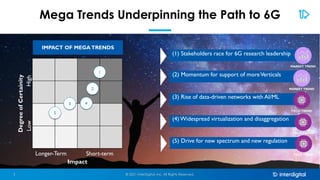
Mega Trends Underpinning the Path to 6G
IMPACT OF MEGATRENDS
2
Low
High
Longer-Term Short-term
Degree
of
Certainity
Impact
(1) Stakeholders race for 6G research leadership
(2) Momentum for support of moreVerticals
(4) Widespread virtualization and disaggregation
(3) Rise of data-driven networks with AI/ML
(5) Drive for new spectrum and new regulation
1
3 4
5
TECH TREND
MARKET TREND
MARKET TREND
TECH TREND
TECH TREND
© 2021 InterDigital, Inc. All Rights Reserved.
3
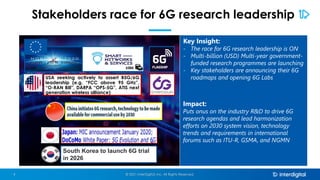
Stakeholders race for 6G research leadership
Key Insight:
- The race for 6G research leadership is ON
- Multi-billion (USD) Multi-year government-
funded research programmes are launching
- Key stakeholders are announcing their 6G
roadmaps and opening 6G Labs
Impact:
Puts onus on the industry R&D to drive 6G
research agendas and lead harmonization
efforts on 2030 system vision, technology
trends and requirements in international
forums such as ITU-R, GSMA, and NGMN
10B€
USA seeking actively to assert B5G/6G
leadership (e.g. “FCC above 95 GHz”,
“O-RAN Bill”, DARPA “OPS-5G”, ATIS next
generation wireless alliance)
South Korea to launch 6G trial
in 2026
© 2021 InterDigital, Inc. All Rights Reserved.
4
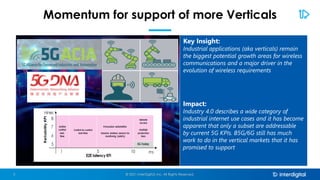
Momentum for support of more Verticals
Key Insight:
Industrial applications (aka verticals) remain
the biggest potential growth areas for wireless
communications and a major driver in the
evolution of wireless requirements
Impact:
Industry 4.0 describes a wide category of
industrial internet use cases and it has become
apparent that only a subset are addressable
by current 5G KPIs. B5G/6G still has much
work to do in the vertical markets that it has
promised to support
© 2021 InterDigital, Inc. All Rights Reserved.
5
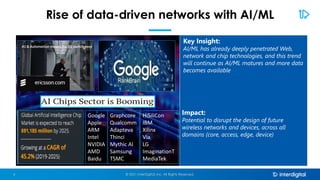
Rise of data-driven networks with AI/ML
Key Insight:
AI/ML has already deeply penetrated Web,
network and chip technologies, and this trend
will continue as AI/ML matures and more data
becomes available
Impact:
Potential to disrupt the design of future
wireless networks and devices, across all
domains (core, access, edge, device)
Google
Apple
ARM
Intel
NVIDIA
AMD
Baidu
Graphcore
Qualcomm
Adapteva
Thinci
Mythic AI
Samsung
TSMC
HiSiliCon
IBM
Xilinx
Via
LG
ImaginationT
MediaTek
© 2021 InterDigital, Inc. All Rights Reserved.
6
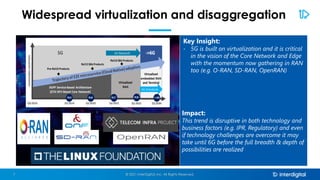
Widespread virtualization and disaggregation
Key Insight:
- 5G is built on virtualization and it is critical
in the vision of the Core Network and Edge
with the momentum now gathering in RAN
too (e.g. O-RAN, SD-RAN, OpenRAN)
Impact:
This trend is disruptive in both technology and
business factors (e.g. IPR, Regulatory) and even
if technology challenges are overcome it may
take until 6G before the full breadth & depth of
possibilities are realized
© 2021 InterDigital, Inc. All Rights Reserved.
7
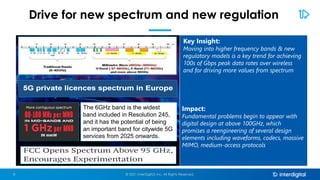
Drive for new spectrum and new regulation
Key Insight:
Moving into higher frequency bands & new
regulatory models is a key trend for achieving
100s of Gbps peak data rates over wireless
and for driving more values from spectrum
Impact:
Fundamental problems begin to appear with
digital design at above 100GHz, which
promises a reengineering of several design
elements including waveforms, codecs, massive
MIMO, medium-access protocols
The 6GHz band is the widest
band included in Resolution 245,
and it has the potential of being
an important band for citywide 5G
services from 2025 onwards.
© 2021 InterDigital, Inc. All Rights Reserved.
8
- Key Forums
- Target Capabilities
- Technology Trends
© 2021 InterDigital, Inc. All Rights Reserved.
9
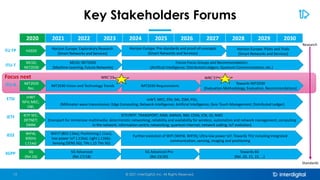
Key Stakeholders Forums
© 2021 InterDigital, Inc. All Rights Reserved.
10
2020 2021 2022 2023 2024 2025 2026 2027 2028 2029 2030
5G
(Rel.16)
5G Advanced
(Rel.17/18)
5G Advanced Pro
(Rel.19/20)
Towards 6G
(Rel..20, 21, 22, …)
3GPP
WiFi6;
60GHz
(.11ay)
WiFi7 (802.11be); Positioning (.11ac);
low power IoT (.11ba); Light (.11bb);
Sensing (SENS SG); THz (.15 THz SG)
Further evolution of WiFi (WiFi8, WiFi9); Ultra-low power IoT; Towards THz including integrated
communication, sensing, imaging and positioning
IEEE
ML5G;
NET2030
ML5G; NET2030
(Machine Learning; Future Networks)
Future Focus Groups and Recommendations
(Artificial Intelligence; Distributed Ledgers; Quantum Communications; etc.)
ITU-T
IETF SFC;
DETNET;
DMM
IETF/IRTF: TRANSPORT; RAW; ANIMA; NM; COIN; ICN; QI; NWC
(transport for immersive multimedia; deterministic networking; reliability and availability for wireless; automation and network management; computing
in the network; information centric networking; quantum internet; network coding; IoT evolution)
IETF
mWT
NFV; MEC;
ENI;
mWT; MEC; ENI; SAI; ZSM; PDL;
(Millimeter wave transmission; Edge Computing; Network Intelligence; Artificial Intelligence; Zero Touch Management; Distributed Ledger)
ETSI
IMT2020
Rec.
IMT2030 Vision and Technology Trends IMT2030 Requirements
Towards IMT2030
(Evaluation Methodology, Evaluation, Recommendations)
ITU-R
WRC’23 WRC’27
Horizon Europe: Exploratory Research
(Smart Networks and Services)
Horizon Europe: Pre-standards and proof-of-concepts
(Smart Networks and Services)
H2020
EU FP Horizon Europe: Pilots and Trials
(Smart Networks and Services)
Standards
Research
Focus next
IMT-2020
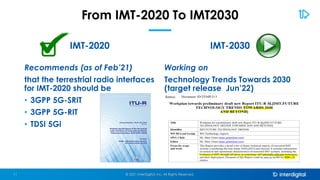
Recommends (as of Feb’21)
that the terrestrial radio interfaces
for IMT-2020 should be
• 3GPP 5G-SRIT
• 3GPP 5G-RIT
• TDSI 5Gi
IMT-2030
Working on
Technology Trends Towards 2030
(target release Jun’22)
© 2021 InterDigital, Inc. All Rights Reserved.
From IMT-2020 To IMT2030
11
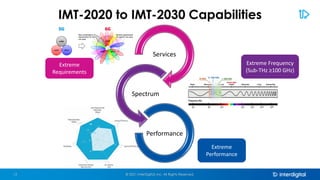
Services
Spectrum
Performance
IMT-2020 to IMT-2030 Capabilities
© 2021 InterDigital, Inc. All Rights Reserved.
12
Extreme Frequency
(Sub-THz ≥100 GHz)
Extreme
Performance
Extreme
Requirements
Services Underpinning 5G Evolution to 6G
© 2021 InterDigital, Inc. All Rights Reserved.
13
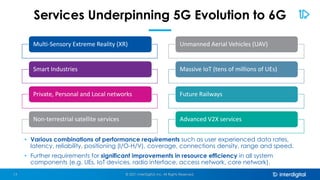
Multi-Sensory Extreme Reality (XR)
Smart Industries
Private, Personal and Local networks
Non-terrestrial satellite services
Unmanned Aerial Vehicles (UAV)
Massive IoT (tens of millions of UEs)
Future Railways
Advanced V2X services
• Various combinations of performance requirements such as user experienced data rates,
latency, reliability, positioning (I/O-H/V), coverage, connections density, range and speed.
• Further requirements for significant improvements in resource efficiency in all system
components (e.g. UEs, IoT devices, radio interface, access network, core network).
Spectrum and Performance Capabilities
© 2021 InterDigital, Inc. All Rights Reserved.
14
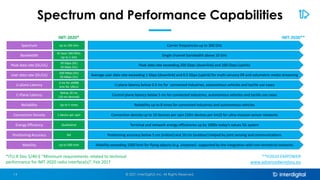
Spectrum Carrier frequencies up to 300 GHz
Up to 100 GHz
Bandwidth Single channel bandwidth above 10 GHz
At least 100 MHz;
Up to 1 GHz
User data rate (DL/UL) Average user data rate exceeding 1 Gbps (downlink) and 0.5 Gbps (uplink) for multi-sensory XR and volumetric media streaming
100 Mbps (DL)
50 Mbps (UL)
U-plane Latency
4 ms for eMBB
1ms for URLLC
U-plane latency below 0.5 ms for connected industries, autonomous vehicles and tactile use cases
C-Plane Latency
Below 20 ms
(10 ms desired)
Control plane latency below 5 ms for connected industries, autonomous vehicles and tactile use cases
Reliability Up to 5 nines Reliability up to 8 nines for connected industries and autonomous vehicles
Connection Density 1 device per sqm Connection density up to 10 devices per sqm (10m devices per km2) for ultra-massive sensor networks
Positioning Accuracy NA Positioning accuracy below 5 cm (indoor) and 10 cm (outdoor) helped by joint sensing and communications
Mobility Up to 500 kmh Mobility exceeding 1000 kmh for flying objects (e.g. airplanes) supported by the integration with non-terrestrial networks
Energy Efficiency Qualitative Terminal and network energy efficiencies up by 1000x today’s values 5G system
*ITU-R Doc 5/40-E “Minimum requirements related to technical
performance for IMT-2020 radio interface(s)”, Feb 2017
IMT-2020*
Peak data rate (DL/UL) Peak data rate exceeding 200 Gbps (downlink) and 100 Gbps (uplink)
20 Gbps (DL)
10 Gbps (UL)
IMT-2030**
**H2020 EMPOWER
www.advancedwireless.eu
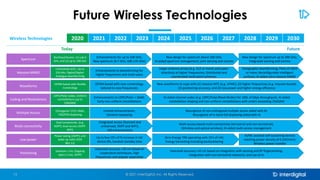
Future Wireless Technologies
© 2021 InterDigital, Inc. All Rights Reserved.
15
2020 2021 2022 2023 2024 2025 2026 2027 2028 2029 2030
Wireless Technologies
Spectrum
Enhancements for up to 100 GHz;
New spectrum (6-7 GHz; 100-170 GHz)
New design for spectrum above 100 GHz;
AI-aided spectrum management; joint sensing and comms
New design for spectrum up to 300 GHz;
Integrated sensing and comms
Backhaul/Access: (1) sub-6
GHz; and (2) up to 100 GHz
Massive MIMO
Enhancements to beamforming for
higher frequencies and multi-users
Larger antenna arrays (e.g. 512 or more) and super-
directivity at higher frequencies; Distributed and
coordinated multi-point schemes.
Holographic beamforming; PAAs of 1024
or more; Reconfigurable intelligent
surfaces; AI-aided ultra massive MIMO
Centralized arch.; Up to
256 AAs; Digital/Digital-
Analogue beamforming
Coding and Modulations
Enhancements to LDPC/Polar + QAM;
Early non-uniform constellations
AI-aided channel codes (e.g. LDPC/Polar/Read-Muller) for 100s of Gbps throughputs; AI-aided
constellation shaping and non-uniform constellations with orders exceeding 256QAM
LDPC/Polar codes; Uniform
constellations (up to
256QAM)
Multiple Access
Orthogonal T/F/C-DMA;
TDD/FDD duplexing
Limited enhancements;
Dynamic duplexing
Resurgence of non-orthogonal multiple access aided with AI;
Resurgence of in-band full duplexing aided with AI
Today
Waveforms
OFDM-based with new numerology
tailored to new frequencies
New waveforms to cope with (1) massive MTC (e.g. UFMC); (2) higher frequencies (e.g. Impulse-based);
(3) positioning accuracy; and (4) low power and higher energy efficiency
OFDM-based with flexible
numerology
Future
Low power
Power saving (3GPP); and
wake-up radio (IEEE
802.11)
Up to few 10’s of % increase in IoE
device-life, handset standby time
Zero-Energy TRX operating with 10’s of nW;
Energy harvesting including backscattering
AI/ML assisted self-sustaining devices
reaching power density of 0.1W/mm2;
Wireless power transfer
Positioning
Solutions <1m; Ongoing
specs (.11az, 3GPP)
Improved accuracy <20 cm based on
cooperative techniques, high
frequencies and angular separation
Improved accuracy <10 cm based on integration with sensing and RF fingerprinting;
Integration with non-terrestrial networks; and use of AI
Multi-connectivity
Dual connectivity (e.g.
3GPP); Dual-access (3GPP-
WiFi)
Integrated access (licensed and
unlicensed; 3GPP and WiFi);
IAB enhancements
Multi-access-based multi-connectivity (terrestrial and non-terrestrial);
(Wireless and optical wireless); AI-aided multi-access management
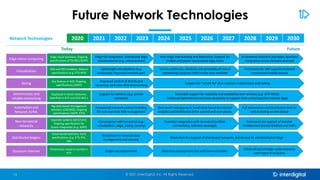
Future Network Technologies
© 2021 InterDigital, Inc. All Rights Reserved.
16
2020 2021 2022 2023 2024 2025 2026 2027 2028 2029 2030
Network Technologies
Edge native computing
Edge+5G integration; Distributed edge
enhancements (e.g. microservices)
Inter-edge interworking and federation; Support for
mobile and power-constrained edge hosts
AI-powered solutions and Apps; Seamless
integration across domains and tech
Edge-cloud solutions; Ongoing
specifications (ETSI MEC/3GPP)
Deterministic and
reliable networking
Support for wireless (e.g. private
networks)
Extended support for reliability and availability over wireless (e.g. IETF RAW);
Enhanced determinism and time sensitivity to support time-critical (tactile) internet Apps
Deployed in wired networks;
Specified in IETF and IEEE 802.1
Automation and
Network AI/ML
AI-powered network control including
for non-real time RAN management
Zero touch management; Small-data based distributed
analytics and distributed AI for control and user planes
Full automation and distribution end-to-
end including on-the-device
Big-data based management
solutions (OSS/BSS); Ongoing
specifications (3GPP, ETSI)
Today
Virtualization
Lightweight virtualization (e.g.
unikernels); Improved runtime perf.
Service continuity, elasticity and portability of virtual
networking functions (VNF) in the core and RAN
Extensions for VNF support on board
constrained mobile devices
SDN and NFV enablers; Mature
specifications (e.g. ETSI NFV)
Future
Non-terrestrial
networks
Separate systems (GEO/LEO);
Ongoing specification for
future integration (e.g. 3GPP)
Convergence with terrestrial (e.g.
virtualization, edge, slicing, latency)
Seamless integration with terrestrial (unified
connectivity, extreme coverage)
Extensions for support of massive
miniaturized (nano) satellites and HAPs
Quantum Internet
Preliminary research started in
IETF
Single hop experiments Multi-hop deployments but with low # of Qubits
Initial roll out of larger scale networks
with higher # of Qubits
Distributed ledgers
Cloud-based solutions; Early
specifications (e.g. ETSI PDL,
SAI)
Blockchain for network data
management and security
Blockchain for support of distributed networks, distributed AI, and distributed Edge
Slicing
Key feature in 5GS; Ongoing
specifications (3GPP)
Improved control of distributed
resources, and inter-slice interworking
Support for “on the fly” slice creation, instantiation and scaling
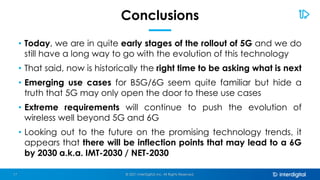
Conclusions
• Today, we are in quite early stages of the rollout of 5G and we do
still have a long way to go with the evolution of this technology
• That said, now is historically the right time to be asking what is next
• Emerging use cases for B5G/6G seem quite familiar but hide a
truth that 5G may only open the door to these use cases
• Extreme requirements will continue to push the evolution of
wireless well beyond 5G and 6G
• Looking out to the future on the promising technology trends, it
appears that there will be inflection points that may lead to a 6G
by 2030 a.k.a. IMT-2030 / NET-2030
© 2021 InterDigital, Inc. All Rights Reserved.
17
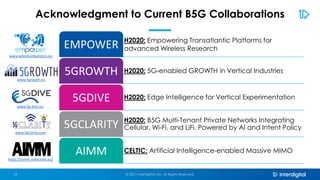
Acknowledgment to Current B5G Collaborations
© 2021 InterDigital, Inc. All Rights Reserved.
18
H2020: Empowering Transatlantic Platforms for
advanced Wireless Research
EMPOWER
H2020: 5G-enabled GROWTH in Vertical Industries
5GROWTH
H2020: Edge Intelligence for Vertical Experimentation
5GDIVE
H2020: B5G Multi-Tenant Private Networks Integrating
Cellular, Wi-Fi, and LiFi, Powered by AI and Intent Policy
5GCLARITY
CELTIC: Artificial Intelligence-enabled Massive MIMO
AIMM
https://aimm.celticnext.eu/
www.5gclarity.com
www.advancedwireless.eu
www.5growth.eu
www.5g-dive.eu
Thank You
Alain.Mourad@InterDigital.com

Technology trends towards 6G

  • 1.
    Technology Trends towards 6G ©2021 InterDigital, Inc. All Rights Reserved. 1 Dr Alain Mourad 6GIC – University of Surrey (UK) 05 February 2021
  • 2.
    Mega Trends to6G © 2021 InterDigital, Inc. All Rights Reserved. 2
  • 3.
    Mega Trends Underpinningthe Path to 6G IMPACT OF MEGATRENDS 2 Low High Longer-Term Short-term Degree of Certainity Impact (1) Stakeholders race for 6G research leadership (2) Momentum for support of moreVerticals (4) Widespread virtualization and disaggregation (3) Rise of data-driven networks with AI/ML (5) Drive for new spectrum and new regulation 1 3 4 5 TECH TREND MARKET TREND MARKET TREND TECH TREND TECH TREND © 2021 InterDigital, Inc. All Rights Reserved. 3
  • 4.
    Stakeholders race for6G research leadership Key Insight: - The race for 6G research leadership is ON - Multi-billion (USD) Multi-year government- funded research programmes are launching - Key stakeholders are announcing their 6G roadmaps and opening 6G Labs Impact: Puts onus on the industry R&D to drive 6G research agendas and lead harmonization efforts on 2030 system vision, technology trends and requirements in international forums such as ITU-R, GSMA, and NGMN 10B€ USA seeking actively to assert B5G/6G leadership (e.g. “FCC above 95 GHz”, “O-RAN Bill”, DARPA “OPS-5G”, ATIS next generation wireless alliance) South Korea to launch 6G trial in 2026 © 2021 InterDigital, Inc. All Rights Reserved. 4
  • 5.
    Momentum for supportof more Verticals Key Insight: Industrial applications (aka verticals) remain the biggest potential growth areas for wireless communications and a major driver in the evolution of wireless requirements Impact: Industry 4.0 describes a wide category of industrial internet use cases and it has become apparent that only a subset are addressable by current 5G KPIs. B5G/6G still has much work to do in the vertical markets that it has promised to support © 2021 InterDigital, Inc. All Rights Reserved. 5
  • 6.
    Rise of data-drivennetworks with AI/ML Key Insight: AI/ML has already deeply penetrated Web, network and chip technologies, and this trend will continue as AI/ML matures and more data becomes available Impact: Potential to disrupt the design of future wireless networks and devices, across all domains (core, access, edge, device) Google Apple ARM Intel NVIDIA AMD Baidu Graphcore Qualcomm Adapteva Thinci Mythic AI Samsung TSMC HiSiliCon IBM Xilinx Via LG ImaginationT MediaTek © 2021 InterDigital, Inc. All Rights Reserved. 6
  • 7.
    Widespread virtualization anddisaggregation Key Insight: - 5G is built on virtualization and it is critical in the vision of the Core Network and Edge with the momentum now gathering in RAN too (e.g. O-RAN, SD-RAN, OpenRAN) Impact: This trend is disruptive in both technology and business factors (e.g. IPR, Regulatory) and even if technology challenges are overcome it may take until 6G before the full breadth & depth of possibilities are realized © 2021 InterDigital, Inc. All Rights Reserved. 7
  • 8.
    Drive for newspectrum and new regulation Key Insight: Moving into higher frequency bands & new regulatory models is a key trend for achieving 100s of Gbps peak data rates over wireless and for driving more values from spectrum Impact: Fundamental problems begin to appear with digital design at above 100GHz, which promises a reengineering of several design elements including waveforms, codecs, massive MIMO, medium-access protocols The 6GHz band is the widest band included in Resolution 245, and it has the potential of being an important band for citywide 5G services from 2025 onwards. © 2021 InterDigital, Inc. All Rights Reserved. 8
  • 9.
    - Key Forums -Target Capabilities - Technology Trends © 2021 InterDigital, Inc. All Rights Reserved. 9
  • 10.
    Key Stakeholders Forums ©2021 InterDigital, Inc. All Rights Reserved. 10 2020 2021 2022 2023 2024 2025 2026 2027 2028 2029 2030 5G (Rel.16) 5G Advanced (Rel.17/18) 5G Advanced Pro (Rel.19/20) Towards 6G (Rel..20, 21, 22, …) 3GPP WiFi6; 60GHz (.11ay) WiFi7 (802.11be); Positioning (.11ac); low power IoT (.11ba); Light (.11bb); Sensing (SENS SG); THz (.15 THz SG) Further evolution of WiFi (WiFi8, WiFi9); Ultra-low power IoT; Towards THz including integrated communication, sensing, imaging and positioning IEEE ML5G; NET2030 ML5G; NET2030 (Machine Learning; Future Networks) Future Focus Groups and Recommendations (Artificial Intelligence; Distributed Ledgers; Quantum Communications; etc.) ITU-T IETF SFC; DETNET; DMM IETF/IRTF: TRANSPORT; RAW; ANIMA; NM; COIN; ICN; QI; NWC (transport for immersive multimedia; deterministic networking; reliability and availability for wireless; automation and network management; computing in the network; information centric networking; quantum internet; network coding; IoT evolution) IETF mWT NFV; MEC; ENI; mWT; MEC; ENI; SAI; ZSM; PDL; (Millimeter wave transmission; Edge Computing; Network Intelligence; Artificial Intelligence; Zero Touch Management; Distributed Ledger) ETSI IMT2020 Rec. IMT2030 Vision and Technology Trends IMT2030 Requirements Towards IMT2030 (Evaluation Methodology, Evaluation, Recommendations) ITU-R WRC’23 WRC’27 Horizon Europe: Exploratory Research (Smart Networks and Services) Horizon Europe: Pre-standards and proof-of-concepts (Smart Networks and Services) H2020 EU FP Horizon Europe: Pilots and Trials (Smart Networks and Services) Standards Research Focus next
  • 11.
    IMT-2020 Recommends (as ofFeb’21) that the terrestrial radio interfaces for IMT-2020 should be • 3GPP 5G-SRIT • 3GPP 5G-RIT • TDSI 5Gi IMT-2030 Working on Technology Trends Towards 2030 (target release Jun’22) © 2021 InterDigital, Inc. All Rights Reserved. From IMT-2020 To IMT2030 11
  • 12.
    Services Spectrum Performance IMT-2020 to IMT-2030Capabilities © 2021 InterDigital, Inc. All Rights Reserved. 12 Extreme Frequency (Sub-THz ≥100 GHz) Extreme Performance Extreme Requirements
  • 13.
    Services Underpinning 5GEvolution to 6G © 2021 InterDigital, Inc. All Rights Reserved. 13 Multi-Sensory Extreme Reality (XR) Smart Industries Private, Personal and Local networks Non-terrestrial satellite services Unmanned Aerial Vehicles (UAV) Massive IoT (tens of millions of UEs) Future Railways Advanced V2X services • Various combinations of performance requirements such as user experienced data rates, latency, reliability, positioning (I/O-H/V), coverage, connections density, range and speed. • Further requirements for significant improvements in resource efficiency in all system components (e.g. UEs, IoT devices, radio interface, access network, core network).
  • 14.
    Spectrum and PerformanceCapabilities © 2021 InterDigital, Inc. All Rights Reserved. 14 Spectrum Carrier frequencies up to 300 GHz Up to 100 GHz Bandwidth Single channel bandwidth above 10 GHz At least 100 MHz; Up to 1 GHz User data rate (DL/UL) Average user data rate exceeding 1 Gbps (downlink) and 0.5 Gbps (uplink) for multi-sensory XR and volumetric media streaming 100 Mbps (DL) 50 Mbps (UL) U-plane Latency 4 ms for eMBB 1ms for URLLC U-plane latency below 0.5 ms for connected industries, autonomous vehicles and tactile use cases C-Plane Latency Below 20 ms (10 ms desired) Control plane latency below 5 ms for connected industries, autonomous vehicles and tactile use cases Reliability Up to 5 nines Reliability up to 8 nines for connected industries and autonomous vehicles Connection Density 1 device per sqm Connection density up to 10 devices per sqm (10m devices per km2) for ultra-massive sensor networks Positioning Accuracy NA Positioning accuracy below 5 cm (indoor) and 10 cm (outdoor) helped by joint sensing and communications Mobility Up to 500 kmh Mobility exceeding 1000 kmh for flying objects (e.g. airplanes) supported by the integration with non-terrestrial networks Energy Efficiency Qualitative Terminal and network energy efficiencies up by 1000x today’s values 5G system *ITU-R Doc 5/40-E “Minimum requirements related to technical performance for IMT-2020 radio interface(s)”, Feb 2017 IMT-2020* Peak data rate (DL/UL) Peak data rate exceeding 200 Gbps (downlink) and 100 Gbps (uplink) 20 Gbps (DL) 10 Gbps (UL) IMT-2030** **H2020 EMPOWER www.advancedwireless.eu
  • 15.
    Future Wireless Technologies ©2021 InterDigital, Inc. All Rights Reserved. 15 2020 2021 2022 2023 2024 2025 2026 2027 2028 2029 2030 Wireless Technologies Spectrum Enhancements for up to 100 GHz; New spectrum (6-7 GHz; 100-170 GHz) New design for spectrum above 100 GHz; AI-aided spectrum management; joint sensing and comms New design for spectrum up to 300 GHz; Integrated sensing and comms Backhaul/Access: (1) sub-6 GHz; and (2) up to 100 GHz Massive MIMO Enhancements to beamforming for higher frequencies and multi-users Larger antenna arrays (e.g. 512 or more) and super- directivity at higher frequencies; Distributed and coordinated multi-point schemes. Holographic beamforming; PAAs of 1024 or more; Reconfigurable intelligent surfaces; AI-aided ultra massive MIMO Centralized arch.; Up to 256 AAs; Digital/Digital- Analogue beamforming Coding and Modulations Enhancements to LDPC/Polar + QAM; Early non-uniform constellations AI-aided channel codes (e.g. LDPC/Polar/Read-Muller) for 100s of Gbps throughputs; AI-aided constellation shaping and non-uniform constellations with orders exceeding 256QAM LDPC/Polar codes; Uniform constellations (up to 256QAM) Multiple Access Orthogonal T/F/C-DMA; TDD/FDD duplexing Limited enhancements; Dynamic duplexing Resurgence of non-orthogonal multiple access aided with AI; Resurgence of in-band full duplexing aided with AI Today Waveforms OFDM-based with new numerology tailored to new frequencies New waveforms to cope with (1) massive MTC (e.g. UFMC); (2) higher frequencies (e.g. Impulse-based); (3) positioning accuracy; and (4) low power and higher energy efficiency OFDM-based with flexible numerology Future Low power Power saving (3GPP); and wake-up radio (IEEE 802.11) Up to few 10’s of % increase in IoE device-life, handset standby time Zero-Energy TRX operating with 10’s of nW; Energy harvesting including backscattering AI/ML assisted self-sustaining devices reaching power density of 0.1W/mm2; Wireless power transfer Positioning Solutions <1m; Ongoing specs (.11az, 3GPP) Improved accuracy <20 cm based on cooperative techniques, high frequencies and angular separation Improved accuracy <10 cm based on integration with sensing and RF fingerprinting; Integration with non-terrestrial networks; and use of AI Multi-connectivity Dual connectivity (e.g. 3GPP); Dual-access (3GPP- WiFi) Integrated access (licensed and unlicensed; 3GPP and WiFi); IAB enhancements Multi-access-based multi-connectivity (terrestrial and non-terrestrial); (Wireless and optical wireless); AI-aided multi-access management
  • 16.
    Future Network Technologies ©2021 InterDigital, Inc. All Rights Reserved. 16 2020 2021 2022 2023 2024 2025 2026 2027 2028 2029 2030 Network Technologies Edge native computing Edge+5G integration; Distributed edge enhancements (e.g. microservices) Inter-edge interworking and federation; Support for mobile and power-constrained edge hosts AI-powered solutions and Apps; Seamless integration across domains and tech Edge-cloud solutions; Ongoing specifications (ETSI MEC/3GPP) Deterministic and reliable networking Support for wireless (e.g. private networks) Extended support for reliability and availability over wireless (e.g. IETF RAW); Enhanced determinism and time sensitivity to support time-critical (tactile) internet Apps Deployed in wired networks; Specified in IETF and IEEE 802.1 Automation and Network AI/ML AI-powered network control including for non-real time RAN management Zero touch management; Small-data based distributed analytics and distributed AI for control and user planes Full automation and distribution end-to- end including on-the-device Big-data based management solutions (OSS/BSS); Ongoing specifications (3GPP, ETSI) Today Virtualization Lightweight virtualization (e.g. unikernels); Improved runtime perf. Service continuity, elasticity and portability of virtual networking functions (VNF) in the core and RAN Extensions for VNF support on board constrained mobile devices SDN and NFV enablers; Mature specifications (e.g. ETSI NFV) Future Non-terrestrial networks Separate systems (GEO/LEO); Ongoing specification for future integration (e.g. 3GPP) Convergence with terrestrial (e.g. virtualization, edge, slicing, latency) Seamless integration with terrestrial (unified connectivity, extreme coverage) Extensions for support of massive miniaturized (nano) satellites and HAPs Quantum Internet Preliminary research started in IETF Single hop experiments Multi-hop deployments but with low # of Qubits Initial roll out of larger scale networks with higher # of Qubits Distributed ledgers Cloud-based solutions; Early specifications (e.g. ETSI PDL, SAI) Blockchain for network data management and security Blockchain for support of distributed networks, distributed AI, and distributed Edge Slicing Key feature in 5GS; Ongoing specifications (3GPP) Improved control of distributed resources, and inter-slice interworking Support for “on the fly” slice creation, instantiation and scaling
  • 17.
    Conclusions • Today, weare in quite early stages of the rollout of 5G and we do still have a long way to go with the evolution of this technology • That said, now is historically the right time to be asking what is next • Emerging use cases for B5G/6G seem quite familiar but hide a truth that 5G may only open the door to these use cases • Extreme requirements will continue to push the evolution of wireless well beyond 5G and 6G • Looking out to the future on the promising technology trends, it appears that there will be inflection points that may lead to a 6G by 2030 a.k.a. IMT-2030 / NET-2030 © 2021 InterDigital, Inc. All Rights Reserved. 17
  • 18.
    Acknowledgment to CurrentB5G Collaborations © 2021 InterDigital, Inc. All Rights Reserved. 18 H2020: Empowering Transatlantic Platforms for advanced Wireless Research EMPOWER H2020: 5G-enabled GROWTH in Vertical Industries 5GROWTH H2020: Edge Intelligence for Vertical Experimentation 5GDIVE H2020: B5G Multi-Tenant Private Networks Integrating Cellular, Wi-Fi, and LiFi, Powered by AI and Intent Policy 5GCLARITY CELTIC: Artificial Intelligence-enabled Massive MIMO AIMM https://aimm.celticnext.eu/ www.5gclarity.com www.advancedwireless.eu www.5growth.eu www.5g-dive.eu
  • 19.