Evaluation
Rhiannah Baker
Production Process Evaluation
Research
• First I researched 3 already existing products, this helped me to see what
already existed, possibly giving me ideas that I could use in my own
product. It also helped me to know what exists so I won’t accidentally
plagiarise it, and get myself into trouble.
• I looked at what they all had in common, and looked at why they are
needed.
• This helped me to know what I needed to include in my product.
• I also researched existing photography articles to know how I need to style
it, and also what to include
Planning
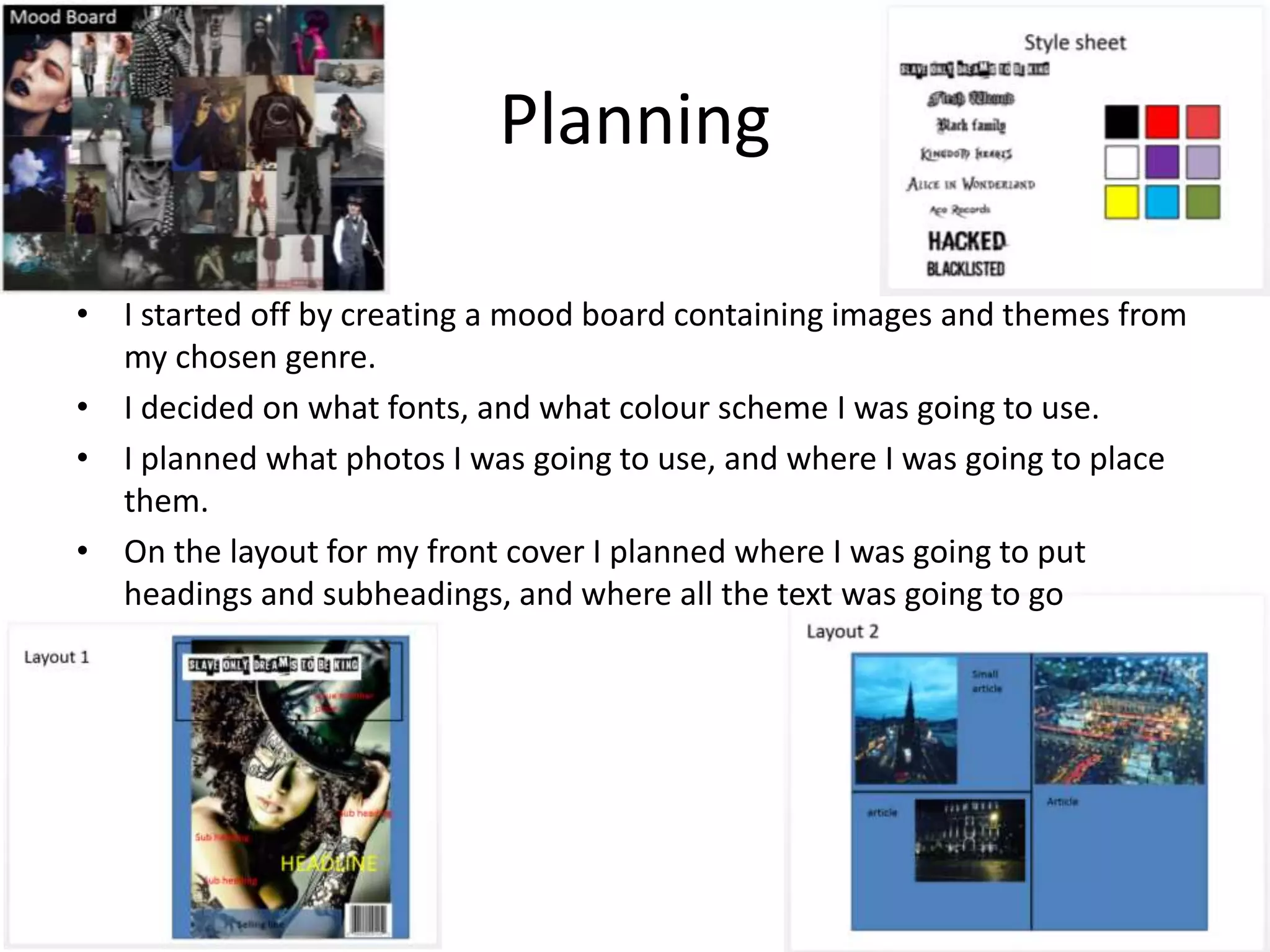
• I started off by creating a mood board containing images and themes from
my chosen genre.
• I decided on what fonts, and what colour scheme I was going to use.
• I planned what photos I was going to use, and where I was going to place
them.
• On the layout for my front cover I planned where I was going to put
headings and subheadings, and where all the text was going to go
Time Management
• I created a day to day schedule, on what I was going to do and work on,
this helped me stick to a deadline and to keep myself organised.
• Even though I created a plan of when I was going to do things, not
everything went exactly to plan. For example I ended up spending too
much time on certain things, meaning I got behind on my work; however I
managed to sort myself out and meet the deadlines.
Technical Qualities
Both my product and the existing product both contain vibrant colours, the use of
lighting is very prominent in both products.
On the double page spreads, both mine and the existing product used black as the
background colour, and white for the font colour.
Another similarity is that both mine and the existing
double page spread use another colour on the
subheadings to highlight them and make them stand out.
Both double page spreads have a large photo, and a few
smaller ones surrounding the text.
Aesthetic Qualities
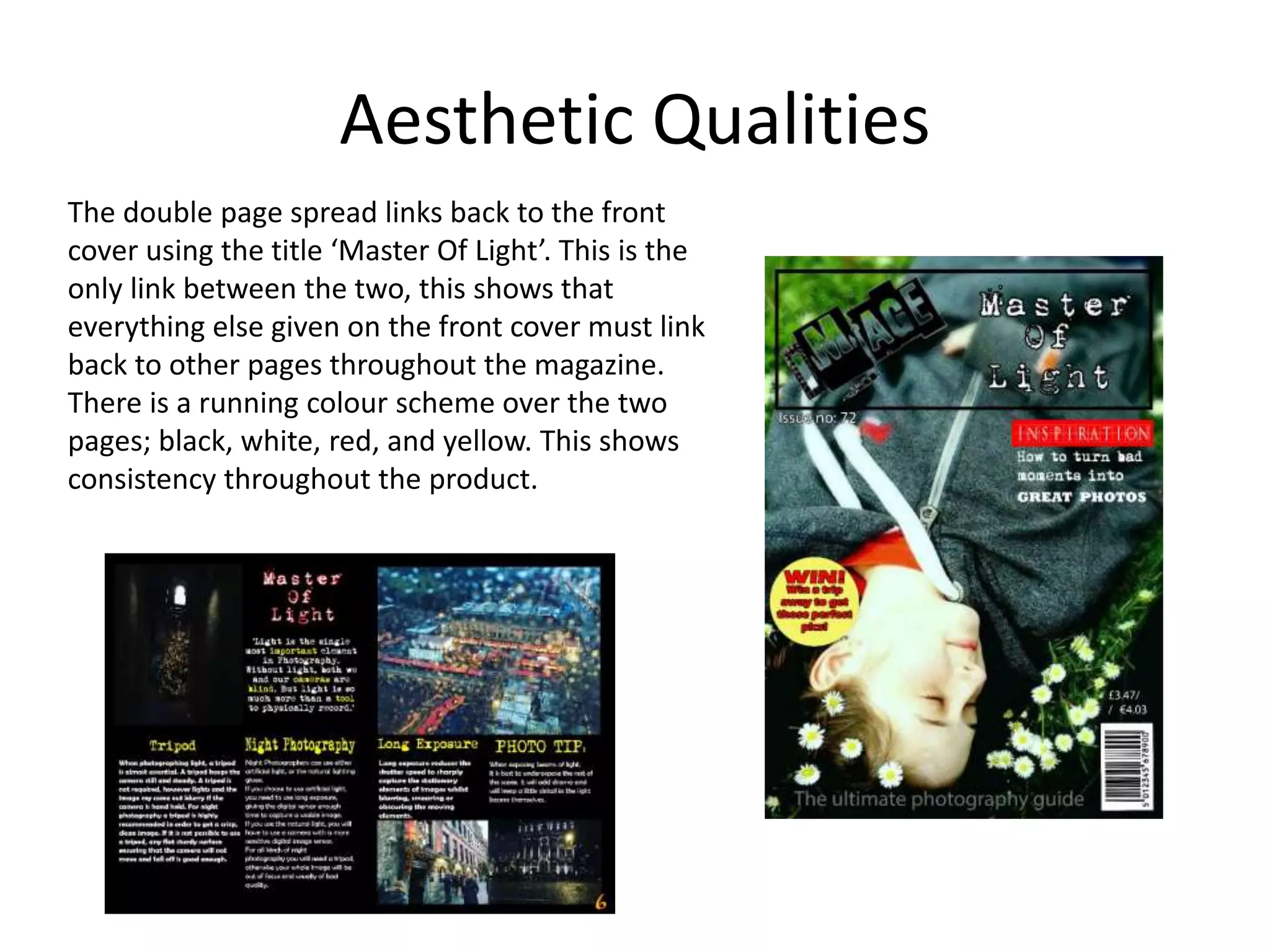
The double page spread links back to the front
cover using the title ‘Master Of Light’. This is the
only link between the two, this shows that
everything else given on the front cover must link
back to other pages throughout the magazine.
There is a running colour scheme over the two
pages; black, white, red, and yellow. This shows
consistency throughout the product.
Audience Appeal
I used basic primary colours throughout my
product to appeal to the targeted male and
female audience.
The simplicity of the cover draws in the audience
to know more about it.
I used a spring photo to also grab the audiences
attention, this is also done by using a young girl
on the cover; this may entice the audience by
reminding them of either themselves, in their
youth, or of someone close to them.
Peer
Feedback
Feedback 1
• What did you like about the product?
– The image on the front cover was a high quality, which made the page
effective and professional. The variety of fonts used worked well with
the cover and the style of the cover worked to reflect the genre.
– The double page spread used the colours of the images so using the
mise-en-scene is really effective. The font choice works nicely and the
information is very well written.
• What improvements could have been made to the product?
– The cover could have done with some final touches on the editing of
the ‘Image’ text as the outline could be smoother.
– The conventions of the selling line and issue number are usually in
capitals
– The text in the plug could have used the space more effectively.
Feedback 2
• What did you like about the product?
– I like the way that although the fonts were different they
all worked together.
– The way you matched the colours of the fonts to the
colours in the photograph.
– There is also a lot of attention to detail and lots of
information in the double page spread.
• What improvements could have been made to
the product?
– The page numbers are too big.
Feedback 3
• What did you like about the product?
– I like how you have used your own images and made
everything fit together. I also like how you have used all
the common conventions for the magazine front cover and
double page spread.
• What improvements could have been made to
the product?
– I think you could improve how the writing on the double
page spread is, the fonts and make everything in line.
Peer Feedback Summary
• What do you agree with from your peer
feedback?
– I agree with almost everything that was said about
my product.
• What do you disagree with from your peer
feedback?
– I think my product as a whole is effective, there
are improvements that could be made it is of good
enough quality for me to be satisfied.
Peer Feedback Summary
I would use the ruler tool more effectively to ensure that everything is in line and
organised on my double page spread. I would also make my page numbers are
smaller.
On the front cover I would make my ‘image’ text smoother and the edges cleaner.
I would also use the small more effectively in the plug, and follow the conventions of
having the issue number and selling line in capital letters.

5.7. evaluation

  • 1.
  • 2.
  • 3.
    Research • First Iresearched 3 already existing products, this helped me to see what already existed, possibly giving me ideas that I could use in my own product. It also helped me to know what exists so I won’t accidentally plagiarise it, and get myself into trouble. • I looked at what they all had in common, and looked at why they are needed. • This helped me to know what I needed to include in my product. • I also researched existing photography articles to know how I need to style it, and also what to include
  • 4.
    Planning • I startedoff by creating a mood board containing images and themes from my chosen genre. • I decided on what fonts, and what colour scheme I was going to use. • I planned what photos I was going to use, and where I was going to place them. • On the layout for my front cover I planned where I was going to put headings and subheadings, and where all the text was going to go
  • 5.
    Time Management • Icreated a day to day schedule, on what I was going to do and work on, this helped me stick to a deadline and to keep myself organised. • Even though I created a plan of when I was going to do things, not everything went exactly to plan. For example I ended up spending too much time on certain things, meaning I got behind on my work; however I managed to sort myself out and meet the deadlines.
  • 6.
    Technical Qualities Both myproduct and the existing product both contain vibrant colours, the use of lighting is very prominent in both products. On the double page spreads, both mine and the existing product used black as the background colour, and white for the font colour. Another similarity is that both mine and the existing double page spread use another colour on the subheadings to highlight them and make them stand out. Both double page spreads have a large photo, and a few smaller ones surrounding the text.
  • 7.
    Aesthetic Qualities The doublepage spread links back to the front cover using the title ‘Master Of Light’. This is the only link between the two, this shows that everything else given on the front cover must link back to other pages throughout the magazine. There is a running colour scheme over the two pages; black, white, red, and yellow. This shows consistency throughout the product.
  • 8.
    Audience Appeal I usedbasic primary colours throughout my product to appeal to the targeted male and female audience. The simplicity of the cover draws in the audience to know more about it. I used a spring photo to also grab the audiences attention, this is also done by using a young girl on the cover; this may entice the audience by reminding them of either themselves, in their youth, or of someone close to them.
  • 9.
  • 10.
    Feedback 1 • Whatdid you like about the product? – The image on the front cover was a high quality, which made the page effective and professional. The variety of fonts used worked well with the cover and the style of the cover worked to reflect the genre. – The double page spread used the colours of the images so using the mise-en-scene is really effective. The font choice works nicely and the information is very well written. • What improvements could have been made to the product? – The cover could have done with some final touches on the editing of the ‘Image’ text as the outline could be smoother. – The conventions of the selling line and issue number are usually in capitals – The text in the plug could have used the space more effectively.
  • 11.
    Feedback 2 • Whatdid you like about the product? – I like the way that although the fonts were different they all worked together. – The way you matched the colours of the fonts to the colours in the photograph. – There is also a lot of attention to detail and lots of information in the double page spread. • What improvements could have been made to the product? – The page numbers are too big.
  • 12.
    Feedback 3 • Whatdid you like about the product? – I like how you have used your own images and made everything fit together. I also like how you have used all the common conventions for the magazine front cover and double page spread. • What improvements could have been made to the product? – I think you could improve how the writing on the double page spread is, the fonts and make everything in line.
  • 13.
    Peer Feedback Summary •What do you agree with from your peer feedback? – I agree with almost everything that was said about my product. • What do you disagree with from your peer feedback? – I think my product as a whole is effective, there are improvements that could be made it is of good enough quality for me to be satisfied.
  • 14.
    Peer Feedback Summary Iwould use the ruler tool more effectively to ensure that everything is in line and organised on my double page spread. I would also make my page numbers are smaller. On the front cover I would make my ‘image’ text smoother and the edges cleaner. I would also use the small more effectively in the plug, and follow the conventions of having the issue number and selling line in capital letters.

Editor's Notes

  • #4 What were the strengths of your research? How did your research help your product? What were the weaknesses of your research? What could you have done better/improve? What effect would this have had on your product?
  • #5 What were the strengths of your planning? How did your planning help your product? What were the weaknesses of your planning? What could you have done better/improve? What effect would this have had on your product?
  • #6 Did you manage your time well? Did you complete your project on time or would your products have improved with additional time? What would you have done if you had more time to produce your work?
  • #7 Compare your work to similar existing products and discuss the similarities and differences Put your final piece(s) in the centre of a page alongside an existing product Use text boxes and arrows
  • #8 Does your work look good? Was it creative? What aspects of your game’s visuals do you like? What would you improve? How would you improve it? Discuss the strengths and weaknesses Put your final piece(s) in the centre of a page and analyse them Use text boxes and arrows
  • #9 How have you appealed to your target audience? What specific bits of content would appeal to your target audience. Refer to your findings from your questionnaire. Put your final piece(s) in the centre of a page and analyse them Use text boxes and arrows
  • #15 What changes would you make to your product based upon your peer feedback and why?