Quiz 2 key
The Euclidean Algorithm
(long division)
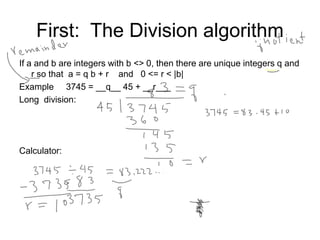
First: The Division algorithm
If a and b are integers with b <> 0, then there are unique integers q and
r so that a = q b + r and 0 <= r < |b|
Example 3745 = __q__ 45 + __r___
Long division:
Calculator:
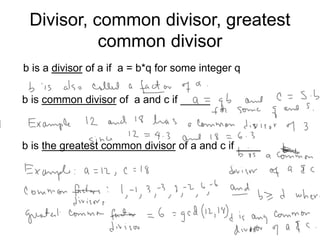
Divisor, common divisor, greatest
common divisor
b is a divisor of a if a = b*q for some integer q
b is common divisor of a and c if _____
b is the greatest common divisor of a and c if ____
Arayabhata-Euclid’s algorithm: How to find
gcd(a,b), the greatest common divisor of a and b
based on a single observation: if a = b q + r, then
any divisor of a and b is also a divisor of r, and any divisor
of b and r is also a divisor of a, so gcd(a,b) = gcd(b,r)
Euclid algorithm: use the division algorithm repeatedly
To reduce the problem to one you can solve.
Example: gcd(55,35)
55 = 35*1 + 20 so gcd(55,35) = gcd(35,20)
35 = 20*1 + 15 so gcd(35,20) = gcd(20,15)
20 = 15*1 + 5 done gcd(55,35) = 5
2 columns of the arayabhata table: the
columns of quotients and remainders
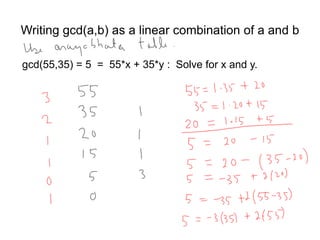
Writing gcd(a,b) as a linear combination of a and b
gcd(55,35) = 5 = 55*x + 35*y : Solve for x and y.
The 1st column of the arayabhata table
An application
Problem: Given a 3 pint can, a 5 pint can, a large tank of
water, and a large empty tank, how can we get exactly 1
pint of water into the empty tank?
We will talk about this on Wednesday
Division algorithm for polynomials in x.
If a(x) and b(x) are polynomials in x then there are unique polynomials
q(x) and r(x) so that a(x) = q(x)*b(x) + r(x) where
r(x) = 0 or deg(r(x)) < deg(b(x))
Example: x^4 = __q(x)___ (x^2 -1) + __r(x)___
Long division:
Divisor, common divisor, and gcd for polynomials
in x
b(x) is a divisor of a(x) if ____
c(x) is a common divisor of a(x) and b(x) if
___
c(x) is a greatest common divisor
Recall 4th grade
If A and B are integers (whole numbers) then we say that
B divides A if there is an integer Q such that A = BQ
Examples:
• 2 divides 6 since there is an integer (3) such that
6 = 2*3
•1 divides any 291 since there is a number (291) such that
291 = 219*1
•If B is any number then B divides 0 since there is a number (0)
such that 0 = B*0
•Another way to say that B divides A is to say that B is a factor of
A
More examples
• 3 does not divide 5 since there is no
whole number Q such that 5 = 3*Q
• 9 does not divide 10 since there is no
whole number Q such that 10 = 9*Q
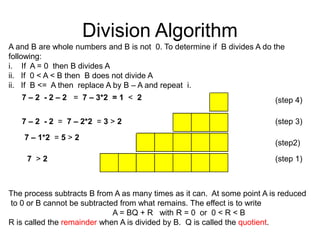
Visualizing division
6
6 = 2*3
7
2 divides 6
7 = 2*3 + 1 2 does not divide 7
Division Algorithm
7 > 2
7 – 1*2 = 5 > 2
7 – 2 - 2 = 7 – 2*2 = 3 > 2
7 – 2 - 2 – 2 = 7 – 3*2 = 1 < 2
A and B are whole numbers and B is not 0. To determine if B divides A do the
following:
i. If A = 0 then B divides A
ii. If 0 < A < B then B does not divide A
ii. If B <= A then replace A by B – A and repeat i.
The process subtracts B from A as many times as it can. At some point A is reduced
to 0 or B cannot be subtracted from what remains. The effect is to write
A = BQ + R with R = 0 or 0 < R < B
R is called the remainder when A is divided by B. Q is called the quotient.
(step 1)
(step2)
(step 3)
(step 4)
“Long Division”
__3 _
7 | 220
210
10
220 = 7*30 + 10
(does 30 subtractions)
10 > 7 so can subtract more
3 1
7 | 220
210
10
_7
3
220 - 7*30 = 1*7 + 3 0 < 3 < 7 process terminates
Quotient = 31 remainder = 3
220 = 7*31 + 3
Division Algorithm
If A and B are integers with B not zero then
there are unique integers Q and R such
that
A = BQ + R with 0 <= R < |B|
Note this allows A and B to be negative
5 = (-2)(-2) + 1 0 < 1 <|-2|
-7 = (-2)(4) + 1 0 < 1<|-2|
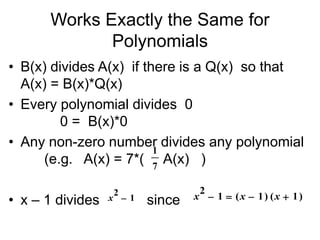
Works Exactly the Same for
Polynomials
• B(x) divides A(x) if there is a Q(x) so that
A(x) = B(x)*Q(x)
• Every polynomial divides 0
0 = B(x)*0
• Any non-zero number divides any polynomial
(e.g. A(x) = 7*( A(x) )
• x – 1 divides since
1
7

x
2
1 

x
2
1 ( )

x 1 ( )

x 1
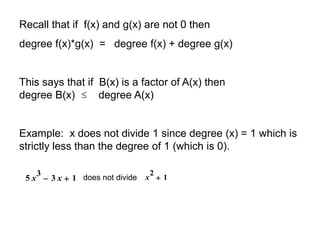
Recall that if f(x) and g(x) are not 0 then
degree f(x)*g(x) = degree f(x) + degree g(x)
This says that if B(x) is a factor of A(x) then
degree B(x) degree A(x)
Example: x does not divide 1 since degree (x) = 1 which is
strictly less than the degree of 1 (which is 0).

 
5 x
3
3 x 1 does not divide 
x
2
1
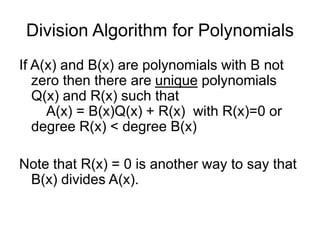
Division Algorithm for Polynomials
If A(x) and B(x) are polynomials with B not
zero then there are unique polynomials
Q(x) and R(x) such that
A(x) = B(x)Q(x) + R(x) with R(x)=0 or
degree R(x) < degree B(x)
Note that R(x) = 0 is another way to say that
B(x) divides A(x).
The Long Division of Polynomials is
a Way to calculate Q(x) and R(x)
Observations:
To calculate Q(x) and R(x) it suffices to find R(x) since
we can divide A(x)- R(x) by B(x) to get R(x)
The uniqueness of the remainder says if in any way you arrange to
write A(x) = B(x)K(x) + P(x) where P(x) is zero or of smaller degree
than B(x) then it must be that P(x) is the R(x) you would get by long
division.
For instance : so the remainder when
is divided by x-1 will be x.
Also so
which says that the remainder when is divided by x -1 is 1.

x
2

x ( )

x 1 x x
2

( )

x 1 ( )
 
1 x x
2

x
3
1 
x
3

( )

x 1 ( )
 
1 x x
2
1
x
2
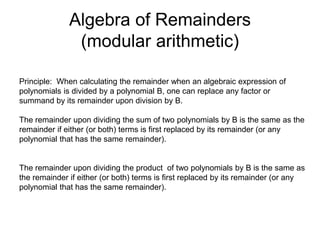
Algebra of Remainders
(modular arithmetic)
Principle: When calculating the remainder when an algebraic expression of
polynomials is divided by a polynomial B, one can replace any factor or
summand by its remainder upon division by B.
The remainder upon dividing the sum of two polynomials by B is the same as the
remainder if either (or both) terms is first replaced by its remainder (or any
polynomial that has the same remainder).
The remainder upon dividing the product of two polynomials by B is the same as
the remainder if either (or both) terms is first replaced by its remainder (or any
polynomial that has the same remainder).
Calculate the remainder upon division of
by  
x
2
x 1
First note that since the remainder of is

x
2

( )
 
x
2
x 1 1 ( )

1 x x
2 
1 x
  
x
4
3 x
3
x 1

  
x
4
3 x
3
x 1   
( )
x
2
2
3 x x
2
x 1
We can replace by its remainder 1-x
x
2

  
x
4
3 x
3
x 1   
( )

1 x
2
3 x ( )

1 x x 1 =      
1 2 x x
2
3 x 3 x
2
x 1
=  
4 x 4 x
2
Now we can replace again to get
x
2
 
8 x 4
Similarly
Calculate the remainder when is divided by
x
4  
x
2
2 x 1
As with the previous example the remainder of is 2x+1
the remainder of is the same as the remainder of or
x
2
x
4
( )

2 x 1
2
 
4 x
2
4 x 1 = 
 
4 ( )

2 x 1 4 x 1 
12 x 5
This says for some polynomial Q(x)

x
4
 
( )
 
x
2
2 x 1 ( )
Q x 12 x 5
is a root of . What is
Replace x by in

1 2  
x
2
2 x 1 ( )

1 2
4

x
4
 
( )
 
x
2
2 x 1 ( )
Q x 12 x 5

1 2
Since it is a root of we have or
 
x
2
2 x 1 
( )

1 2
4

12 ( )

1 2 5 
17 12 2
The Greatest Common Divisor (GCD)
(also called GCFactor)
• The GCD of two integers A1 and A2 is the
largest integer that divides both.
– Examples: gcd(n,1)=1 for any n
– gcd(n,0) = |n| if n is not 0
• (gcd(0,0) does not exist
• GCD 12 and 20
– Factors of 12 = {-12,-6,-4,-3,-2,-1,1,2,3,4,6,12}
– Factors of 20 = {-20,-10,-5,-4,-2,-1,1,2, 4, 5,10,20}
– Common factors = {-4, -2,-1,1,2,4}
– Greatest common factor = 4
• Not a practical for large numbers
• Factors of 5280
• Factors of 4680
GCD(5280,4680) = ?












































1 2 3 4 5 6
8 10 11 12 15 16
20 22 24 30 32 33
40 44 48 55 60 66
80 88 96 110 120 132
160 165 176 220 240 264
330 352 440 480 528 660
880 1056 1320 1760 2640 5280












































1 2 3 4 5 6
8 9 10 12 13 15
18 20 24 26 30 36
39 40 45 52 60 65
72 78 90 104 117 120
130 156 180 195 234 260
312 360 390 468 520 585
780 936 1170 1560 2340 4680
• 146057167872 has 1056 positive factors
• 5228296875 has 120 positive factors
• There is no known way to find a single
factor (other than itself and 1) of a
randomly chosen number in a “small”
number of steps.
• We can find the GCD of pairs of HUGE
numbers in a small number of steps.
Theorem: If A, B, d and n are numbers and
d divides both A and B then it also divides
both A and B+/-n*A
Proof: A = d*r
B = d*s
n*A = d*(n*r)
B + n*A = d*s +/- d*(n*r) = d*(s +/- n*r)
Theorem: GCD(A,B) = GCD(A,B+/- n*A)
Using this over and over …
GCD(146057167872, 5228296875) =
GCD(146057167872 – 27* 5228296875, 5228296875) =
GCD(4893152247, 5228296875) =
GCD(5228296875- 1*4893152247, 4893152247) =
GCD(335144628, 4893152247 ) =
GCD(4893152247-14* 335144628,335144628 ) =
GCD(201127455, 335144628) =
GCD( 201127455, 335144628- 1*201127455 ) =
GCD( 201127455, 134017173) =
GCD( 201127455 – 1*134017173, 134017173) =
GCD( 67110282, 134017173) =
GCD( 67110282, 134017173 – 1* 67110282) =GCD(67110282,66906891)=
GCD(67110282-328* 66906891,66906891)=GCD(203391, 66906891)=
GCD(203391, 66906891-328*203391) =GCD(203391,194634) =
GCD(203391-1*194634, 194634) = GCD(8748, 194634) =
GCD(8748, 194634-22*8748) = GCD(8748,2187) = GCD(8748-4*2187, 2187) = GCD(2187,0)
So we calculated the GCD without factoring. It has to stop because each time we
subtracted a multiple of the smaller from the larger so that the resulting number is
even smaller. Process has to eventually get to 0.
Euclid Algorithm
To find the gcd of numbers A1 and A2 with A1 > A2 >= 0
a. If A2 = 0 then gcd = A1
b. If A2 > 0 then A1 = A2 q2 + A3 with A2>A3 >=0
c. Replace A1 by A2, A2 by A3 and go to step a.
This is exactly what we did in the previous example.
Example: gcd(120,85)
120 = 85*1 + 35
85 = 35*2 + 15
35 = 15*2 + 5
15 = 5*3 + 0 gcd = 5 (gcd is the last non-zero remainder)
Tabulate: note pattern
120 = 85*1 + 35 































120 " "
85 1
35 2
15 2
5 3
0 " "
85 = 35*2 + 15
35 = 15*2 + 5
15 = 5*3 + 0
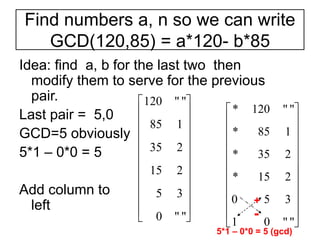
Find numbers a, n so we can write
GCD(120,85) = a*120- b*85
Idea: find a, b for the last two then
modify them to serve for the previous
pair.
Last pair = 5,0
GCD=5 obviously
5*1 – 0*0 = 5
Add column to
left
































120 " "
85 1
35 2
15 2
5 3
0 " "
































* 120 " "
* 85 1
* 35 2
* 15 2
0 5 3
1 0 " "
5*1 – 0*0 = 5 (gcd)
+
-
First: Fill in columns 2 and 3
































* 120 " "
* 85 1
* 35 2
* 15 2
0 5 3
1 0 " "
1*5 – 0*0 = 5 ( the gcd)
Now want a and b so that a*15+b*5 = 5
Have which says 15=5*3+0 or
15 – 5*3 = 0
Substituting in the first equation
1*5 – 0*(15 – 5*3) = 5
1*5 +(0*3)*5 -0*15 = 5
(1+0*3)*5 - 0*15 = 5
Then begin filling in column 1
































* 120 " "
* 85 1
* 35 2
* 15 2
0 5 3
1 0 " "
(1+0*3)*5 - 0*15 = 5
-
+
Note the pattern
































* 120 " "
* 85 1
* 35 2
1 15 2
0 5 3
1 0 " "
+
-
-
+
?
































* 120 " "
* 85 1
* 35 2
1 15 2
0 5 3
1 0 " "
Pattern
= * +






































"Answers" "Integers" "Divisions"
7 120 "Begin"
5 85 1
2 35 2
1 15 2
0 5 3
1 0 "done"
=
+
*
-
=
*
+
+
+
-
-
-
5*120-7*85 = 5
2*85-5*35 = -5
1*35-2*15 = 5
0*15 -1* 5 = -5
1*5 - 0*0=5
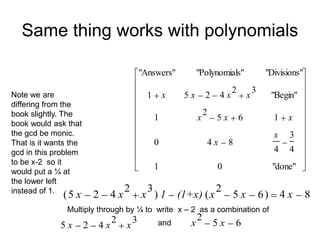
Same thing works with polynomials
Note we are
differing from the
book slightly. The
book would ask that
the gcd be monic.
That is it wants the
gcd in this problem
to be x-2 so it
would put a ¼ at
the lower left
instead of 1.




































"Answers" "Polynomials" "Divisions"

1 x   
5 x 2 4 x
2
x
3
"Begin"
1  
x
2
5 x 6 
1 x
0 
4 x 8 
x
4
3
4
1 0 "done"


( )
  
5 x 2 4 x
2
x
3
1 (1+x) ( )
 
x
2
5 x 6 
4 x 8
Multiply through by ¼ to write x – 2 as a combination of
  
5 x 2 4 x
2
x
3  
x
2
5 x 6
and
1*( ) - ( )*( ) = -3 - 3x










































"Answers" "Polynomials" "Divisions"

3 x
2
5
2
   
3 8 x
2
8 x 3 x
3
"Begin"
1  
2 x
2
2 x 
3 x
2
5
2
0  
3 3 x
2 x
3
1 0 "done"
   
3 8 x
2
8 x 3 x
3 
3 x
2
5
2  
2 x
2
2 x
Lead coefficient of the gcd is -3.
Monic gcd is (-3 -3x)/(-3) = 1+x. Divide both sides by -3 to get monic gcd as a
linear combination.

lecture4a_fall05.ppt for student learning

  • 1.
  • 2.
  • 3.
    First: The Divisionalgorithm If a and b are integers with b <> 0, then there are unique integers q and r so that a = q b + r and 0 <= r < |b| Example 3745 = __q__ 45 + __r___ Long division: Calculator:
  • 4.
    Divisor, common divisor,greatest common divisor b is a divisor of a if a = b*q for some integer q b is common divisor of a and c if _____ b is the greatest common divisor of a and c if ____
  • 5.
    Arayabhata-Euclid’s algorithm: Howto find gcd(a,b), the greatest common divisor of a and b based on a single observation: if a = b q + r, then any divisor of a and b is also a divisor of r, and any divisor of b and r is also a divisor of a, so gcd(a,b) = gcd(b,r) Euclid algorithm: use the division algorithm repeatedly To reduce the problem to one you can solve. Example: gcd(55,35) 55 = 35*1 + 20 so gcd(55,35) = gcd(35,20) 35 = 20*1 + 15 so gcd(35,20) = gcd(20,15) 20 = 15*1 + 5 done gcd(55,35) = 5
  • 6.
    2 columns ofthe arayabhata table: the columns of quotients and remainders
  • 7.
    Writing gcd(a,b) asa linear combination of a and b gcd(55,35) = 5 = 55*x + 35*y : Solve for x and y.
  • 8.
    The 1st columnof the arayabhata table
  • 9.
    An application Problem: Givena 3 pint can, a 5 pint can, a large tank of water, and a large empty tank, how can we get exactly 1 pint of water into the empty tank?
  • 10.
    We will talkabout this on Wednesday Division algorithm for polynomials in x. If a(x) and b(x) are polynomials in x then there are unique polynomials q(x) and r(x) so that a(x) = q(x)*b(x) + r(x) where r(x) = 0 or deg(r(x)) < deg(b(x)) Example: x^4 = __q(x)___ (x^2 -1) + __r(x)___ Long division:
  • 11.
    Divisor, common divisor,and gcd for polynomials in x b(x) is a divisor of a(x) if ____ c(x) is a common divisor of a(x) and b(x) if ___ c(x) is a greatest common divisor
  • 12.
    Recall 4th grade IfA and B are integers (whole numbers) then we say that B divides A if there is an integer Q such that A = BQ Examples: • 2 divides 6 since there is an integer (3) such that 6 = 2*3 •1 divides any 291 since there is a number (291) such that 291 = 219*1 •If B is any number then B divides 0 since there is a number (0) such that 0 = B*0 •Another way to say that B divides A is to say that B is a factor of A
  • 13.
    More examples • 3does not divide 5 since there is no whole number Q such that 5 = 3*Q • 9 does not divide 10 since there is no whole number Q such that 10 = 9*Q
  • 14.
    Visualizing division 6 6 =2*3 7 2 divides 6 7 = 2*3 + 1 2 does not divide 7
  • 15.
    Division Algorithm 7 >2 7 – 1*2 = 5 > 2 7 – 2 - 2 = 7 – 2*2 = 3 > 2 7 – 2 - 2 – 2 = 7 – 3*2 = 1 < 2 A and B are whole numbers and B is not 0. To determine if B divides A do the following: i. If A = 0 then B divides A ii. If 0 < A < B then B does not divide A ii. If B <= A then replace A by B – A and repeat i. The process subtracts B from A as many times as it can. At some point A is reduced to 0 or B cannot be subtracted from what remains. The effect is to write A = BQ + R with R = 0 or 0 < R < B R is called the remainder when A is divided by B. Q is called the quotient. (step 1) (step2) (step 3) (step 4)
  • 16.
    “Long Division” __3 _ 7| 220 210 10 220 = 7*30 + 10 (does 30 subtractions) 10 > 7 so can subtract more 3 1 7 | 220 210 10 _7 3 220 - 7*30 = 1*7 + 3 0 < 3 < 7 process terminates Quotient = 31 remainder = 3 220 = 7*31 + 3
  • 17.
    Division Algorithm If Aand B are integers with B not zero then there are unique integers Q and R such that A = BQ + R with 0 <= R < |B| Note this allows A and B to be negative 5 = (-2)(-2) + 1 0 < 1 <|-2| -7 = (-2)(4) + 1 0 < 1<|-2|
  • 18.
    Works Exactly theSame for Polynomials • B(x) divides A(x) if there is a Q(x) so that A(x) = B(x)*Q(x) • Every polynomial divides 0 0 = B(x)*0 • Any non-zero number divides any polynomial (e.g. A(x) = 7*( A(x) ) • x – 1 divides since 1 7  x 2 1   x 2 1 ( )  x 1 ( )  x 1
  • 19.
    Recall that iff(x) and g(x) are not 0 then degree f(x)*g(x) = degree f(x) + degree g(x) This says that if B(x) is a factor of A(x) then degree B(x) degree A(x) Example: x does not divide 1 since degree (x) = 1 which is strictly less than the degree of 1 (which is 0).    5 x 3 3 x 1 does not divide  x 2 1
  • 20.
    Division Algorithm forPolynomials If A(x) and B(x) are polynomials with B not zero then there are unique polynomials Q(x) and R(x) such that A(x) = B(x)Q(x) + R(x) with R(x)=0 or degree R(x) < degree B(x) Note that R(x) = 0 is another way to say that B(x) divides A(x).
  • 21.
    The Long Divisionof Polynomials is a Way to calculate Q(x) and R(x) Observations: To calculate Q(x) and R(x) it suffices to find R(x) since we can divide A(x)- R(x) by B(x) to get R(x) The uniqueness of the remainder says if in any way you arrange to write A(x) = B(x)K(x) + P(x) where P(x) is zero or of smaller degree than B(x) then it must be that P(x) is the R(x) you would get by long division. For instance : so the remainder when is divided by x-1 will be x. Also so which says that the remainder when is divided by x -1 is 1.  x 2  x ( )  x 1 x x 2  ( )  x 1 ( )   1 x x 2  x 3 1  x 3  ( )  x 1 ( )   1 x x 2 1 x 2
  • 22.
    Algebra of Remainders (modulararithmetic) Principle: When calculating the remainder when an algebraic expression of polynomials is divided by a polynomial B, one can replace any factor or summand by its remainder upon division by B. The remainder upon dividing the sum of two polynomials by B is the same as the remainder if either (or both) terms is first replaced by its remainder (or any polynomial that has the same remainder). The remainder upon dividing the product of two polynomials by B is the same as the remainder if either (or both) terms is first replaced by its remainder (or any polynomial that has the same remainder).
  • 23.
    Calculate the remainderupon division of by   x 2 x 1 First note that since the remainder of is  x 2  ( )   x 2 x 1 1 ( )  1 x x 2  1 x    x 4 3 x 3 x 1     x 4 3 x 3 x 1    ( ) x 2 2 3 x x 2 x 1 We can replace by its remainder 1-x x 2     x 4 3 x 3 x 1    ( )  1 x 2 3 x ( )  1 x x 1 =       1 2 x x 2 3 x 3 x 2 x 1 =   4 x 4 x 2 Now we can replace again to get x 2   8 x 4
  • 24.
    Similarly Calculate the remainderwhen is divided by x 4   x 2 2 x 1 As with the previous example the remainder of is 2x+1 the remainder of is the same as the remainder of or x 2 x 4 ( )  2 x 1 2   4 x 2 4 x 1 =    4 ( )  2 x 1 4 x 1  12 x 5 This says for some polynomial Q(x)  x 4   ( )   x 2 2 x 1 ( ) Q x 12 x 5 is a root of . What is Replace x by in  1 2   x 2 2 x 1 ( )  1 2 4  x 4   ( )   x 2 2 x 1 ( ) Q x 12 x 5  1 2 Since it is a root of we have or   x 2 2 x 1  ( )  1 2 4  12 ( )  1 2 5  17 12 2
  • 25.
    The Greatest CommonDivisor (GCD) (also called GCFactor) • The GCD of two integers A1 and A2 is the largest integer that divides both. – Examples: gcd(n,1)=1 for any n – gcd(n,0) = |n| if n is not 0 • (gcd(0,0) does not exist • GCD 12 and 20 – Factors of 12 = {-12,-6,-4,-3,-2,-1,1,2,3,4,6,12} – Factors of 20 = {-20,-10,-5,-4,-2,-1,1,2, 4, 5,10,20} – Common factors = {-4, -2,-1,1,2,4} – Greatest common factor = 4 • Not a practical for large numbers
  • 26.
    • Factors of5280 • Factors of 4680 GCD(5280,4680) = ?                                             1 2 3 4 5 6 8 10 11 12 15 16 20 22 24 30 32 33 40 44 48 55 60 66 80 88 96 110 120 132 160 165 176 220 240 264 330 352 440 480 528 660 880 1056 1320 1760 2640 5280                                             1 2 3 4 5 6 8 9 10 12 13 15 18 20 24 26 30 36 39 40 45 52 60 65 72 78 90 104 117 120 130 156 180 195 234 260 312 360 390 468 520 585 780 936 1170 1560 2340 4680
  • 27.
    • 146057167872 has1056 positive factors • 5228296875 has 120 positive factors • There is no known way to find a single factor (other than itself and 1) of a randomly chosen number in a “small” number of steps. • We can find the GCD of pairs of HUGE numbers in a small number of steps.
  • 28.
    Theorem: If A,B, d and n are numbers and d divides both A and B then it also divides both A and B+/-n*A Proof: A = d*r B = d*s n*A = d*(n*r) B + n*A = d*s +/- d*(n*r) = d*(s +/- n*r) Theorem: GCD(A,B) = GCD(A,B+/- n*A)
  • 29.
    Using this overand over … GCD(146057167872, 5228296875) = GCD(146057167872 – 27* 5228296875, 5228296875) = GCD(4893152247, 5228296875) = GCD(5228296875- 1*4893152247, 4893152247) = GCD(335144628, 4893152247 ) = GCD(4893152247-14* 335144628,335144628 ) = GCD(201127455, 335144628) = GCD( 201127455, 335144628- 1*201127455 ) = GCD( 201127455, 134017173) = GCD( 201127455 – 1*134017173, 134017173) = GCD( 67110282, 134017173) = GCD( 67110282, 134017173 – 1* 67110282) =GCD(67110282,66906891)= GCD(67110282-328* 66906891,66906891)=GCD(203391, 66906891)= GCD(203391, 66906891-328*203391) =GCD(203391,194634) = GCD(203391-1*194634, 194634) = GCD(8748, 194634) = GCD(8748, 194634-22*8748) = GCD(8748,2187) = GCD(8748-4*2187, 2187) = GCD(2187,0) So we calculated the GCD without factoring. It has to stop because each time we subtracted a multiple of the smaller from the larger so that the resulting number is even smaller. Process has to eventually get to 0.
  • 30.
    Euclid Algorithm To findthe gcd of numbers A1 and A2 with A1 > A2 >= 0 a. If A2 = 0 then gcd = A1 b. If A2 > 0 then A1 = A2 q2 + A3 with A2>A3 >=0 c. Replace A1 by A2, A2 by A3 and go to step a. This is exactly what we did in the previous example. Example: gcd(120,85) 120 = 85*1 + 35 85 = 35*2 + 15 35 = 15*2 + 5 15 = 5*3 + 0 gcd = 5 (gcd is the last non-zero remainder)
  • 31.
    Tabulate: note pattern 120= 85*1 + 35                                 120 " " 85 1 35 2 15 2 5 3 0 " " 85 = 35*2 + 15 35 = 15*2 + 5 15 = 5*3 + 0
  • 32.
    Find numbers a,n so we can write GCD(120,85) = a*120- b*85 Idea: find a, b for the last two then modify them to serve for the previous pair. Last pair = 5,0 GCD=5 obviously 5*1 – 0*0 = 5 Add column to left                                 120 " " 85 1 35 2 15 2 5 3 0 " "                                 * 120 " " * 85 1 * 35 2 * 15 2 0 5 3 1 0 " " 5*1 – 0*0 = 5 (gcd) + -
  • 33.
    First: Fill incolumns 2 and 3                                 * 120 " " * 85 1 * 35 2 * 15 2 0 5 3 1 0 " " 1*5 – 0*0 = 5 ( the gcd) Now want a and b so that a*15+b*5 = 5 Have which says 15=5*3+0 or 15 – 5*3 = 0 Substituting in the first equation 1*5 – 0*(15 – 5*3) = 5 1*5 +(0*3)*5 -0*15 = 5 (1+0*3)*5 - 0*15 = 5
  • 34.
    Then begin fillingin column 1                                 * 120 " " * 85 1 * 35 2 * 15 2 0 5 3 1 0 " " (1+0*3)*5 - 0*15 = 5 - +
  • 35.
    Note the pattern                                 *120 " " * 85 1 * 35 2 1 15 2 0 5 3 1 0 " " + - - + ?                                 * 120 " " * 85 1 * 35 2 1 15 2 0 5 3 1 0 " " Pattern = * +
  • 36.
                                          "Answers" "Integers" "Divisions" 7120 "Begin" 5 85 1 2 35 2 1 15 2 0 5 3 1 0 "done" = + * - = * + + + - - - 5*120-7*85 = 5 2*85-5*35 = -5 1*35-2*15 = 5 0*15 -1* 5 = -5 1*5 - 0*0=5
  • 37.
    Same thing workswith polynomials Note we are differing from the book slightly. The book would ask that the gcd be monic. That is it wants the gcd in this problem to be x-2 so it would put a ¼ at the lower left instead of 1.                                     "Answers" "Polynomials" "Divisions"  1 x    5 x 2 4 x 2 x 3 "Begin" 1   x 2 5 x 6  1 x 0  4 x 8  x 4 3 4 1 0 "done"   ( )    5 x 2 4 x 2 x 3 1 (1+x) ( )   x 2 5 x 6  4 x 8 Multiply through by ¼ to write x – 2 as a combination of    5 x 2 4 x 2 x 3   x 2 5 x 6 and
  • 38.
    1*( ) -( )*( ) = -3 - 3x                                           "Answers" "Polynomials" "Divisions"  3 x 2 5 2     3 8 x 2 8 x 3 x 3 "Begin" 1   2 x 2 2 x  3 x 2 5 2 0   3 3 x 2 x 3 1 0 "done"     3 8 x 2 8 x 3 x 3  3 x 2 5 2   2 x 2 2 x Lead coefficient of the gcd is -3. Monic gcd is (-3 -3x)/(-3) = 1+x. Divide both sides by -3 to get monic gcd as a linear combination.