Lesson 53
 Factor Theorem & Remainder Theorem
                                Text: Chapter 4, section 3 & 4

    Flashback to algebraic long division:

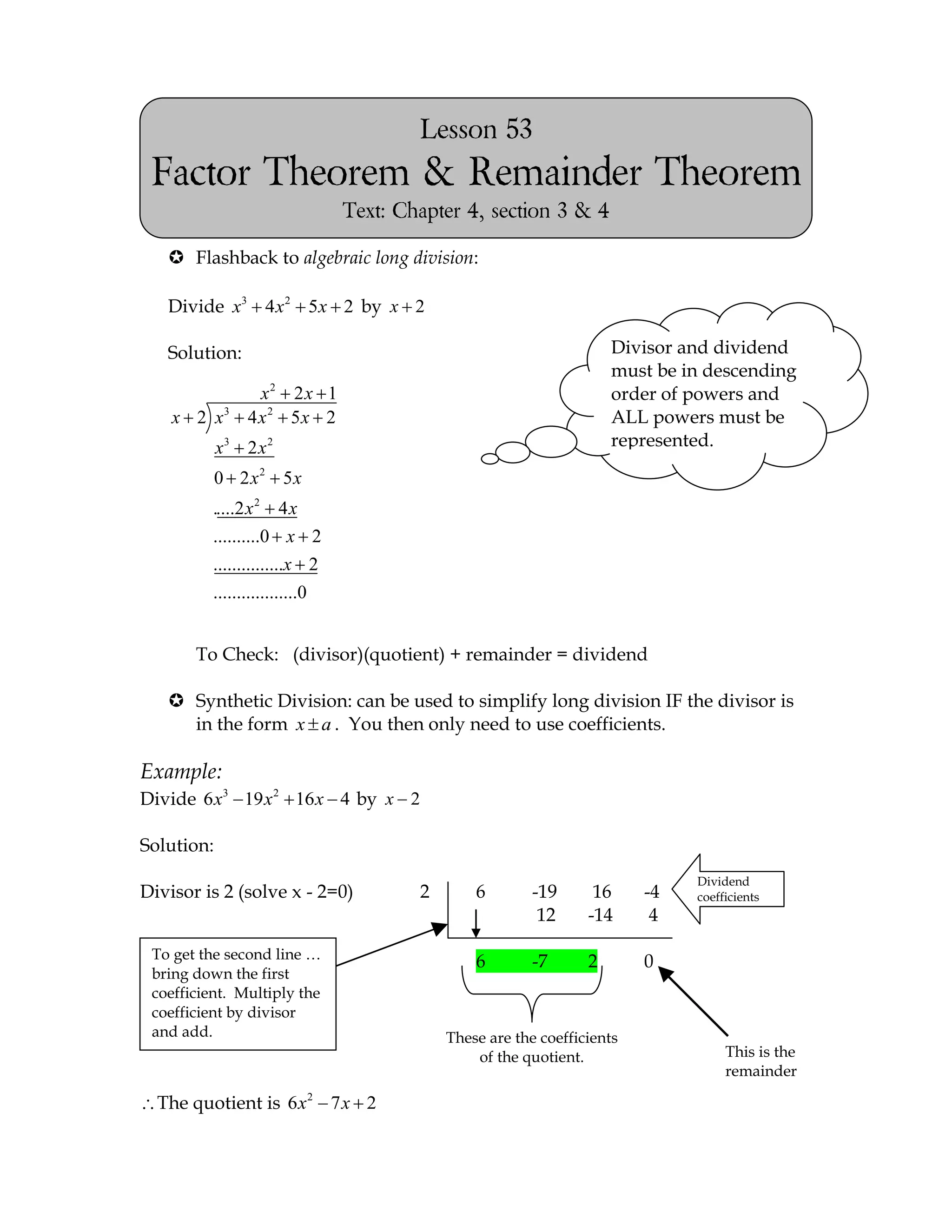
   Divide x3 4 x 2 5x 2 by x 2

   Solution:                                                         Divisor and dividend
                                                                     must be in descending
                   x2 2 x 1                                          order of powers and
    x 2 x3       4 x2 5x 2                                           ALL powers must be
            x3 2 x 2                                                 represented.

            0 2 x2 5x
          .....2 x 2 4 x
          ..........0 x 2
          ...............x 2
          ..................0


       To Check: (divisor)(quotient) + remainder = dividend

    Synthetic Division: can be used to simplify long division IF the divisor is
     in the form x a . You then only need to use coefficients.

Example:
Divide 6 x3 19 x 2 16 x 4 by x 2

Solution:
                                                                              Dividend
Divisor is 2 (solve x - 2=0)            2       6        -19      16     -4   coefficients
                                                          12     -14      4

 To get the second line …
                                                6        -7      2       0
 bring down the first
 coefficient. Multiply the
 coefficient by divisor
 and add.                                   These are the coefficients
                                                of the quotient.                   This is the
                                                                                   remainder

  The quotient is 6 x 2 7 x 2
Example:

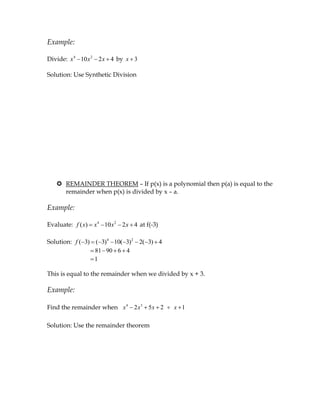
Divide: x 4 10 x 2 2 x 4 by x 3

Solution: Use Synthetic Division


    REMAINDER THEOREM – If p(x) is a polynomial then p(a) is equal to the
     remainder when p(x) is divided by x – a.

Example:

Evaluate: f ( x)   x4 10 x2 2 x 4 at f(-3)

Solution: f ( 3) ( 3)4 10( 3)2 2( 3) 4
                 81 90 6 4
                 1

This is equal to the remainder when we divided by x + 3.

Example:

Find the remainder when x 4 2 x 3 5 x 2      x 1

Solution: Use the remainder theorem
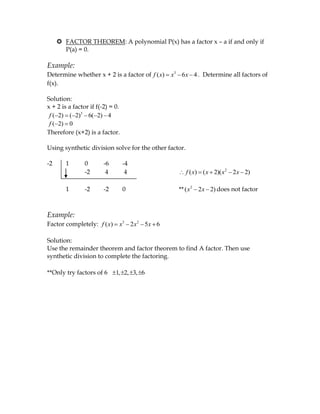
 FACTOR THEOREM: A polynomial P(x) has a factor x – a if and only if
       P(a) = 0.

Example:
Determine whether x + 2 is a factor of f ( x)   x3 6 x 4 . Determine all factors of
f(x).

Solution:
x + 2 is a factor if f(-2) = 0.
 f ( 2) ( 2)3 6( 2) 4
 f ( 2) 0
Therefore (x+2) is a factor.

Using synthetic division solve for the other factor.

-2      1       0       -6        -4
                -2       4         4                   f ( x) ( x 2)( x2 2 x 2)

        1       -2      -2        0               ** ( x 2 2 x 2) does not factor


Example:
Factor completely: f ( x)     x3 2 x 2 5 x 6

Solution:
Use the remainder theorem and factor theorem to find A factor. Then use
synthetic division to complete the factoring.

**Only try factors of 6      1, 2, 3, 6
Example:
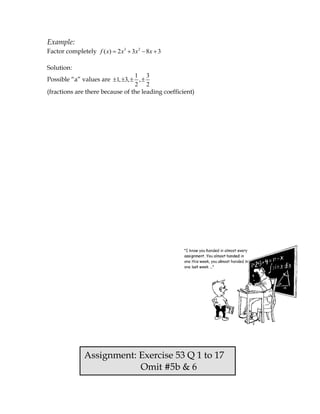
Factor completely f ( x) 2 x3 3x 2 8x 3

Solution:
                                 1 3
Possible “a” values are 1, 3,      ,
                                 2 2
(fractions are there because of the leading coefficient)


              Assignment: Exercise 53 Q 1 to 17
                          Omit #5b & 6

Lesson 53

  • 1.
    Lesson 53 FactorTheorem & Remainder Theorem Text: Chapter 4, section 3 & 4  Flashback to algebraic long division: Divide x3 4 x 2 5x 2 by x 2 Solution: Divisor and dividend must be in descending x2 2 x 1 order of powers and x 2 x3 4 x2 5x 2 ALL powers must be x3 2 x 2 represented. 0 2 x2 5x .....2 x 2 4 x ..........0 x 2 ...............x 2 ..................0 To Check: (divisor)(quotient) + remainder = dividend  Synthetic Division: can be used to simplify long division IF the divisor is in the form x a . You then only need to use coefficients. Example: Divide 6 x3 19 x 2 16 x 4 by x 2 Solution: Dividend Divisor is 2 (solve x - 2=0) 2 6 -19 16 -4 coefficients 12 -14 4 To get the second line … 6 -7 2 0 bring down the first coefficient. Multiply the coefficient by divisor and add. These are the coefficients of the quotient. This is the remainder The quotient is 6 x 2 7 x 2
  • 2.
    Example: Divide: x 410 x 2 2 x 4 by x 3 Solution: Use Synthetic Division  REMAINDER THEOREM – If p(x) is a polynomial then p(a) is equal to the remainder when p(x) is divided by x – a. Example: Evaluate: f ( x) x4 10 x2 2 x 4 at f(-3) Solution: f ( 3) ( 3)4 10( 3)2 2( 3) 4 81 90 6 4 1 This is equal to the remainder when we divided by x + 3. Example: Find the remainder when x 4 2 x 3 5 x 2 x 1 Solution: Use the remainder theorem
  • 3.
     FACTOR THEOREM:A polynomial P(x) has a factor x – a if and only if P(a) = 0. Example: Determine whether x + 2 is a factor of f ( x) x3 6 x 4 . Determine all factors of f(x). Solution: x + 2 is a factor if f(-2) = 0. f ( 2) ( 2)3 6( 2) 4 f ( 2) 0 Therefore (x+2) is a factor. Using synthetic division solve for the other factor. -2 1 0 -6 -4 -2 4 4 f ( x) ( x 2)( x2 2 x 2) 1 -2 -2 0 ** ( x 2 2 x 2) does not factor Example: Factor completely: f ( x) x3 2 x 2 5 x 6 Solution: Use the remainder theorem and factor theorem to find A factor. Then use synthetic division to complete the factoring. **Only try factors of 6 1, 2, 3, 6
  • 4.
    Example: Factor completely f( x) 2 x3 3x 2 8x 3 Solution: 1 3 Possible “a” values are 1, 3, , 2 2 (fractions are there because of the leading coefficient) Assignment: Exercise 53 Q 1 to 17 Omit #5b & 6