SEND WITHOUT SUBJECT: REVISITING
COLLEGE COMPOSITION

  Aubrey Mishou, Anne Arundel Community College
  almishou@aacc.edu

  AFACCT ’12 Conference, Montgomery College Rockville
  Session 5.15       January 6, 2012

  Narrated Presentation
Narration should start automatically when viewing slideshow 
ENGLISH AFTER THE FALL: FROM
LITERATURE TO TEXTUALITY
   “The fall of English is actually part of the fall of all
    humanities in a world that is driven by technological
    progress and the bottom line. In such a world the
    humanities must demonstrate their usefulness. […]
    We need to see the main function of English
    departments as helping students become better
    users of the language – basically, better readers and
    writers” (Scholes xiv-v). …

   “[T]he business of English departments is to help
    student improve as readers and writers, to become
    better producers and consumers of verbal texts” (34).

                       Narration buttons will usually be over here 
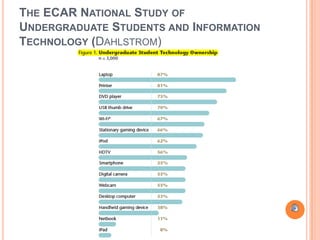
THE ECAR NATIONAL STUDY OF
UNDERGRADUATE STUDENTS AND INFORMATION
TECHNOLOGY (DAHLSTROM)
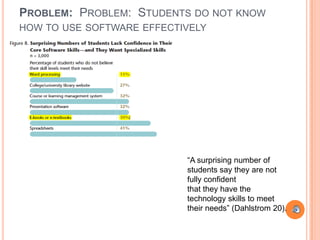
PROBLEM: PROBLEM: STUDENTS DO NOT KNOW
HOW TO USE SOFTWARE EFFECTIVELY


                           “A surprising number of
                           students say they are not
                           fully confident
                           that they have the
                           technology skills to meet
                           their needs” (Dahlstrom 20).
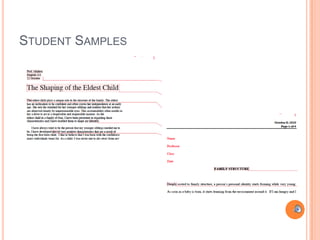
STUDENT SAMPLES
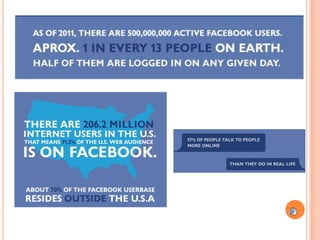
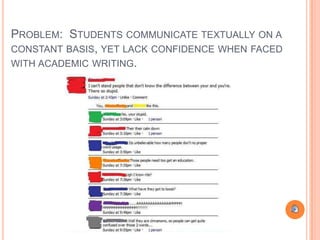
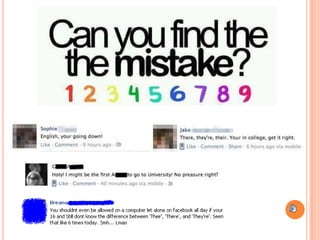
PROBLEM: STUDENTS COMMUNICATE TEXTUALLY ON A
CONSTANT BASIS, YET LACK CONFIDENCE WHEN FACED
WITH ACADEMIC WRITING.
PROBLEM: INSTRUCTORS DON‟T ALWAYS USE
TECHNOLOGY IN THE CLASSROOM, AND DO NOT
DEMONSTRATE, OR LECTURE ON, THE EFFECTIVE USE OF
ACADEMIC SOFTWARE.

    “Even though those                    “Many instructors need help
     technologies are                       getting technology to work
     commonplace on most                    successfully. Almost one-
     campuses, some students                third of students (31 percent)
     say that their instructors don‟t       agree that their instructors
     use them effectively or that           require help in getting
     they themselves don‟t have             technology up and running.
     the skills they need to use            More than one in four
     them effectively” (Rice).              students (26 percent) agree
                                            that their professors don‟t
                                            know how to use technology
    “„Students are saying they             that is available. About half of
     want to see classes taught             students (51 percent) agree
     more like how they live their          that they know more about
     lives,‟ Mr. Roberts said. „I           technology than their
     don‟t think they just want             professors do” (Dahlstrom
     technology for technology‟s            25).
     sake‟” (Rice).
JACQUES DERRIDA
   "I wouldn‟t think that one single department should
    be in charge [of teaching writing], because if you
    concentrate the teaching of composition in a single
    department – for instance, the literature department
    – then you‟ll have the hegemony of some kind of
    norm in writing. The people in mathematics and
    history and law don‟t have to write the same way.
    … you have to adjust the transformations of the
    way you write according to each discipline, the
    discourse of the discipline.”

   Solution: teach software such as word processing
    in composition courses as an integral element of
    successful communication.
LESSON 2
Computer Skills
For English Classes, and Beyond
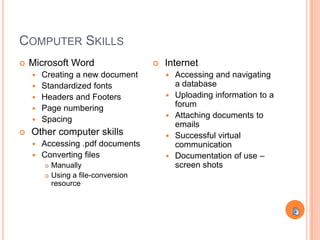
COMPUTER SKILLS
   Microsoft Word                       Internet
       Creating a new document              Accessing and navigating
       Standardized fonts                    a database
       Headers and Footers                  Uploading information to a
       Page numbering                        forum
       Spacing                              Attaching documents to
                                              emails
   Other computer skills                    Successful virtual
     Accessing .pdf documents                communication
     Converting files                       Documentation of use –
           Manually                          screen shots
           Using a file-conversion
            resource
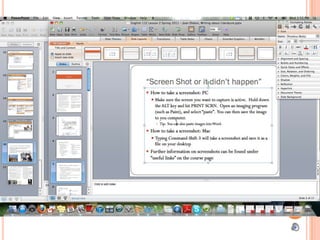
“SCREEN SHOT OR IT DIDN‟T HAPPEN”
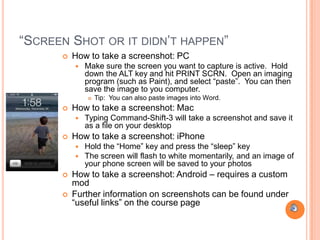
         How to take a screenshot: PC
             Make sure the screen you want to capture is active. Hold
              down the ALT key and hit PRINT SCRN. Open an imaging
              program (such as Paint), and select “paste”. You can then
              save the image to you computer.
                 Tip: You can also paste images into Word.
         How to take a screenshot: Mac
             Typing Command-Shift-3 will take a screenshot and save it
              as a file on your desktop
         How to take a screenshot: iPhone
             Hold the “Home” key and press the “sleep” key
             The screen will flash to white momentarily, and an image of
              your phone screen will be saved to your photos
         How to take a screenshot: Android – requires a custom
          mod
         Further information on screenshots can be found under
          “useful links” on the course page
CONVERTING FILES: MANUALLY
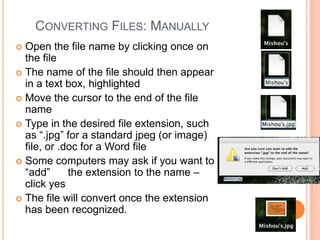
 Open the file name by clicking once on
  the file
 The name of the file should then appear
  in a text box, highlighted
 Move the cursor to the end of the file
  name
 Type in the desired file extension, such
  as “.jpg” for a standard jpeg (or image)
  file, or .doc for a Word file
 Some computers may ask if you want to
  “add”      the extension to the name –
  click yes
 The file will convert once the extension
  has been recognized.
CONVERTING FILES: GOOGLEDOCS
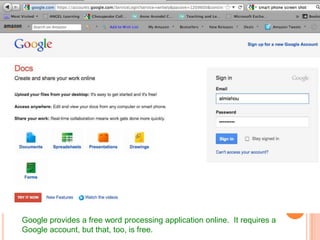
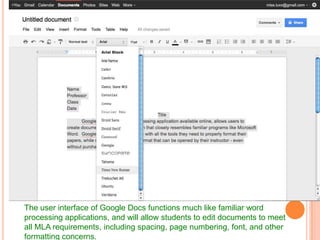
 The following screenshots demonstrate how to use
  the application GoogleDocs
  (www.docs.google.com) to properly format, and
  save, essays for English 112
 Also available for file conversion: www.zamzar.com
     Zamzar will require you to give your email address so
      that a link to your converted filed can be sent directly to
      you
     After you retrieve your link you should be sure to
      download your paper; Zamzar will not save your work
      indefinitely, so it is important that you save your
      converted file to your computer or flash drive.
Google provides a free word processing application online. It requires a
Google account, but that, too, is free.
The user interface of Google Docs functions much like familiar word
processing applications, and will allow students to edit documents to meet
all MLA requirements, including spacing, page numbering, font, and other
formatting concerns.
SOLUTION: LEARN TO USE TECHNOLOGY IN
    THE CLASSROOM
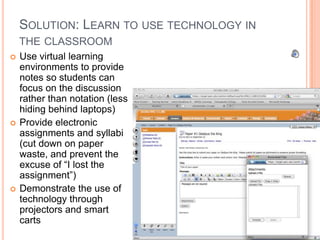
   Use virtual learning
    environments to provide
    notes so students can
    focus on the discussion
    rather than notation (less
    hiding behind laptops)
   Provide electronic
    assignments and syllabi
    (cut down on paper
    waste, and prevent the
    excuse of “I lost the
    assignment”)
   Demonstrate the use of
    technology through
    projectors and smart
    carts
SOLUTION: LOOK TO SOCIAL MEDIA AS
SUPPLEMENTARY TEXTS
   “We live in a world
    dominated by mixed
    media rather than by
    different spheres
    partitioned off from one
    another” (Scholes 13).

   “…[W]e have much to
    gain by moving from the
    limiting notion of literature
    to the more inclusive
    concept of
    textuality...”(Scholes 31).


                                    (Munroe)
ASSIGNMENTS
   Proofreading Everyday: Due April 13 (20 points)
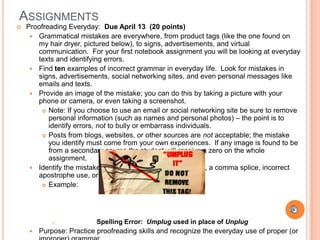
      Grammatical mistakes are everywhere, from product tags (like the one found on
       my hair dryer, pictured below), to signs, advertisements, and virtual
       communication. For your first notebook assignment you will be looking at everyday
       texts and identifying errors.
      Find ten examples of incorrect grammar in everyday life. Look for mistakes in
       signs, advertisements, social networking sites, and even personal messages like
       emails and texts.
      Provide an image of the mistake; you can do this by taking a picture with your
       phone or camera, or even taking a screenshot.
          Note: If you choose to use an email or social networking site be sure to remove
           personal information (such as names and personal photos) – the point is to
           identify errors, not to bully or embarrass individuals.
          Posts from blogs, websites, or other sources are not acceptable; the mistake
           you identify must come from your own experiences. If any image is found to be
           from a secondary source the student will receive a zero on the whole
           assignment.
      Identify the mistake being made. Is it a spelling error, a comma splice, incorrect
       apostrophe use, or even a homonym?
          Example:


                          Spelling Error: Umplug used in place of Unplug
        Purpose: Practice proofreading skills and recognize the everyday use of proper (or
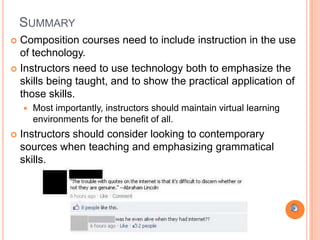
SUMMARY
 Composition courses need to include instruction in the use
  of technology.
 Instructors need to use technology both to emphasize the
  skills being taught, and to show the practical application of
  those skills.
       Most importantly, instructors should maintain virtual learning
        environments for the benefit of all.
   Instructors should consider looking to contemporary
    sources when teaching and emphasizing grammatical
    skills.
WORKS CITED
   Dahlstrom, Eden, et al. “The ECAR National Study of            Undergraduate
            Students and Information Technology.” Boulder: EDUCAUSE Center for
            Applied Research, 2001. PDF file.
   Dunn, Jeff. “Can you find the the mistake?” Meme. Edudemic.com.          Edudemic.
            14 Oct. 2011. Web. 15 Dec. 2011.
   Fowler, H. Ramsey, Jane E. Aaron, and Cynthia K. Marshall. “The          Apostrophe.”
    The Little, Brown Handbook. Instructor‟s            Edition. New York: Longman,
    2010. Print. 451-8.
   ---. “Exercise 37.1 Revising: Appropriate Words.” 454-5.
   Lundy, Brook, et al. “The Best Obnoxious Responses to Misspellings       on
            Facebook.” HappyPlace.com. Someecards, Inc, 27 Dec.              2011. Web.
            2 Jan. 2012.
   Lunsford, Andrea A. and John J. Ruszkiewicz. Everything’s an Argument. New
            York: Bedford/St. Martin‟s, 2009. Print.
   Munroe, Randall. “Listen to Yourself.” Cartoon. xkcd.com. xkcd,          n.d. Web.
            30 Dec. 2012.
   “Obsessed with Facebook.” Infographic. Online Schools. OnlineSchools.org.
            2010. Web. 1 Oct. 2011.
   Olson, Gary A., ed. “Jacques Derrida on Rhetoric and Composition: A
            Conversation.” Rhetoric: Concepts, Definitions, Boundaries. Eds. William A.
    Convino and David A. Jolliffe. Boston: Allyn and Bacon, 1995. Print.     545-64.
   Rice, Alexandra. “Students Push Their Facebook Use Further Into          Course
            Work.” Wired Campus. The Chronicle of Higher           Education. 27 Oct.
            2011. Web. 7 Nov. 2011.
   Scholes, Robert. English After the Fall: From Literature to Textuality.  Iowa City:
    University of Iowa Press, 2011. Uncorrected Proof.

5.15.mishou

  • 1.
    SEND WITHOUT SUBJECT:REVISITING COLLEGE COMPOSITION Aubrey Mishou, Anne Arundel Community College almishou@aacc.edu AFACCT ’12 Conference, Montgomery College Rockville Session 5.15 January 6, 2012 Narrated Presentation
  • 2.
    Narration should startautomatically when viewing slideshow 
  • 3.
    ENGLISH AFTER THEFALL: FROM LITERATURE TO TEXTUALITY  “The fall of English is actually part of the fall of all humanities in a world that is driven by technological progress and the bottom line. In such a world the humanities must demonstrate their usefulness. […] We need to see the main function of English departments as helping students become better users of the language – basically, better readers and writers” (Scholes xiv-v). …  “[T]he business of English departments is to help student improve as readers and writers, to become better producers and consumers of verbal texts” (34). Narration buttons will usually be over here 
  • 5.
    THE ECAR NATIONALSTUDY OF UNDERGRADUATE STUDENTS AND INFORMATION TECHNOLOGY (DAHLSTROM)
  • 6.
    PROBLEM: PROBLEM: STUDENTSDO NOT KNOW HOW TO USE SOFTWARE EFFECTIVELY “A surprising number of students say they are not fully confident that they have the technology skills to meet their needs” (Dahlstrom 20).
  • 7.
  • 8.
    PROBLEM: STUDENTS COMMUNICATETEXTUALLY ON A CONSTANT BASIS, YET LACK CONFIDENCE WHEN FACED WITH ACADEMIC WRITING.
  • 9.
    PROBLEM: INSTRUCTORS DON‟TALWAYS USE TECHNOLOGY IN THE CLASSROOM, AND DO NOT DEMONSTRATE, OR LECTURE ON, THE EFFECTIVE USE OF ACADEMIC SOFTWARE.  “Even though those  “Many instructors need help technologies are getting technology to work commonplace on most successfully. Almost one- campuses, some students third of students (31 percent) say that their instructors don‟t agree that their instructors use them effectively or that require help in getting they themselves don‟t have technology up and running. the skills they need to use More than one in four them effectively” (Rice). students (26 percent) agree that their professors don‟t know how to use technology  “„Students are saying they that is available. About half of want to see classes taught students (51 percent) agree more like how they live their that they know more about lives,‟ Mr. Roberts said. „I technology than their don‟t think they just want professors do” (Dahlstrom technology for technology‟s 25). sake‟” (Rice).
  • 10.
    JACQUES DERRIDA  "I wouldn‟t think that one single department should be in charge [of teaching writing], because if you concentrate the teaching of composition in a single department – for instance, the literature department – then you‟ll have the hegemony of some kind of norm in writing. The people in mathematics and history and law don‟t have to write the same way. … you have to adjust the transformations of the way you write according to each discipline, the discourse of the discipline.”  Solution: teach software such as word processing in composition courses as an integral element of successful communication.
  • 11.
    LESSON 2 Computer Skills ForEnglish Classes, and Beyond
  • 12.
    COMPUTER SKILLS  Microsoft Word  Internet  Creating a new document  Accessing and navigating  Standardized fonts a database  Headers and Footers  Uploading information to a  Page numbering forum  Spacing  Attaching documents to emails  Other computer skills  Successful virtual  Accessing .pdf documents communication  Converting files  Documentation of use –  Manually screen shots  Using a file-conversion resource
  • 14.
    “SCREEN SHOT ORIT DIDN‟T HAPPEN”  How to take a screenshot: PC  Make sure the screen you want to capture is active. Hold down the ALT key and hit PRINT SCRN. Open an imaging program (such as Paint), and select “paste”. You can then save the image to you computer.  Tip: You can also paste images into Word.  How to take a screenshot: Mac  Typing Command-Shift-3 will take a screenshot and save it as a file on your desktop  How to take a screenshot: iPhone  Hold the “Home” key and press the “sleep” key  The screen will flash to white momentarily, and an image of your phone screen will be saved to your photos  How to take a screenshot: Android – requires a custom mod  Further information on screenshots can be found under “useful links” on the course page
  • 15.
    CONVERTING FILES: MANUALLY Open the file name by clicking once on the file  The name of the file should then appear in a text box, highlighted  Move the cursor to the end of the file name  Type in the desired file extension, such as “.jpg” for a standard jpeg (or image) file, or .doc for a Word file  Some computers may ask if you want to “add” the extension to the name – click yes  The file will convert once the extension has been recognized.
  • 16.
    CONVERTING FILES: GOOGLEDOCS The following screenshots demonstrate how to use the application GoogleDocs (www.docs.google.com) to properly format, and save, essays for English 112  Also available for file conversion: www.zamzar.com  Zamzar will require you to give your email address so that a link to your converted filed can be sent directly to you  After you retrieve your link you should be sure to download your paper; Zamzar will not save your work indefinitely, so it is important that you save your converted file to your computer or flash drive.
  • 17.
    Google provides afree word processing application online. It requires a Google account, but that, too, is free.
  • 18.
    The user interfaceof Google Docs functions much like familiar word processing applications, and will allow students to edit documents to meet all MLA requirements, including spacing, page numbering, font, and other formatting concerns.
  • 19.
    SOLUTION: LEARN TOUSE TECHNOLOGY IN THE CLASSROOM  Use virtual learning environments to provide notes so students can focus on the discussion rather than notation (less hiding behind laptops)  Provide electronic assignments and syllabi (cut down on paper waste, and prevent the excuse of “I lost the assignment”)  Demonstrate the use of technology through projectors and smart carts
  • 20.
    SOLUTION: LOOK TOSOCIAL MEDIA AS SUPPLEMENTARY TEXTS  “We live in a world dominated by mixed media rather than by different spheres partitioned off from one another” (Scholes 13).  “…[W]e have much to gain by moving from the limiting notion of literature to the more inclusive concept of textuality...”(Scholes 31). (Munroe)
  • 22.
    ASSIGNMENTS  Proofreading Everyday: Due April 13 (20 points)  Grammatical mistakes are everywhere, from product tags (like the one found on my hair dryer, pictured below), to signs, advertisements, and virtual communication. For your first notebook assignment you will be looking at everyday texts and identifying errors.  Find ten examples of incorrect grammar in everyday life. Look for mistakes in signs, advertisements, social networking sites, and even personal messages like emails and texts.  Provide an image of the mistake; you can do this by taking a picture with your phone or camera, or even taking a screenshot.  Note: If you choose to use an email or social networking site be sure to remove personal information (such as names and personal photos) – the point is to identify errors, not to bully or embarrass individuals.  Posts from blogs, websites, or other sources are not acceptable; the mistake you identify must come from your own experiences. If any image is found to be from a secondary source the student will receive a zero on the whole assignment.  Identify the mistake being made. Is it a spelling error, a comma splice, incorrect apostrophe use, or even a homonym?  Example:  Spelling Error: Umplug used in place of Unplug  Purpose: Practice proofreading skills and recognize the everyday use of proper (or
  • 23.
    SUMMARY  Composition coursesneed to include instruction in the use of technology.  Instructors need to use technology both to emphasize the skills being taught, and to show the practical application of those skills.  Most importantly, instructors should maintain virtual learning environments for the benefit of all.  Instructors should consider looking to contemporary sources when teaching and emphasizing grammatical skills.
  • 24.
    WORKS CITED  Dahlstrom, Eden, et al. “The ECAR National Study of Undergraduate Students and Information Technology.” Boulder: EDUCAUSE Center for Applied Research, 2001. PDF file.  Dunn, Jeff. “Can you find the the mistake?” Meme. Edudemic.com. Edudemic. 14 Oct. 2011. Web. 15 Dec. 2011.  Fowler, H. Ramsey, Jane E. Aaron, and Cynthia K. Marshall. “The Apostrophe.” The Little, Brown Handbook. Instructor‟s Edition. New York: Longman, 2010. Print. 451-8.  ---. “Exercise 37.1 Revising: Appropriate Words.” 454-5.  Lundy, Brook, et al. “The Best Obnoxious Responses to Misspellings on Facebook.” HappyPlace.com. Someecards, Inc, 27 Dec. 2011. Web. 2 Jan. 2012.  Lunsford, Andrea A. and John J. Ruszkiewicz. Everything’s an Argument. New York: Bedford/St. Martin‟s, 2009. Print.  Munroe, Randall. “Listen to Yourself.” Cartoon. xkcd.com. xkcd, n.d. Web. 30 Dec. 2012.  “Obsessed with Facebook.” Infographic. Online Schools. OnlineSchools.org. 2010. Web. 1 Oct. 2011.  Olson, Gary A., ed. “Jacques Derrida on Rhetoric and Composition: A Conversation.” Rhetoric: Concepts, Definitions, Boundaries. Eds. William A. Convino and David A. Jolliffe. Boston: Allyn and Bacon, 1995. Print. 545-64.  Rice, Alexandra. “Students Push Their Facebook Use Further Into Course Work.” Wired Campus. The Chronicle of Higher Education. 27 Oct. 2011. Web. 7 Nov. 2011.  Scholes, Robert. English After the Fall: From Literature to Textuality. Iowa City: University of Iowa Press, 2011. Uncorrected Proof.