Establishing Meaning and Pursuing Personal Fulfillment in the Classroom
Stephanie Beltz, PhD ABD
Anne Arundel Community College
AFACCT 2016 Conference, College of Southern Maryland
Session 4.4, 1/8/16, 3:00-4:00 p.m.
sbeltz@aacc.edu
Teaching with Purpose:
• Is it because…
Why Are You Working in Higher
Education?
•1. You enjoy the drama of departmental politics?
•2. Bureaucratic red-tape gets you out of bed in the morning?
•3. As full-time faculty, you’re a closeted fan of the tenure process?
(Sign me up for extra committees!).
•4. As part-time faculty, nothing thrills you more than explaining to
students that “office” hours actually take place in the hallway outside of
class?
•5. As an administrator, you enjoy being the one to blame for
cutting courses with low registration?
• But really, why are you?
Why Are You Working in Higher
Education? (continued)
•My reasons:
• I love learning
• I love sharing knowledge with others
• I love developing and growing interpersonal relationships
• I love changing lives
• I love inspiring others to reach their fullest potential
• I love watching the reactions of students who are surprised,
challenged, moved, or falling out of their chairs laughing in
response to something I’ve said
• I love helping others by using my unique knowledge base
and skill set
• I love leaving my job every day knowing that I’ve made a
difference
• That makes sense. Most people are!
• Why?
So You’re Here to Find Happiness,
Connection, Purpose, Success…AND Do
It Like a Pro
•The concepts we’ve just identified are the factors that
contribute to our well-being (Seligman, 2011).
•This is where research in the field of Positive Psychology
becomes relevant to our discussion.
•Let’s look at the basic theoretical underpinnings of
Positive Psychology before we talk about well-being.
• Positive Psychology is a relatively young discipline founded from
the realization that we can foster human strengths in addition
to correcting deficits, which is based on the traditional disease
model (Seligman & Csikszentmihalyi, 2000).
What is Positive Psychology?
•Grew out of a number of previously
established psychological paradigms, most
notably humanism (e.g., Maslow, Rogers,
etc.)
Martin Seligman Mihaly Csikszentmihalyi
“A science of positive subjective experience,
positive individual traits, and positive
institutions promises to improve quality of
life and prevent the pathologies that arise
when life is barren and meaningless”
(Seligman & Csikszentmihalyi, 2000, p.5).
Well-Being: PERMA
(Seligman, 2011)
"Enjoyment appears at the
boundary of boredom and
anxiety, when the challenges
are balanced with the
person's capacity to act”
(Csikszentmihalyi, 1990).
Flow
But Why Does Well-Being Matter in the Classroom?
•The obvious reason:
•Why is that a problem?
We all want to be happy and fulfilled.
•Some not-so-obvious reasons:
•Just like psychology’s traditional focus on the disease model, higher
education has historically emphasized deficit remediation!
•This approach does NOT tap into
student motivation or engagement
•This approach does NOT lead to
student excellence
•This approach does NOT lead to
faculty satisfaction or engagement
Some Empirical Evidence for the Cautious Optimist
Implications for:
Faculty Students
•Employees who used four or more of their signature
strengths had more positive work experiences and work-
as-a-calling than those who expressed less than four
(Harzer & Ruch, 2012)
•Character strengths play a key role in health and
ambitious work behavior (Gander, Proyer, Ruch, & Wyss,
2012)
•Positive mood produces broader attention (Rowe et al.,
2007), more creative thinking (Estrada et al., 1994), and
more holistic thinking (Kuhl, 2000)
•“Flow only occurs when you deploy your highest strengths
and talents to meet the challenges that come your way, and
it is clear that flow facilitates learning” (Seligman et. al,
2009, p. 296)
•A randomized, controlled evaluation of a positive
psychology program implemented in a Philadelphia high
school yielded these results: an increase in students’
curiosity, love of learning, creativity, enjoyment, and
engagement in school (Seligman et. al, 2009)
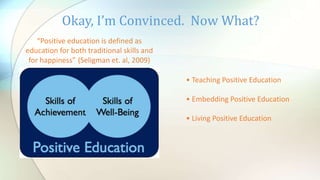
Okay, I’m Convinced. Now What?
“Positive education is defined as
education for both traditional skills and
for happiness” (Seligman et. al, 2009)
• Teaching Positive Education
• Embedding Positive Education
• Living Positive Education
Teaching
Positive Education
• Dedicate a class session, or part of a session, to familiarizing students with
elements of positive psychology (resilience, gratitude, strengths, meaning, flow,
positive relationships, and positive emotion).
• Help students identify their strengths by asking them questions like:
•What did you learn with the greatest ease in high school?
•What do people say they like best about you?
•What fascinates you?
•What is something you accomplished that you’re really proud of?
(Schreiner & Hulme, 2009)
• Use an instrument to determine character strengths, personality, and
personal happiness. Examples: VIA Character Strengths Survey, Myers-Briggs,
and Positive Affectivity & Negative Affectivity Scale (PANAS), respectively.
https://www.authentichappiness.sas.upenn.edu VIA Character Strengths
Embedding Positive Education
• Structure course activities to take advantage of the unique dynamics of that
particular class
• Teach using multiple modalities to engage all students
• Provide choice and variety in assignments to allow students to leverage their
strengths
• Approach exams as another opportunity for students to learn, rather than an
opportunity to test what they already know
• Climate control: Periodically ask students what is/isn’t working in the class
• Use humor or a fun surprise (pop quizzes don’t count) as a quick way to
create positive mood
• Apply positive psychology to course material
•Examples: “English teachers can use signature strengths and resiliency to discuss
novels; Religion teachers ask students about the relationship between ethics and pleasure;
Music teachers use resilience skills to build optimism from performances that did not go
well; Athletic coaches teach the skill of “letting go of grudges” against teammates who
perform poorly” (Seligman et. al, 2009)
Living Positive Education
• TEACH WHAT YOU LOVE
• Produce flow in the classroom
• Teach from your own strengths
• Provide a learning environment
that balances skill and challenge
• Get to know your students as individuals
and invest in these relationships!
Humanize yourself!
• Take a moment during every class to appreciate something that has gone well
• Encourage, praise, and approach students with unconditional positive regard
• Help students develop the courage to fail
• Build course projects that will inspire change, contribute to society, and provide
meaning for both you and your students
Let Me Leave You With This…
• We focused a lot on how students can benefit from Positive
Education, but make no mistake, the rewards that come from using
this model are shared by faculty/administrators/staff as well.
• Think back to your all-time favorite teacher. What made him/her
so special? Now…imagine if you could be that for each student you
encounter. How would YOU feel knowing you had such an impact?
*Proud*Joyful*Accomplished*Inspirational*Important*Satisfied*
*Happy*Connected*Optimistic*Confident*Intelligent*
*Engaged*Flourishing*Wise*Creative*Talented*Knowledgeable*
*Resilient*Responsible*Altruistic*
Looks like you’re on your way to a meaningful, fulfilled life!
References
Csikszentmihalyi, M. (1990) Flow: The Psychology of Optimal Experience. New York: HarperCollins.
Estrada, C.A., Isen, A.M. & Young, M.J. (1994) Positive affect improves creative problem solving and influences reported source of practice
satisfaction in physicians, Motivation and Emotion, 18, 285-299.
Gander, F., Proyer, R. T., Ruch, W., & Wyss, T. (2012). Strength-based positive interventions: Further evidence for their potential in
enhancing well-being. Journal of Happiness Studies
Harzer, C., & Ruch, W. (2012): When the job is a calling: The role of applying one's signature strengths at work. Journal of Positive
Psychology.
Kuhl, J. (2000) A functional-design approach to motivation and self-regulation: the dynamics of personality systems interactions, in: M.
Boekaerts, P.R. Pintrich & M. Zeidner (Eds), Handbook of self-regulation (San Diego, Academic Press), 111-169.
Rowe, G., Hirsh, J.B., Anderson, A.K. & Smith, E.E. (2007) Positive affect increases the breadth of attentional selection, PNAS Proceedings of
the National Academy of Sciences of the United States of America, 104, 383-388.
Schreiner, L., & Hulme, E. (2009, June). Developing college students’ strengths: Positive psychology on campus. Presented at the World
Congress on Positive Psychology.
Seligman, M., Ernst, R., Gillham, J., Reivich, K., & Linkins, M. (2009). Positive education: positive psychology and classroom interventions
Seligman, M. (2011). What is well-being? Retrieved from http://www.authentichappiness.sas.upenn.edu/newsletter.aspx?id=1533
Seligman, M. & Csikszentmihalyi, M. (2000). Positive psychology: An introduction. American Psychologist, 55(1), 5-14.

4 4beltz16

  • 1.
    Establishing Meaning andPursuing Personal Fulfillment in the Classroom Stephanie Beltz, PhD ABD Anne Arundel Community College AFACCT 2016 Conference, College of Southern Maryland Session 4.4, 1/8/16, 3:00-4:00 p.m. sbeltz@aacc.edu Teaching with Purpose:
  • 2.
    • Is itbecause… Why Are You Working in Higher Education? •1. You enjoy the drama of departmental politics? •2. Bureaucratic red-tape gets you out of bed in the morning? •3. As full-time faculty, you’re a closeted fan of the tenure process? (Sign me up for extra committees!). •4. As part-time faculty, nothing thrills you more than explaining to students that “office” hours actually take place in the hallway outside of class? •5. As an administrator, you enjoy being the one to blame for cutting courses with low registration?
  • 3.
    • But really,why are you? Why Are You Working in Higher Education? (continued) •My reasons: • I love learning • I love sharing knowledge with others • I love developing and growing interpersonal relationships • I love changing lives • I love inspiring others to reach their fullest potential • I love watching the reactions of students who are surprised, challenged, moved, or falling out of their chairs laughing in response to something I’ve said • I love helping others by using my unique knowledge base and skill set • I love leaving my job every day knowing that I’ve made a difference
  • 4.
    • That makessense. Most people are! • Why? So You’re Here to Find Happiness, Connection, Purpose, Success…AND Do It Like a Pro •The concepts we’ve just identified are the factors that contribute to our well-being (Seligman, 2011). •This is where research in the field of Positive Psychology becomes relevant to our discussion. •Let’s look at the basic theoretical underpinnings of Positive Psychology before we talk about well-being.
  • 5.
    • Positive Psychologyis a relatively young discipline founded from the realization that we can foster human strengths in addition to correcting deficits, which is based on the traditional disease model (Seligman & Csikszentmihalyi, 2000). What is Positive Psychology? •Grew out of a number of previously established psychological paradigms, most notably humanism (e.g., Maslow, Rogers, etc.) Martin Seligman Mihaly Csikszentmihalyi “A science of positive subjective experience, positive individual traits, and positive institutions promises to improve quality of life and prevent the pathologies that arise when life is barren and meaningless” (Seligman & Csikszentmihalyi, 2000, p.5).
  • 6.
  • 7.
    "Enjoyment appears atthe boundary of boredom and anxiety, when the challenges are balanced with the person's capacity to act” (Csikszentmihalyi, 1990). Flow
  • 8.
    But Why DoesWell-Being Matter in the Classroom? •The obvious reason: •Why is that a problem? We all want to be happy and fulfilled. •Some not-so-obvious reasons: •Just like psychology’s traditional focus on the disease model, higher education has historically emphasized deficit remediation! •This approach does NOT tap into student motivation or engagement •This approach does NOT lead to student excellence •This approach does NOT lead to faculty satisfaction or engagement
  • 9.
    Some Empirical Evidencefor the Cautious Optimist Implications for: Faculty Students •Employees who used four or more of their signature strengths had more positive work experiences and work- as-a-calling than those who expressed less than four (Harzer & Ruch, 2012) •Character strengths play a key role in health and ambitious work behavior (Gander, Proyer, Ruch, & Wyss, 2012) •Positive mood produces broader attention (Rowe et al., 2007), more creative thinking (Estrada et al., 1994), and more holistic thinking (Kuhl, 2000) •“Flow only occurs when you deploy your highest strengths and talents to meet the challenges that come your way, and it is clear that flow facilitates learning” (Seligman et. al, 2009, p. 296) •A randomized, controlled evaluation of a positive psychology program implemented in a Philadelphia high school yielded these results: an increase in students’ curiosity, love of learning, creativity, enjoyment, and engagement in school (Seligman et. al, 2009)
  • 10.
    Okay, I’m Convinced.Now What? “Positive education is defined as education for both traditional skills and for happiness” (Seligman et. al, 2009) • Teaching Positive Education • Embedding Positive Education • Living Positive Education
  • 11.
    Teaching Positive Education • Dedicatea class session, or part of a session, to familiarizing students with elements of positive psychology (resilience, gratitude, strengths, meaning, flow, positive relationships, and positive emotion). • Help students identify their strengths by asking them questions like: •What did you learn with the greatest ease in high school? •What do people say they like best about you? •What fascinates you? •What is something you accomplished that you’re really proud of? (Schreiner & Hulme, 2009) • Use an instrument to determine character strengths, personality, and personal happiness. Examples: VIA Character Strengths Survey, Myers-Briggs, and Positive Affectivity & Negative Affectivity Scale (PANAS), respectively. https://www.authentichappiness.sas.upenn.edu VIA Character Strengths
  • 12.
    Embedding Positive Education •Structure course activities to take advantage of the unique dynamics of that particular class • Teach using multiple modalities to engage all students • Provide choice and variety in assignments to allow students to leverage their strengths • Approach exams as another opportunity for students to learn, rather than an opportunity to test what they already know • Climate control: Periodically ask students what is/isn’t working in the class • Use humor or a fun surprise (pop quizzes don’t count) as a quick way to create positive mood • Apply positive psychology to course material •Examples: “English teachers can use signature strengths and resiliency to discuss novels; Religion teachers ask students about the relationship between ethics and pleasure; Music teachers use resilience skills to build optimism from performances that did not go well; Athletic coaches teach the skill of “letting go of grudges” against teammates who perform poorly” (Seligman et. al, 2009)
  • 13.
    Living Positive Education •TEACH WHAT YOU LOVE • Produce flow in the classroom • Teach from your own strengths • Provide a learning environment that balances skill and challenge • Get to know your students as individuals and invest in these relationships! Humanize yourself! • Take a moment during every class to appreciate something that has gone well • Encourage, praise, and approach students with unconditional positive regard • Help students develop the courage to fail • Build course projects that will inspire change, contribute to society, and provide meaning for both you and your students
  • 14.
    Let Me LeaveYou With This… • We focused a lot on how students can benefit from Positive Education, but make no mistake, the rewards that come from using this model are shared by faculty/administrators/staff as well. • Think back to your all-time favorite teacher. What made him/her so special? Now…imagine if you could be that for each student you encounter. How would YOU feel knowing you had such an impact? *Proud*Joyful*Accomplished*Inspirational*Important*Satisfied* *Happy*Connected*Optimistic*Confident*Intelligent* *Engaged*Flourishing*Wise*Creative*Talented*Knowledgeable* *Resilient*Responsible*Altruistic* Looks like you’re on your way to a meaningful, fulfilled life!
  • 15.
    References Csikszentmihalyi, M. (1990)Flow: The Psychology of Optimal Experience. New York: HarperCollins. Estrada, C.A., Isen, A.M. & Young, M.J. (1994) Positive affect improves creative problem solving and influences reported source of practice satisfaction in physicians, Motivation and Emotion, 18, 285-299. Gander, F., Proyer, R. T., Ruch, W., & Wyss, T. (2012). Strength-based positive interventions: Further evidence for their potential in enhancing well-being. Journal of Happiness Studies Harzer, C., & Ruch, W. (2012): When the job is a calling: The role of applying one's signature strengths at work. Journal of Positive Psychology. Kuhl, J. (2000) A functional-design approach to motivation and self-regulation: the dynamics of personality systems interactions, in: M. Boekaerts, P.R. Pintrich & M. Zeidner (Eds), Handbook of self-regulation (San Diego, Academic Press), 111-169. Rowe, G., Hirsh, J.B., Anderson, A.K. & Smith, E.E. (2007) Positive affect increases the breadth of attentional selection, PNAS Proceedings of the National Academy of Sciences of the United States of America, 104, 383-388. Schreiner, L., & Hulme, E. (2009, June). Developing college students’ strengths: Positive psychology on campus. Presented at the World Congress on Positive Psychology. Seligman, M., Ernst, R., Gillham, J., Reivich, K., & Linkins, M. (2009). Positive education: positive psychology and classroom interventions Seligman, M. (2011). What is well-being? Retrieved from http://www.authentichappiness.sas.upenn.edu/newsletter.aspx?id=1533 Seligman, M. & Csikszentmihalyi, M. (2000). Positive psychology: An introduction. American Psychologist, 55(1), 5-14.