Chapter 7
Traditional Training
Methods
Rania Hassan Ali
MBA - Major : HR
Faculty Of Commerce, Cairo University
7-2
Presentation Methods
Methods in which trainees are passive recipients of
information, which may include:
• Lecture:Trainer or more present information and
may ask questions by use visual aids provided, while
trainees listen and absorb information.
7-3
Presentation Methods
(CONT.)
• Audiovisual instruction: includes slides, and
video,which is a popular instructional method used
for improving communications skills, interviewing
skills, and customer-service skills and fors how how
procedures should be followed.
7-4
Presentation Methods
(CONT.)
Advantages:
• Least expensive and time-consuming ways to present a large
amount of information to large groups of trainees.
• Supports training methods such as behavior modeling and
technology-based techniques.
• Flexibility in customizing the session depending on trainees’
expertise.
• It requires minimum knowledge of technology and
equipment.
7-5
Presentation Methods
(CONT.)
Disadvantages:
• Lacks participant involvement, feedback, and useful
connection to the work environment.
• It is difficult to judge quickly and efficiently the
learners’ level of understanding.
• Too much content for the trainee to learn.
7-6
Hands-on Methods
Training methods that require the trainee
to be actively involved in learning.
7-7
Hands-on Methods
(CONT.)
• On-the-job training (OJT):new employees learning during work by observing peers
or managers performing the job and trying to imitate their behavior.
• Self-directed learning: employees take responsibility for all aspects of learning
including when it is conducted and who will be involved
• Apprenticeship: work-study training method with both on-the-job and classroom
training.
• Simulation: training method that represents a real-life situation which trainees’
decisions resulting from what would happen if they were on the job.
• Case studies: description, analyze, critique and suggesting about how employees or
an organization dealt with a difficult situation.
• Business games: trainees to gather information, analyze it, and make decisions for
management skill development.
• Role- plays: require the trainees act characters assigned to them.
• Behavior modeling: determine a set of behaviors that are necessary to complete a
task to replicate (teaching skills.)
7-8
Hands-on Methods
(CONT.)
Advantages:
• Training is immediately applicable to the job.
• Meets specific business training needs and help
attract talented employees.
• Is a social activity.
• Indicates Current Skill Level.
• interact with their peers and discuss their learning
with the instructor.
7-9
Hands-on Methods
(CONT.)
Disadvantages:
• The case may not actually relate to the work situation or
problem that the trainee will encounter.
• High development costs.
• Not every situation can be included.
• Loss of creativity as the training provides one model to
perform a skill.
• Too Simple the skill may not be enough to cover the
situation effectively.
7-10
Group Building Methods
Training methods designed to improve
team or group effectiveness by Involve
experiential learning.
7-11
Group Building Methods
(Adventure learning )
• Adventure learning - Focuses on the development of
teamwork and leadership skills through structured
activities.
• Best suited for developing skills related to group
effectiveness such as self-awareness, problem
solving, conflict management, risk taking.
7-12
Group Building Methods
(Team training )
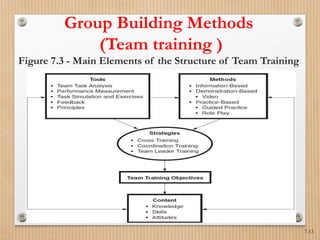
• Team training - coordinates the team performance
who work together to achieve a common goal,
through develop procedures to identify & resolve
errors and coordinate information gathering
Team performance
knowledge, attitudes, and behavior.
7-13
Group Building Methods
(Team training )
Figure 7.3 - Main Elements of the Structure of Team Training
7-14
Group Building Methods
(Action learning)
• Action learning
• Gives teams or work groups an actual problem, has them
solve it and commit to an action plan, and holds them
accountable for implementing the plan.
• Addresses how to change the business, better utilize
technology, remove barriers between the customer and
company, and develop global leaders.
7-15
Group Building Methods
(CONT.)
Advantages
• Addresses how to change the business,
• better utilize technology,
• remove barriers between the customer and company, and
develop global leaders.
7-16
Choosing a Training Method
• Identify the type of learning outcome that you
want training to influence.
• Consider the extent to which the learning method
facilitates learning and transfer of training.
• Evaluate the costs related to development and use
of the method.
• Consider the effectiveness of the training method.

T&DChap 7 (traditional training methods).pdf

  • 1.
    Chapter 7 Traditional Training Methods RaniaHassan Ali MBA - Major : HR Faculty Of Commerce, Cairo University
  • 2.
    7-2 Presentation Methods Methods inwhich trainees are passive recipients of information, which may include: • Lecture:Trainer or more present information and may ask questions by use visual aids provided, while trainees listen and absorb information.
  • 3.
    7-3 Presentation Methods (CONT.) • Audiovisualinstruction: includes slides, and video,which is a popular instructional method used for improving communications skills, interviewing skills, and customer-service skills and fors how how procedures should be followed.
  • 4.
    7-4 Presentation Methods (CONT.) Advantages: • Leastexpensive and time-consuming ways to present a large amount of information to large groups of trainees. • Supports training methods such as behavior modeling and technology-based techniques. • Flexibility in customizing the session depending on trainees’ expertise. • It requires minimum knowledge of technology and equipment.
  • 5.
    7-5 Presentation Methods (CONT.) Disadvantages: • Lacksparticipant involvement, feedback, and useful connection to the work environment. • It is difficult to judge quickly and efficiently the learners’ level of understanding. • Too much content for the trainee to learn.
  • 6.
    7-6 Hands-on Methods Training methodsthat require the trainee to be actively involved in learning.
  • 7.
    7-7 Hands-on Methods (CONT.) • On-the-jobtraining (OJT):new employees learning during work by observing peers or managers performing the job and trying to imitate their behavior. • Self-directed learning: employees take responsibility for all aspects of learning including when it is conducted and who will be involved • Apprenticeship: work-study training method with both on-the-job and classroom training. • Simulation: training method that represents a real-life situation which trainees’ decisions resulting from what would happen if they were on the job. • Case studies: description, analyze, critique and suggesting about how employees or an organization dealt with a difficult situation. • Business games: trainees to gather information, analyze it, and make decisions for management skill development. • Role- plays: require the trainees act characters assigned to them. • Behavior modeling: determine a set of behaviors that are necessary to complete a task to replicate (teaching skills.)
  • 8.
    7-8 Hands-on Methods (CONT.) Advantages: • Trainingis immediately applicable to the job. • Meets specific business training needs and help attract talented employees. • Is a social activity. • Indicates Current Skill Level. • interact with their peers and discuss their learning with the instructor.
  • 9.
    7-9 Hands-on Methods (CONT.) Disadvantages: • Thecase may not actually relate to the work situation or problem that the trainee will encounter. • High development costs. • Not every situation can be included. • Loss of creativity as the training provides one model to perform a skill. • Too Simple the skill may not be enough to cover the situation effectively.
  • 10.
    7-10 Group Building Methods Trainingmethods designed to improve team or group effectiveness by Involve experiential learning.
  • 11.
    7-11 Group Building Methods (Adventurelearning ) • Adventure learning - Focuses on the development of teamwork and leadership skills through structured activities. • Best suited for developing skills related to group effectiveness such as self-awareness, problem solving, conflict management, risk taking.
  • 12.
    7-12 Group Building Methods (Teamtraining ) • Team training - coordinates the team performance who work together to achieve a common goal, through develop procedures to identify & resolve errors and coordinate information gathering Team performance knowledge, attitudes, and behavior.
  • 13.
    7-13 Group Building Methods (Teamtraining ) Figure 7.3 - Main Elements of the Structure of Team Training
  • 14.
    7-14 Group Building Methods (Actionlearning) • Action learning • Gives teams or work groups an actual problem, has them solve it and commit to an action plan, and holds them accountable for implementing the plan. • Addresses how to change the business, better utilize technology, remove barriers between the customer and company, and develop global leaders.
  • 15.
    7-15 Group Building Methods (CONT.) Advantages •Addresses how to change the business, • better utilize technology, • remove barriers between the customer and company, and develop global leaders.
  • 16.
    7-16 Choosing a TrainingMethod • Identify the type of learning outcome that you want training to influence. • Consider the extent to which the learning method facilitates learning and transfer of training. • Evaluate the costs related to development and use of the method. • Consider the effectiveness of the training method.