Employee Selection
Adapted by the Faculty from the textbook:
Staffing Organizations, Herber & Heneman,
McGraw Hill
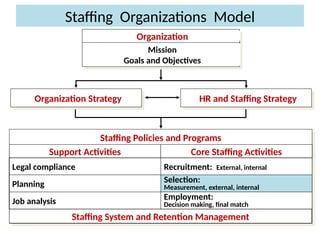
Organization Strategy HR and Staffing Strategy
Staffing Policies and Programs
Staffing System and Retention Management
Support Activities
Legal compliance
Planning
Job analysis
Core Staffing Activities
Recruitment: External, internal
Selection:
Measurement, external, internal
Employment:
Decision making, final match
Organization
Mission
Goals and Objectives
Staffing Organizations Model
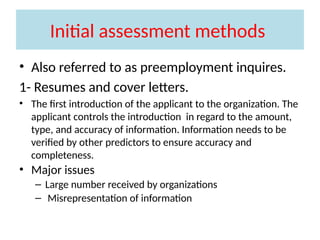
Initial assessment methods
• Also referred to as preemployment inquires.
1- Resumes and cover letters.
• The first introduction of the applicant to the organization. The
applicant controls the introduction in regard to the amount,
type, and accuracy of information. Information needs to be
verified by other predictors to ensure accuracy and
completeness.
• Major issues
– Large number received by organizations
– Misrepresentation of information
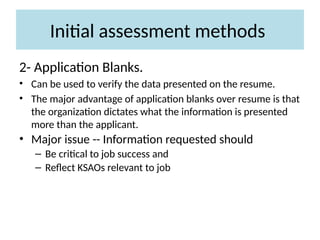
Initial assessment methods
2- Application Blanks.
• Can be used to verify the data presented on the resume.
• The major advantage of application blanks over resume is that
the organization dictates what the information is presented
more than the applicant.
• Major issue -- Information requested should
– Be critical to job success and
– Reflect KSAOs relevant to job
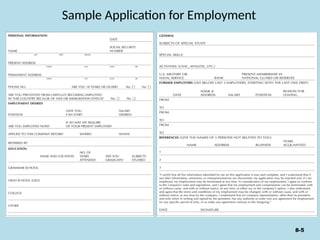
Sample Application for Employment
8-5
Initial assessment methods
3- Biographical Information:
• Personal history information of applicant’s background and
interests
– “Best predictor of future behavior is past behavior”
– Past behaviors may reflect ability or motivation
4- Reference Checks:
• Reference & Background Checks: Reference checks and
background checks are conducted to verify the information
provided by the candidates. Reference checks can be through
formal letters, telephone conversations. However it is merely
a formality and selections decisions are seldom affected by it.
Initial assessment methods
5- Initial interview:
• Purpose -- Screen out most obvious cases of person / job
mismatches
• interview should focus on an assessment of KSAO’S that are
absolute requirements for the applicant.
Substantive assessment methods
• This kind of methods is the heart of staffing
decisions, because substantive selection is the
highlight of actual hiring decisions.
• Organizations use initial assessment methods to
make rough cuts among applicants, weeding
out the obviously unqualified.
• Substantive are used to make more precise
decisions about applicant among those who
meet the minimum qualifications for the job.
Substantive assessment methods
1- Employment/selection tests
• an instrument used to test the applicant’s ability, personality
of knowledge including: t, personality test, aptitude test,
genetic test, etc.
2- Employment interview
Dialogue between interviewer and applicants Interviwee)
including a series of questions to screen applicants.
3- Selection Decision
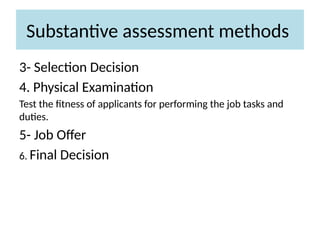
4. Physical Examination
Test the fitness of applicants for performing the job tasks and
duties.
5- Job Offer
6. Final Decision
Substantive assessment methods
9-11
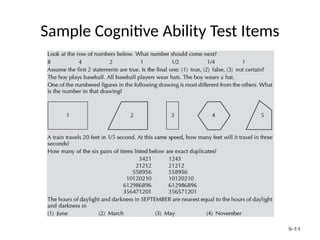
Sample Cognitive Ability Test Items
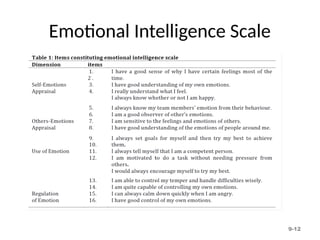
Emotional Intelligence Scale
9-12
9-13
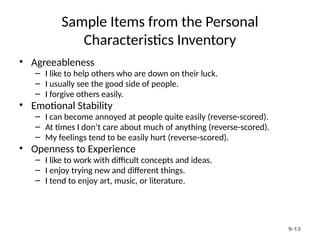
Sample Items from the Personal
Characteristics Inventory
• Agreeableness
– I like to help others who are down on their luck.
– I usually see the good side of people.
– I forgive others easily.
• Emotional Stability
– I can become annoyed at people quite easily (reverse-scored).
– At times I don’t care about much of anything (reverse-scored).
– My feelings tend to be easily hurt (reverse-scored).
• Openness to Experience
– I like to work with difficult concepts and ideas.
– I enjoy trying new and different things.
– I tend to enjoy art, music, or literature.
9-14
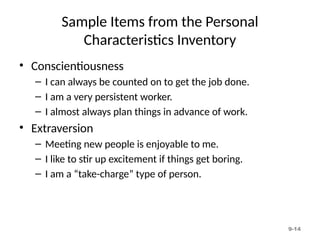
Sample Items from the Personal
Characteristics Inventory
• Conscientiousness
– I can always be counted on to get the job done.
– I am a very persistent worker.
– I almost always plan things in advance of work.
• Extraversion
– Meeting new people is enjoyable to me.
– I like to stir up excitement if things get boring.
– I am a “take-charge” type of person.
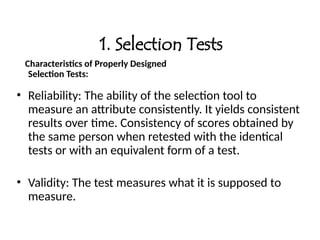
1. Selection Tests
Characteristics of Properly Designed
Selection Tests:
• Reliability: The ability of the selection tool to
measure an attribute consistently. It yields consistent
results over time. Consistency of scores obtained by
the same person when retested with the identical
tests or with an equivalent form of a test.
• Validity: The test measures what it is supposed to
measure.
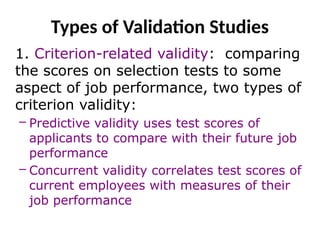
Types of Validation Studies
1. Criterion-related validity: comparing
the scores on selection tests to some
aspect of job performance, two types of
criterion validity:
– Predictive validity uses test scores of
applicants to compare with their future job
performance
– Concurrent validity correlates test scores of
current employees with measures of their
job performance
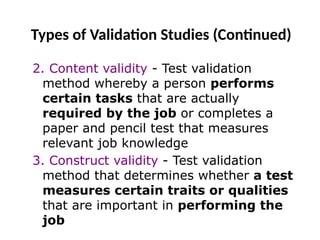
Types of Validation Studies (Continued)
2. Content validity - Test validation
method whereby a person performs
certain tasks that are actually
required by the job or completes a
paper and pencil test that measures
relevant job knowledge
3. Construct validity - Test validation
method that determines whether a test
measures certain traits or qualities
that are important in performing the
job
Characteristics of Properly Designed
Selection Tests (Cont..)
Generalizability is the degree to which the validity of a
selection method established in one context extends to
other contexts such as different situations, different
samples of people, and different time periods.
2. Employment Interview
• The next step in selection is employment
interview. Here interview is a formal and in-
depth conversation between applicant’s
acceptability. It is considered to be an
excellent selection device. Interviews can be
One-to-One, Panel Interview, or Sequential
Interviews. Besides there can be Structured
and Unstructured interviews, Behavioral
Interviews, Stress Interviews.
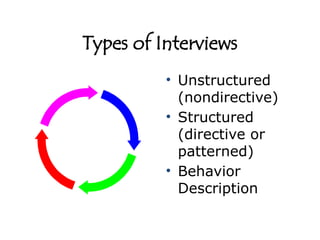
Types of Interviews
• Unstructured
(nondirective)
• Structured
(directive or
patterned)
• Behavior
Description
A. THE UNSTRUCTURED (NONDIRECTIVE) INTERVIEW—An
interview where probing, open-ended questions are asked.
This type of interview is comprehensive, and the interviewer
encourages the applicant to do much of the talking.
B. THE STRUCTURED (DIRECTIVE OR PATTERNED) INTERVIEW—
An interview consisting of a series of job-related questions
that are asked consistently of each applicant for a particular
job.
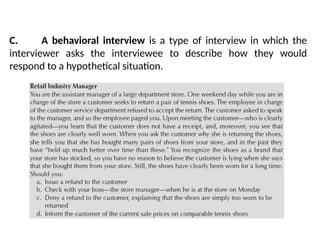
C. A behavioral interview is a type of interview in which the
interviewer asks the interviewee to describe how they would
respond to a hypothetical situation.
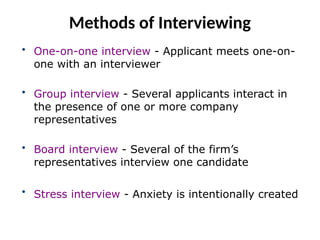
Methods of Interviewing
• One-on-one interview - Applicant meets one-on-
one with an interviewer
• Group interview - Several applicants interact in
the presence of one or more company
representatives
• Board interview - Several of the firm’s
representatives interview one candidate
• Stress interview - Anxiety is intentionally created
• 3. Selection Decision: After obtaining all the
information, the most critical step is the selection
decision is to be made. The final decision has to be
made out of applicants who have passed preliminary
interviews, tests, final interviews and reference
checks. The views of line managers are considered
generally because it is the line manager who is
responsible for the performance of the new
employee.
• 4. Physical Examination: After the selection decision is
made, the candidate is required to undergo a physical
fitness test. A job offer is often contingent upon the
candidate passing the physical examination.
• 5. Job Offer: The next step in selection process
is job offer to those applicants who have
crossed all the previous hurdles. It is made by
way of letter of appointment.
• 6. Final Selection: candidates who have cleared
all the above process are finally selected and
job offer is issued to them. The job offer
contains the pay-scale, allowance and other
conditions of the job.
Guidelines for Increasing Retention and controlling high labor
turnover
- Create an engaging onboarding process
- Show your appreciation
- Encourage a work-life balance
- Offer professional development opportunities
-Design fair reward allocation systems
-Assign employees to jobs that meet their needs for
work characteristics
-Provide clear communication with employees
-Design fair reward allocation systems
-Ensure supervisors provide a positive environment
QUIZ

chapter 6.retention strategies at workplace

  • 1.
    Employee Selection Adapted bythe Faculty from the textbook: Staffing Organizations, Herber & Heneman, McGraw Hill
  • 2.
    Organization Strategy HRand Staffing Strategy Staffing Policies and Programs Staffing System and Retention Management Support Activities Legal compliance Planning Job analysis Core Staffing Activities Recruitment: External, internal Selection: Measurement, external, internal Employment: Decision making, final match Organization Mission Goals and Objectives Staffing Organizations Model
  • 3.
    Initial assessment methods •Also referred to as preemployment inquires. 1- Resumes and cover letters. • The first introduction of the applicant to the organization. The applicant controls the introduction in regard to the amount, type, and accuracy of information. Information needs to be verified by other predictors to ensure accuracy and completeness. • Major issues – Large number received by organizations – Misrepresentation of information
  • 4.
    Initial assessment methods 2-Application Blanks. • Can be used to verify the data presented on the resume. • The major advantage of application blanks over resume is that the organization dictates what the information is presented more than the applicant. • Major issue -- Information requested should – Be critical to job success and – Reflect KSAOs relevant to job
  • 5.
    Sample Application forEmployment 8-5
  • 6.
    Initial assessment methods 3-Biographical Information: • Personal history information of applicant’s background and interests – “Best predictor of future behavior is past behavior” – Past behaviors may reflect ability or motivation 4- Reference Checks: • Reference & Background Checks: Reference checks and background checks are conducted to verify the information provided by the candidates. Reference checks can be through formal letters, telephone conversations. However it is merely a formality and selections decisions are seldom affected by it.
  • 7.
    Initial assessment methods 5-Initial interview: • Purpose -- Screen out most obvious cases of person / job mismatches • interview should focus on an assessment of KSAO’S that are absolute requirements for the applicant.
  • 8.
    Substantive assessment methods •This kind of methods is the heart of staffing decisions, because substantive selection is the highlight of actual hiring decisions. • Organizations use initial assessment methods to make rough cuts among applicants, weeding out the obviously unqualified. • Substantive are used to make more precise decisions about applicant among those who meet the minimum qualifications for the job.
  • 9.
    Substantive assessment methods 1-Employment/selection tests • an instrument used to test the applicant’s ability, personality of knowledge including: t, personality test, aptitude test, genetic test, etc. 2- Employment interview Dialogue between interviewer and applicants Interviwee) including a series of questions to screen applicants.
  • 10.
    3- Selection Decision 4.Physical Examination Test the fitness of applicants for performing the job tasks and duties. 5- Job Offer 6. Final Decision Substantive assessment methods
  • 11.
  • 12.
  • 13.
    9-13 Sample Items fromthe Personal Characteristics Inventory • Agreeableness – I like to help others who are down on their luck. – I usually see the good side of people. – I forgive others easily. • Emotional Stability – I can become annoyed at people quite easily (reverse-scored). – At times I don’t care about much of anything (reverse-scored). – My feelings tend to be easily hurt (reverse-scored). • Openness to Experience – I like to work with difficult concepts and ideas. – I enjoy trying new and different things. – I tend to enjoy art, music, or literature.
  • 14.
    9-14 Sample Items fromthe Personal Characteristics Inventory • Conscientiousness – I can always be counted on to get the job done. – I am a very persistent worker. – I almost always plan things in advance of work. • Extraversion – Meeting new people is enjoyable to me. – I like to stir up excitement if things get boring. – I am a “take-charge” type of person.
  • 15.
    1. Selection Tests Characteristicsof Properly Designed Selection Tests: • Reliability: The ability of the selection tool to measure an attribute consistently. It yields consistent results over time. Consistency of scores obtained by the same person when retested with the identical tests or with an equivalent form of a test. • Validity: The test measures what it is supposed to measure.
  • 16.
    Types of ValidationStudies 1. Criterion-related validity: comparing the scores on selection tests to some aspect of job performance, two types of criterion validity: – Predictive validity uses test scores of applicants to compare with their future job performance – Concurrent validity correlates test scores of current employees with measures of their job performance
  • 17.
    Types of ValidationStudies (Continued) 2. Content validity - Test validation method whereby a person performs certain tasks that are actually required by the job or completes a paper and pencil test that measures relevant job knowledge 3. Construct validity - Test validation method that determines whether a test measures certain traits or qualities that are important in performing the job
  • 18.
    Characteristics of ProperlyDesigned Selection Tests (Cont..) Generalizability is the degree to which the validity of a selection method established in one context extends to other contexts such as different situations, different samples of people, and different time periods.
  • 19.
    2. Employment Interview •The next step in selection is employment interview. Here interview is a formal and in- depth conversation between applicant’s acceptability. It is considered to be an excellent selection device. Interviews can be One-to-One, Panel Interview, or Sequential Interviews. Besides there can be Structured and Unstructured interviews, Behavioral Interviews, Stress Interviews.
  • 20.
    Types of Interviews •Unstructured (nondirective) • Structured (directive or patterned) • Behavior Description
  • 21.
    A. THE UNSTRUCTURED(NONDIRECTIVE) INTERVIEW—An interview where probing, open-ended questions are asked. This type of interview is comprehensive, and the interviewer encourages the applicant to do much of the talking. B. THE STRUCTURED (DIRECTIVE OR PATTERNED) INTERVIEW— An interview consisting of a series of job-related questions that are asked consistently of each applicant for a particular job.
  • 22.
    C. A behavioralinterview is a type of interview in which the interviewer asks the interviewee to describe how they would respond to a hypothetical situation.
  • 23.
    Methods of Interviewing •One-on-one interview - Applicant meets one-on- one with an interviewer • Group interview - Several applicants interact in the presence of one or more company representatives • Board interview - Several of the firm’s representatives interview one candidate • Stress interview - Anxiety is intentionally created
  • 24.
    • 3. SelectionDecision: After obtaining all the information, the most critical step is the selection decision is to be made. The final decision has to be made out of applicants who have passed preliminary interviews, tests, final interviews and reference checks. The views of line managers are considered generally because it is the line manager who is responsible for the performance of the new employee. • 4. Physical Examination: After the selection decision is made, the candidate is required to undergo a physical fitness test. A job offer is often contingent upon the candidate passing the physical examination.
  • 25.
    • 5. JobOffer: The next step in selection process is job offer to those applicants who have crossed all the previous hurdles. It is made by way of letter of appointment. • 6. Final Selection: candidates who have cleared all the above process are finally selected and job offer is issued to them. The job offer contains the pay-scale, allowance and other conditions of the job.
  • 26.
    Guidelines for IncreasingRetention and controlling high labor turnover - Create an engaging onboarding process - Show your appreciation - Encourage a work-life balance - Offer professional development opportunities -Design fair reward allocation systems -Assign employees to jobs that meet their needs for work characteristics -Provide clear communication with employees -Design fair reward allocation systems -Ensure supervisors provide a positive environment
  • 27.