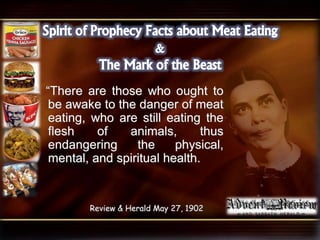
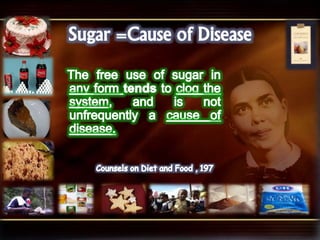
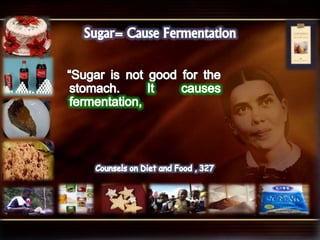
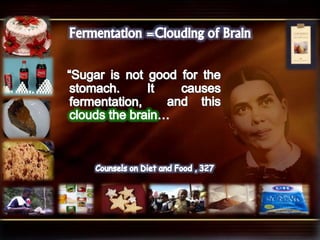
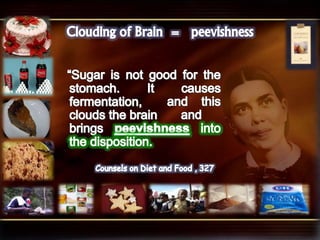
“There are those who ought to
be awake to the danger of meat
eating, who are still eating the
flesh of animals, thus
endangering the physical,
mental, and spiritual health.

Review & Herald May 27, 1902
In order to be fitted for
translation, the people of God
must know themselves.
Counsel on Diet and Food 33
They must understand in regard
to their own physical frames,
that they may be able with the
psalmist to exclaim, ‘I will
praise Thee, for I am fearfully
and wonderfully made.
Counsel on Diet and Food 33
They should ever have the
appetite in subjection to the
moral and intellectual organs.
The body should be servant to
the mind, and not the mind to
the body.”
Counsel on Diet and Food 33
“Men, then, can make their
bodies unholy by sinful
indulgences. If unholy, they are
unfitted to be spiritual
worshipers, and are not worthy
of heaven.
Counsel on Diet and Food 70
If man will cherish the light that
God in mercy gives him upon
health reform, he may be
sanctified through the truth, and
fitted for immortality.”
Counsel on Diet and Food 70
PEEVISHNESS (NOUN)
An irritable petulant (Unreasonably irritable or ill-
tempered;)
Contemptuous in speech or behavior and feeling
Choler (Anger),
Crossness,
Fretfulness,
Fussiness,
Irritability,
Petulance
http://www.thefreedictionary.com/
PEEVISHNESS (NOUN)
Ill humor,
Distemper - an angry and disagreeable mood
Testiness (impatient)
Touchiness - feeling easily irritated
Pet - a fit of petulance or sulkiness (especially at what
is felt to be a slight
http://www.thefreedictionary.com/
2.Peevishness - a disposition to exhibit
uncontrolled anger; "his temper was well
known to all his employees“
pettishness, snappishness, surliness, biliousness,
irritability, temper
http://www.thefreedictionary.com/
PEEVISHNESS (NOUN)
Ill nature - a disagreeable, irritable, or malevolent
disposition
Malevolent- having, showing, or arising from
intense often vicious ill will, spite, or hatred
productive of harm or evil
Querulousness - the quality of being given to complaining
http://www.thefreedictionary.com/
PEEVISHNESS (NOUN)
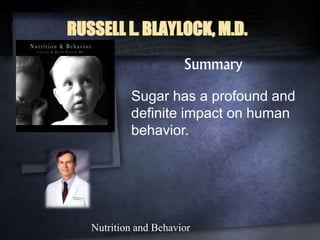
Nutrition and Behavior
RUSSELL L. BLAYLOCK, M.D.
Summary
Sugar has a profound and
definite impact on human
behavior.
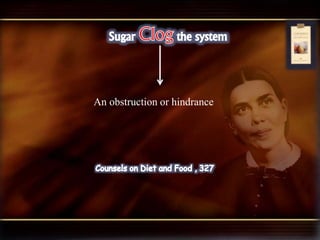
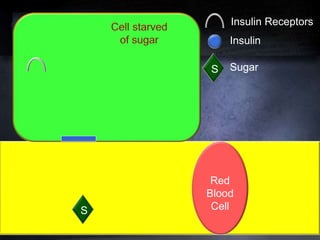
An obstruction or hindrance
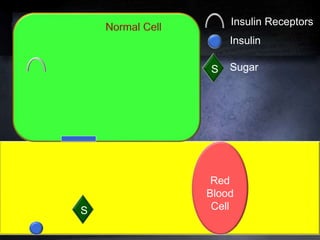
Red
Blood
CellS
Insulin Receptors
Insulin
S Sugar
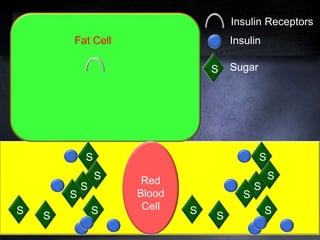
Red
Blood
CellS
Insulin Receptors
Insulin
S Sugar
S
Fat Cell
S
S
S
S
S
S
Insulin Receptors
Insulin
S Sugar
Red
Blood
CellS
S
S
S
S
S
S
Sugar and Cardiovascular
Disease
A Statement for Healthcare
Professionals From the
Committee on Nutrition of the
Council on Nutrition, Physical
Activity, and Metabolism of
the American Heart
Association
Barbara V. Howard, PhD;
Judith Wylie-Rosett, RD, EdD
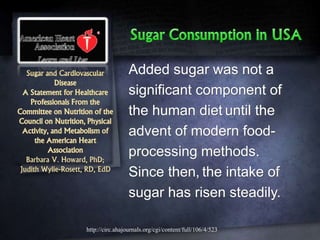
Added sugar was not a
significant component of
the human diet until the
advent of modern food-
processing methods.
Since then, the intake of
sugar has risen steadily.
http://circ.ahajournals.org/cgi/content/full/106/4/523
Sugar and Cardiovascular
Disease
A Statement for Healthcare
Professionals From the
Committee on Nutrition of the
Council on Nutrition, Physical
Activity, and Metabolism of
the American Heart
Association
Barbara V. Howard, PhD;
Judith Wylie-Rosett, RD, EdD
The average US sugar
utilization per capita on the
basis of food
disappearance data was 55
kg (120 lb) per year in
1970, and it reached 68 kg
(150 lb) per year in 1995
(almost 0.5 lb per day).1
http://circ.ahajournals.org/cgi/content/full/106/4/523
Sugar and Cardiovascular
Disease
A Statement for Healthcare
Professionals From the
Committee on Nutrition of the
Council on Nutrition, Physical
Activity, and Metabolism of
the American Heart
Association
Barbara V. Howard, PhD;
Judith Wylie-Rosett, RD, EdD
Sugar (simple
carbohydrate) intake
averages 25% of total
energy intake. Data from
the 1989 to 1991
Continuing Survey of Food
Intake by
http://circ.ahajournals.org/cgi/content/full/106/4/523
Sugar and Cardiovascular
Disease
A Statement for Healthcare
Professionals From the
Committee on Nutrition of the
Council on Nutrition, Physical
Activity, and Metabolism of
the American Heart
Association
Barbara V. Howard, PhD;
Judith Wylie-Rosett, RD, EdD
Individuals indicate that soft
drinks and sugars added at
the table (eg, sugar/syrups
and jams) are 2 of the top 4
carbohydrate sources for
US adults.2
http://circ.ahajournals.org/cgi/content/full/106/4/523
Sugar and Cardiovascular
Disease
A Statement for Healthcare
Professionals From the
Committee on Nutrition of the
Council on Nutrition, Physical
Activity, and Metabolism of
the American Heart
Association
Barbara V. Howard, PhD;
Judith Wylie-Rosett, RD, EdD
Yudkin and colleagues in
the 1960s3 and 1970s4
found that a higher intake of
sugar was associated with
increased CVD in both
within-country and cross-
country comparisons.
http://circ.ahajournals.org/cgi/content/full/106/4/523
Sugar and Cardiovascular
Disease
A Statement for Healthcare
Professionals From the
Committee on Nutrition of the
Council on Nutrition, Physical
Activity, and Metabolism of
the American Heart
Association
Barbara V. Howard, PhD;
Judith Wylie-Rosett, RD, EdD
A number of studies link
dietary sugar with adverse
changes in lipoproteins.
http://circ.ahajournals.org/cgi/content/full/106/4/523
Sugar and Cardiovascular
Disease
A Statement for Healthcare
Professionals From the
Committee on Nutrition of the
Council on Nutrition, Physical
Activity, and Metabolism of
the American Heart
Association
Barbara V. Howard, PhD;
Judith Wylie-Rosett, RD, EdD
Several studies have
shown an inverse
association between dietary
sucrose and high-density
lipoprotein (HDL)
cholesterol.8,9 .
http://circ.ahajournals.org/cgi/content/full/106/4/523
HDL-High Density Lipoprotein (Good)
Sugar and Cardiovascular
Disease
A Statement for Healthcare
Professionals From the
Committee on Nutrition of the
Council on Nutrition, Physical
Activity, and Metabolism of
the American Heart
Association
Barbara V. Howard, PhD;
Judith Wylie-Rosett, RD, EdD
Few epidemiological
studies have directly
examined the relationship
between sugar intake and
diabetes incidence.
http://circ.ahajournals.org/cgi/content/full/106/4/523
Sugar and Cardiovascular
Disease
A Statement for Healthcare
Professionals From the
Committee on Nutrition of the
Council on Nutrition, Physical
Activity, and Metabolism of
the American Heart
Association
Barbara V. Howard, PhD;
Judith Wylie-Rosett, RD, EdD
“...diets lower in
carbohydrate are higher in
fat (high fat intake predicts
diabetes risk because of
increased obesity).16
http://circ.ahajournals.org/cgi/content/full/106/4/523
Sugar and Cardiovascular
Disease
A Statement for Healthcare
Professionals From the
Committee on Nutrition of the
Council on Nutrition, Physical
Activity, and Metabolism of
the American Heart
Association
Barbara V. Howard, PhD;
Judith Wylie-Rosett, RD, EdD
On the other hand, two
recent prospective cohort
studies have reported food
frequency consumption
data that showed that a
history of
http://circ.ahajournals.org/cgi/content/full/106/4/523
Sugar and Cardiovascular
Disease
A Statement for Healthcare
Professionals From the
Committee on Nutrition of the
Council on Nutrition, Physical
Activity, and Metabolism of
the American Heart
Association
Barbara V. Howard, PhD;
Judith Wylie-Rosett, RD, EdD
consumption of foods with
a high glycemic load
predicts the development of
type 2 diabetes in women17
and men.18l
http://circ.ahajournals.org/cgi/content/full/106/4/523
Sugar and Cancer
A poison, as defined by Stedman's Medical
Dictionary, is any substance, either taken
internally or applied externally that is
injurious to health or dangerous to life.
http://www.caringmedical.com/media_articles/Sugar_Increases_Cancer_Growth.htm
Sugar is a Poison
Sugar and Cancer
Sugar meets this definition as its effects on
the human body over time can lead to the
following conditions:
When the blood sugar becomes too high,
metabolism is altered, and disease
processes begin. In regard to cancer, this
means cancer physiology.
http://www.caringmedical.com/media_articles/Sugar_Increases_Cancer_Growth.htm
Sugar is a Poison
Sugar and Cancer
High blood sugars have the following effects
that aid cancer physiology:
Increase amount of energy source for
cancer cells.
http://www.caringmedical.com/media_articles/Sugar_Increases_Cancer_Growth.htm
Sugar is a Poison
Sugar and Cancer
High blood sugars have the following effects
that aid cancer physiology:
Increase insulin levels that stimulate cancer
growth.
http://www.caringmedical.com/media_articles/Sugar_Increases_Cancer_Growth.htm
Sugar is a Poison
Sugar and Cancer
High blood sugars have the following effects
that aid cancer physiology:
Elevate lactic acid levels that lower tumor
pH.(low ph=increase in acidity)
http://www.caringmedical.com/media_articles/Sugar_Increases_Cancer_Growth.htm
Sugar is a Poison
Sugar and Cancer
High blood sugars have the following effects
that aid cancer physiology:
Encourage anaerobic metabolism
Anaerobic metabolism-The creation of energy through the combustion of carbohydrates
in the absence of oxygen. This occurs when the lungs cannot put enough oxygen into the
bloodstream to keep up with the demands from the muscles energy. It generally is used
only for short bursts of activity..
http://www.caringmedical.com/media_articles/Sugar_Increases_Cancer_Growth.htm
Sugar is a Poison
Sugar and Cancer
High blood sugars have the following effects
that aid cancer physiology:
Increase protein kinase C (enzymes that
control other protein), which increases
cancer risk.
http://www.caringmedical.com/media_articles/Sugar_Increases_Cancer_Growth.htm
Sugar is a Poison
Sugar and Cancer
High blood sugars have the following effects
that aid cancer physiology:
Increase prostaglandin E-2 levels (fatty
compound), increasing platelet stickiness.
http://www.caringmedical.com/media_articles/Sugar_Increases_Cancer_Growth.htm
Sugar is a Poison
Sugar and Cancer
High blood sugars have the following effects
that aid cancer physiology:
Lower immunity.
http://www.caringmedical.com/media_articles/Sugar_Increases_Cancer_Growth.htm
Sugar is a Poison
“And said, If thou wilt
diligently hearken to the
voice of the LORD thy God,
and wilt do that which is
right in his sight, and wilt
give ear to his
commandments, and keep
all his statutes, I will put
none of these diseases
upon thee, which I have
brought upon the
Egyptians: for I am theExodus 15:26
Genesis 2:17
Godly Trust
Open Air
Daily Exercise
Sunshine
roper Rest
Lots of Water
Always Temperate
utrition
Genesis 1:6-7
Genesis 2:15
Genesis 1:16
Genesis 2:3
Genesis 2:10
Genesis 2:16-17
Genesis 1:29 ratitude
enevolence
Proverbs 17:22
Luke 23:33-43
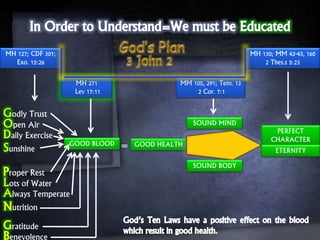
MH 127; CDF 301;
Exo. 15:26
MH 271
Lev 17:11
MM 105, 291; Tem. 13
2 Cor. 7:1
MH 130; MM 42-43, 160
2 Thes.s 5:23
Godly Trust
Open Air
Daily Exercise
Sunshine
roper Rest
Lots of Water
Always Temperate
utrition
GOOD BLOOD GOOD HEALTH=
SOUND MIND
SOUND BODY
PERFECT
CHARACTER
ETERNITY
ratitude
enevolence
Glycemic index
The glycemic index measures how fast a
food is likely to raise your blood sugar.
http://www.diabetesnet.com/diabetes_food_diet/glycemic_index.php#ixzz10V0LuIIp
Glycemic Load
Glycemic load or GL combines both the
quality and quantity of carbohydrate in one
‘number’.
It’s the best way to predict blood glucose
values of different types and amounts of
food. The formula is: GL = (GI x the
amount of carbohydrate) divided by 100. [1]
http://en.wikipedia.org/wiki/Glycemic_load
To our
Medical Missionary Chart
Chart

5 sugar comma-pen-october-30-2010

  • 15.
    “There are thosewho ought to be awake to the danger of meat eating, who are still eating the flesh of animals, thus endangering the physical, mental, and spiritual health. Review & Herald May 27, 1902

  • 16.
    Review & HeraldMay 27, 1902
  • 17.
    In order tobe fitted for translation, the people of God must know themselves. Counsel on Diet and Food 33
  • 18.
    They must understandin regard to their own physical frames, that they may be able with the psalmist to exclaim, ‘I will praise Thee, for I am fearfully and wonderfully made. Counsel on Diet and Food 33
  • 19.
    They should everhave the appetite in subjection to the moral and intellectual organs. The body should be servant to the mind, and not the mind to the body.” Counsel on Diet and Food 33
  • 20.
    “Men, then, canmake their bodies unholy by sinful indulgences. If unholy, they are unfitted to be spiritual worshipers, and are not worthy of heaven. Counsel on Diet and Food 70
  • 21.
    If man willcherish the light that God in mercy gives him upon health reform, he may be sanctified through the truth, and fitted for immortality.” Counsel on Diet and Food 70
  • 28.
    PEEVISHNESS (NOUN) An irritablepetulant (Unreasonably irritable or ill- tempered;) Contemptuous in speech or behavior and feeling Choler (Anger), Crossness, Fretfulness, Fussiness, Irritability, Petulance http://www.thefreedictionary.com/
  • 29.
    PEEVISHNESS (NOUN) Ill humor, Distemper- an angry and disagreeable mood Testiness (impatient) Touchiness - feeling easily irritated Pet - a fit of petulance or sulkiness (especially at what is felt to be a slight http://www.thefreedictionary.com/
  • 30.
    2.Peevishness - adisposition to exhibit uncontrolled anger; "his temper was well known to all his employees“ pettishness, snappishness, surliness, biliousness, irritability, temper http://www.thefreedictionary.com/ PEEVISHNESS (NOUN)
  • 31.
    Ill nature -a disagreeable, irritable, or malevolent disposition Malevolent- having, showing, or arising from intense often vicious ill will, spite, or hatred productive of harm or evil Querulousness - the quality of being given to complaining http://www.thefreedictionary.com/ PEEVISHNESS (NOUN)
  • 32.
    Nutrition and Behavior RUSSELLL. BLAYLOCK, M.D. Summary Sugar has a profound and definite impact on human behavior.
  • 34.
  • 35.
  • 36.
  • 37.
    S Fat Cell S S S S S S Insulin Receptors Insulin SSugar Red Blood CellS S S S S S S
  • 38.
    Sugar and Cardiovascular Disease AStatement for Healthcare Professionals From the Committee on Nutrition of the Council on Nutrition, Physical Activity, and Metabolism of the American Heart Association Barbara V. Howard, PhD; Judith Wylie-Rosett, RD, EdD Added sugar was not a significant component of the human diet until the advent of modern food- processing methods. Since then, the intake of sugar has risen steadily. http://circ.ahajournals.org/cgi/content/full/106/4/523
  • 39.
    Sugar and Cardiovascular Disease AStatement for Healthcare Professionals From the Committee on Nutrition of the Council on Nutrition, Physical Activity, and Metabolism of the American Heart Association Barbara V. Howard, PhD; Judith Wylie-Rosett, RD, EdD The average US sugar utilization per capita on the basis of food disappearance data was 55 kg (120 lb) per year in 1970, and it reached 68 kg (150 lb) per year in 1995 (almost 0.5 lb per day).1 http://circ.ahajournals.org/cgi/content/full/106/4/523
  • 40.
    Sugar and Cardiovascular Disease AStatement for Healthcare Professionals From the Committee on Nutrition of the Council on Nutrition, Physical Activity, and Metabolism of the American Heart Association Barbara V. Howard, PhD; Judith Wylie-Rosett, RD, EdD Sugar (simple carbohydrate) intake averages 25% of total energy intake. Data from the 1989 to 1991 Continuing Survey of Food Intake by http://circ.ahajournals.org/cgi/content/full/106/4/523
  • 41.
    Sugar and Cardiovascular Disease AStatement for Healthcare Professionals From the Committee on Nutrition of the Council on Nutrition, Physical Activity, and Metabolism of the American Heart Association Barbara V. Howard, PhD; Judith Wylie-Rosett, RD, EdD Individuals indicate that soft drinks and sugars added at the table (eg, sugar/syrups and jams) are 2 of the top 4 carbohydrate sources for US adults.2 http://circ.ahajournals.org/cgi/content/full/106/4/523
  • 42.
    Sugar and Cardiovascular Disease AStatement for Healthcare Professionals From the Committee on Nutrition of the Council on Nutrition, Physical Activity, and Metabolism of the American Heart Association Barbara V. Howard, PhD; Judith Wylie-Rosett, RD, EdD Yudkin and colleagues in the 1960s3 and 1970s4 found that a higher intake of sugar was associated with increased CVD in both within-country and cross- country comparisons. http://circ.ahajournals.org/cgi/content/full/106/4/523
  • 43.
    Sugar and Cardiovascular Disease AStatement for Healthcare Professionals From the Committee on Nutrition of the Council on Nutrition, Physical Activity, and Metabolism of the American Heart Association Barbara V. Howard, PhD; Judith Wylie-Rosett, RD, EdD A number of studies link dietary sugar with adverse changes in lipoproteins. http://circ.ahajournals.org/cgi/content/full/106/4/523
  • 44.
    Sugar and Cardiovascular Disease AStatement for Healthcare Professionals From the Committee on Nutrition of the Council on Nutrition, Physical Activity, and Metabolism of the American Heart Association Barbara V. Howard, PhD; Judith Wylie-Rosett, RD, EdD Several studies have shown an inverse association between dietary sucrose and high-density lipoprotein (HDL) cholesterol.8,9 . http://circ.ahajournals.org/cgi/content/full/106/4/523 HDL-High Density Lipoprotein (Good)
  • 45.
    Sugar and Cardiovascular Disease AStatement for Healthcare Professionals From the Committee on Nutrition of the Council on Nutrition, Physical Activity, and Metabolism of the American Heart Association Barbara V. Howard, PhD; Judith Wylie-Rosett, RD, EdD Few epidemiological studies have directly examined the relationship between sugar intake and diabetes incidence. http://circ.ahajournals.org/cgi/content/full/106/4/523
  • 46.
    Sugar and Cardiovascular Disease AStatement for Healthcare Professionals From the Committee on Nutrition of the Council on Nutrition, Physical Activity, and Metabolism of the American Heart Association Barbara V. Howard, PhD; Judith Wylie-Rosett, RD, EdD “...diets lower in carbohydrate are higher in fat (high fat intake predicts diabetes risk because of increased obesity).16 http://circ.ahajournals.org/cgi/content/full/106/4/523
  • 47.
    Sugar and Cardiovascular Disease AStatement for Healthcare Professionals From the Committee on Nutrition of the Council on Nutrition, Physical Activity, and Metabolism of the American Heart Association Barbara V. Howard, PhD; Judith Wylie-Rosett, RD, EdD On the other hand, two recent prospective cohort studies have reported food frequency consumption data that showed that a history of http://circ.ahajournals.org/cgi/content/full/106/4/523
  • 48.
    Sugar and Cardiovascular Disease AStatement for Healthcare Professionals From the Committee on Nutrition of the Council on Nutrition, Physical Activity, and Metabolism of the American Heart Association Barbara V. Howard, PhD; Judith Wylie-Rosett, RD, EdD consumption of foods with a high glycemic load predicts the development of type 2 diabetes in women17 and men.18l http://circ.ahajournals.org/cgi/content/full/106/4/523
  • 49.
    Sugar and Cancer Apoison, as defined by Stedman's Medical Dictionary, is any substance, either taken internally or applied externally that is injurious to health or dangerous to life. http://www.caringmedical.com/media_articles/Sugar_Increases_Cancer_Growth.htm Sugar is a Poison
  • 50.
    Sugar and Cancer Sugarmeets this definition as its effects on the human body over time can lead to the following conditions: When the blood sugar becomes too high, metabolism is altered, and disease processes begin. In regard to cancer, this means cancer physiology. http://www.caringmedical.com/media_articles/Sugar_Increases_Cancer_Growth.htm Sugar is a Poison
  • 51.
    Sugar and Cancer Highblood sugars have the following effects that aid cancer physiology: Increase amount of energy source for cancer cells. http://www.caringmedical.com/media_articles/Sugar_Increases_Cancer_Growth.htm Sugar is a Poison
  • 52.
    Sugar and Cancer Highblood sugars have the following effects that aid cancer physiology: Increase insulin levels that stimulate cancer growth. http://www.caringmedical.com/media_articles/Sugar_Increases_Cancer_Growth.htm Sugar is a Poison
  • 53.
    Sugar and Cancer Highblood sugars have the following effects that aid cancer physiology: Elevate lactic acid levels that lower tumor pH.(low ph=increase in acidity) http://www.caringmedical.com/media_articles/Sugar_Increases_Cancer_Growth.htm Sugar is a Poison
  • 54.
    Sugar and Cancer Highblood sugars have the following effects that aid cancer physiology: Encourage anaerobic metabolism Anaerobic metabolism-The creation of energy through the combustion of carbohydrates in the absence of oxygen. This occurs when the lungs cannot put enough oxygen into the bloodstream to keep up with the demands from the muscles energy. It generally is used only for short bursts of activity.. http://www.caringmedical.com/media_articles/Sugar_Increases_Cancer_Growth.htm Sugar is a Poison
  • 55.
    Sugar and Cancer Highblood sugars have the following effects that aid cancer physiology: Increase protein kinase C (enzymes that control other protein), which increases cancer risk. http://www.caringmedical.com/media_articles/Sugar_Increases_Cancer_Growth.htm Sugar is a Poison
  • 56.
    Sugar and Cancer Highblood sugars have the following effects that aid cancer physiology: Increase prostaglandin E-2 levels (fatty compound), increasing platelet stickiness. http://www.caringmedical.com/media_articles/Sugar_Increases_Cancer_Growth.htm Sugar is a Poison
  • 57.
    Sugar and Cancer Highblood sugars have the following effects that aid cancer physiology: Lower immunity. http://www.caringmedical.com/media_articles/Sugar_Increases_Cancer_Growth.htm Sugar is a Poison
  • 59.
    “And said, Ifthou wilt diligently hearken to the voice of the LORD thy God, and wilt do that which is right in his sight, and wilt give ear to his commandments, and keep all his statutes, I will put none of these diseases upon thee, which I have brought upon the Egyptians: for I am theExodus 15:26
  • 60.
    Genesis 2:17 Godly Trust OpenAir Daily Exercise Sunshine roper Rest Lots of Water Always Temperate utrition Genesis 1:6-7 Genesis 2:15 Genesis 1:16 Genesis 2:3 Genesis 2:10 Genesis 2:16-17 Genesis 1:29 ratitude enevolence Proverbs 17:22 Luke 23:33-43
  • 61.
    MH 127; CDF301; Exo. 15:26 MH 271 Lev 17:11 MM 105, 291; Tem. 13 2 Cor. 7:1 MH 130; MM 42-43, 160 2 Thes.s 5:23 Godly Trust Open Air Daily Exercise Sunshine roper Rest Lots of Water Always Temperate utrition GOOD BLOOD GOOD HEALTH= SOUND MIND SOUND BODY PERFECT CHARACTER ETERNITY ratitude enevolence
  • 62.
    Glycemic index The glycemicindex measures how fast a food is likely to raise your blood sugar. http://www.diabetesnet.com/diabetes_food_diet/glycemic_index.php#ixzz10V0LuIIp
  • 63.
    Glycemic Load Glycemic loador GL combines both the quality and quantity of carbohydrate in one ‘number’. It’s the best way to predict blood glucose values of different types and amounts of food. The formula is: GL = (GI x the amount of carbohydrate) divided by 100. [1] http://en.wikipedia.org/wiki/Glycemic_load
  • 64.