Has nutrition research helped
 us with our food choices?
       Simon Thornley (Epidemiologist)
           University of Auckland
Summary
   What is science/epidemiology?
   A brief history of human nutrition
   I get involved… diversion into tobacco
   Food addiction?
   What next?
My view
   Yes, but many nutrition scientists are not
    listening to the data
   Fructose, sugar, carbohydrates are often
    overlooked
What is science or research?
   “In God we trust, all others bring data”
       William Edward Deming

   “First establish the facts, then seek to
    explain them”
       Aristotle
Science
   Anarchistic; consensus not useful
   Hypothesis and argument
   Disproof over proof
   Uncertainty over absolutes
   Integration
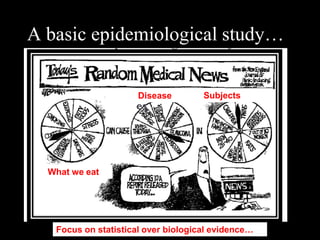
A basic epidemiological study…

                      Disease        Subjects


  What we eat


   Focus on statistical over biological evidence…
Error…
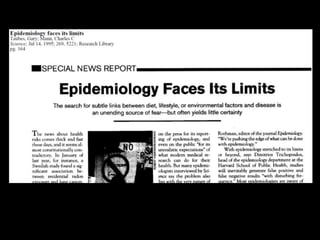
   Many contradictory studies
Not included in CI or p-value                     Accounted for by 95%
[Quantitative bias analysis]     Error            confidence interval and
                                                  p-value
    Selection bias
     recruitment %


Information             Systematic       Random
    bias
Accuracy of measures?


 Unmeasured                              False +ve           False –ve
                                            ~5%                ~10 to 20%
 confounding
RCT? From literature?
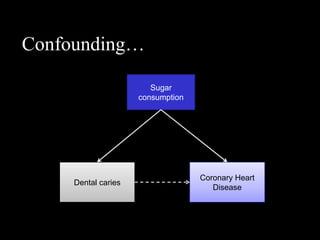
Confounding…

                        Sugar
                     consumption


                                   Coronary Heart
     Dental caries
                                      Disease
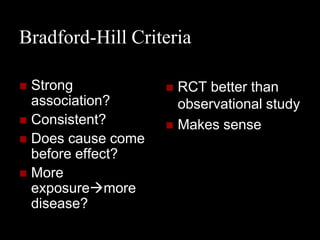
Bradford-Hill Criteria

 Strong             RCT better than
  association?        observational study
 Consistent?        Makes sense
 Does cause come
  before effect?
 More
  exposuremore
  disease?
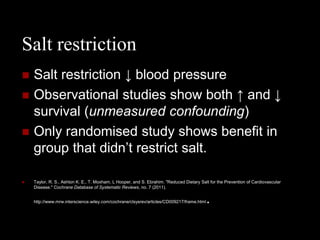
Salt restriction
   Salt restriction ↓ blood pressure
   Observational studies show both ↑ and ↓
    survival (unmeasured confounding)
   Only randomised study shows benefit in
    group that didn’t restrict salt.

   Taylor, R. S., Ashton K. E., T. Moxham, L Hooper, and S. Ebrahim. "Reduced Dietary Salt for the Prevention of Cardiovascular
    Disease." Cochrane Database of Systematic Reviews, no. 7 (2011).


    http://www.mrw.interscience.wiley.com/cochrane/clsysrev/articles/CD009217/frame.html   .
Is the idea falsifiable?

HOW DOES SCIENCE GO
WRONG?
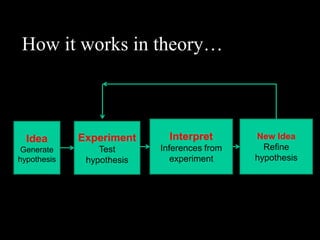
How it works in theory…


  Idea       Experiment      Interpret       New Idea
 Generate        Test      Inferences from     Refine
hypothesis    hypothesis      experiment     hypothesis
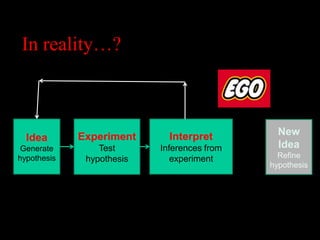
In reality…?


             Experiment      Interpret         New
  Idea
 Generate        Test      Inferences from     Idea
hypothesis    hypothesis      experiment       Refine
                                             hypothesis
Some history…

NUTRITION IDEAS OVER THE
LAST 100 YEARS…
   Museum photo…
   Dairy photo
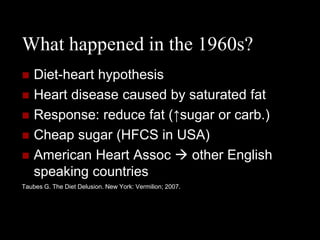
What happened in the 1960s?
   Diet-heart hypothesis
   Heart disease caused by saturated fat
   Response: reduce fat (↑sugar or carb.)
   Cheap sugar (HFCS in USA)
   American Heart Assoc  other English
    speaking countries
Taubes G. The Diet Delusion. New York: Vermilion; 2007.
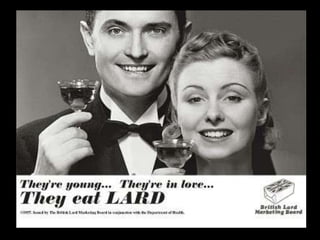
Brain washing?
THE ACCEPTED STORY
Nutrition to the rescue…
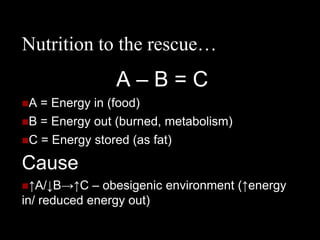
                A–B=C
A = Energy in (food)
B = Energy out (burned, metabolism)
C = Energy stored (as fat)

Cause
↑A/↓B→↑C    – obesigenic environment (↑energy
in/ reduced energy out)
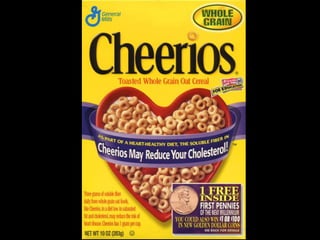
What’s ok...

THE GOOD!
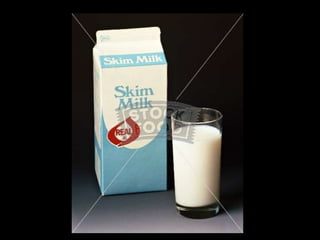
It’s not OK... Ever!

THE BAD
http://longwhitekid.files.wordpress.com/201
1/08/anchor-best-new-zealand-butter-
380h-x-270w-heavy-card-21.jpg
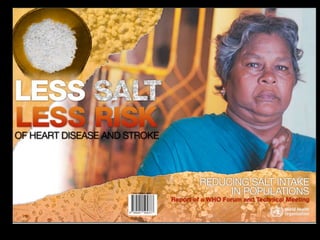
Salt
WE ALL LIVED HAPPILY
EVER AFTER?
AN ALTERNATIVE VIEW
EMERGES…
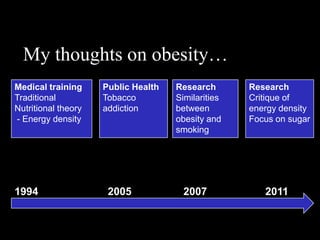
My thoughts on obesity…
Medical training     Public Health   Research       Research
Traditional          Tobacco         Similarities   Critique of
Nutritional theory   addiction       between        energy density
- Energy density                     obesity and    Focus on sugar
                                     smoking


1994                  2005            2007             2011
Why does a smoker smoke?
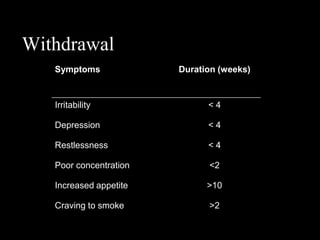
Withdrawal
   Symptoms             Duration (weeks)


   Irritability               <4

   Depression                 <4

   Restlessness               <4

   Poor concentration         <2

   Increased appetite         >10

   Craving to smoke           >2
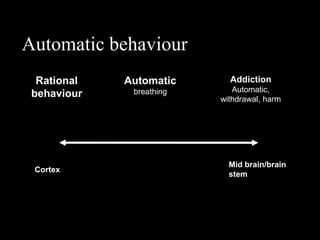
Automatic behaviour
  Rational   Automatic      Addiction
              breathing      Automatic,
 behaviour                withdrawal, harm


                            Mid brain/brain
 Cortex
                            stem
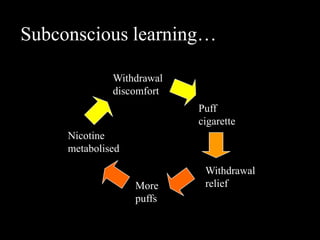
Subconscious learning…

              Withdrawal
              discomfort
                           Puff
                           cigarette
     Nicotine
     metabolised

                            Withdrawal
                   More     relief
                   puffs
How do cigarettes work...?
FOOD ADDICTION?
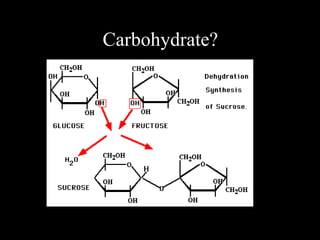
Carbohydrate?
Eating and addiction?
   Atkins Diet
   An executive who had tried obesity surgery,
    laxatives, diets, everything…

“Often I would shake until I could put
some sugar in my mouth”
 “Ihad an hour’s drive from my office to
  my home, and I knew every
  restaurant, candy machine and soft
  drink dispenser”
What about glucose?
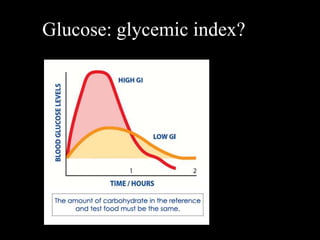
   Is refined starch the same as nicotine?
   Are low GI foods the obese person’s
    equivalent to a smoker’s nicotine patch or
    gum?
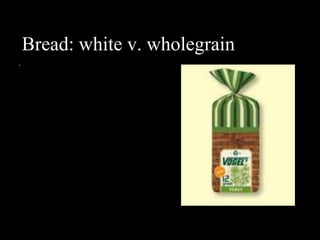
Bread: white v. wholegrain
Glucose: glycemic index?
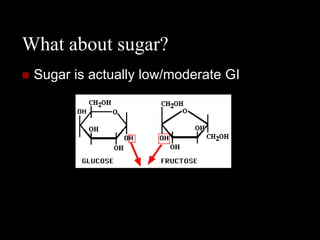
What about sugar?
   Sugar is actually low/moderate GI
I TAKE A LOOK AT SUGAR?
The medical gurus say sugar is
OK?
   “Excess sucrose has largely been
    exonerated as an important dietary factor in
    the aetiology of type-2 diabetes...”
J. I. Mann and A. S. Truswell
Diseases of overnourished societies and the need for dietary change: in the
Oxford Textbook of Medicine, 4th Edition.


   Postprandial glycemia (GI) used to
    exonnerate sugar…
Sugar: traditional views
   30% increase over last 30 years
Popkin BM, Nielsen SJ. The sweetening of the world's diet. Obesity Research 2003;11(11):1325-32.

   “Empty calorie”
Nestle M. Soft drink "pouring rights": marketing empty calories to children. Public Health Reports
   2000;115(4):308-19.

   Fructose not mentioned

   Something is missing?
Update...
   AHA turns around.
   “Fructose... has been indirectly implicated
    in the epidemics of obesity and type 2
    diabetes”
Circulation 2009;120;1011-1020
Fructose: what has changed?
     GI ignores fructose
     Sweeter than glucose
     Linked to:
            Gout, diabetes, weight gain, metabolic syndrome
            Hypertension, rotten teeth
            High triglycerides, dyslipidaemia, CVD
     Tends to ↑ hunger
Johnson, R.J., et al., Hypothesis: Could Excessive Fructose Intake and Uric Acid Cause Type 2 Diabetes? Endocr Rev, 2009. 30(1): p. 96-
     116.
Segal, M.S., E. Gollub, and R.J. Johnson, Is the fructose index more relevant with regards to cardiovascular disease than the glycemic index?
      European Journal of Nutrition, 2007. 46(7): p. 406-17.
What about saturated fat?
   Recent summaries
     no association with heart disease.


Skeaff CM, Miller J. Dietary Fat and Coronary Heart Disease: Summary of Evidence
   from Prospective Cohort and Randomised Controlled Trials. Ann Nutr Metab
   2009;55:173–201


Mente A, de Koning L, Shannon HS, Anand SS (April 2009). A systematic review of the
   evidence supporting a causal link between dietary factors and coronary heart
   disease. Arch. Intern. Med. 169 (7): 659–69.
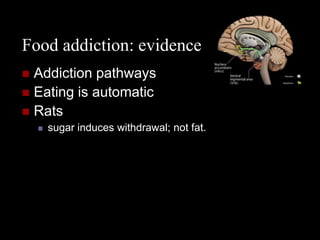
Food addiction: evidence
 Addiction pathways
 Eating is automatic
 Rats
       sugar induces withdrawal; not fat.
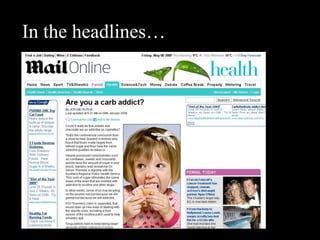
In the headlines…
My inbox...
 “For three weeks I cut all sugar and
  flour…
 then…
       mood swings…,
       depression…,
       stomach pain…,
       joint and muscle pain…,
       the shakes….”
“People who knew me started thinking I was
hiding a drug problem.”
Overeater’s Anonymous
   “When you are addicted to drugs you put
    the tiger in the cage to recover;
   When you are addicted to food, you put the
    tiger in the cage, but take it out three times
    for a walk”
       Kerri-Lynn Murphy Kriz
Critique: Academia
   “Any addictive … hypothesis can't explain
    the rise that we've seen over the last …
    30 years of obesity.”
Prof. Boyd Swinburn, Professor of Population Health,
  Deakin University 13 Jan 2009
SO WHAT?
Synopsis
 Nutrition focuses on energy not hunger
 Low fat idea predates obesity epidemic
 Sugar intake continues to ↑
 Likely subtle addiction
 Likely cause of major risk factors for heart
  disease
 Many nutrition researchers stuck in
  energy paradigm (cf. some pop science)
More details
Thank you!
Slides and my articles are
available at:
www.slideshare.net/sithor

'Low carb downunder' conference

  • 1.
    Has nutrition researchhelped us with our food choices? Simon Thornley (Epidemiologist) University of Auckland
  • 2.
    Summary  What is science/epidemiology?  A brief history of human nutrition  I get involved… diversion into tobacco  Food addiction?  What next?
  • 3.
    My view  Yes, but many nutrition scientists are not listening to the data  Fructose, sugar, carbohydrates are often overlooked
  • 4.
    What is scienceor research?  “In God we trust, all others bring data”  William Edward Deming  “First establish the facts, then seek to explain them”  Aristotle
  • 5.
    Science  Anarchistic; consensus not useful  Hypothesis and argument  Disproof over proof  Uncertainty over absolutes  Integration
  • 6.
    A basic epidemiologicalstudy… Disease Subjects What we eat Focus on statistical over biological evidence…
  • 8.
    Error…  Many contradictory studies Not included in CI or p-value Accounted for by 95% [Quantitative bias analysis] Error confidence interval and p-value Selection bias recruitment % Information Systematic Random bias Accuracy of measures? Unmeasured False +ve False –ve ~5% ~10 to 20% confounding RCT? From literature?
  • 9.
    Confounding… Sugar consumption Coronary Heart Dental caries Disease
  • 10.
    Bradford-Hill Criteria  Strong  RCT better than association? observational study  Consistent?  Makes sense  Does cause come before effect?  More exposuremore disease?
  • 11.
    Salt restriction  Salt restriction ↓ blood pressure  Observational studies show both ↑ and ↓ survival (unmeasured confounding)  Only randomised study shows benefit in group that didn’t restrict salt.  Taylor, R. S., Ashton K. E., T. Moxham, L Hooper, and S. Ebrahim. "Reduced Dietary Salt for the Prevention of Cardiovascular Disease." Cochrane Database of Systematic Reviews, no. 7 (2011). http://www.mrw.interscience.wiley.com/cochrane/clsysrev/articles/CD009217/frame.html .
  • 13.
    Is the ideafalsifiable? HOW DOES SCIENCE GO WRONG?
  • 14.
    How it worksin theory… Idea Experiment Interpret New Idea Generate Test Inferences from Refine hypothesis hypothesis experiment hypothesis
  • 15.
    In reality…? Experiment Interpret New Idea Generate Test Inferences from Idea hypothesis hypothesis experiment Refine hypothesis
  • 16.
    Some history… NUTRITION IDEASOVER THE LAST 100 YEARS…
  • 17.
    Museum photo…
  • 18.
    Dairy photo
  • 19.
    What happened inthe 1960s?  Diet-heart hypothesis  Heart disease caused by saturated fat  Response: reduce fat (↑sugar or carb.)  Cheap sugar (HFCS in USA)  American Heart Assoc  other English speaking countries Taubes G. The Diet Delusion. New York: Vermilion; 2007.
  • 20.
  • 21.
    Nutrition to therescue… A–B=C A = Energy in (food) B = Energy out (burned, metabolism) C = Energy stored (as fat) Cause ↑A/↓B→↑C – obesigenic environment (↑energy in/ reduced energy out)
  • 22.
  • 30.
    It’s not OK...Ever! THE BAD
  • 32.
  • 33.
  • 36.
    WE ALL LIVEDHAPPILY EVER AFTER?
  • 38.
  • 39.
    My thoughts onobesity… Medical training Public Health Research Research Traditional Tobacco Similarities Critique of Nutritional theory addiction between energy density - Energy density obesity and Focus on sugar smoking 1994 2005 2007 2011
  • 40.
    Why does asmoker smoke?
  • 41.
    Withdrawal Symptoms Duration (weeks) Irritability <4 Depression <4 Restlessness <4 Poor concentration <2 Increased appetite >10 Craving to smoke >2
  • 42.
    Automatic behaviour Rational Automatic Addiction breathing Automatic, behaviour withdrawal, harm Mid brain/brain Cortex stem
  • 43.
    Subconscious learning… Withdrawal discomfort Puff cigarette Nicotine metabolised Withdrawal More relief puffs
  • 44.
  • 45.
  • 46.
  • 47.
    Eating and addiction?  Atkins Diet  An executive who had tried obesity surgery, laxatives, diets, everything… “Often I would shake until I could put some sugar in my mouth”
  • 48.
     “Ihad anhour’s drive from my office to my home, and I knew every restaurant, candy machine and soft drink dispenser”
  • 49.
    What about glucose?  Is refined starch the same as nicotine?  Are low GI foods the obese person’s equivalent to a smoker’s nicotine patch or gum?
  • 50.
    Bread: white v.wholegrain
  • 51.
  • 52.
    What about sugar?  Sugar is actually low/moderate GI
  • 53.
    I TAKE ALOOK AT SUGAR?
  • 55.
    The medical gurussay sugar is OK?  “Excess sucrose has largely been exonerated as an important dietary factor in the aetiology of type-2 diabetes...” J. I. Mann and A. S. Truswell Diseases of overnourished societies and the need for dietary change: in the Oxford Textbook of Medicine, 4th Edition.  Postprandial glycemia (GI) used to exonnerate sugar…
  • 56.
    Sugar: traditional views  30% increase over last 30 years Popkin BM, Nielsen SJ. The sweetening of the world's diet. Obesity Research 2003;11(11):1325-32.  “Empty calorie” Nestle M. Soft drink "pouring rights": marketing empty calories to children. Public Health Reports 2000;115(4):308-19.  Fructose not mentioned  Something is missing?
  • 59.
    Update...  AHA turns around.  “Fructose... has been indirectly implicated in the epidemics of obesity and type 2 diabetes” Circulation 2009;120;1011-1020
  • 60.
    Fructose: what haschanged?  GI ignores fructose  Sweeter than glucose  Linked to:  Gout, diabetes, weight gain, metabolic syndrome  Hypertension, rotten teeth  High triglycerides, dyslipidaemia, CVD  Tends to ↑ hunger Johnson, R.J., et al., Hypothesis: Could Excessive Fructose Intake and Uric Acid Cause Type 2 Diabetes? Endocr Rev, 2009. 30(1): p. 96- 116. Segal, M.S., E. Gollub, and R.J. Johnson, Is the fructose index more relevant with regards to cardiovascular disease than the glycemic index? European Journal of Nutrition, 2007. 46(7): p. 406-17.
  • 61.
    What about saturatedfat?  Recent summaries  no association with heart disease. Skeaff CM, Miller J. Dietary Fat and Coronary Heart Disease: Summary of Evidence from Prospective Cohort and Randomised Controlled Trials. Ann Nutr Metab 2009;55:173–201 Mente A, de Koning L, Shannon HS, Anand SS (April 2009). A systematic review of the evidence supporting a causal link between dietary factors and coronary heart disease. Arch. Intern. Med. 169 (7): 659–69.
  • 62.
    Food addiction: evidence Addiction pathways  Eating is automatic  Rats  sugar induces withdrawal; not fat.
  • 63.
  • 64.
    My inbox...  “Forthree weeks I cut all sugar and flour…  then…  mood swings…,  depression…,  stomach pain…,  joint and muscle pain…,  the shakes….”
  • 65.
    “People who knewme started thinking I was hiding a drug problem.”
  • 66.
    Overeater’s Anonymous  “When you are addicted to drugs you put the tiger in the cage to recover;  When you are addicted to food, you put the tiger in the cage, but take it out three times for a walk” Kerri-Lynn Murphy Kriz
  • 67.
    Critique: Academia  “Any addictive … hypothesis can't explain the rise that we've seen over the last … 30 years of obesity.” Prof. Boyd Swinburn, Professor of Population Health, Deakin University 13 Jan 2009
  • 69.
  • 70.
    Synopsis  Nutrition focuseson energy not hunger  Low fat idea predates obesity epidemic  Sugar intake continues to ↑  Likely subtle addiction  Likely cause of major risk factors for heart disease  Many nutrition researchers stuck in energy paradigm (cf. some pop science)
  • 71.
  • 72.
    Thank you! Slides andmy articles are available at: www.slideshare.net/sithor

Editor's Notes

  • #11 Eg. vitamin D. Plausible biological mechanism, consistent studies.Essentially inductionist principles. Critique: Rely heavily on the subjective judgement of the reviewer. Temporality particularly important (prospective studies stronger). Expanding scientific literature makes almost all plausible hypotheses supported.
  • #47 Important, because in a prominent publication summarising findings, not one mention of the health effects of fructose was mentioned.
  • #57 How much sugar do you think Nzers eat on average?
  • #60 Why the about face????