Technology
Technology
Technology
By
D Snehith Kumar
17601A0530
Agenda
Introduction
Evolution
5G technology
Architecture
Comparision
Advantages
Disadvantages
Applications
Conclusion
Reference
Introduction
Now we're headed toward 5G the next generation of
wireless it will be able to handle a thousand times more
traffic than today's networks and it'll be up to 10 times faster
than 4G LTE.
5G is the 5th generation mobile network. It is a new global
wireless standard after 1G, 2G, 3G, and 4G networks. 5G
enables a new kind of network that is designed to connect
virtually everyone and everything together including
machines, objects, and devices.
01
Introduction
Every new generation of wireless
1G 2G 3G 4G
Evolution
Evolution
02
Networks delivers faster speeds and more
functionality to our smartphones!
Evolution
03
1G brought us the very
first cell phones.
2G let us text for the
first time.
4G delivered the speeds that
we enjoy today!
3G brought us online.
Thanks
Namastey!
Evolution
04
First Generation wireless technology (1G) is the original analog (An analog or
analogue signal is any continuous signal for which the time varying feature
(variable) of the signal is a representation of some other time varying quantity),
voice-only cellular telephone standard, developed in the 1980s. The main difference
between two succeeding mobile telephone systems, 1G and 2G, is that the radio
signals that 1G networks use are analog, while 2G networks are digital.
Speed was upto 2.4kbps.
It Allows the voice calls in 1 country.
1G network use analog Signal.
AMPS was first launched in USA in 1G mobile systems.
1G WIRELESS SYSTEM
1G
2.4kbps Speed.
05
2G WIRELESS SYSTEM
2G (or 2-G) is short for second-generation wireless telephone technology. Second
generation 2G cellular telecom networks were commercially launched on the GSM
standard in Finland by Radiolinja (now part of Elisa Oyj) in 1991. 2G network allows for
much greater penetration intensity.
2G network use digital signals
Its data speed was upto 64kbps
It provides MMS ( Multi Media Messages).
It provides better quality and capacity.
164kbps Speed.
2G
06
2.5G WIRELESS SYSTEM
2.75G (EDGE)
2.5G is a stepping stone between 2G and 3G cellular wireless technologies. The term
"second and a half generation" is used to describe 2G-systems that have
implemented a packet switched domain in addition to the circuit switched domain.
It does not necessarily provide faster services because bundling of timeslots is used
for circuit switched data services (HSCSD) as well.
GPRS networks evolved to EDGE networks with the introduction of 8PSK encoding.
Enhanced Data rates for GSM Evolution, Enhanced GPRS (EGPRS), or IMT Single
Carrier (IMT-SC) is a backward-compatible digital mobile phone technology that
allows improved data transmission rates, as an extension on top of standard GSM.
EDGE was deployed on GSM networks beginning in 2003—initially by Cingular (now
AT&T) in the United States.
In between 2G and 3G there is another generation called 2.5G
2. 2.5G represents handsets with data capabilities over GPRS
3. But this had not brought out any new revolution 2G
07
International Mobile Telecommunications-2000 (IMT--2000), better known as 3G or 3rd
Generation, is a generation of standards for mobile phones and mobile
telecommunications services fulfilling specifications by the International
Telecommunication Union.
3G is also known as IMT-2000.
Data Transmission speed increased from 144kbps - 2mbps.
To accommodate web-based applications and audio and video files.
3G WIRELESS SYSTEM
144kbps - 2mbps Speed
3G
08
4G refers to the fourth generation of cellular wireless standards. It is a successor to 3G and
2G families of standards. The nomenclature of the generations generally refers to a
change in the fundamental nature of the service, non-backwards compatible
transmission technology, and new frequency bands.3G technologies make use of TDMA
and CDMA. 3G (Third Generation Technology) technologies make use of value added
services like mobile television, GPS (global positioning system) and video conferencing.
4G name was started from late 2000.
Capable of providing 14Mbps - 100Gbps Speed.
4G WIRELESS SYSTEM
14 Mbps - 100 Mbps Speed.
4G
09
Now we're headed toward 5G
the next generation of wireless it will
be able to handle a thousand times more
traffic than today's networks and it'll be up to 10 times
faster than 4G LTE
5G Technology
5G Technology
10
5G technology refer to short name of fifth Generation which was started from late 2010s
Complete wireless communication with almost no limitations.
Its highly supportable to www wireless (world wide web)
High speed & high capacity
Upto 1.5Gbps Speed.
Fast data transmission that of the previous generation.
High capacity
5G is more effective.
5G WIRELESS SYSTEM
47 Mbps - 1.5 Gbps Speed.
5G
11
What makes 5G special?
To understand how 5G will differ from today’s 4G networks, it’s helpful to
walk through these five technologies and consider what each will mean
for wireless users.
5G
12
Millimeter Waves
Today’s wireless networks have run into a problem: More people and
devices are consuming more data than ever before, but it remains
crammed on the same bands of the radio-frequency spectrum that mobile
providers have always used. That means less bandwidth for everyone,
causing slower service and more dropped connections.
One way to get around that problem is to simply transmit signals on a whole new swath
of the spectrum, one that’s never been used for mobile service before. That’s why
providers are experimenting with broadcasting on millimeter waves, which use higher
frequencies than the radio waves that have long been used for mobile phones.
There is one major drawback to millimeter waves, though—they can’t easily travel through
buildings or obstacles and they can be absorbed by foliage and rain. That’s why 5G
networks will likely augment traditional cellular towers with another new technology,
called small cells.
Millimeter Waves
13
Small cells are portable miniature base stations that require minimal power
to operate and can be placed every 250 meters or so throughout cities. To
prevent signals from being dropped, carriers could install thousands of
these stations in a city to form a dense network that acts like a relay team,
receiving signals from other base stations and sending data to users at any
location.
While traditional cell networks have also come to rely on an increasing number of base
stations, achieving 5G performance will require an even greater infrastructure. Luckily,
antennas on small cells can be much smaller than traditional antennas if they are
transmitting tiny millimeter waves. This size difference makes it even easier to stick cells
on light poles and atop buildings.
In addition to broadcasting over millimeter waves, 5G base stations will also have many
more antennas than the base stations of today’s cellular networks—to take advantage of
another new technology: massive MIMO.
Small Cells
Small Cells
14
Today’s 4G base stations have a dozen ports for antennas that handle all
cellular traffic: eight for transmitters and four for receivers. But 5G base
stations can support about a hundred ports, which means many more
antennas can fit on a single array. That capability means a base station
could send and receive signals from many more users at once, increasing
the capacity of mobile networks by a factor of 22 or greater.
Today’s 4G base stations have a dozen ports for antennas that handle all cellular traffic:
eight for transmitters and four for receivers. But 5G base stations can support about a
hundred ports, which means many more antennas can fit on a single array. That
capability means a base station could send and receive signals from many more users at
once, increasing the capacity of mobile networks by a factor of 22 or greater.
Massive MIMO looks very promising for the future of 5G. However, installing so many more
antennas to handle cellular traffic also causes more interference if those signals cross.
That’s why 5G stations must incorporate beamforming.
Massive MIMO
Massive MIMO
15
Beamforming is a traffic-signaling system for cellular base stations that
identifies the most efficient data-delivery route to a particular user, and it
reduces interference for nearby users in the process. Depending on the
situation and the technology, there are several ways for 5G networks to
implement it.
Beamforming can help massive MIMO arrays make more efficient use of the spectrum
around them. The primary challenge for massive MIMO is to reduce interference while
transmitting more information from many more antennas at once. At massive MIMO base
stations, signal-processing algorithms plot the best transmission route through the air to
each user. Then they can send individual data packets in many different directions,
bouncing them off buildings and other objects in a precisely coordinated pattern. By
choreographing the packets’ movements and arrival time, beamforming allows many users
and antennas on a massive MIMO array to exchange much more information at once.
Besides boosting data rates by broadcasting over millimeter waves and beefing up
spectrum efficiency with massive MIMO, wireless engineers are also trying to achieve the
high throughput and low latency required for 5G through a technology called full duplex,
which modifies the way antennas deliver and receive data.
Beamforming
Beamforming
16
Today's base stations and cellphones rely on transceivers that must take
turns if transmitting and receiving information over the same frequency, or
operate on different frequencies if a user wishes to transmit and receive
information at the same time.
With 5G, a transceiver will be able to transmit and receive data at the same time, on the
same frequency. This technology is known as full duplex, and it could double the capacity
of wireless networks at their most fundamental physical layer: Picture two people talking
at the same time but still able to understand one another—which means their
conversation could take half as long and their next discussion could start sooner.
With these and other 5G technologies, engineers hope to build the wireless network that
future smartphone users, VR gamers, and autonomous cars will rely on every day. Already,
researchers and companies have set high expectations for 5G by promising ultralow
latency and record-breaking data speeds for consumers. If they can solve the remaining
challenges, and figure out how to make all these systems work together, ultrafast 5G
service could reach consumers in the next five years.
Full Duplex
Full Duplex
17
But as more
users come online 4G networks have just
about reached the limit of what they're
capable of at a time when users want
even more data for their smart phone and devices
5G
18
just imagine downloading an HD movie in
under a second and then let your
imagination run wild 5g will be the
foundation for virtual reality
autonomous driving the Internet of
Things and stuff we can't even yet
imagine
5G
19
Architecture
Architecture
20
Comparision
Technology
Technology
Switching Circuit Packet Circuit Packet
Up to 1GB
Up to 20Mbps
Combination
of Broadband
LAN/WAN/PAN
Combination
of Broadband
LAN/WAN/PAN
Data Rate
4G (2000 - 10) 4G (2010 - 20)
Comparision
21
Advantages
HIGH SPEED INTERNET ACCESS.
HIGH SECURITY.
GREATER SPEED IN TRANSMISSIONS.
LOWER LATENCY.
GREATER NUMBER OF CONNECTED DEVICES.
NETWORK SLICING.
Advantages
22
Disadvantages
OBSTRUCTIONS CAN IMPACT CONNECTIVITY
INITIAL COSTS FOR ROLLOUT ARE HIGH
LIMITATIONS OF RURAL ACCESS
BATTERY DRAIN ON DEVICES
UPLOAD SPEEDS DON’T MATCH DOWNLOAD SPEEDS
DETRACTING FROM THE AESTHETICS
Disadvantages
23
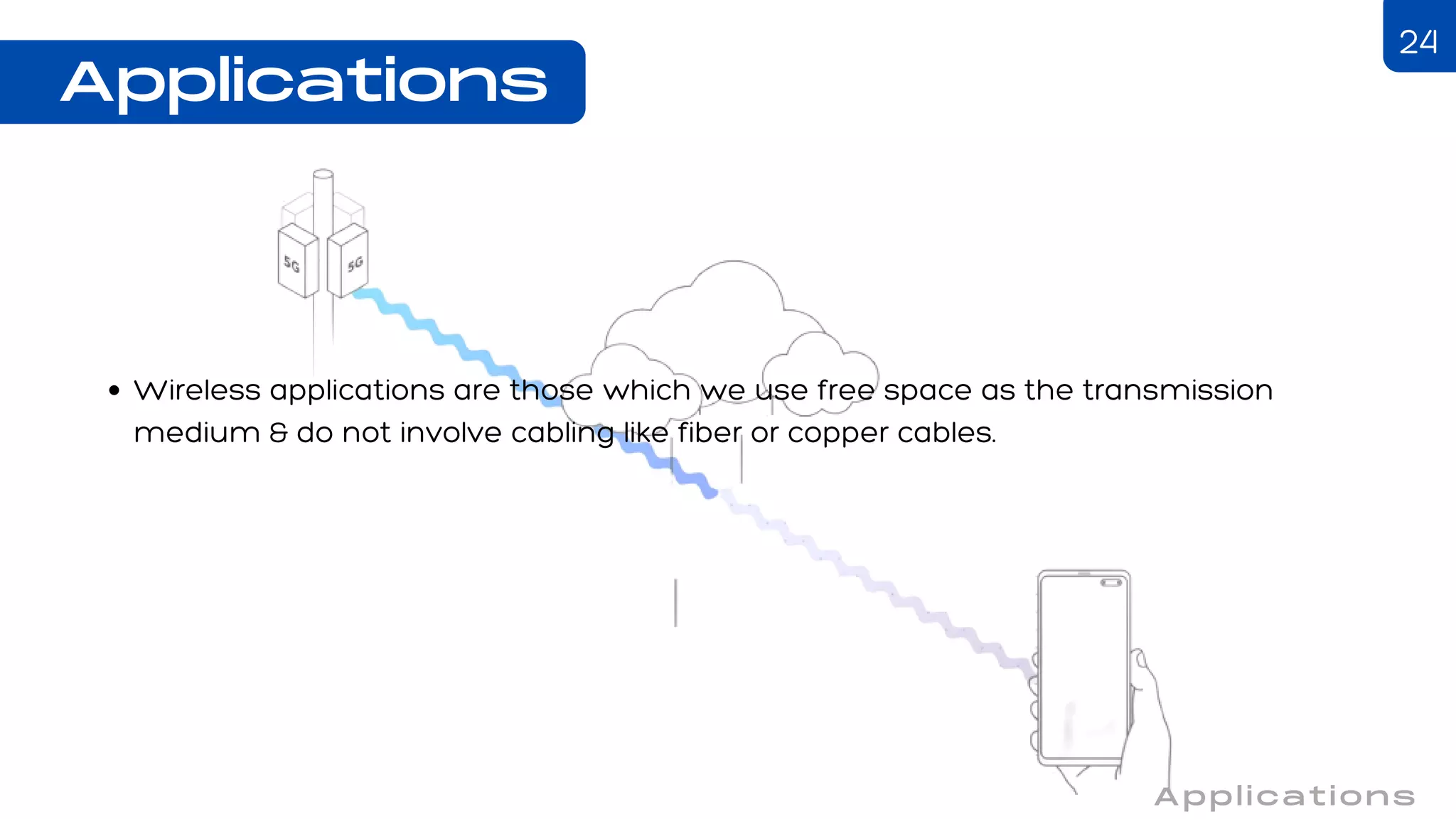
Wireless applications are those which we use free space as the transmission
medium & do not involve cabling like fiber or copper cables.
Applications
Applications
24
Conclusion
All totally the best way to help all users is to use 5G as the next wireless
system and in totally it is safety and secure for public, this need
demands solution.
Today's society is going wireless and if it has problem, 5G is answer.
5G technology is going to give tough competition to computers and
laptops.
It is available in market since 2020 but only specific regions and cost also
may vary with more reliability than previous mobiles.
Conclusion
25
Reference
https://spectrum.ieee.org/video/telecom/wireless/everything-you-need-
to-know-about-5g
https://www.youtube.com/watch?v=GEx_d0SjvS0
https://www.qualcomm.com/5g/what-is-
5g#:~:text=A%3A%205G%20is%20designed%20to%20deliver%20peak%20data
%20rates%20up,just%20how%20fast%20it%20is.
1.
2.
3.
Reference
26
Thank You!
snehithkumar
www.quickplants.me
www.snehith.rocks
www.accesscloud.online

5G Technology Seminar Presentation.

  • 1.
  • 2.
  • 3.
    Introduction Now we're headedtoward 5G the next generation of wireless it will be able to handle a thousand times more traffic than today's networks and it'll be up to 10 times faster than 4G LTE. 5G is the 5th generation mobile network. It is a new global wireless standard after 1G, 2G, 3G, and 4G networks. 5G enables a new kind of network that is designed to connect virtually everyone and everything together including machines, objects, and devices. 01 Introduction
  • 4.
    Every new generationof wireless 1G 2G 3G 4G Evolution Evolution 02
  • 5.
    Networks delivers fasterspeeds and more functionality to our smartphones! Evolution 03
  • 6.
    1G brought usthe very first cell phones. 2G let us text for the first time. 4G delivered the speeds that we enjoy today! 3G brought us online. Thanks Namastey! Evolution 04
  • 7.
    First Generation wirelesstechnology (1G) is the original analog (An analog or analogue signal is any continuous signal for which the time varying feature (variable) of the signal is a representation of some other time varying quantity), voice-only cellular telephone standard, developed in the 1980s. The main difference between two succeeding mobile telephone systems, 1G and 2G, is that the radio signals that 1G networks use are analog, while 2G networks are digital. Speed was upto 2.4kbps. It Allows the voice calls in 1 country. 1G network use analog Signal. AMPS was first launched in USA in 1G mobile systems. 1G WIRELESS SYSTEM 1G 2.4kbps Speed. 05
  • 8.
    2G WIRELESS SYSTEM 2G(or 2-G) is short for second-generation wireless telephone technology. Second generation 2G cellular telecom networks were commercially launched on the GSM standard in Finland by Radiolinja (now part of Elisa Oyj) in 1991. 2G network allows for much greater penetration intensity. 2G network use digital signals Its data speed was upto 64kbps It provides MMS ( Multi Media Messages). It provides better quality and capacity. 164kbps Speed. 2G 06
  • 9.
    2.5G WIRELESS SYSTEM 2.75G(EDGE) 2.5G is a stepping stone between 2G and 3G cellular wireless technologies. The term "second and a half generation" is used to describe 2G-systems that have implemented a packet switched domain in addition to the circuit switched domain. It does not necessarily provide faster services because bundling of timeslots is used for circuit switched data services (HSCSD) as well. GPRS networks evolved to EDGE networks with the introduction of 8PSK encoding. Enhanced Data rates for GSM Evolution, Enhanced GPRS (EGPRS), or IMT Single Carrier (IMT-SC) is a backward-compatible digital mobile phone technology that allows improved data transmission rates, as an extension on top of standard GSM. EDGE was deployed on GSM networks beginning in 2003—initially by Cingular (now AT&T) in the United States. In between 2G and 3G there is another generation called 2.5G 2. 2.5G represents handsets with data capabilities over GPRS 3. But this had not brought out any new revolution 2G 07
  • 10.
    International Mobile Telecommunications-2000(IMT--2000), better known as 3G or 3rd Generation, is a generation of standards for mobile phones and mobile telecommunications services fulfilling specifications by the International Telecommunication Union. 3G is also known as IMT-2000. Data Transmission speed increased from 144kbps - 2mbps. To accommodate web-based applications and audio and video files. 3G WIRELESS SYSTEM 144kbps - 2mbps Speed 3G 08
  • 11.
    4G refers tothe fourth generation of cellular wireless standards. It is a successor to 3G and 2G families of standards. The nomenclature of the generations generally refers to a change in the fundamental nature of the service, non-backwards compatible transmission technology, and new frequency bands.3G technologies make use of TDMA and CDMA. 3G (Third Generation Technology) technologies make use of value added services like mobile television, GPS (global positioning system) and video conferencing. 4G name was started from late 2000. Capable of providing 14Mbps - 100Gbps Speed. 4G WIRELESS SYSTEM 14 Mbps - 100 Mbps Speed. 4G 09
  • 12.
    Now we're headedtoward 5G the next generation of wireless it will be able to handle a thousand times more traffic than today's networks and it'll be up to 10 times faster than 4G LTE 5G Technology 5G Technology 10
  • 13.
    5G technology referto short name of fifth Generation which was started from late 2010s Complete wireless communication with almost no limitations. Its highly supportable to www wireless (world wide web) High speed & high capacity Upto 1.5Gbps Speed. Fast data transmission that of the previous generation. High capacity 5G is more effective. 5G WIRELESS SYSTEM 47 Mbps - 1.5 Gbps Speed. 5G 11
  • 14.
    What makes 5Gspecial? To understand how 5G will differ from today’s 4G networks, it’s helpful to walk through these five technologies and consider what each will mean for wireless users. 5G 12
  • 15.
    Millimeter Waves Today’s wirelessnetworks have run into a problem: More people and devices are consuming more data than ever before, but it remains crammed on the same bands of the radio-frequency spectrum that mobile providers have always used. That means less bandwidth for everyone, causing slower service and more dropped connections. One way to get around that problem is to simply transmit signals on a whole new swath of the spectrum, one that’s never been used for mobile service before. That’s why providers are experimenting with broadcasting on millimeter waves, which use higher frequencies than the radio waves that have long been used for mobile phones. There is one major drawback to millimeter waves, though—they can’t easily travel through buildings or obstacles and they can be absorbed by foliage and rain. That’s why 5G networks will likely augment traditional cellular towers with another new technology, called small cells. Millimeter Waves 13
  • 16.
    Small cells areportable miniature base stations that require minimal power to operate and can be placed every 250 meters or so throughout cities. To prevent signals from being dropped, carriers could install thousands of these stations in a city to form a dense network that acts like a relay team, receiving signals from other base stations and sending data to users at any location. While traditional cell networks have also come to rely on an increasing number of base stations, achieving 5G performance will require an even greater infrastructure. Luckily, antennas on small cells can be much smaller than traditional antennas if they are transmitting tiny millimeter waves. This size difference makes it even easier to stick cells on light poles and atop buildings. In addition to broadcasting over millimeter waves, 5G base stations will also have many more antennas than the base stations of today’s cellular networks—to take advantage of another new technology: massive MIMO. Small Cells Small Cells 14
  • 17.
    Today’s 4G basestations have a dozen ports for antennas that handle all cellular traffic: eight for transmitters and four for receivers. But 5G base stations can support about a hundred ports, which means many more antennas can fit on a single array. That capability means a base station could send and receive signals from many more users at once, increasing the capacity of mobile networks by a factor of 22 or greater. Today’s 4G base stations have a dozen ports for antennas that handle all cellular traffic: eight for transmitters and four for receivers. But 5G base stations can support about a hundred ports, which means many more antennas can fit on a single array. That capability means a base station could send and receive signals from many more users at once, increasing the capacity of mobile networks by a factor of 22 or greater. Massive MIMO looks very promising for the future of 5G. However, installing so many more antennas to handle cellular traffic also causes more interference if those signals cross. That’s why 5G stations must incorporate beamforming. Massive MIMO Massive MIMO 15
  • 18.
    Beamforming is atraffic-signaling system for cellular base stations that identifies the most efficient data-delivery route to a particular user, and it reduces interference for nearby users in the process. Depending on the situation and the technology, there are several ways for 5G networks to implement it. Beamforming can help massive MIMO arrays make more efficient use of the spectrum around them. The primary challenge for massive MIMO is to reduce interference while transmitting more information from many more antennas at once. At massive MIMO base stations, signal-processing algorithms plot the best transmission route through the air to each user. Then they can send individual data packets in many different directions, bouncing them off buildings and other objects in a precisely coordinated pattern. By choreographing the packets’ movements and arrival time, beamforming allows many users and antennas on a massive MIMO array to exchange much more information at once. Besides boosting data rates by broadcasting over millimeter waves and beefing up spectrum efficiency with massive MIMO, wireless engineers are also trying to achieve the high throughput and low latency required for 5G through a technology called full duplex, which modifies the way antennas deliver and receive data. Beamforming Beamforming 16
  • 19.
    Today's base stationsand cellphones rely on transceivers that must take turns if transmitting and receiving information over the same frequency, or operate on different frequencies if a user wishes to transmit and receive information at the same time. With 5G, a transceiver will be able to transmit and receive data at the same time, on the same frequency. This technology is known as full duplex, and it could double the capacity of wireless networks at their most fundamental physical layer: Picture two people talking at the same time but still able to understand one another—which means their conversation could take half as long and their next discussion could start sooner. With these and other 5G technologies, engineers hope to build the wireless network that future smartphone users, VR gamers, and autonomous cars will rely on every day. Already, researchers and companies have set high expectations for 5G by promising ultralow latency and record-breaking data speeds for consumers. If they can solve the remaining challenges, and figure out how to make all these systems work together, ultrafast 5G service could reach consumers in the next five years. Full Duplex Full Duplex 17
  • 20.
    But as more userscome online 4G networks have just about reached the limit of what they're capable of at a time when users want even more data for their smart phone and devices 5G 18
  • 21.
    just imagine downloadingan HD movie in under a second and then let your imagination run wild 5g will be the foundation for virtual reality autonomous driving the Internet of Things and stuff we can't even yet imagine 5G 19
  • 22.
  • 23.
    Comparision Technology Technology Switching Circuit PacketCircuit Packet Up to 1GB Up to 20Mbps Combination of Broadband LAN/WAN/PAN Combination of Broadband LAN/WAN/PAN Data Rate 4G (2000 - 10) 4G (2010 - 20) Comparision 21
  • 24.
    Advantages HIGH SPEED INTERNETACCESS. HIGH SECURITY. GREATER SPEED IN TRANSMISSIONS. LOWER LATENCY. GREATER NUMBER OF CONNECTED DEVICES. NETWORK SLICING. Advantages 22
  • 25.
    Disadvantages OBSTRUCTIONS CAN IMPACTCONNECTIVITY INITIAL COSTS FOR ROLLOUT ARE HIGH LIMITATIONS OF RURAL ACCESS BATTERY DRAIN ON DEVICES UPLOAD SPEEDS DON’T MATCH DOWNLOAD SPEEDS DETRACTING FROM THE AESTHETICS Disadvantages 23
  • 26.
    Wireless applications arethose which we use free space as the transmission medium & do not involve cabling like fiber or copper cables. Applications Applications 24
  • 27.
    Conclusion All totally thebest way to help all users is to use 5G as the next wireless system and in totally it is safety and secure for public, this need demands solution. Today's society is going wireless and if it has problem, 5G is answer. 5G technology is going to give tough competition to computers and laptops. It is available in market since 2020 but only specific regions and cost also may vary with more reliability than previous mobiles. Conclusion 25
  • 28.
  • 29.