Introduction to 5G
By TK Mondal
SDE, RTTC, Kalyani
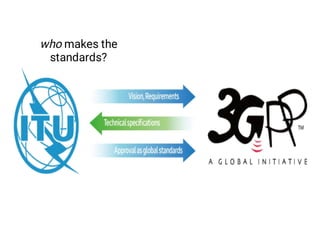
who makes the
standards?







5th Generation Mobile Network or simply 5G is the
forthcoming revolution of mobile technology.
Complete wireless communication with almost no
limitations.
5G aims to design a Multi-Bandwidth Data Path by
integrating the current and future networks for new
network architecture of 5G real wireless world.
5G is a packet switched wireless system with wide area
coverage(wwww) or world wide wireless web.
Flexible channel bandwidth between 5 and 20MHz ,
optionally up to 40MHz.
The 5G wireless internet networks are real wireless world
which shall be supported by CDMA, OFDM, MC-CDMA,
UWB and IPv6.
5G enables speed more than 1 GBps
5G
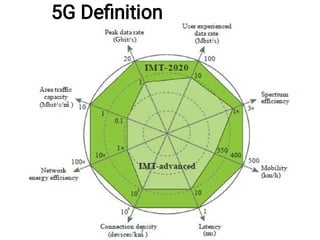
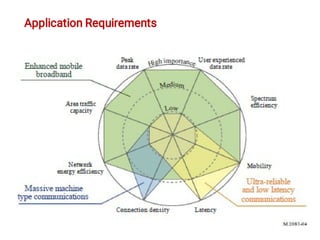
5G is defined by IMT-2020 requirements in terms
of 8 parameters:
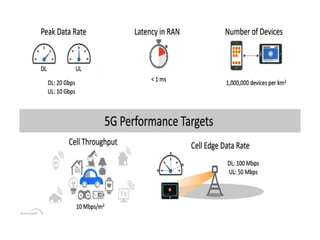
a peak rate up to 20 Gbps per user, User
experienced rate of 100 Mbps, Mobility support to
500 km/h, a latency of 1 ms, a density of a million
connections per m2, energy efficiency 100× of 4G
5G Standard
1.
2.
3.
4.
5.
6.
7.
8.
Peak Data Rate: max rate per user under ideal
conditions. 10 Gbps for mobiles, 20 Gbps under certain
conditions.
User experienced Data Rate: 95% Rate across the
coverage area per user. 100 Mbps in urban/suburban
areas. 1 Gbps hotspot.
Latency: Radio contribution to latency between send
and receive
Mobility: Max speed at which seamless handover and
QoS is guaranteed
Connection Density: Devices per km2
Energy Efficiency: Network bits/Joule, User bits/Joule
Spectrum Efficiency: Throughput per Hz per cell
Area Traffic Capacity: Throughput per m2
5G Definition
5G Definition
1.
2.
3.
4.
5.
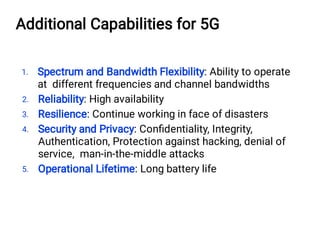
Spectrum and Bandwidth Flexibility: Ability to operate
at different frequencies and channel bandwidths
Reliability: High availability
Resilience: Continue working in face of disasters
Security and Privacy: Confidentiality, Integrity,
Authentication, Protection against hacking, denial of
service, man-in-the-middle attacks
Operational Lifetime: Long battery life
Additional Capabilities for 5G
1.
2.
3.
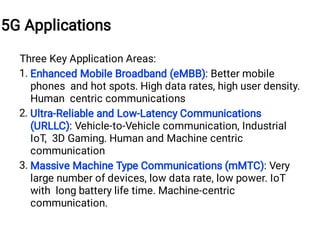
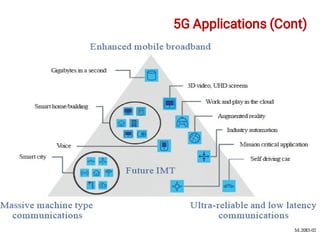
Three Key Application Areas:
Enhanced Mobile Broadband (eMBB): Better mobile
phones and hot spots. High data rates, high user density.
Human centric communications
Ultra-Reliable and Low-Latency Communications
(URLLC): Vehicle-to-Vehicle communication, Industrial
IoT, 3D Gaming. Human and Machine centric
communication
Massive Machine Type Communications (mMTC): Very
large number of devices, low data rate, low power. IoT
with long battery life time. Machine-centric
communication.
5G Applications
5G Applications (Cont)
Application Requirements
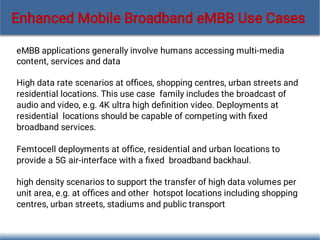
eMBB applications generally involve humans accessing multi-media
content, services and data
High data rate scenarios at offices, shopping centres, urban streets and
residential locations. This use case family includes the broadcast of
audio and video, e.g. 4K ultra high definition video. Deployments at
residential locations should be capable of competing with fixed
broadband services.
Femtocell deployments at office, residential and urban locations to
provide a 5G air-interface with a fixed broadband backhaul.
high density scenarios to support the transfer of high data volumes per
unit area, e.g. at offices and other hotspot locations including shopping
centres, urban streets, stadiums and public transport
Enhanced Mobile Broadband eMBB Use Cases
•
•
•
•
•
•
•
•
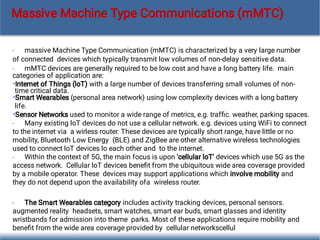
massive Machine Type Communication (mMTC) is characterized by a very large number
of connected devices which typically transmit low volumes of non-delay sensitive data.
mMTC devices are generally required to be low cost and have a long battery life. main
categories of application are:
Internet of Things (loT) with a large number of devices transferring small volumes of non-
time critical data.
Smart Wearables (personal area network) using low complexity devices with a long battery
life.
Sensor Networks used to monitor a wide range of metrics, e.g. traffic. weather, parking spaces.
Many existing loT devices do not use a cellular network. e.g. devices using WiFi to connect
to the internet via a wirless router. These devices are typically short range, have little or no
mobility, Bluetooth Low Energy (BLE) and ZigBee are other alternative wireless technologies
used to connect loT devices lo each other and to the internet.
Within the context of 5G, the main focus is upon 'cellular loT' devices which use 5G as the
access network. Cellular loT devices benefit from the ubiquitous wide area coverage provided
by a mobile operator. These devices may support applications which involve mobility and
they do not depend upon the availability ofa wireless router.
The Smart Wearables category includes activity tracking devices, personal sensors.
augmented reality headsets, smart watches, smart ear buds, smart glasses and identity
wristbands for admission into theme parks. Most of these applications require mobility and
benefit from the wide area coverage provided by cellular networkscellul
Massive Machine Type Communications (mMTC)
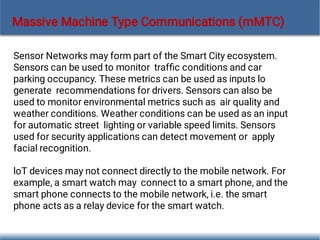
Sensor Networks may form part of the Smart City ecosystem.
Sensors can be used to monitor traffic conditions and car
parking occupancy. These metrics can be used as inputs lo
generate recommendations for drivers. Sensors can also be
used to monitor environmental metrics such as air quality and
weather conditions. Weather conditions can be used as an input
for automatic street lighting or variable speed limits. Sensors
used for security applications can detect movement or apply
facial recognition.
loT devices may not connect directly to the mobile network. For
example, a smart watch may connect to a smart phone, and the
smart phone connects to the mobile network, i.e. the smart
phone acts as a relay device for the smart watch.
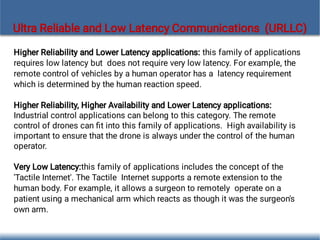
Ultra Reliable and Low Latency Communications (URLLC)
Higher Reliability and Lower Latency applications: this family of applications
requires low latency but does not require very low latency. For example, the
remote control of vehicles by a human operator has a latency requirement
which is determined by the human reaction speed.
Higher Reliability, Higher Availability and Lower Latency applications:
Industrial control applications can belong to this category. The remote
control of drones can fit into this family of applications. High availability is
important to ensure that the drone is always under the control of the human
operator.
Very Low Latency:this family of applications includes the concept of the
'Tactile Internet'. The Tactile Internet supports a remote extension to the
human body. For example, it allows a surgeon to remotely operate on a
patient using a mechanical arm which reacts as though it was the surgeon's
own arm.
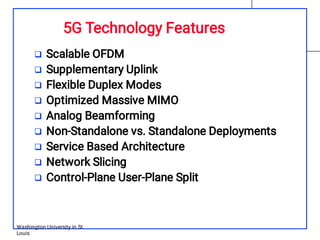
5G Technology Features
Washington University in St.
Louis









Scalable OFDM
Supplementary Uplink
Flexible Duplex Modes
Optimized Massive MIMO
Analog Beamforming
Non-Standalone vs. Standalone Deployments
Service Based Architecture
Network Slicing
Control-Plane User-Plane Split




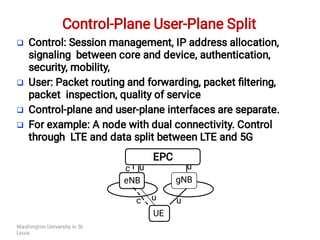
Control: Session management, IP address allocation,
signaling between core and device, authentication,
security, mobility,
User: Packet routing and forwarding, packet filtering,
packet inspection, quality of service
Control-plane and user-plane interfaces are separate.
For example: A node with dual connectivity. Control
through LTE and data split between LTE and 5G
EPC
eNB
c
Washington University in St.
Louis
c u
UE
u u
gNB
u
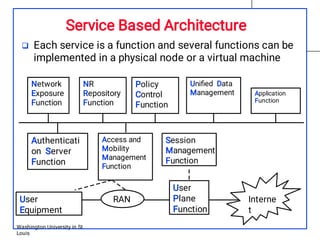
Service Based Architecture
 Each service is a function and several functions can be
implemented in a physical node or a virtual machine
Network
Exposure
Function
NR
Repository
Function
Unified Data
Management Application
Function
Policy
Control
Function
Authenticati
on Server
Function
Access and
Mobility
Management
Function
User
Plane
Function
Session
Management
Function
User
Equipment
RAN Interne
t
Washington University in St.
Louis
Network Slicing




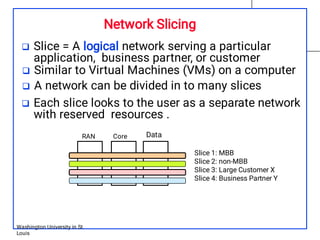
Slice = A logical network serving a particular
application, business partner, or customer
Similar to Virtual Machines (VMs) on a computer
A network can be divided in to many slices
Each slice looks to the user as a separate network
with reserved resources .
RAN Core Data
Slice 1: MBB
Slice 2: non-MBB
Slice 3: Large Customer X
Slice 4: Business Partner Y
Washington University in St.
Louis
MME
RNC IMS
Hardware
Set Top
Box
CGNAT
Residential
Gateway
Hardware
MME
Washington University in St.
Louis
RNC IMS
Residential
Gateway CGNAT
Set Top
Box
MME
RNC IMS
MME
RNC IMS
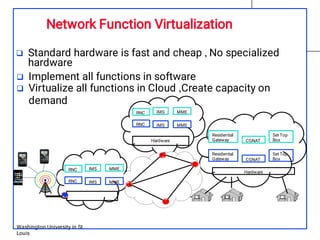
Network Function Virtualization



Standard hardware is fast and cheap  No specialized
hardware
Implement all functions in software
Virtualize all functions in Cloud Create capacity on
demand
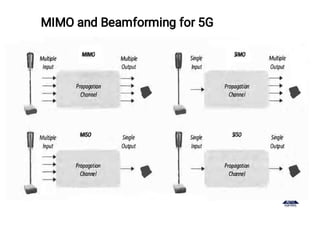
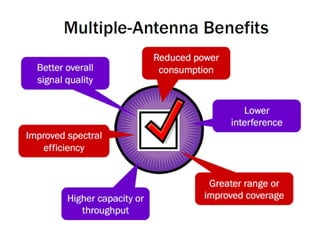
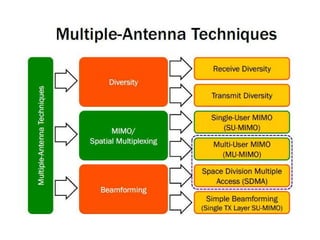
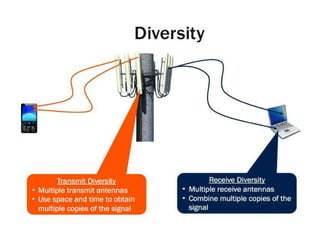
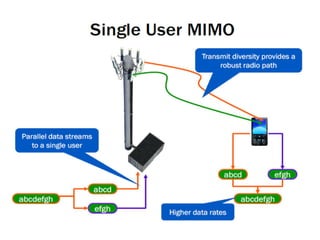
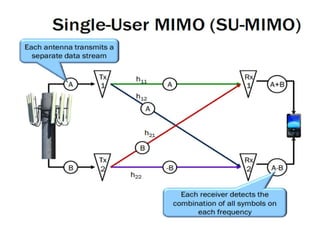
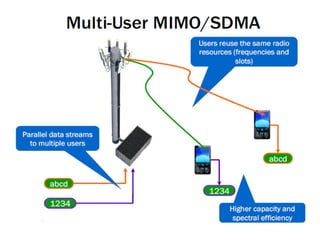
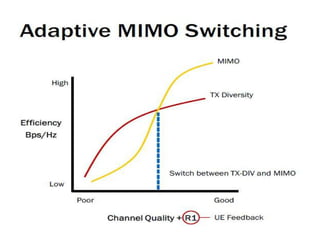
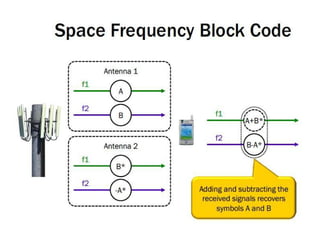
MIMO and Beamforming for 5G
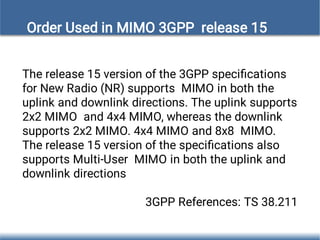
The release 15 version of the 3GPP specifications
for New Radio (NR) supports MIMO in both the
uplink and downlink directions. The uplink supports
2x2 MIMO and 4x4 MIMO, whereas the downlink
supports 2x2 MIMO. 4x4 MIMO and 8x8 MIMO.
The release 15 version of the specifications also
supports Multi-User MIMO in both the uplink and
downlink directions
3GPP References: TS 38.211
Order Used in MIMO 3GPP release 15
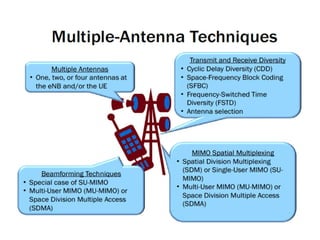
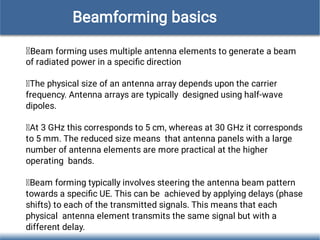
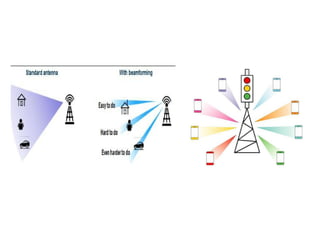
Beam forming uses multiple antenna elements to generate a beam
of radiated power in a specific direction
The physical size of an antenna array depends upon the carrier
frequency. Antenna arrays are typically designed using half-wave
dipoles.
At 3 GHz this corresponds to 5 cm, whereas at 30 GHz it corresponds
to 5 mm. The reduced size means that antenna panels with a large
number of antenna elements are more practical at the higher
operating bands.
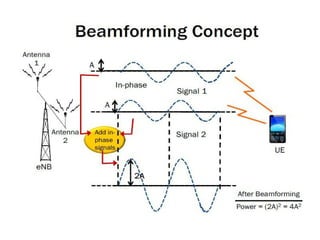
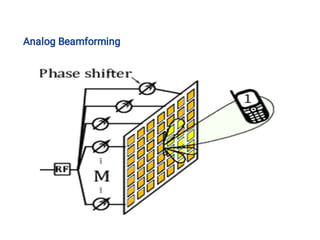
Beam forming typically involves steering the antenna beam pattern
towards a specific UE. This can be achieved by applying delays (phase
shifts) to each of the transmitted signals. This means that each
physical antenna element transmits the same signal but with a
different delay.
Beamforming basics
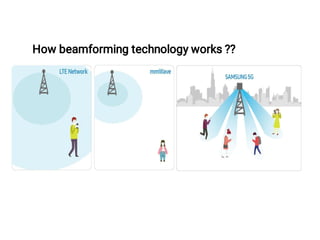
How beamforming technology works ??
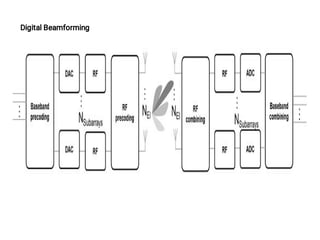
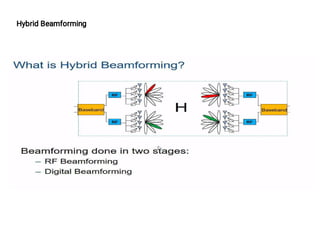
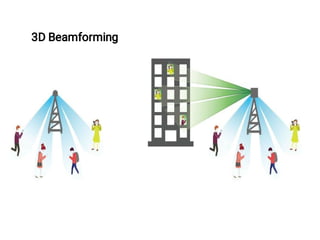
Types Of Beamforming used in 5G
Analog Beamforming
Digital Beamforming
Hybrid Beamforming
3D Beamforming
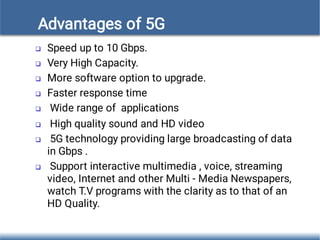
Advantages of 5G








Speed up to 10 Gbps.
Very High Capacity.
More software option to upgrade.
Faster response time
Wide range of applications
High quality sound and HD video
5G technology providing large broadcasting of data
in Gbps .
Support interactive multimedia , voice, streaming
video, Internet and other Multi - Media Newspapers,
watch T.V programs with the clarity as to that of an
HD Quality.
Any
Question ?
For PPT mail me at :
tkm.nscbttc@gmail.com

5g TECHNOLOY

  • 1.
    Introduction to 5G ByTK Mondal SDE, RTTC, Kalyani
  • 2.
  • 4.
           5th Generation MobileNetwork or simply 5G is the forthcoming revolution of mobile technology. Complete wireless communication with almost no limitations. 5G aims to design a Multi-Bandwidth Data Path by integrating the current and future networks for new network architecture of 5G real wireless world. 5G is a packet switched wireless system with wide area coverage(wwww) or world wide wireless web. Flexible channel bandwidth between 5 and 20MHz , optionally up to 40MHz. The 5G wireless internet networks are real wireless world which shall be supported by CDMA, OFDM, MC-CDMA, UWB and IPv6. 5G enables speed more than 1 GBps 5G
  • 5.
    5G is definedby IMT-2020 requirements in terms of 8 parameters: a peak rate up to 20 Gbps per user, User experienced rate of 100 Mbps, Mobility support to 500 km/h, a latency of 1 ms, a density of a million connections per m2, energy efficiency 100× of 4G 5G Standard
  • 6.
    1. 2. 3. 4. 5. 6. 7. 8. Peak Data Rate:max rate per user under ideal conditions. 10 Gbps for mobiles, 20 Gbps under certain conditions. User experienced Data Rate: 95% Rate across the coverage area per user. 100 Mbps in urban/suburban areas. 1 Gbps hotspot. Latency: Radio contribution to latency between send and receive Mobility: Max speed at which seamless handover and QoS is guaranteed Connection Density: Devices per km2 Energy Efficiency: Network bits/Joule, User bits/Joule Spectrum Efficiency: Throughput per Hz per cell Area Traffic Capacity: Throughput per m2 5G Definition
  • 8.
  • 9.
    1. 2. 3. 4. 5. Spectrum and BandwidthFlexibility: Ability to operate at different frequencies and channel bandwidths Reliability: High availability Resilience: Continue working in face of disasters Security and Privacy: Confidentiality, Integrity, Authentication, Protection against hacking, denial of service, man-in-the-middle attacks Operational Lifetime: Long battery life Additional Capabilities for 5G
  • 10.
    1. 2. 3. Three Key ApplicationAreas: Enhanced Mobile Broadband (eMBB): Better mobile phones and hot spots. High data rates, high user density. Human centric communications Ultra-Reliable and Low-Latency Communications (URLLC): Vehicle-to-Vehicle communication, Industrial IoT, 3D Gaming. Human and Machine centric communication Massive Machine Type Communications (mMTC): Very large number of devices, low data rate, low power. IoT with long battery life time. Machine-centric communication. 5G Applications
  • 11.
  • 12.
  • 13.
    eMBB applications generallyinvolve humans accessing multi-media content, services and data High data rate scenarios at offices, shopping centres, urban streets and residential locations. This use case family includes the broadcast of audio and video, e.g. 4K ultra high definition video. Deployments at residential locations should be capable of competing with fixed broadband services. Femtocell deployments at office, residential and urban locations to provide a 5G air-interface with a fixed broadband backhaul. high density scenarios to support the transfer of high data volumes per unit area, e.g. at offices and other hotspot locations including shopping centres, urban streets, stadiums and public transport Enhanced Mobile Broadband eMBB Use Cases
  • 14.
    • • • • • • • • massive Machine TypeCommunication (mMTC) is characterized by a very large number of connected devices which typically transmit low volumes of non-delay sensitive data. mMTC devices are generally required to be low cost and have a long battery life. main categories of application are: Internet of Things (loT) with a large number of devices transferring small volumes of non- time critical data. Smart Wearables (personal area network) using low complexity devices with a long battery life. Sensor Networks used to monitor a wide range of metrics, e.g. traffic. weather, parking spaces. Many existing loT devices do not use a cellular network. e.g. devices using WiFi to connect to the internet via a wirless router. These devices are typically short range, have little or no mobility, Bluetooth Low Energy (BLE) and ZigBee are other alternative wireless technologies used to connect loT devices lo each other and to the internet. Within the context of 5G, the main focus is upon 'cellular loT' devices which use 5G as the access network. Cellular loT devices benefit from the ubiquitous wide area coverage provided by a mobile operator. These devices may support applications which involve mobility and they do not depend upon the availability ofa wireless router. The Smart Wearables category includes activity tracking devices, personal sensors. augmented reality headsets, smart watches, smart ear buds, smart glasses and identity wristbands for admission into theme parks. Most of these applications require mobility and benefit from the wide area coverage provided by cellular networkscellul Massive Machine Type Communications (mMTC)
  • 15.
    Massive Machine TypeCommunications (mMTC) Sensor Networks may form part of the Smart City ecosystem. Sensors can be used to monitor traffic conditions and car parking occupancy. These metrics can be used as inputs lo generate recommendations for drivers. Sensors can also be used to monitor environmental metrics such as air quality and weather conditions. Weather conditions can be used as an input for automatic street lighting or variable speed limits. Sensors used for security applications can detect movement or apply facial recognition. loT devices may not connect directly to the mobile network. For example, a smart watch may connect to a smart phone, and the smart phone connects to the mobile network, i.e. the smart phone acts as a relay device for the smart watch.
  • 16.
    Ultra Reliable andLow Latency Communications (URLLC) Higher Reliability and Lower Latency applications: this family of applications requires low latency but does not require very low latency. For example, the remote control of vehicles by a human operator has a latency requirement which is determined by the human reaction speed. Higher Reliability, Higher Availability and Lower Latency applications: Industrial control applications can belong to this category. The remote control of drones can fit into this family of applications. High availability is important to ensure that the drone is always under the control of the human operator. Very Low Latency:this family of applications includes the concept of the 'Tactile Internet'. The Tactile Internet supports a remote extension to the human body. For example, it allows a surgeon to remotely operate on a patient using a mechanical arm which reacts as though it was the surgeon's own arm.
  • 17.
    5G Technology Features WashingtonUniversity in St. Louis          Scalable OFDM Supplementary Uplink Flexible Duplex Modes Optimized Massive MIMO Analog Beamforming Non-Standalone vs. Standalone Deployments Service Based Architecture Network Slicing Control-Plane User-Plane Split
  • 18.
    Control-Plane User-Plane Split     Control:Session management, IP address allocation, signaling between core and device, authentication, security, mobility, User: Packet routing and forwarding, packet filtering, packet inspection, quality of service Control-plane and user-plane interfaces are separate. For example: A node with dual connectivity. Control through LTE and data split between LTE and 5G EPC eNB c Washington University in St. Louis c u UE u u gNB u
  • 19.
    Service Based Architecture Each service is a function and several functions can be implemented in a physical node or a virtual machine Network Exposure Function NR Repository Function Unified Data Management Application Function Policy Control Function Authenticati on Server Function Access and Mobility Management Function User Plane Function Session Management Function User Equipment RAN Interne t Washington University in St. Louis
  • 20.
    Network Slicing     Slice =A logical network serving a particular application, business partner, or customer Similar to Virtual Machines (VMs) on a computer A network can be divided in to many slices Each slice looks to the user as a separate network with reserved resources . RAN Core Data Slice 1: MBB Slice 2: non-MBB Slice 3: Large Customer X Slice 4: Business Partner Y Washington University in St. Louis
  • 21.
    MME RNC IMS Hardware Set Top Box CGNAT Residential Gateway Hardware MME WashingtonUniversity in St. Louis RNC IMS Residential Gateway CGNAT Set Top Box MME RNC IMS MME RNC IMS Network Function Virtualization    Standard hardware is fast and cheap  No specialized hardware Implement all functions in software Virtualize all functions in Cloud Create capacity on demand
  • 22.
  • 32.
    The release 15version of the 3GPP specifications for New Radio (NR) supports MIMO in both the uplink and downlink directions. The uplink supports 2x2 MIMO and 4x4 MIMO, whereas the downlink supports 2x2 MIMO. 4x4 MIMO and 8x8 MIMO. The release 15 version of the specifications also supports Multi-User MIMO in both the uplink and downlink directions 3GPP References: TS 38.211 Order Used in MIMO 3GPP release 15
  • 33.
    Beam forming usesmultiple antenna elements to generate a beam of radiated power in a specific direction The physical size of an antenna array depends upon the carrier frequency. Antenna arrays are typically designed using half-wave dipoles. At 3 GHz this corresponds to 5 cm, whereas at 30 GHz it corresponds to 5 mm. The reduced size means that antenna panels with a large number of antenna elements are more practical at the higher operating bands. Beam forming typically involves steering the antenna beam pattern towards a specific UE. This can be achieved by applying delays (phase shifts) to each of the transmitted signals. This means that each physical antenna element transmits the same signal but with a different delay. Beamforming basics
  • 36.
  • 37.
  • 38.
  • 39.
  • 40.
  • 41.
  • 42.
    Advantages of 5G         Speedup to 10 Gbps. Very High Capacity. More software option to upgrade. Faster response time Wide range of applications High quality sound and HD video 5G technology providing large broadcasting of data in Gbps . Support interactive multimedia , voice, streaming video, Internet and other Multi - Media Newspapers, watch T.V programs with the clarity as to that of an HD Quality.
  • 43.
  • 44.
    For PPT mailme at : tkm.nscbttc@gmail.com