11
DEMANDDEMAND
DEMANDDEMAND
1.1. MEANING OF DEMANDMEANING OF DEMAND
2.2. DEFINITION OF DEMANDDEFINITION OF DEMAND
3.3. ESSENTIAL ELEMENTS OF DEMANDESSENTIAL ELEMENTS OF DEMAND
4.4. TYPES OF DEMANDTYPES OF DEMAND
22
33
MEANING OF DEMANDMEANING OF DEMAND
The demand of a commodity is the quantity,The demand of a commodity is the quantity,
which a person is willing to buy at awhich a person is willing to buy at a
particular price, at a particular time.particular price, at a particular time.
44
DEFINITION OF DEMANDDEFINITION OF DEMAND
In the words ofIn the words of Prof. Mill,Prof. Mill, “The demand of a“The demand of a
commodity is the quantity that a consumer iscommodity is the quantity that a consumer is
ready to purchase at a given price”.ready to purchase at a given price”.
55
ESSENTIAL ELEMENTS OFESSENTIAL ELEMENTS OF
DEMANDDEMAND
 There must be an effective desireThere must be an effective desire
 Desired commodity must be available inDesired commodity must be available in
the market.the market.
 The demand must be expressed at aThe demand must be expressed at a
particular price.particular price.
 The demand must be expressed withThe demand must be expressed with
reference to a particular time.reference to a particular time.
66
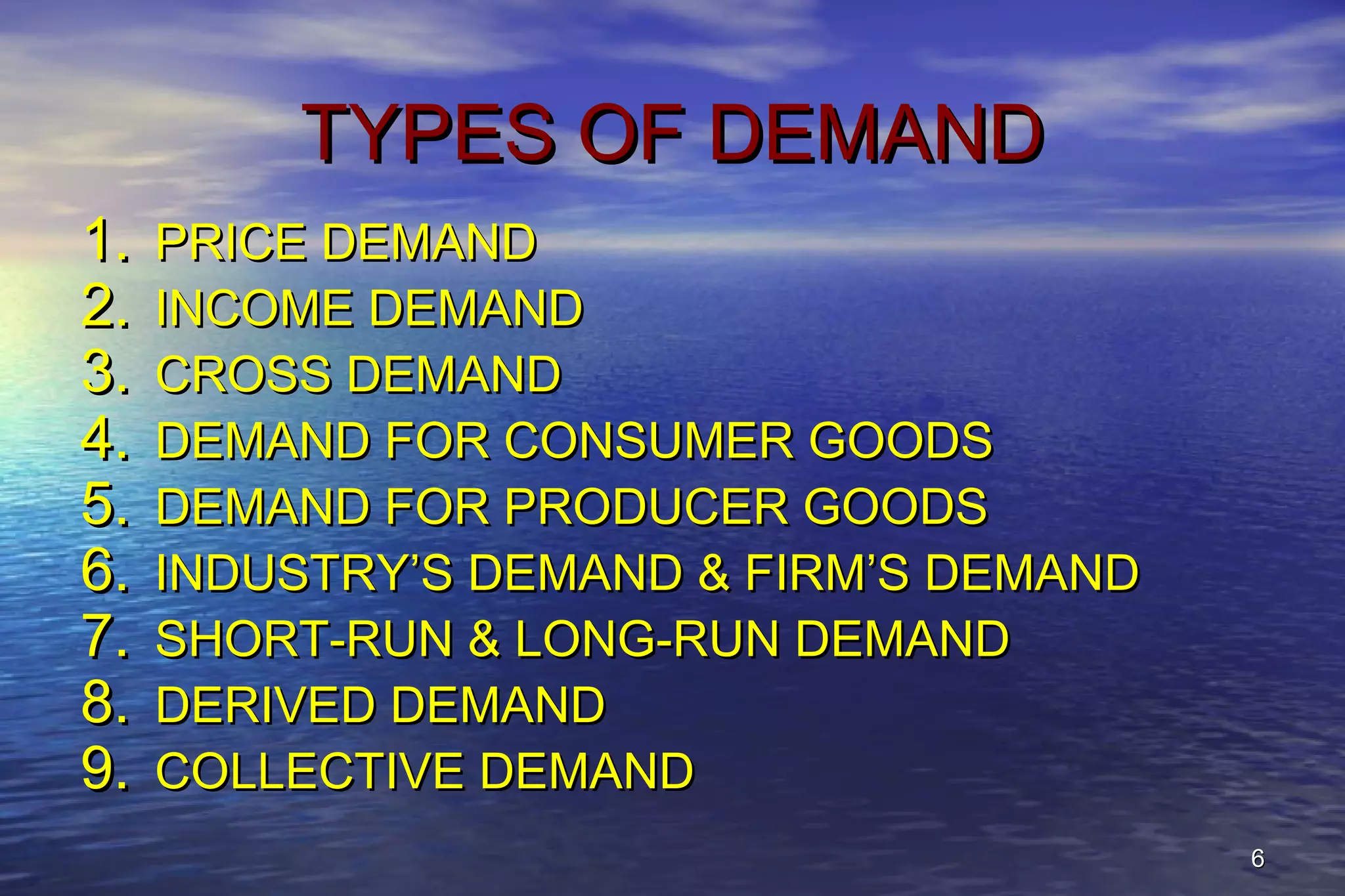
TYPES OF DEMANDTYPES OF DEMAND
1.1. PRICE DEMANDPRICE DEMAND
2.2. INCOME DEMANDINCOME DEMAND
3.3. CROSS DEMANDCROSS DEMAND
4.4. DEMAND FOR CONSUMER GOODSDEMAND FOR CONSUMER GOODS
5.5. DEMAND FOR PRODUCER GOODSDEMAND FOR PRODUCER GOODS
6.6. INDUSTRY’S DEMAND & FIRM’S DEMANDINDUSTRY’S DEMAND & FIRM’S DEMAND
7.7. SHORT-RUN & LONG-RUN DEMANDSHORT-RUN & LONG-RUN DEMAND
8.8. DERIVED DEMANDDERIVED DEMAND
9.9. COLLECTIVE DEMANDCOLLECTIVE DEMAND
77
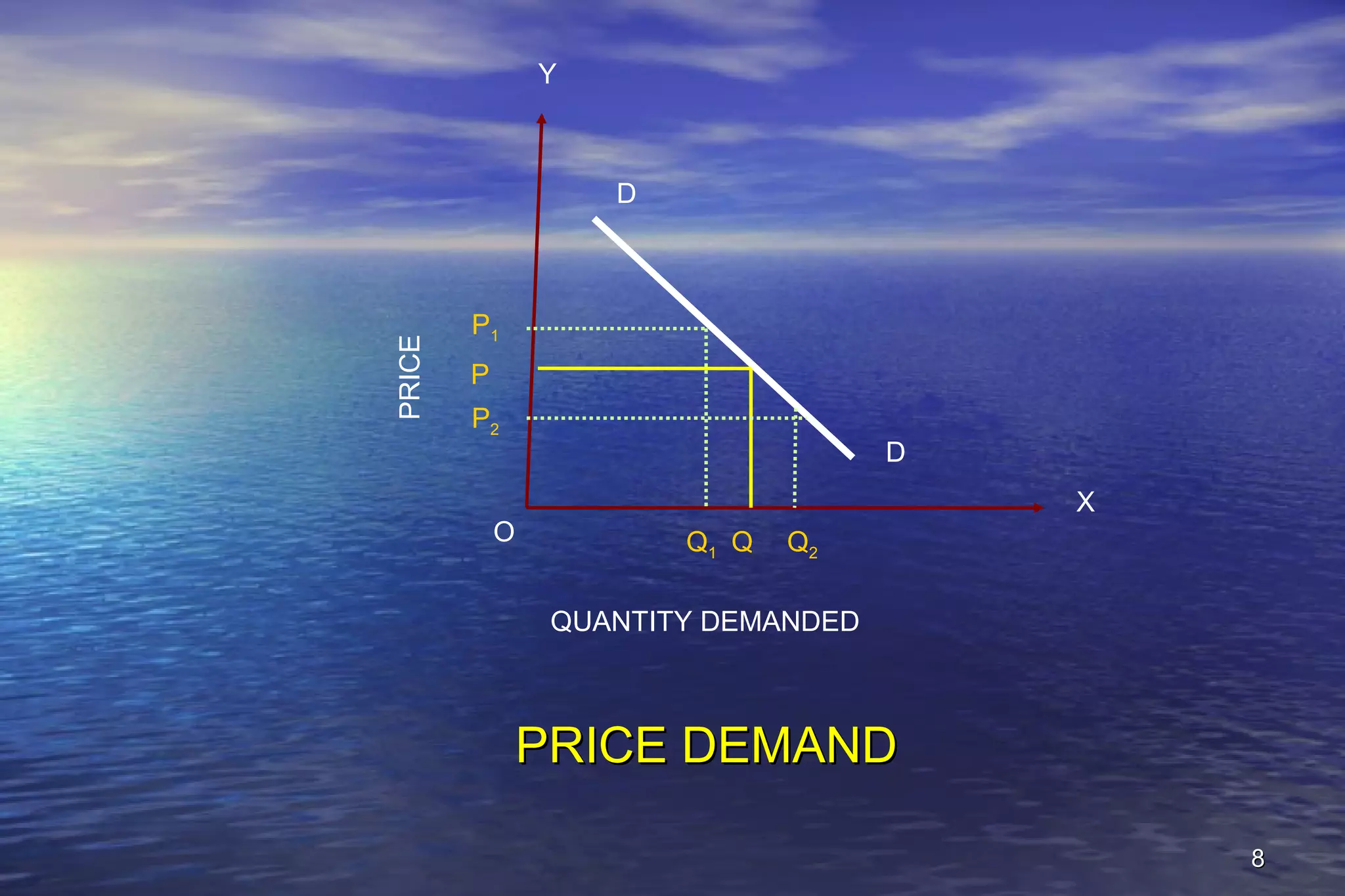
1.1. PRICE DEMANDPRICE DEMAND
 The demand of a commodity at a givenThe demand of a commodity at a given
price other things remaining constant isprice other things remaining constant is
known as price demand.known as price demand.
 The demand of a commodity decreasesThe demand of a commodity decreases
on a increase in its price & vice-versa.on a increase in its price & vice-versa.
 It can be explained with the help ofIt can be explained with the help of
following diagram:following diagram:
88
P
PRICE
QUANTITY DEMANDED
Q
X
Y
O
D
D
P1
P2
Q1 Q2
PRICE DEMANDPRICE DEMAND
99
2. INCOME DEMAND2. INCOME DEMAND
 It explains different quantities of aIt explains different quantities of a
commodity that would be purchased by acommodity that would be purchased by a
consumer at different level of incomeconsumer at different level of income
other things remaining constant.other things remaining constant.
 It can be studied in two forms:It can be studied in two forms:
(i)(i) Superior GoodsSuperior Goods
(ii)(ii) Inferior goodsInferior goods
1010
(i)(i) Superior GoodsSuperior Goods
• There is a direct relationship between demand ofThere is a direct relationship between demand of
superior goods & income of consumers.superior goods & income of consumers.
• i.e. with an increase in the income demand ofi.e. with an increase in the income demand of
superior goods increases & vice versa.superior goods increases & vice versa.
• It can be explained with the help of followingIt can be explained with the help of following
diagram:diagram:
1111
QUANTITY DEMANDED OF SUPERIOR GOODS
I
INCOMEOFCONSUMERS
Q
X
Y
O
D
D
I 1
I 2
Q1Q2
INCOME DEMANDINCOME DEMAND
((SUPERIOR GOODS))
1212
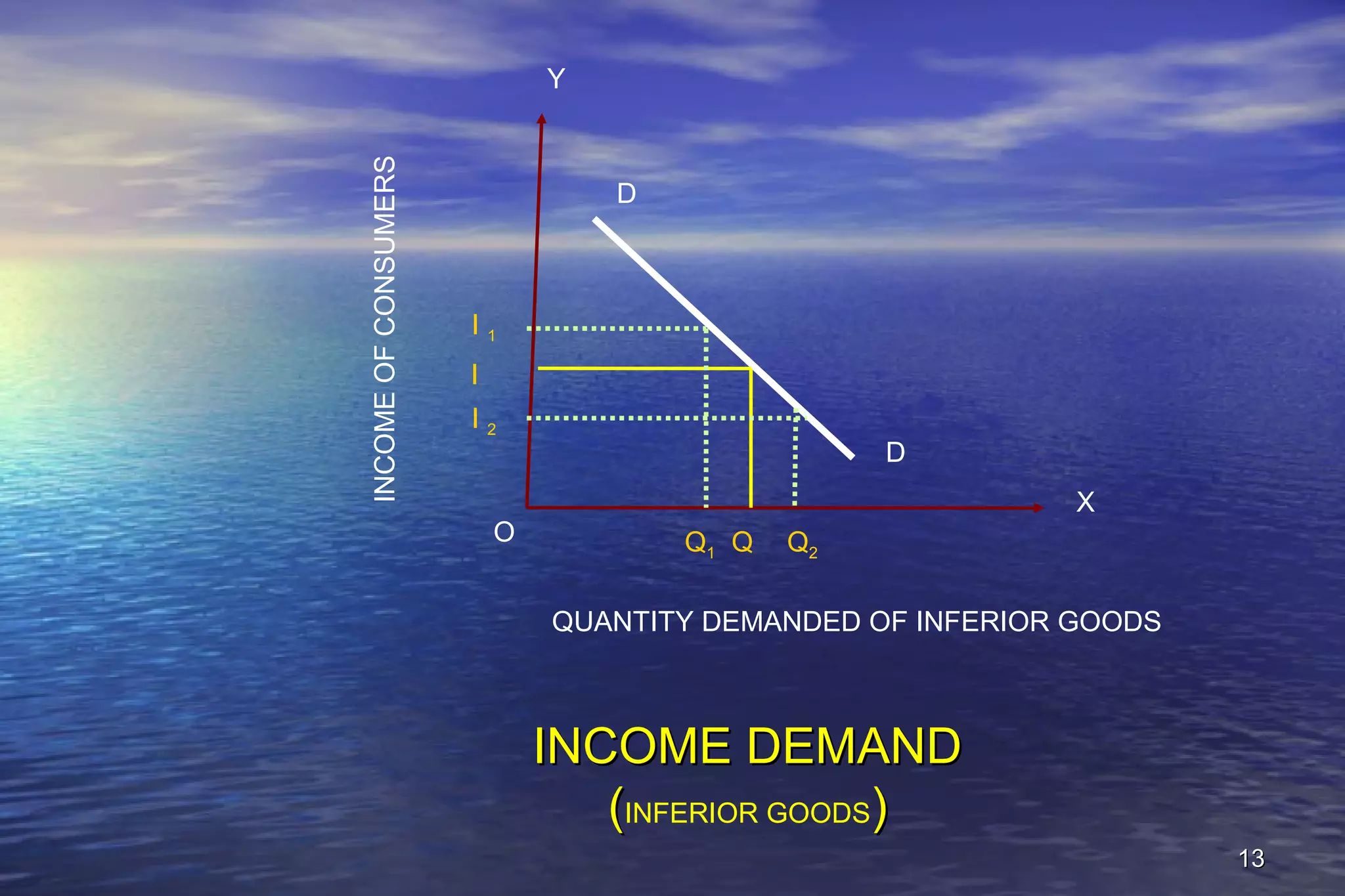
(ii)(ii) Inferior goodsInferior goods
• There is an inverse relationship betweenThere is an inverse relationship between
demand of inferior goods & income ofdemand of inferior goods & income of
consumers.consumers.
• i.e. with an increase in the income, demand ofi.e. with an increase in the income, demand of
inferior goods decreases & vice versa.inferior goods decreases & vice versa.
• It can be explained with the help of followingIt can be explained with the help of following
1313
INCOME DEMANDINCOME DEMAND
((INFERIOR GOODS))
INCOMEOFCONSUMERS
QUANTITY DEMANDED OF INFERIOR GOODS
I
Q
X
O
D
D
I 1
I 2
Q2Q1
Y
1414
3.3. CROSS DEMANDCROSS DEMAND
• The demand which studies the effect on theThe demand which studies the effect on the
demand of a particular commodity, of changes indemand of a particular commodity, of changes in
the price of other related commodities, otherthe price of other related commodities, other
factors remaining constant.factors remaining constant.
• It can be studied in three formsIt can be studied in three forms::
(i)(i) Complementary GoodsComplementary Goods
(ii)(ii) Substitute GoodsSubstitute Goods
(iii)(iii) Independent GoodsIndependent Goods
1515
(i)(i) Complementary GoodsComplementary Goods
• Goods which are used with a particular good are known asGoods which are used with a particular good are known as
Complementary Goods.Complementary Goods.
• For example: car – petrol, pen – ink, bread – butter, etc.For example: car – petrol, pen – ink, bread – butter, etc.
• There is an inverse relationship i.e. when the price of aThere is an inverse relationship i.e. when the price of a
commodity increases than the demand for both the goodscommodity increases than the demand for both the goods
decreases.decreases.
• It can be explained with the help of following diagram:It can be explained with the help of following diagram:
1616
P
PRICEOFPEN
QUANTITY DEMANDED OF COMPLEMENTARY GOODS
Q
X
O
D
D
P1
P2
Q1 Q2
CROSS DEMANDCROSS DEMAND
((COMPLEMENTARY GOODS))
Y
1717
(ii)(ii) Substitute GoodsSubstitute Goods
• Goods which are used in place of a particular good areGoods which are used in place of a particular good are
known asknown as Substitute Goods.Substitute Goods.
• For example: tea – coffee , etc.For example: tea – coffee , etc.
• There is a direct relationship i.e. when the price of aThere is a direct relationship i.e. when the price of a
particular commodity increases than the demand of itsparticular commodity increases than the demand of its
substitute goods also increases.substitute goods also increases.
• It can be explained with the help of following diagram:It can be explained with the help of following diagram:
1818
P
PRICEOFTEA
QUANTITY DEMANDED OF SUBSTITUTE GOODS
Q
X
O
D
D
P 1
P 2
Q1Q2
CROSS DEMANDCROSS DEMAND
((SUBSTITUTE GOODS))
Y
1919
(iii)(iii) Independent GoodsIndependent Goods
• Goods which are not related with eachGoods which are not related with each
otherother
• For example:For example:furniture, cloth, etc.furniture, cloth, etc.
• Demand of such commodities is notDemand of such commodities is not
affected by the price of any commodityaffected by the price of any commodity
2020
4.4. DEMAND FOR CONSUMERDEMAND FOR CONSUMER
GOODSGOODS
• The demand of goods which areThe demand of goods which are
demanded by consumers to satisfy theirdemanded by consumers to satisfy their
wants directly.wants directly.
• It is of two types:It is of two types:
(i)(i) Durable Consumer GoodsDurable Consumer Goods
(ii)(ii) Non – Durable Consumer GoodsNon – Durable Consumer Goods
2121
i.i. DURABLE CONSUMERDURABLE CONSUMER
GOODS:GOODS:
• Which are used for a long timeWhich are used for a long time
• Which can be used again & againWhich can be used again & again
• For example: television, freeze,For example: television, freeze,
scooter, car, clothes, furniture, etc.scooter, car, clothes, furniture, etc.
ii.ii. NON – DURABLE CONSUMERNON – DURABLE CONSUMER
GOODS:GOODS:
• Which can be used only onceWhich can be used only once
For example: milk, ink, food, petrol,For example: milk, ink, food, petrol,
2222
5.DEMAND FOR PRODUCER5.DEMAND FOR PRODUCER
GOODSGOODS
• The demand of goods which areThe demand of goods which are
used in the production of otherused in the production of other
goodsgoods
• For example: machines, raw –For example: machines, raw –
2323
6.6. INDUSTRY’S DEMAND &INDUSTRY’S DEMAND &
FIRM’S DEMANDFIRM’S DEMAND
• Firm’s demand means the demand of aFirm’s demand means the demand of a
particular firm of an industry. For example:particular firm of an industry. For example:
Demand of rubber by X Ltd.Demand of rubber by X Ltd.
• Industry’s demand means the demand of allIndustry’s demand means the demand of all
the firms together. For example: Demand ofthe firms together. For example: Demand of
rubber by all firms including X Ltd.rubber by all firms including X Ltd.
2424
7.7. SHORT-RUN & LONG-RUNSHORT-RUN & LONG-RUN
DEMANDDEMAND
• Short-run demand refers to the demand ,Short-run demand refers to the demand ,
which is expected to continue in short – run.which is expected to continue in short – run.
• Long-run demand refers to the demand ,Long-run demand refers to the demand ,
which is expected to continue in long – run.which is expected to continue in long – run.
2525
7.7. DERIVED DEMANDDERIVED DEMAND
• The demand of a particular good or service whichThe demand of a particular good or service which
depends upon the demand of other goods anddepends upon the demand of other goods and
services is known as derived demand.services is known as derived demand.
• For example:For example: demand of intermediate goodsdemand of intermediate goods
and services.and services.
8.8.COLLECTIVE DEMANDCOLLECTIVE DEMAND
• Demand for a particular commodity for no. ofDemand for a particular commodity for no. of
uses.uses.
• For example: demand for water, electricity, etc.For example: demand for water, electricity, etc.
2626

5 demand

  • 1.
  • 2.
    DEMANDDEMAND 1.1. MEANING OFDEMANDMEANING OF DEMAND 2.2. DEFINITION OF DEMANDDEFINITION OF DEMAND 3.3. ESSENTIAL ELEMENTS OF DEMANDESSENTIAL ELEMENTS OF DEMAND 4.4. TYPES OF DEMANDTYPES OF DEMAND 22
  • 3.
    33 MEANING OF DEMANDMEANINGOF DEMAND The demand of a commodity is the quantity,The demand of a commodity is the quantity, which a person is willing to buy at awhich a person is willing to buy at a particular price, at a particular time.particular price, at a particular time.
  • 4.
    44 DEFINITION OF DEMANDDEFINITIONOF DEMAND In the words ofIn the words of Prof. Mill,Prof. Mill, “The demand of a“The demand of a commodity is the quantity that a consumer iscommodity is the quantity that a consumer is ready to purchase at a given price”.ready to purchase at a given price”.
  • 5.
    55 ESSENTIAL ELEMENTS OFESSENTIALELEMENTS OF DEMANDDEMAND  There must be an effective desireThere must be an effective desire  Desired commodity must be available inDesired commodity must be available in the market.the market.  The demand must be expressed at aThe demand must be expressed at a particular price.particular price.  The demand must be expressed withThe demand must be expressed with reference to a particular time.reference to a particular time.
  • 6.
    66 TYPES OF DEMANDTYPESOF DEMAND 1.1. PRICE DEMANDPRICE DEMAND 2.2. INCOME DEMANDINCOME DEMAND 3.3. CROSS DEMANDCROSS DEMAND 4.4. DEMAND FOR CONSUMER GOODSDEMAND FOR CONSUMER GOODS 5.5. DEMAND FOR PRODUCER GOODSDEMAND FOR PRODUCER GOODS 6.6. INDUSTRY’S DEMAND & FIRM’S DEMANDINDUSTRY’S DEMAND & FIRM’S DEMAND 7.7. SHORT-RUN & LONG-RUN DEMANDSHORT-RUN & LONG-RUN DEMAND 8.8. DERIVED DEMANDDERIVED DEMAND 9.9. COLLECTIVE DEMANDCOLLECTIVE DEMAND
  • 7.
    77 1.1. PRICE DEMANDPRICEDEMAND  The demand of a commodity at a givenThe demand of a commodity at a given price other things remaining constant isprice other things remaining constant is known as price demand.known as price demand.  The demand of a commodity decreasesThe demand of a commodity decreases on a increase in its price & vice-versa.on a increase in its price & vice-versa.  It can be explained with the help ofIt can be explained with the help of following diagram:following diagram:
  • 8.
  • 9.
    99 2. INCOME DEMAND2.INCOME DEMAND  It explains different quantities of aIt explains different quantities of a commodity that would be purchased by acommodity that would be purchased by a consumer at different level of incomeconsumer at different level of income other things remaining constant.other things remaining constant.  It can be studied in two forms:It can be studied in two forms: (i)(i) Superior GoodsSuperior Goods (ii)(ii) Inferior goodsInferior goods
  • 10.
    1010 (i)(i) Superior GoodsSuperiorGoods • There is a direct relationship between demand ofThere is a direct relationship between demand of superior goods & income of consumers.superior goods & income of consumers. • i.e. with an increase in the income demand ofi.e. with an increase in the income demand of superior goods increases & vice versa.superior goods increases & vice versa. • It can be explained with the help of followingIt can be explained with the help of following diagram:diagram:
  • 11.
    1111 QUANTITY DEMANDED OFSUPERIOR GOODS I INCOMEOFCONSUMERS Q X Y O D D I 1 I 2 Q1Q2 INCOME DEMANDINCOME DEMAND ((SUPERIOR GOODS))
  • 12.
    1212 (ii)(ii) Inferior goodsInferiorgoods • There is an inverse relationship betweenThere is an inverse relationship between demand of inferior goods & income ofdemand of inferior goods & income of consumers.consumers. • i.e. with an increase in the income, demand ofi.e. with an increase in the income, demand of inferior goods decreases & vice versa.inferior goods decreases & vice versa. • It can be explained with the help of followingIt can be explained with the help of following
  • 13.
    1313 INCOME DEMANDINCOME DEMAND ((INFERIORGOODS)) INCOMEOFCONSUMERS QUANTITY DEMANDED OF INFERIOR GOODS I Q X O D D I 1 I 2 Q2Q1 Y
  • 14.
    1414 3.3. CROSS DEMANDCROSSDEMAND • The demand which studies the effect on theThe demand which studies the effect on the demand of a particular commodity, of changes indemand of a particular commodity, of changes in the price of other related commodities, otherthe price of other related commodities, other factors remaining constant.factors remaining constant. • It can be studied in three formsIt can be studied in three forms:: (i)(i) Complementary GoodsComplementary Goods (ii)(ii) Substitute GoodsSubstitute Goods (iii)(iii) Independent GoodsIndependent Goods
  • 15.
    1515 (i)(i) Complementary GoodsComplementaryGoods • Goods which are used with a particular good are known asGoods which are used with a particular good are known as Complementary Goods.Complementary Goods. • For example: car – petrol, pen – ink, bread – butter, etc.For example: car – petrol, pen – ink, bread – butter, etc. • There is an inverse relationship i.e. when the price of aThere is an inverse relationship i.e. when the price of a commodity increases than the demand for both the goodscommodity increases than the demand for both the goods decreases.decreases. • It can be explained with the help of following diagram:It can be explained with the help of following diagram:
  • 16.
    1616 P PRICEOFPEN QUANTITY DEMANDED OFCOMPLEMENTARY GOODS Q X O D D P1 P2 Q1 Q2 CROSS DEMANDCROSS DEMAND ((COMPLEMENTARY GOODS)) Y
  • 17.
    1717 (ii)(ii) Substitute GoodsSubstituteGoods • Goods which are used in place of a particular good areGoods which are used in place of a particular good are known asknown as Substitute Goods.Substitute Goods. • For example: tea – coffee , etc.For example: tea – coffee , etc. • There is a direct relationship i.e. when the price of aThere is a direct relationship i.e. when the price of a particular commodity increases than the demand of itsparticular commodity increases than the demand of its substitute goods also increases.substitute goods also increases. • It can be explained with the help of following diagram:It can be explained with the help of following diagram:
  • 18.
    1818 P PRICEOFTEA QUANTITY DEMANDED OFSUBSTITUTE GOODS Q X O D D P 1 P 2 Q1Q2 CROSS DEMANDCROSS DEMAND ((SUBSTITUTE GOODS)) Y
  • 19.
    1919 (iii)(iii) Independent GoodsIndependentGoods • Goods which are not related with eachGoods which are not related with each otherother • For example:For example:furniture, cloth, etc.furniture, cloth, etc. • Demand of such commodities is notDemand of such commodities is not affected by the price of any commodityaffected by the price of any commodity
  • 20.
    2020 4.4. DEMAND FORCONSUMERDEMAND FOR CONSUMER GOODSGOODS • The demand of goods which areThe demand of goods which are demanded by consumers to satisfy theirdemanded by consumers to satisfy their wants directly.wants directly. • It is of two types:It is of two types: (i)(i) Durable Consumer GoodsDurable Consumer Goods (ii)(ii) Non – Durable Consumer GoodsNon – Durable Consumer Goods
  • 21.
    2121 i.i. DURABLE CONSUMERDURABLECONSUMER GOODS:GOODS: • Which are used for a long timeWhich are used for a long time • Which can be used again & againWhich can be used again & again • For example: television, freeze,For example: television, freeze, scooter, car, clothes, furniture, etc.scooter, car, clothes, furniture, etc. ii.ii. NON – DURABLE CONSUMERNON – DURABLE CONSUMER GOODS:GOODS: • Which can be used only onceWhich can be used only once For example: milk, ink, food, petrol,For example: milk, ink, food, petrol,
  • 22.
    2222 5.DEMAND FOR PRODUCER5.DEMANDFOR PRODUCER GOODSGOODS • The demand of goods which areThe demand of goods which are used in the production of otherused in the production of other goodsgoods • For example: machines, raw –For example: machines, raw –
  • 23.
    2323 6.6. INDUSTRY’S DEMAND&INDUSTRY’S DEMAND & FIRM’S DEMANDFIRM’S DEMAND • Firm’s demand means the demand of aFirm’s demand means the demand of a particular firm of an industry. For example:particular firm of an industry. For example: Demand of rubber by X Ltd.Demand of rubber by X Ltd. • Industry’s demand means the demand of allIndustry’s demand means the demand of all the firms together. For example: Demand ofthe firms together. For example: Demand of rubber by all firms including X Ltd.rubber by all firms including X Ltd.
  • 24.
    2424 7.7. SHORT-RUN &LONG-RUNSHORT-RUN & LONG-RUN DEMANDDEMAND • Short-run demand refers to the demand ,Short-run demand refers to the demand , which is expected to continue in short – run.which is expected to continue in short – run. • Long-run demand refers to the demand ,Long-run demand refers to the demand , which is expected to continue in long – run.which is expected to continue in long – run.
  • 25.
    2525 7.7. DERIVED DEMANDDERIVEDDEMAND • The demand of a particular good or service whichThe demand of a particular good or service which depends upon the demand of other goods anddepends upon the demand of other goods and services is known as derived demand.services is known as derived demand. • For example:For example: demand of intermediate goodsdemand of intermediate goods and services.and services.
  • 26.
    8.8.COLLECTIVE DEMANDCOLLECTIVE DEMAND •Demand for a particular commodity for no. ofDemand for a particular commodity for no. of uses.uses. • For example: demand for water, electricity, etc.For example: demand for water, electricity, etc. 2626