CAPACITY TO CONTRACT
DEFINITION
Section 11 of the Contract Act provides
that, “Every person is competent to contract who is
of the age of majority according to the law to which
he is subject & who is of sound mind & is not
disqualified from contracting by any law to which
he is a subject.”
AGE OF MAJORITY
According to section 3 of Indian
majority Act-1875 every person domiciled in
India attains majority on the of 18 years of
age.
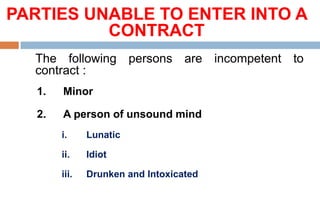
PARTIES UNABLE TO ENTER INTO A
CONTRACT
The following persons are incompetent to
contract :
1. Minor
2. A person of unsound mind
i. Lunatic
ii. Idiot
iii. Drunken and Intoxicated
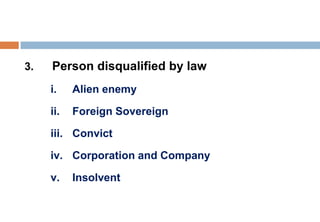
3. Person disqualified by law
i. Alien enemy
ii. Foreign Sovereign
iii. Convict
iv. Corporation and Company
v. Insolvent
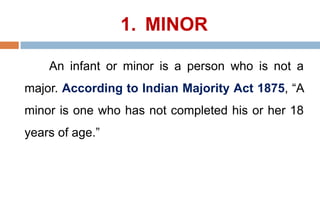
1. MINOR
An infant or minor is a person who is not a
major. According to Indian Majority Act 1875, “A
minor is one who has not completed his or her 18
years of age.”
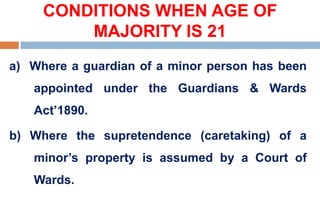
CONDITIONS WHEN AGE OF
MAJORITY IS 21
a) Where a guardian of a minor person has been
appointed under the Guardians & Wards
Act’1890.
b) Where the supretendence (caretaking) of a
minor’s property is assumed by a Court of
Wards.
MINOR’S AGREEMENT
i. An agreement with or by minor is void and inoperative
ab initio. A minor’s has received any benefit under a
void contract, he cannot be asked to return the same.
ii. He can be a promisee or beneficiary.
iii. His agreement cannot be ratified by him on attaining
the age of majority.
iv. If he has received any benefit under a void agreement,
he cannot be asked to compensate or pay for it.
v. Contd….
v. He can always plead minority. Fraudulent representation by
a minor- no difference in the status of agreement. The
contract remains void.
vi. There can be no specific performance of the agreements
entered into by him as they are void ab initio.
vii. He cannot enter into a contract of partnership. A minor with
the consent of all the partners, be admitted to the benefits
of an existing partnership.
viii. He cannot be adjusted insolvent.
Contd….
ix. He is liable for ‘ necessaries’ supplied or necessary services.
(a) A minor can enter into contract of apprenticeship, or for
training or instruction in a special art, education, etc.
(b) These are allowed because it generates benefits to the
Minor.
x. He can be an agent.
Minor can act as an agent but not personally liable. But he
cannot be principal.
Contd….
xi. His parents/ guardians are/ is not liable for the
contract entered into by him. Minor’s
parent/guardians are not liable to a minor’s
creditor for the breach of contract by the minor.
xii. A minor is liable in tort (a civil wrong).
xiii. A minor cannot become shareholder of a company
except when the shares are fullypaid up and transfer
by share
MINOR’S LIABILITY FOR
NECESSARIES u/s 68
i. A minor is liable to pay for his necessaries
supplied to him or to anyone whom he is
legally bound to support.
ii. The claim arises not out of contract but out of
what are called quasi - contracts.
NECESSARIES
i. NECESSARY GOODS
 required to maintain a bare existence
 Eg: bread & clothes, watch and a bicycle, engagement
ring,etc.
ii. SERVICES RENDERED
 Eg: education, training, medical advice, legal advice,
house given to a minor on rent, etc.
Note: loans incurred to obtain necessaries : binds him, not
personally liable, only his estate is liable.
2. PERSON OF UNSOUND MIND
According to section 11, “ A person is said to be
of sound mind for the purpose of making contract if, at
the time when he/she makes it, he/she is capable of
understanding it and of forming a rational judgment as
to its effect upon his interests.”
UNSOUND MIND: SEC 12
 Person usually of sound mind &
occasionally of unsound mind – may not
make a contract when unsound mind.
 Person usually of unsound mind &
occasionally of sound mind – may make a
contract when sound mind.
UNSOUNDNESS OF MIND MAY ARISE
FROM
1. IDIOCY
2. LUNACY OR INSANITY
3. DRUNKNESS
4. MENTAL DECAY
5. DELIRIOUS PERSONS
6. HYPNOTIZED PERSONS
1. IDIOCY
An idiot is a person who is congenital (by
birth) unsound mind. His incapacity is permanent
and therefore he can never understand contract and
make a rational judgment as to its effects upon his
interest. Consequently, the agreement of an idiot is
absolutely void ab initio. He is not personally liable
even for the payment of necessaries of life supplied
to him.
2. LUNACY OR INSANITY
Lunatic is not permanently of unsound
mined. He can enter into contract during lucid
intervals i.e., during period when he is of sound
mind.
3. DRUNKNESS
A drunkan or intoxicated person suffers
from tempoary incapacity to contract i.e. at
the time when he is so drunk or intoxicated
that he is incapable of forming a rational
judgement. The position of a drunken or
intoxicated person is similar to that of a
lunatic.
4. MENTAL DECAY
There may be mental decay or senile mind
the to old age or poor health. When such
person is not capable of understanding the
contract and its effect upon his interest, he
cannot enter into contract.
 ⇒
5. DELIRIOUS PERSONS
A person delirious from fever is also not
capable of understanding the nature and
implications of an agreement. Therefore, he
cannot enter into a contract so long as delirium
lasts.
6. HYPNOTIZED PERSONS
Hypnotism produces temporary incapacity
till a person is under the effect of artificial
induced sleep.
AGREEMENTS ENTERED ARE VOID
u/s 68
 Persons of unsound mind are liable for
necessaries.
 No personal liability attaches.
 Their estate is only liable.
3. PERSONS DISQUALIFIED BY
ANY LAW
Following are the persons who are disqualified from
contracting by any law :-
i. Alien Enemies
ii. Foreign Ambassadors & Sovereigns
iii. Insolvent
iv. Convicts
v. Married Women
i) ALIEN ENEMIES
An Alien is a foreigner who is not a subject of
the country in which he lives. Alien is either an
Alien friend or Alien enemy. An Alien whose
country is at war or whose country has not
good relations with our country is called an
Alien enemy.
ii) FOREIGN AMBASSADORS &
SOVEREIGNS
Any contract made with foreign
ambassadors, sovereigns & diplomatic
representatives are void. Contract with those
persons can be made by taking permission of
High Court or Supreme Court.
iii) INSOLVENT
An insolvent can not enter into a contract. He
can enter into any contract after attaining
solvency.
iv) CONVICTS
A convict while undergoing imprisonment is
incapable of entering into any contract. After
the completion of imprisonment, he is allowed
to enter into any contract.
v) MARRIED WOMEN
A woman is competent to enter into a
contract only for her separate or personal
property. She is not allowed to contract for her
husband’s property except in a special
circumstances.
vi)CORPORATIONS
 A corporation is an artificial person created
by law, having a legal existence apart from
its members.
 It cannot enter into contracts of a strictly
paersonal nature. As it is an artificial and
not a natural person

Capacity to contract

  • 1.
  • 2.
    DEFINITION Section 11 ofthe Contract Act provides that, “Every person is competent to contract who is of the age of majority according to the law to which he is subject & who is of sound mind & is not disqualified from contracting by any law to which he is a subject.”
  • 3.
    AGE OF MAJORITY Accordingto section 3 of Indian majority Act-1875 every person domiciled in India attains majority on the of 18 years of age.
  • 4.
    PARTIES UNABLE TOENTER INTO A CONTRACT The following persons are incompetent to contract : 1. Minor 2. A person of unsound mind i. Lunatic ii. Idiot iii. Drunken and Intoxicated
  • 5.
    3. Person disqualifiedby law i. Alien enemy ii. Foreign Sovereign iii. Convict iv. Corporation and Company v. Insolvent
  • 6.
    1. MINOR An infantor minor is a person who is not a major. According to Indian Majority Act 1875, “A minor is one who has not completed his or her 18 years of age.”
  • 7.
    CONDITIONS WHEN AGEOF MAJORITY IS 21 a) Where a guardian of a minor person has been appointed under the Guardians & Wards Act’1890. b) Where the supretendence (caretaking) of a minor’s property is assumed by a Court of Wards.
  • 8.
    MINOR’S AGREEMENT i. Anagreement with or by minor is void and inoperative ab initio. A minor’s has received any benefit under a void contract, he cannot be asked to return the same. ii. He can be a promisee or beneficiary. iii. His agreement cannot be ratified by him on attaining the age of majority. iv. If he has received any benefit under a void agreement, he cannot be asked to compensate or pay for it. v. Contd….
  • 9.
    v. He canalways plead minority. Fraudulent representation by a minor- no difference in the status of agreement. The contract remains void. vi. There can be no specific performance of the agreements entered into by him as they are void ab initio. vii. He cannot enter into a contract of partnership. A minor with the consent of all the partners, be admitted to the benefits of an existing partnership. viii. He cannot be adjusted insolvent. Contd….
  • 10.
    ix. He isliable for ‘ necessaries’ supplied or necessary services. (a) A minor can enter into contract of apprenticeship, or for training or instruction in a special art, education, etc. (b) These are allowed because it generates benefits to the Minor. x. He can be an agent. Minor can act as an agent but not personally liable. But he cannot be principal. Contd….
  • 11.
    xi. His parents/guardians are/ is not liable for the contract entered into by him. Minor’s parent/guardians are not liable to a minor’s creditor for the breach of contract by the minor. xii. A minor is liable in tort (a civil wrong). xiii. A minor cannot become shareholder of a company except when the shares are fullypaid up and transfer by share
  • 12.
    MINOR’S LIABILITY FOR NECESSARIESu/s 68 i. A minor is liable to pay for his necessaries supplied to him or to anyone whom he is legally bound to support. ii. The claim arises not out of contract but out of what are called quasi - contracts.
  • 13.
    NECESSARIES i. NECESSARY GOODS required to maintain a bare existence  Eg: bread & clothes, watch and a bicycle, engagement ring,etc. ii. SERVICES RENDERED  Eg: education, training, medical advice, legal advice, house given to a minor on rent, etc. Note: loans incurred to obtain necessaries : binds him, not personally liable, only his estate is liable.
  • 14.
    2. PERSON OFUNSOUND MIND According to section 11, “ A person is said to be of sound mind for the purpose of making contract if, at the time when he/she makes it, he/she is capable of understanding it and of forming a rational judgment as to its effect upon his interests.”
  • 15.
    UNSOUND MIND: SEC12  Person usually of sound mind & occasionally of unsound mind – may not make a contract when unsound mind.  Person usually of unsound mind & occasionally of sound mind – may make a contract when sound mind.
  • 16.
    UNSOUNDNESS OF MINDMAY ARISE FROM 1. IDIOCY 2. LUNACY OR INSANITY 3. DRUNKNESS 4. MENTAL DECAY 5. DELIRIOUS PERSONS 6. HYPNOTIZED PERSONS
  • 17.
    1. IDIOCY An idiotis a person who is congenital (by birth) unsound mind. His incapacity is permanent and therefore he can never understand contract and make a rational judgment as to its effects upon his interest. Consequently, the agreement of an idiot is absolutely void ab initio. He is not personally liable even for the payment of necessaries of life supplied to him.
  • 18.
    2. LUNACY ORINSANITY Lunatic is not permanently of unsound mined. He can enter into contract during lucid intervals i.e., during period when he is of sound mind.
  • 19.
    3. DRUNKNESS A drunkanor intoxicated person suffers from tempoary incapacity to contract i.e. at the time when he is so drunk or intoxicated that he is incapable of forming a rational judgement. The position of a drunken or intoxicated person is similar to that of a lunatic.
  • 20.
    4. MENTAL DECAY Theremay be mental decay or senile mind the to old age or poor health. When such person is not capable of understanding the contract and its effect upon his interest, he cannot enter into contract.  ⇒
  • 21.
    5. DELIRIOUS PERSONS Aperson delirious from fever is also not capable of understanding the nature and implications of an agreement. Therefore, he cannot enter into a contract so long as delirium lasts.
  • 22.
    6. HYPNOTIZED PERSONS Hypnotismproduces temporary incapacity till a person is under the effect of artificial induced sleep.
  • 23.
    AGREEMENTS ENTERED AREVOID u/s 68  Persons of unsound mind are liable for necessaries.  No personal liability attaches.  Their estate is only liable.
  • 24.
    3. PERSONS DISQUALIFIEDBY ANY LAW Following are the persons who are disqualified from contracting by any law :- i. Alien Enemies ii. Foreign Ambassadors & Sovereigns iii. Insolvent iv. Convicts v. Married Women
  • 25.
    i) ALIEN ENEMIES AnAlien is a foreigner who is not a subject of the country in which he lives. Alien is either an Alien friend or Alien enemy. An Alien whose country is at war or whose country has not good relations with our country is called an Alien enemy.
  • 26.
    ii) FOREIGN AMBASSADORS& SOVEREIGNS Any contract made with foreign ambassadors, sovereigns & diplomatic representatives are void. Contract with those persons can be made by taking permission of High Court or Supreme Court.
  • 27.
    iii) INSOLVENT An insolventcan not enter into a contract. He can enter into any contract after attaining solvency.
  • 28.
    iv) CONVICTS A convictwhile undergoing imprisonment is incapable of entering into any contract. After the completion of imprisonment, he is allowed to enter into any contract.
  • 29.
    v) MARRIED WOMEN Awoman is competent to enter into a contract only for her separate or personal property. She is not allowed to contract for her husband’s property except in a special circumstances.
  • 30.
    vi)CORPORATIONS  A corporationis an artificial person created by law, having a legal existence apart from its members.  It cannot enter into contracts of a strictly paersonal nature. As it is an artificial and not a natural person