Project Glass
Introductionto Project Glass:(1)
Project Glass is wearable computing mainstream. It is just like hands-free compute. Project
glass has a camera, display screen and a battery hidden inside the frame.
It looksas thoughProjectGlasswill see apublicrelease in2014 at the earliest.Latestnewsisthat
developerswill be able togetholdof 'exploreredition'unitsatsome pointin2013 witha "broad
consumeroffering"arrivingayearlater.
Working of Project Glass:
Project Glass is based on cloud computing. It has transmitters to transfer data to cloud using
WIFI internet. Project Glass will probably use a transparent AMOLED display to put
information in front of your eyeballs. It's location-aware thanks to a camera and GPS, and
you can scroll and click on information by tilting your head, something that is apparently
quite easy to master. Project glass will also use voice input and output.
Features: (2)
 Communicatesdirectly with the cloud via
IP.
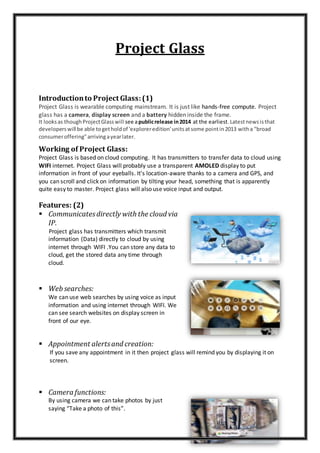
Project glass has transmitters which transmit
information (Data) directly to cloud by using
internet through WIFI .You can store any data to
cloud, get the stored data any time through
cloud.
 Web searches:
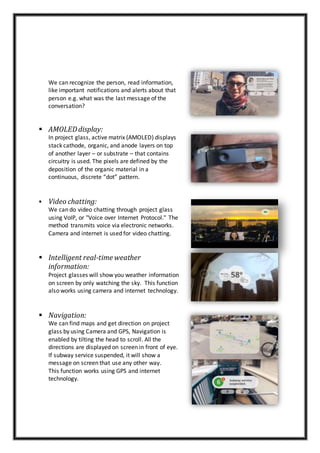
We can use web searches by using voice as input
information and using internet through WIFI. We
can see search websites on display screen in
front of our eye.
 Appointment alertsand creation:
If you save any appointment in it then project glass will remind you by displaying it on
screen.
 Camera functions:
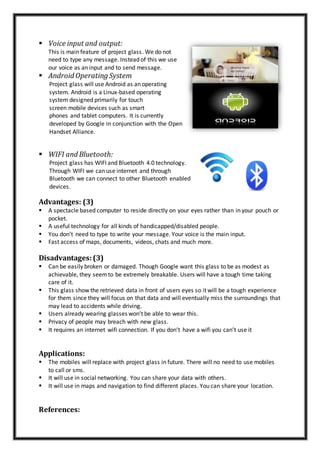
By using camera we can take photos by just
saying “Take a photo of this”.
We can recognize the person, read information,
like important notifications and alerts about that
person e.g. what was the last message of the
conversation?
 AMOLEDdisplay:
In project glass, active matrix (AMOLED) displays
stack cathode, organic, and anode layers on top
of another layer – or substrate – that contains
circuitry is used. The pixels are defined by the
deposition of the organic material in a
continuous, discrete “dot” pattern.
 Video chatting:
We can do video chatting through project glass
using VoIP, or "Voice over Internet Protocol." The
method transmits voice via electronic networks.
Camera and internet is used for video chatting.
 Intelligent real-time weather
information:
Project glasses will show you weather information
on screen by only watching the sky. This function
also works using camera and internet technology.
 Navigation:
We can find maps and get direction on project
glass by using Camera and GPS, Navigation is
enabled by tilting the head to scroll. All the
directions are displayed on screen in front of eye.
If subway service suspended, it will show a
message on screen that use any other way.
This function works using GPS and internet
technology.
 Voice input and output:
This is main feature of project glass. We do not
need to type any message. Instead of this we use
our voice as an input and to send message.
 Android Operating System
Project glass will use Android as an operating
system. Android is a Linux-based operating
system designed primarily for touch
screen mobile devices such as smart
phones and tablet computers. It is currently
developed by Google in conjunction with the Open
Handset Alliance.
 WIFI and Bluetooth:
Project glass has WIFI and Bluetooth 4.0 technology.
Through WIFI we can use internet and through
Bluetooth we can connect to other Bluetooth enabled
devices.
Advantages: (3)
 A spectacle based computer to reside directly on your eyes rather than in your pouch or
pocket.
 A useful technology for all kinds of handicapped/disabled people.
 You don’t need to type to write your message. Your voice is the main input.
 Fast access of maps, documents, videos, chats and much more.
Disadvantages: (3)
 Can be easily broken or damaged. Though Google want this glass to be as modest as
achievable, they seemto be extremely breakable. Users will have a tough time taking
care of it.
 This glass show the retrieved data in front of users eyes so it will be a tough experience
for them since they will focus on that data and will eventually miss the surroundings that
may lead to accidents while driving.
 Users already wearing glasses won’t be able to wear this.
 Privacy of people may breach with new glass.
 It requires an internet wifi connection. If you don’t have a wifi you can’t use it
Applications:
 The mobiles will replace with project glass in future. There will no need to use mobiles
to call or sms.
 It will use in social networking. You can share your data with others.
 It will use in maps and navigation to find different places. You can share your location.
References:
(1) http://www.techradar.com
(2) http://usabilitygeek.com
(3) http://www.thenewstribe.com

Project glass

  • 1.
    Project Glass Introductionto ProjectGlass:(1) Project Glass is wearable computing mainstream. It is just like hands-free compute. Project glass has a camera, display screen and a battery hidden inside the frame. It looksas thoughProjectGlasswill see apublicrelease in2014 at the earliest.Latestnewsisthat developerswill be able togetholdof 'exploreredition'unitsatsome pointin2013 witha "broad consumeroffering"arrivingayearlater. Working of Project Glass: Project Glass is based on cloud computing. It has transmitters to transfer data to cloud using WIFI internet. Project Glass will probably use a transparent AMOLED display to put information in front of your eyeballs. It's location-aware thanks to a camera and GPS, and you can scroll and click on information by tilting your head, something that is apparently quite easy to master. Project glass will also use voice input and output. Features: (2)  Communicatesdirectly with the cloud via IP. Project glass has transmitters which transmit information (Data) directly to cloud by using internet through WIFI .You can store any data to cloud, get the stored data any time through cloud.  Web searches: We can use web searches by using voice as input information and using internet through WIFI. We can see search websites on display screen in front of our eye.  Appointment alertsand creation: If you save any appointment in it then project glass will remind you by displaying it on screen.  Camera functions: By using camera we can take photos by just saying “Take a photo of this”.
  • 2.
    We can recognizethe person, read information, like important notifications and alerts about that person e.g. what was the last message of the conversation?  AMOLEDdisplay: In project glass, active matrix (AMOLED) displays stack cathode, organic, and anode layers on top of another layer – or substrate – that contains circuitry is used. The pixels are defined by the deposition of the organic material in a continuous, discrete “dot” pattern.  Video chatting: We can do video chatting through project glass using VoIP, or "Voice over Internet Protocol." The method transmits voice via electronic networks. Camera and internet is used for video chatting.  Intelligent real-time weather information: Project glasses will show you weather information on screen by only watching the sky. This function also works using camera and internet technology.  Navigation: We can find maps and get direction on project glass by using Camera and GPS, Navigation is enabled by tilting the head to scroll. All the directions are displayed on screen in front of eye. If subway service suspended, it will show a message on screen that use any other way. This function works using GPS and internet technology.
  • 3.
     Voice inputand output: This is main feature of project glass. We do not need to type any message. Instead of this we use our voice as an input and to send message.  Android Operating System Project glass will use Android as an operating system. Android is a Linux-based operating system designed primarily for touch screen mobile devices such as smart phones and tablet computers. It is currently developed by Google in conjunction with the Open Handset Alliance.  WIFI and Bluetooth: Project glass has WIFI and Bluetooth 4.0 technology. Through WIFI we can use internet and through Bluetooth we can connect to other Bluetooth enabled devices. Advantages: (3)  A spectacle based computer to reside directly on your eyes rather than in your pouch or pocket.  A useful technology for all kinds of handicapped/disabled people.  You don’t need to type to write your message. Your voice is the main input.  Fast access of maps, documents, videos, chats and much more. Disadvantages: (3)  Can be easily broken or damaged. Though Google want this glass to be as modest as achievable, they seemto be extremely breakable. Users will have a tough time taking care of it.  This glass show the retrieved data in front of users eyes so it will be a tough experience for them since they will focus on that data and will eventually miss the surroundings that may lead to accidents while driving.  Users already wearing glasses won’t be able to wear this.  Privacy of people may breach with new glass.  It requires an internet wifi connection. If you don’t have a wifi you can’t use it Applications:  The mobiles will replace with project glass in future. There will no need to use mobiles to call or sms.  It will use in social networking. You can share your data with others.  It will use in maps and navigation to find different places. You can share your location. References:
  • 4.