1G, 2G, 3G, 4G
TECHNOLOGY
Presented
By
Aurovindo Sahu
Reg. No. 12031024
2nd semester MCA
Overview
Introduction
Generation of wireless network
technology
1st Generation (1G)
 Drawbacks of 1G
2nd Generation (2G)
 Benefits of 2G technology & drawbacks
2.5G wireless
Overview (con’t)
3rd Generation (3G)
 Benefits of 3G
 Drawbacks of 3G
4th Generation (4G)
 Why 4G ?
 Benefits of 4G
Comparison between 3G and 4G
Conclusion
Introduction
What is the Generation of cellular network
technology ??
1st Generation (1G)
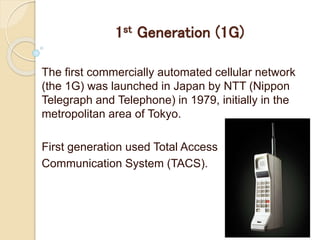
The first commercially automated cellular network
(the 1G) was launched in Japan by NTT (Nippon
Telegraph and Telephone) in 1979, initially in the
metropolitan area of Tokyo.
First generation used Total Access
Communication System (TACS).
Drawbacks of 1G
 Poor voice quality
 Poor battery life
 Large phone size
 No security
 Frequent call drops
 Can’t send text message
2nd Generation (2G)
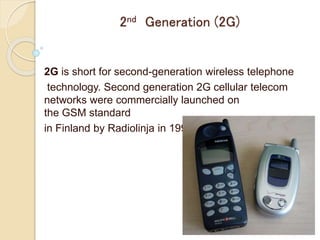
2G is short for second-generation wireless telephone
technology. Second generation 2G cellular telecom
networks were commercially launched on
the GSM standard
in Finland by Radiolinja in 1991.
Benefits of 2G Technology
 Phone conversations were digitally
encrypted.
 Text message service.
 Roaming facility.
Drawbacks of 2G Technology
 Roaming facility is semi-global
 Voice quality is not so good
2.5G wireless
An interim stage that is taken between 2G and
3G that is 2.5G.
Features includes
 Phone calls/ Fax
 Voice mail
 Send/ Receive e-mail message
 web browsing
 Camera phones
 Speed: 64-144 kb/sec
3rd Generation (3G)
 To meet the growing demand in network capacity,
rates required for high speed data transfer and
multimedia applications, 3G standard started
evolving.
 3G technologies enable network operators to offer
users a wider range of more advanced services.
 Data are sent through the technology called packet
switching / circuit switching.
Features includes
 Phone calls/ Fax
 Global roaming
 Send/ receive large email messages
 High speed web
 Navigation/ maps
 Video conferencing
 TV streaming
 Speed : 200 kb/sec- 2 mb/ sec
Advantages of 3G
 More bandwidth, security & reliability.
 Inter- portability between service providers.
 High data rates.
 Rich multimedia services.
 Always online devices.
Disadvantages of 3G
 Expensive input fees for the 3G service
licenses.
 Numerous differences in the licensing terms.
 It is a challenge to build the necessary.
 Infrastructure for 3G.
 Expense of 3G phones.
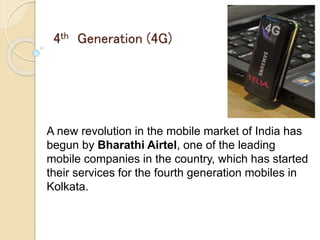
4th Generation (4G)
A new revolution in the mobile market of India has
begun by Bharathi Airtel, one of the leading
mobile companies in the country, which has started
their services for the fourth generation mobiles in
Kolkata.
What is 4G ?
 Faster and more reliable – 100 Mbps
 Lower cost than previous generations
 Multi-standard wireless system
 Wi-Fi
 Coverage of wide area
 Wide variety of services capability
 IPv6 core
 Only packet switching used.
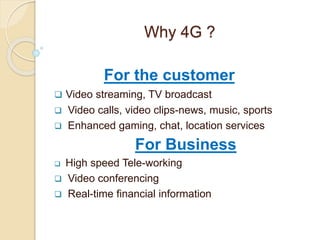
Why 4G ?
For the customer
 Video streaming, TV broadcast
 Video calls, video clips-news, music, sports
 Enhanced gaming, chat, location services
For Business
 High speed Tele-working
 Video conferencing
 Real-time financial information
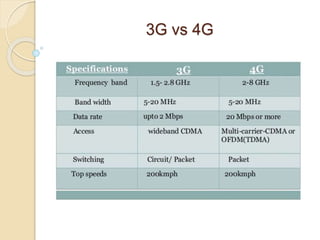
3G vs 4G
Conclusion
Wireless systems becoming an important
infrastructure in our society. A virtual global system
is a good solution that can efficiently connect many
dedicated wireless systems including 1G to 4G
cellular systems.
1G,2G, 3G, 4G TECHNOLOGY.pptx

1G,2G, 3G, 4G TECHNOLOGY.pptx

  • 1.
    1G, 2G, 3G,4G TECHNOLOGY Presented By Aurovindo Sahu Reg. No. 12031024 2nd semester MCA
  • 2.
    Overview Introduction Generation of wirelessnetwork technology 1st Generation (1G)  Drawbacks of 1G 2nd Generation (2G)  Benefits of 2G technology & drawbacks 2.5G wireless
  • 3.
    Overview (con’t) 3rd Generation(3G)  Benefits of 3G  Drawbacks of 3G 4th Generation (4G)  Why 4G ?  Benefits of 4G Comparison between 3G and 4G Conclusion
  • 4.
    Introduction What is theGeneration of cellular network technology ??
  • 5.
    1st Generation (1G) Thefirst commercially automated cellular network (the 1G) was launched in Japan by NTT (Nippon Telegraph and Telephone) in 1979, initially in the metropolitan area of Tokyo. First generation used Total Access Communication System (TACS).
  • 6.
    Drawbacks of 1G Poor voice quality  Poor battery life  Large phone size  No security  Frequent call drops  Can’t send text message
  • 7.
    2nd Generation (2G) 2Gis short for second-generation wireless telephone technology. Second generation 2G cellular telecom networks were commercially launched on the GSM standard in Finland by Radiolinja in 1991.
  • 8.
    Benefits of 2GTechnology  Phone conversations were digitally encrypted.  Text message service.  Roaming facility. Drawbacks of 2G Technology  Roaming facility is semi-global  Voice quality is not so good
  • 9.
    2.5G wireless An interimstage that is taken between 2G and 3G that is 2.5G. Features includes  Phone calls/ Fax  Voice mail  Send/ Receive e-mail message  web browsing  Camera phones  Speed: 64-144 kb/sec
  • 10.
    3rd Generation (3G) To meet the growing demand in network capacity, rates required for high speed data transfer and multimedia applications, 3G standard started evolving.  3G technologies enable network operators to offer users a wider range of more advanced services.  Data are sent through the technology called packet switching / circuit switching.
  • 11.
    Features includes  Phonecalls/ Fax  Global roaming  Send/ receive large email messages  High speed web  Navigation/ maps  Video conferencing  TV streaming  Speed : 200 kb/sec- 2 mb/ sec
  • 12.
    Advantages of 3G More bandwidth, security & reliability.  Inter- portability between service providers.  High data rates.  Rich multimedia services.  Always online devices.
  • 13.
    Disadvantages of 3G Expensive input fees for the 3G service licenses.  Numerous differences in the licensing terms.  It is a challenge to build the necessary.  Infrastructure for 3G.  Expense of 3G phones.
  • 14.
    4th Generation (4G) Anew revolution in the mobile market of India has begun by Bharathi Airtel, one of the leading mobile companies in the country, which has started their services for the fourth generation mobiles in Kolkata.
  • 15.
    What is 4G?  Faster and more reliable – 100 Mbps  Lower cost than previous generations  Multi-standard wireless system  Wi-Fi  Coverage of wide area  Wide variety of services capability  IPv6 core  Only packet switching used.
  • 16.
    Why 4G ? Forthe customer  Video streaming, TV broadcast  Video calls, video clips-news, music, sports  Enhanced gaming, chat, location services For Business  High speed Tele-working  Video conferencing  Real-time financial information
  • 17.
  • 18.
    Conclusion Wireless systems becomingan important infrastructure in our society. A virtual global system is a good solution that can efficiently connect many dedicated wireless systems including 1G to 4G cellular systems.