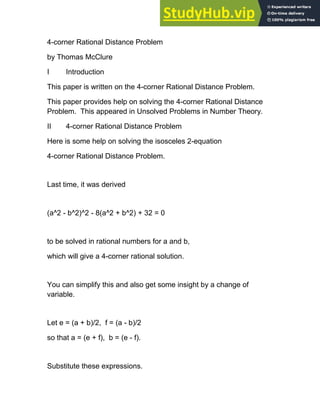
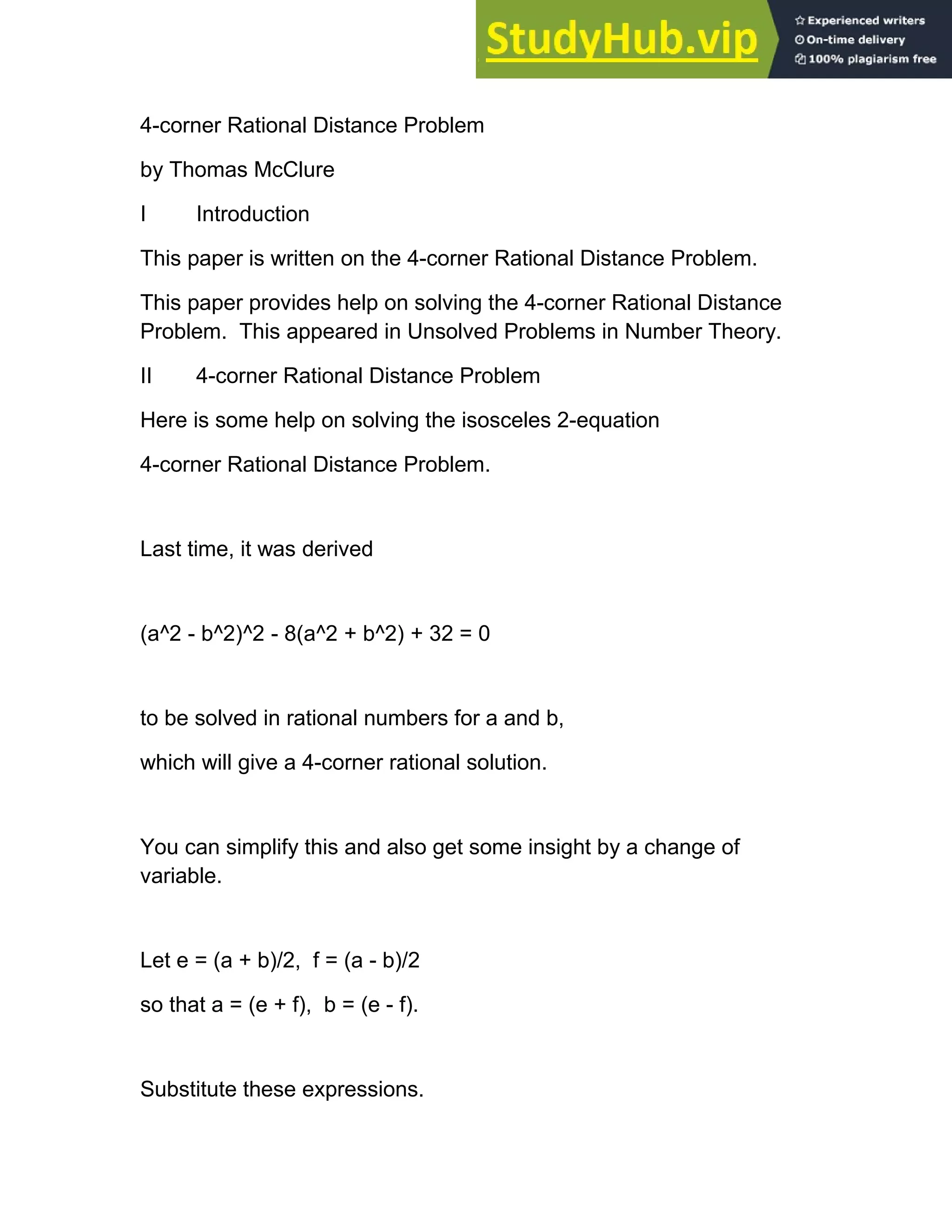
4-corner Rational Distance Problem
by Thomas McClure
I Introduction
This paper is written on the 4-corner Rational Distance Problem.
This paper provides help on solving the 4-corner Rational Distance
Problem. This appeared in Unsolved Problems in Number Theory.
II 4-corner Rational Distance Problem
Here is some help on solving the isosceles 2-equation
4-corner Rational Distance Problem.
Last time, it was derived
(a^2 - b^2)^2 - 8(a^2 + b^2) + 32 = 0
to be solved in rational numbers for a and b,
which will give a 4-corner rational solution.
You can simplify this and also get some insight by a change of
variable.
Let e = (a + b)/2, f = (a - b)/2
so that a = (e + f), b = (e - f).
Substitute these expressions.
[(e+f)^2 - (e-f)^2]^2 - 8[(e+f)^2 + (e-f)^2] + 32 = 0
or
(4ef)^2 - 8(2e^2 + 2f^2) + 32 = 0
or
(ef)^2 - (e^2 + f^2) + 2 = 0
If you separate the 2 into 1 + 1, this can be written as
(e^2 - 1)(f^2 - 1) = -1
One of e^2 and f^2 must be above 1 and the other below 1.
We can assume that a and b are positive
and we can flip the diagram so that a > b,
therefore, since [e' = a+b] and [f' = a-b],
we can make [e' larger than f'].
[e' = 2e f' = 2f]
[So e'^2 > 1 and f'^2 < 1].
II abc conjecture
(a + b) = c = e' = 2e
c < rad(abc), where the rad function is a product of primes in abc,
in most usual cases, and [For every ε > 0]
c > rad(abc)^(1 + ε)
in special cases.
Hence, e' = c, where c takes two differents values.
Then e'^2 > 1 {c, c} 4e^2 > 1
(e^2 - 1)(f^2 - 1) = -1
(e - 1)(e + 1)(f - 1)(f + 1) = 0 [unit circle]
e = 1 , e = -1 , f = 1 , f = -1
but f < 1 , f = {0,-1}
but e > 1 , e = {-1,0,+1} base > 1 {c, c}
e'^2 = {c, c}^2 = 4e^2
2e = {c, c} = c = (a + b)
e = {c, c}/2
III Conclusion
By the abc conjecture
2e = {c, c} = c = (a + b)
e = {c, c}/2
e has two values of c divided by 1/2 which are both equal (a + b).
A [unit circle] solution of the equation
(e^2 - 1)(f^2 - 1) = -1
(e - 1)(e + 1)(f - 1)(f + 1) = 0 [unit circle]
e = 1 , e = -1 , f = 1 , f = -1
but f < 1 , f = {0,-1}
but e > 1 , e = {-1,0,+1} base > 1 {c, c}
e'^2 = {c, c}^2 = 4e^2
Hence, the raditional distance problem has solutions by the abc
conjecture.
Appendix
Rational Distance
Given a unit square, can you find any point in the same plane, either
inside or outside the square, that is a rational distance from all four
corners?
Or, put another way, given a square ABCD of any size, can you find a
point P in the same plane such that the distances AB, PA, PB, PC,
and PD are all integers?
The problem is to find such a point, or prove that no such point can
exist.
http://www.unsolvedproblems.org/index_files/RationalDistance.htm
For further information, please see:
[1] Guy, Richard K. Unsolved Problems in Number Theory, Vol. 1,
Springer-Verlag, 2nd ed. 1991, 181-185.
[2] Barbara, Roy. "The rational distance problem", Mathematical
Gazette 95, March 2011, 59-61.
abc conjecture
Let A, B, and C be three coprime integers such that
A + B = C
Now multiply together all the distinct primes that divide any of these
numbers, and call the result rad(ABC).
For example, if we start with 4 + 11 = 15, we have 2 (which divides
4), 11 (which divides 11) and 3 and 5 (which divide 15), so rad(ABC)
= 2 x 11 x 3 x 5 = 330.
C is almost always smaller than rad(ABC), but not always. If you start
with 2 + 243 = 245, the primes are 2 (which divides 2), 3 (which
divides 243), and 5 and 7 (which divide 245). So rad(ABC) = 2 x 3 x 5
x 7 = 210. In this case, C is much bigger than rad(ABC).
Let’s count C as “much bigger” whenever it’s bigger than rad(ABC)1.1
or rad(ABC)1.001 or rad(ABC)1.000000000001 or rad(ABC)1+Є. The
ABC conjecture says that no matter how small Є, there will still be
only finitely many examples where C counts as much bigger than
rad(ABC).
The problem is to prove or disprove the conjecture.
http://www.unsolvedproblems.org/index_files/abc.htm
For further information, please see:
[1] http://mathworld.wolfram.com/abcConjecture.html
[2] http://www.math.unicaen.fr/~nitaj/abc.html
[3] http://en.wikipedia.org/wiki/Abc_conjecture
(4)
Jan 5 at 5:42 PM
To
UnsolvedProblems@yahoogroups.com
Jan 5 at 7:40 PM
Hi Rob,
You wrote
> It’s unfortunate that this particular parameterization
M
a
t
s
o
n
,
R
o
b
D
.'
r
o
b
e
rt
.
d
.
m
a
t
s
o
n
@
le
i
d
o
s.
c
o
m
[
U
n
s
o
lv
e
d
P
r
o
b
le
e
e
m
o
r
g
3
2
3
@
y
a
h
o
o
.c
o
m
[
U
n
s
o
lv
e
d
P
r
o
b
le
m
s
]
<
U
n
s
ol
v
e
d
P
r
o
bl
e
m
> apparently cannot result in a rational solution for C.
It's only the first two formulas that can't make a rational C.
There are still a lot of other possibilities that might work.
---------------------------
Here is how I get from the p,q formulation to the s,t formulation.
[5] 2pqY - qX^2 + qp^2 = 2pqX - pY^2 + pq^2
Let t = -(X^2)(q/p) so that q = -tp/X^2
Substitute q into [5] and divide by p.
[5a] -2tpY/X^2 + t - tp^2/X^2 = -2tp/X - Y^2 + t^2p^2/X^4
Rearrange and factor.
[5b] t[(p^2/X^4)(t+X^2) + 2(p/X^2)(Y-X)] = t+Y^2
Multiply both sides by t(t+X^2).
[5c] t^2[(p/X^2)^2(t+X^2)^2 + 2(p/X^2)(t+X^2)(Y-X)] =
t(t+X^2)(t+Y^2)
Complete the square
[5d] t^2[(p/X^2)^2(t+X^2)^2 + 2(p/X^2)(t+X^2)(Y-X) + (Y-X)^2)] =
t(t+X^2)(t+Y^2) + t^2(Y-X)^2
which gives
[5e] t^2[(p/X^2)(t+X^2) + (Y-X)]^2 = t(t+X^2)(t+Y^2) + t^2(Y X)^2
Let s = t[(p/X^2)(t+X^2) + (Y-X)]
so that
[6] p = X^2(s/t-Y+X) / (t+X^2)
and then [5e] becomes
[5f] s^2 = t(t+X^2)(t+Y^2) + t^2(Y-X)^2
Using X^2 + Y^2 = Z^2, [5f] becomes
s^2 = t^3 + 2(Z^2-XY)t^2 + (XY)^2t
This can also be factored as
s^2 = t (t + (Z+X)(Z-Y)) (t + (Z-X)(Z+Y))
Lee
__._,_.___
Posted by: leemorg323@yahoo.com
so that
p = X^2(s/t-Y+X) / (t+X^2)
and then [5e] becomes
[5f] s^2 = t(t+X^2)(t+Y^2) + t^2(Y-X)^2
Using X^2 + Y^2 = Z^2, [5f] becomes
s^2 = t^3 + 2(Z^2-XY)t^2 + (XY)^2t
This can also be factored as
s^2 = t (t + (Z+X)(Z-Y)) (t + (Z-X)(Z+Y))
Lee
__._,_.___
Posted by: leemorg323@yahoo.com
leemorg323@yahoo.com [UnsolvedProblems]
<UnsolvedProblems@yahoogroups.com>
To
UnsolvedProblems@yahoogroups.com
Jan 5 at 7:37 PM
I have discovered a supernatural math pattern.
We know that there can't be four squares in arithmetic
progression,
but the only proof technique uses infinite descent
which doesn't explain why it's impossible.
So in an effort to find a different proof, I enumerated the value
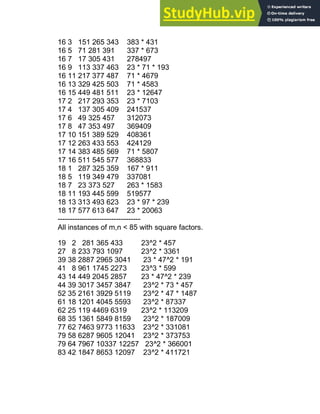
of
the fourth term of primitive three-square arithmetic
progressions.
Below is the SAGE program I used followed by the [edited]
output.
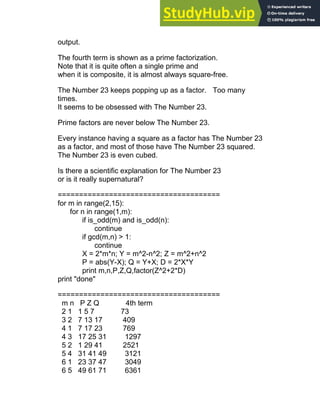
The fourth term is shown as a prime factorization.
Note that it is quite often a single prime and
when it is composite, it is almost always square-free.
The Number 23 keeps popping up as a factor. Too many
times.
It seems to be obsessed with The Number 23.
Prime factors are never below The Number 23.
Every instance having a square as a factor has The Number 23
as a factor, and most of those have The Number 23 squared.
The Number 23 is even cubed.
Is there a scientific explanation for The Number 23
or is it really supernatural?
======================================
for m in range(2,15):
for n in range(1,m):
if is_odd(m) and is_odd(n):
continue
if gcd(m,n) > 1:
continue
X = 2*m*n; Y = m^2-n^2; Z = m^2+n^2
P = abs(Y-X); Q = Y+X; D = 2*X*Y
print m,n,P,Z,Q,factor(Z^2+2*D)
print "done"
======================================
m n P Z Q 4th term
2 1 1 5 7 73
3 2 7 13 17 409
4 1 7 17 23 769
4 3 17 25 31 1297
5 2 1 29 41 2521
5 4 31 41 49 3121
6 1 23 37 47 3049
6 5 49 61 71 6361
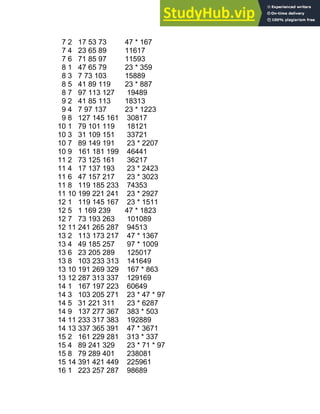
7 2 17 53 73 47 * 167
7 4 23 65 89 11617
7 6 71 85 97 11593
8 1 47 65 79 23 * 359
8 3 7 73 103 15889
8 5 41 89 119 23 * 887
8 7 97 113 127 19489
9 2 41 85 113 18313
9 4 7 97 137 23 * 1223
9 8 127 145 161 30817
10 1 79 101 119 18121
10 3 31 109 151 33721
10 7 89 149 191 23 * 2207
10 9 161 181 199 46441
11 2 73 125 161 36217
11 4 17 137 193 23 * 2423
11 6 47 157 217 23 * 3023
11 8 119 185 233 74353
11 10 199 221 241 23 * 2927
12 1 119 145 167 23 * 1511
12 5 1 169 239 47 * 1823
12 7 73 193 263 101089
12 11 241 265 287 94513
13 2 113 173 217 47 * 1367
13 4 49 185 257 97 * 1009
13 6 23 205 289 125017
13 8 103 233 313 141649
13 10 191 269 329 167 * 863
13 12 287 313 337 129169
14 1 167 197 223 60649
14 3 103 205 271 23 * 47 * 97
14 5 31 221 311 23 * 6287
14 9 137 277 367 383 * 503
14 11 233 317 383 192889
14 13 337 365 391 47 * 3671
15 2 161 229 281 313 * 337
15 4 89 241 329 23 * 71 * 97
15 8 79 289 401 238081
15 14 391 421 449 225961
16 1 223 257 287 98689
16 3 151 265 343 383 * 431
16 5 71 281 391 337 * 673
16 7 17 305 431 278497
16 9 113 337 463 23 * 71 * 193
16 11 217 377 487 71 * 4679
16 13 329 425 503 71 * 4583
16 15 449 481 511 23 * 12647
17 2 217 293 353 23 * 7103
17 4 137 305 409 241537
17 6 49 325 457 312073
17 8 47 353 497 369409
17 10 151 389 529 408361
17 12 263 433 553 424129
17 14 383 485 569 71 * 5807
17 16 511 545 577 368833
18 1 287 325 359 167 * 911
18 5 119 349 479 337081
18 7 23 373 527 263 * 1583
18 11 193 445 599 519577
18 13 313 493 623 23 * 97 * 239
18 17 577 613 647 23 * 20063
----------------------------------
All instances of m,n < 85 with square factors.
19 2 281 365 433 23^2 * 457
27 8 233 793 1097 23^2 * 3361
39 38 2887 2965 3041 23 * 47^2 * 191
41 8 961 1745 2273 23^3 * 599
43 14 449 2045 2857 23 * 47^2 * 239
44 39 3017 3457 3847 23^2 * 73 * 457
52 35 2161 3929 5119 23^2 * 47 * 1487
61 18 1201 4045 5593 23^2 * 87337
62 25 119 4469 6319 23^2 * 113209
68 35 1361 5849 8159 23^2 * 187009
77 62 7463 9773 11633 23^2 * 331081
79 58 6287 9605 12041 23^2 * 373753
79 64 7967 10337 12257 23^2 * 366001
83 42 1847 8653 12097 23^2 * 411721
__._,_.___
Posted by: leemorg323@yahoo.com
im Roberts tsr21@yahoo.com
[UnsolvedProblems] <UnsolvedProblems@yahoogroups.com
>
To
unsolvedproblems@yahoogroups.com
Today at 4:25 AM
Those interested in proofs that there cannot be four squares in
arithmetic progression might be interested in the paper at
http://www.math.ku.dk/~kiming/lecture_notes/2007-2008-
elliptic_curves/4_squares_in_arithmetic_progression.pdf
Tim
III Conclusion
This paper is written on the 4-corner Rational Distance Problem.
__._,_.___
Posted by: Tim Roberts <tsr21@yahoo.com>

4-Corner Rational Distance Problems

  • 1.
    4-corner Rational DistanceProblem by Thomas McClure I Introduction This paper is written on the 4-corner Rational Distance Problem. This paper provides help on solving the 4-corner Rational Distance Problem. This appeared in Unsolved Problems in Number Theory. II 4-corner Rational Distance Problem Here is some help on solving the isosceles 2-equation 4-corner Rational Distance Problem. Last time, it was derived (a^2 - b^2)^2 - 8(a^2 + b^2) + 32 = 0 to be solved in rational numbers for a and b, which will give a 4-corner rational solution. You can simplify this and also get some insight by a change of variable. Let e = (a + b)/2, f = (a - b)/2 so that a = (e + f), b = (e - f). Substitute these expressions.
  • 2.
    [(e+f)^2 - (e-f)^2]^2- 8[(e+f)^2 + (e-f)^2] + 32 = 0 or (4ef)^2 - 8(2e^2 + 2f^2) + 32 = 0 or (ef)^2 - (e^2 + f^2) + 2 = 0 If you separate the 2 into 1 + 1, this can be written as (e^2 - 1)(f^2 - 1) = -1 One of e^2 and f^2 must be above 1 and the other below 1. We can assume that a and b are positive and we can flip the diagram so that a > b, therefore, since [e' = a+b] and [f' = a-b], we can make [e' larger than f']. [e' = 2e f' = 2f] [So e'^2 > 1 and f'^2 < 1]. II abc conjecture (a + b) = c = e' = 2e c < rad(abc), where the rad function is a product of primes in abc, in most usual cases, and [For every ε > 0]
  • 3.
    c > rad(abc)^(1+ ε) in special cases. Hence, e' = c, where c takes two differents values. Then e'^2 > 1 {c, c} 4e^2 > 1 (e^2 - 1)(f^2 - 1) = -1 (e - 1)(e + 1)(f - 1)(f + 1) = 0 [unit circle] e = 1 , e = -1 , f = 1 , f = -1 but f < 1 , f = {0,-1} but e > 1 , e = {-1,0,+1} base > 1 {c, c} e'^2 = {c, c}^2 = 4e^2 2e = {c, c} = c = (a + b) e = {c, c}/2 III Conclusion By the abc conjecture 2e = {c, c} = c = (a + b) e = {c, c}/2 e has two values of c divided by 1/2 which are both equal (a + b). A [unit circle] solution of the equation (e^2 - 1)(f^2 - 1) = -1 (e - 1)(e + 1)(f - 1)(f + 1) = 0 [unit circle] e = 1 , e = -1 , f = 1 , f = -1 but f < 1 , f = {0,-1}
  • 4.
    but e >1 , e = {-1,0,+1} base > 1 {c, c} e'^2 = {c, c}^2 = 4e^2 Hence, the raditional distance problem has solutions by the abc conjecture. Appendix Rational Distance Given a unit square, can you find any point in the same plane, either inside or outside the square, that is a rational distance from all four corners? Or, put another way, given a square ABCD of any size, can you find a point P in the same plane such that the distances AB, PA, PB, PC, and PD are all integers? The problem is to find such a point, or prove that no such point can exist. http://www.unsolvedproblems.org/index_files/RationalDistance.htm For further information, please see: [1] Guy, Richard K. Unsolved Problems in Number Theory, Vol. 1, Springer-Verlag, 2nd ed. 1991, 181-185. [2] Barbara, Roy. "The rational distance problem", Mathematical Gazette 95, March 2011, 59-61. abc conjecture Let A, B, and C be three coprime integers such that
  • 5.
    A + B= C Now multiply together all the distinct primes that divide any of these numbers, and call the result rad(ABC). For example, if we start with 4 + 11 = 15, we have 2 (which divides 4), 11 (which divides 11) and 3 and 5 (which divide 15), so rad(ABC) = 2 x 11 x 3 x 5 = 330. C is almost always smaller than rad(ABC), but not always. If you start with 2 + 243 = 245, the primes are 2 (which divides 2), 3 (which divides 243), and 5 and 7 (which divide 245). So rad(ABC) = 2 x 3 x 5 x 7 = 210. In this case, C is much bigger than rad(ABC). Let’s count C as “much bigger” whenever it’s bigger than rad(ABC)1.1 or rad(ABC)1.001 or rad(ABC)1.000000000001 or rad(ABC)1+Є. The ABC conjecture says that no matter how small Є, there will still be only finitely many examples where C counts as much bigger than rad(ABC). The problem is to prove or disprove the conjecture. http://www.unsolvedproblems.org/index_files/abc.htm For further information, please see: [1] http://mathworld.wolfram.com/abcConjecture.html
  • 6.
    [2] http://www.math.unicaen.fr/~nitaj/abc.html [3] http://en.wikipedia.org/wiki/Abc_conjecture (4) Jan5 at 5:42 PM To UnsolvedProblems@yahoogroups.com Jan 5 at 7:40 PM Hi Rob, You wrote > It’s unfortunate that this particular parameterization M a t s o n , R o b D .' r o b e rt . d . m a t s o n @ le i d o s. c o m [ U n s o lv e d P r o b le e e m o r g 3 2 3 @ y a h o o .c o m [ U n s o lv e d P r o b le m s ] < U n s ol v e d P r o bl e m
  • 7.
    > apparently cannotresult in a rational solution for C. It's only the first two formulas that can't make a rational C. There are still a lot of other possibilities that might work. --------------------------- Here is how I get from the p,q formulation to the s,t formulation. [5] 2pqY - qX^2 + qp^2 = 2pqX - pY^2 + pq^2 Let t = -(X^2)(q/p) so that q = -tp/X^2 Substitute q into [5] and divide by p. [5a] -2tpY/X^2 + t - tp^2/X^2 = -2tp/X - Y^2 + t^2p^2/X^4 Rearrange and factor. [5b] t[(p^2/X^4)(t+X^2) + 2(p/X^2)(Y-X)] = t+Y^2 Multiply both sides by t(t+X^2). [5c] t^2[(p/X^2)^2(t+X^2)^2 + 2(p/X^2)(t+X^2)(Y-X)] = t(t+X^2)(t+Y^2) Complete the square [5d] t^2[(p/X^2)^2(t+X^2)^2 + 2(p/X^2)(t+X^2)(Y-X) + (Y-X)^2)] = t(t+X^2)(t+Y^2) + t^2(Y-X)^2 which gives [5e] t^2[(p/X^2)(t+X^2) + (Y-X)]^2 = t(t+X^2)(t+Y^2) + t^2(Y X)^2 Let s = t[(p/X^2)(t+X^2) + (Y-X)]
  • 8.
    so that [6] p= X^2(s/t-Y+X) / (t+X^2) and then [5e] becomes [5f] s^2 = t(t+X^2)(t+Y^2) + t^2(Y-X)^2 Using X^2 + Y^2 = Z^2, [5f] becomes s^2 = t^3 + 2(Z^2-XY)t^2 + (XY)^2t This can also be factored as s^2 = t (t + (Z+X)(Z-Y)) (t + (Z-X)(Z+Y)) Lee __._,_.___ Posted by: leemorg323@yahoo.com so that p = X^2(s/t-Y+X) / (t+X^2) and then [5e] becomes [5f] s^2 = t(t+X^2)(t+Y^2) + t^2(Y-X)^2 Using X^2 + Y^2 = Z^2, [5f] becomes s^2 = t^3 + 2(Z^2-XY)t^2 + (XY)^2t This can also be factored as s^2 = t (t + (Z+X)(Z-Y)) (t + (Z-X)(Z+Y))
  • 9.
    Lee __._,_.___ Posted by: leemorg323@yahoo.com leemorg323@yahoo.com[UnsolvedProblems] <UnsolvedProblems@yahoogroups.com> To UnsolvedProblems@yahoogroups.com Jan 5 at 7:37 PM I have discovered a supernatural math pattern. We know that there can't be four squares in arithmetic progression, but the only proof technique uses infinite descent which doesn't explain why it's impossible. So in an effort to find a different proof, I enumerated the value of the fourth term of primitive three-square arithmetic progressions. Below is the SAGE program I used followed by the [edited]
  • 10.
    output. The fourth termis shown as a prime factorization. Note that it is quite often a single prime and when it is composite, it is almost always square-free. The Number 23 keeps popping up as a factor. Too many times. It seems to be obsessed with The Number 23. Prime factors are never below The Number 23. Every instance having a square as a factor has The Number 23 as a factor, and most of those have The Number 23 squared. The Number 23 is even cubed. Is there a scientific explanation for The Number 23 or is it really supernatural? ====================================== for m in range(2,15): for n in range(1,m): if is_odd(m) and is_odd(n): continue if gcd(m,n) > 1: continue X = 2*m*n; Y = m^2-n^2; Z = m^2+n^2 P = abs(Y-X); Q = Y+X; D = 2*X*Y print m,n,P,Z,Q,factor(Z^2+2*D) print "done" ====================================== m n P Z Q 4th term 2 1 1 5 7 73 3 2 7 13 17 409 4 1 7 17 23 769 4 3 17 25 31 1297 5 2 1 29 41 2521 5 4 31 41 49 3121 6 1 23 37 47 3049 6 5 49 61 71 6361
  • 11.
    7 2 1753 73 47 * 167 7 4 23 65 89 11617 7 6 71 85 97 11593 8 1 47 65 79 23 * 359 8 3 7 73 103 15889 8 5 41 89 119 23 * 887 8 7 97 113 127 19489 9 2 41 85 113 18313 9 4 7 97 137 23 * 1223 9 8 127 145 161 30817 10 1 79 101 119 18121 10 3 31 109 151 33721 10 7 89 149 191 23 * 2207 10 9 161 181 199 46441 11 2 73 125 161 36217 11 4 17 137 193 23 * 2423 11 6 47 157 217 23 * 3023 11 8 119 185 233 74353 11 10 199 221 241 23 * 2927 12 1 119 145 167 23 * 1511 12 5 1 169 239 47 * 1823 12 7 73 193 263 101089 12 11 241 265 287 94513 13 2 113 173 217 47 * 1367 13 4 49 185 257 97 * 1009 13 6 23 205 289 125017 13 8 103 233 313 141649 13 10 191 269 329 167 * 863 13 12 287 313 337 129169 14 1 167 197 223 60649 14 3 103 205 271 23 * 47 * 97 14 5 31 221 311 23 * 6287 14 9 137 277 367 383 * 503 14 11 233 317 383 192889 14 13 337 365 391 47 * 3671 15 2 161 229 281 313 * 337 15 4 89 241 329 23 * 71 * 97 15 8 79 289 401 238081 15 14 391 421 449 225961 16 1 223 257 287 98689
  • 12.
    16 3 151265 343 383 * 431 16 5 71 281 391 337 * 673 16 7 17 305 431 278497 16 9 113 337 463 23 * 71 * 193 16 11 217 377 487 71 * 4679 16 13 329 425 503 71 * 4583 16 15 449 481 511 23 * 12647 17 2 217 293 353 23 * 7103 17 4 137 305 409 241537 17 6 49 325 457 312073 17 8 47 353 497 369409 17 10 151 389 529 408361 17 12 263 433 553 424129 17 14 383 485 569 71 * 5807 17 16 511 545 577 368833 18 1 287 325 359 167 * 911 18 5 119 349 479 337081 18 7 23 373 527 263 * 1583 18 11 193 445 599 519577 18 13 313 493 623 23 * 97 * 239 18 17 577 613 647 23 * 20063 ---------------------------------- All instances of m,n < 85 with square factors. 19 2 281 365 433 23^2 * 457 27 8 233 793 1097 23^2 * 3361 39 38 2887 2965 3041 23 * 47^2 * 191 41 8 961 1745 2273 23^3 * 599 43 14 449 2045 2857 23 * 47^2 * 239 44 39 3017 3457 3847 23^2 * 73 * 457 52 35 2161 3929 5119 23^2 * 47 * 1487 61 18 1201 4045 5593 23^2 * 87337 62 25 119 4469 6319 23^2 * 113209 68 35 1361 5849 8159 23^2 * 187009 77 62 7463 9773 11633 23^2 * 331081 79 58 6287 9605 12041 23^2 * 373753 79 64 7967 10337 12257 23^2 * 366001 83 42 1847 8653 12097 23^2 * 411721
  • 13.
    __._,_.___ Posted by: leemorg323@yahoo.com imRoberts tsr21@yahoo.com [UnsolvedProblems] <UnsolvedProblems@yahoogroups.com > To unsolvedproblems@yahoogroups.com Today at 4:25 AM Those interested in proofs that there cannot be four squares in arithmetic progression might be interested in the paper at http://www.math.ku.dk/~kiming/lecture_notes/2007-2008- elliptic_curves/4_squares_in_arithmetic_progression.pdf Tim
  • 14.
    III Conclusion This paperis written on the 4-corner Rational Distance Problem. __._,_.___ Posted by: Tim Roberts <tsr21@yahoo.com>