@ IJTSRD | Available Online @ www.ijtsrd.com
ISSN No: 2456
International
Research
Emotion Recognition using Image Processing
Yash Bardhan, Tejas A. Fulzele, Prabhat Ranjan, Shekh
Department of Electronics and Telecommunication
ABSTRACT
Emotion plays an important role in daily life of
human being. The need and importance of automatic
emotion recognition has grown with increasing role of
human computer interaction applications. All emotion
is derived from the presence of stimulus in body
which evoke the physiological response.
Keywords: Emotion recognition, Face recognition,
Edge detection, Feature extraction, Database, RGB
I. INTRODUCTION
In our day to day life emotions or facial expression
are the prime factors which are required for
communication purpose. Human has an ability
through which it can detect emotions of any person
without error, whereas in case of machines like
computer this does not holds true. An Emotion is a
mental and physiological state which is subjective and
private it involves lot of behaviour, actions, thoughts
and feelings. The facial expression plays a vital role in
communicating without any actual verbal
communication between human being and also it
comes under non-verbal communication technique.
Research in facial emotion recognition has being
carried so as to improve non verbal communication
especially while determining emotion recognition. In
fact there exist other applications such as by using
MATLAB which benefit from automatic facial
emotion recognition.
@ IJTSRD | Available Online @ www.ijtsrd.com | Volume – 2 | Issue – 3 | Mar-Apr 2018
ISSN No: 2456 - 6470 | www.ijtsrd.com | Volume
International Journal of Trend in Scientific
Research and Development (IJTSRD)
International Open Access Journal
Emotion Recognition using Image Processing
Yash Bardhan, Tejas A. Fulzele, Prabhat Ranjan, Shekhar Upadhyay, Prof. V.D. Bharate
Department of Electronics and Telecommunication, Sinhgad Academy of Engineering
Kondhwa, Pune, India
Emotion plays an important role in daily life of
human being. The need and importance of automatic
emotion recognition has grown with increasing role of
human computer interaction applications. All emotion
is derived from the presence of stimulus in body
hich evoke the physiological response.
Emotion recognition, Face recognition,
Edge detection, Feature extraction, Database, RGB
In our day to day life emotions or facial expression
are the prime factors which are required for
communication purpose. Human has an ability
through which it can detect emotions of any person
without error, whereas in case of machines like
oes not holds true. An Emotion is a
mental and physiological state which is subjective and
private it involves lot of behaviour, actions, thoughts
and feelings. The facial expression plays a vital role in
communicating without any actual verbal
on between human being and also it
verbal communication technique.
Research in facial emotion recognition has being
carried so as to improve non verbal communication
especially while determining emotion recognition. In
r applications such as by using
MATLAB which benefit from automatic facial
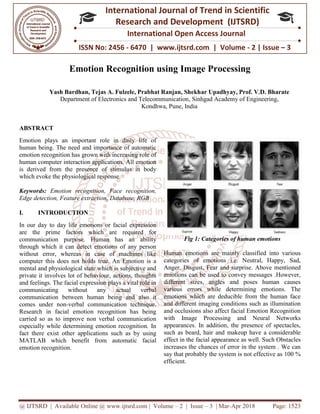
Fig 1: Categories of human emotions
Human emotions are mainly classified into various
categories of emotions i.e. Neutral, Happy, Sad,
Anger, Disgust, Fear and surprise. Above mentioned
emotions can be used to convey messages .However,
different sizes, angles and poses human causes
various errors while determining emotions. The
emotions which are deducible from the human face
and different imaging condition
and occlusions also affect facial Emotion Recognition
with Image Processing and Neural Networks
appearances. In addition, the presence of spectacles,
such as beard, hair and makeup have a considerable
effect in the facial appearance
increases the chances of error in the system . We can
say that probably the system is not effective as 100 %
efficient.
Apr 2018 Page: 1523
6470 | www.ijtsrd.com | Volume - 2 | Issue – 3
Scientific
(IJTSRD)
International Open Access Journal
Emotion Recognition using Image Processing
ar Upadhyay, Prof. V.D. Bharate
Sinhgad Academy of Engineering,
Categories of human emotions
Human emotions are mainly classified into various
categories of emotions i.e. Neutral, Happy, Sad,
r and surprise. Above mentioned
emotions can be used to convey messages .However,
different sizes, angles and poses human causes
various errors while determining emotions. The
emotions which are deducible from the human face
and different imaging conditions such as illumination
and occlusions also affect facial Emotion Recognition
with Image Processing and Neural Networks
appearances. In addition, the presence of spectacles,
such as beard, hair and makeup have a considerable
effect in the facial appearance as well. Such Obstacles
increases the chances of error in the system . We can
say that probably the system is not effective as 100 %
International Journal of Trend in Scientific Research and Development (IJTSRD) ISSN: 2456-6470
@ IJTSRD | Available Online @ www.ijtsrd.com | Volume – 2 | Issue – 3 | Mar-Apr 2018 Page: 1524
II. SYSTEM DESCRIPTION
Fig. 2 Block diagram of the system
a) Pre-processing: [3] Pre-processing of image is a
technique which enhances the image quality using
histogram equalization. After this, we discover the
probability of the largest connected region which is
related to facial region. If the connected regions
height & width is larger than or equal to 50 and the
ratio of height to width is between 1 and 2, then it
might be considered as face. [2]For detection of facial
boundary regions, firstly convert RBG image into
binary image. To do this we have used inbuilt Matlab
function. This binary image further might be used to
isolate the forehead from the face.
b) Boundary detection Method:
Face detection: For a given image detecting a human
face might be a complex task due to various possible
variations in the face. The different sizes and angles
that human face posses may cause this variation.[1]
Facial expression approach can be divided into three
steps so that the face in an image is known for further
processing. Facial feature extraction is the method
used to represent the facial expression and finally
classification which is the step that classifies the
features extracted in the appropriate expression.
Fig. 3: Steps in face detection stage.(a) Original
image b) Result image from original image c) Region
after refining d) Face detected )
c) Eye Extraction:
The eyes display strong vertical edges (horizontal
transitions) due to its iris and eye white.[4] Thus, the
Canny edge can be applied to an image and the
horizontal projection of vertical edges can be obtained
to determine the Y coordinate of the eyes.[3][4] The
Canny edge detection is applied to the upper half of
the face image and the sum of each row is
horizontally plotted. The top two peaks in horizontal
projection of edges are obtained and the peak with the
lower intensity value in horizontal projection of
intensity is selected as the Y coordinate of the eyes.
Then pair of regions that satisfy certain geometric
conditions are selected as eyes from those regions.
Fig 4: Steps in eye extraction(a) Regions around the y
coordinate of eyes b) After dilating and filling the
edge image c) After growing the regions d) Selected
eye regions)
d) Feature extraction:
After the face has been detected in the scene, the next
step is to extract the emotion information of the face
in automatic way. It is known that the face
representation and the kind of input image will affect
the choice of the approach. Various analysis of face
has been developed.[2] For this, the Ekman has given
some descriptions of emotion states related to facial
points from physiologist point of view. According
these relations, this paper originally defines fourteen
feature points as Fig 5.
International Journal of Trend in Scientific Research and Development (IJTSRD) ISSN: 2456-6470
@ IJTSRD | Available Online @ www.ijtsrd.com | Volume – 2 | Issue – 3 | Mar-Apr 2018 Page: 1525
Fig. 5 The fourteen feature points defined in face
III. EXPERIMENT RESULTS
This section will show some experiment for facial
emotion recognition. All experiments are considered
to be in the same environment condition, and the
background can be complex.
Fig 6.(a)Human emotion.
Fig 6.(b) Edge detection
Fig 6.(c) Mouth region
Fig 6.(d) Nose region
Fig 6.(e) Eyes region
IV. RESULT
In this project we will use the classes that are based
on different emotions of human beings to store
various features of different images, which have been
utilised further for the next part of our project which
is testing, as a reference. We have designed a
classifier which utilises the features present in the
reference classes in order to determine type of
emotion of the photo that is being provided during
testing process. The distance measures extracted from
the facial features provide very reliable and valuable
information for robust recognition of facial features.
Facial expression database is used which is more
reliable. Facial expression analysis experiments
carried out is person independent which is more
challenging then experiment carried out in a person
dependent manner. There is no need for manual
system for determining emotion of a person.
However, average recognition rate is lesser for anger
class due to confusion with neutral and anger classes.
Also, output is less precise if the person in the image
is wearing spectacles. If technical issues occur in the
code or the system implementing this code, it may
affect result.
V. CONCLUSION
We have presented an emotion detection algorithm by
using facial image. The algorithm composed of three
stages. In image processing stage, the face region and
facial components are extracted. The pre-processing
of image has been shown by removing noises present
in the image and applying filter algorithm in it. In
Facial detection we have detected individual regions
around the face and used it to extract the features and
maintained a database for testing and training of
image.
VI. ACKNOWLEDGEMENT
We would like to express our sincere gratitude to our
guide Prof. V.D. Bharate for providing his valuable
guidance, comments and suggestions throughout the
project. His constant guidance and willingness to
share his vast knowledge made us understand this
project and its manifestations in great depths and
helped us to complete the assigned tasks. We would
also like to thank our project co-ordinator Prof. S.S.
Shah for providing this opportunity.
International Journal of Trend in Scientific Research and Development (IJTSRD) ISSN: 2456-6470
@ IJTSRD | Available Online @ www.ijtsrd.com | Volume – 2 | Issue – 3 | Mar-Apr 2018 Page: 1526
REFERENCES
1. Moon Hwan Kim, Young Hoon Joo, and Jin Bae
Park, “Emotion Detection Algorithm Using
Frontal Face Image”, IEEE 2013.
2. Leh Luoh , Chih-Chang Huang and Hsueh-Yen
Liu “Image processing based emotion
recognition” , IEEE 6, December 2011
3. Prof.Poonam Yewale,ShwetaS. Zure, Awanti M.
Awate ,“Image processing” ,IEEE December
2015.
4. DARWIN C, “The expression of emotions”, John
Murray, IEEE Trans, vol 20, no.15, London, U.K
2000
5. O.Diaz, G.Bueno, J.Salido, “Face recognition
using histogram of oriented gradients”,2011

Emotion Recognition using Image Processing

  • 1.
    @ IJTSRD |Available Online @ www.ijtsrd.com ISSN No: 2456 International Research Emotion Recognition using Image Processing Yash Bardhan, Tejas A. Fulzele, Prabhat Ranjan, Shekh Department of Electronics and Telecommunication ABSTRACT Emotion plays an important role in daily life of human being. The need and importance of automatic emotion recognition has grown with increasing role of human computer interaction applications. All emotion is derived from the presence of stimulus in body which evoke the physiological response. Keywords: Emotion recognition, Face recognition, Edge detection, Feature extraction, Database, RGB I. INTRODUCTION In our day to day life emotions or facial expression are the prime factors which are required for communication purpose. Human has an ability through which it can detect emotions of any person without error, whereas in case of machines like computer this does not holds true. An Emotion is a mental and physiological state which is subjective and private it involves lot of behaviour, actions, thoughts and feelings. The facial expression plays a vital role in communicating without any actual verbal communication between human being and also it comes under non-verbal communication technique. Research in facial emotion recognition has being carried so as to improve non verbal communication especially while determining emotion recognition. In fact there exist other applications such as by using MATLAB which benefit from automatic facial emotion recognition. @ IJTSRD | Available Online @ www.ijtsrd.com | Volume – 2 | Issue – 3 | Mar-Apr 2018 ISSN No: 2456 - 6470 | www.ijtsrd.com | Volume International Journal of Trend in Scientific Research and Development (IJTSRD) International Open Access Journal Emotion Recognition using Image Processing Yash Bardhan, Tejas A. Fulzele, Prabhat Ranjan, Shekhar Upadhyay, Prof. V.D. Bharate Department of Electronics and Telecommunication, Sinhgad Academy of Engineering Kondhwa, Pune, India Emotion plays an important role in daily life of human being. The need and importance of automatic emotion recognition has grown with increasing role of human computer interaction applications. All emotion is derived from the presence of stimulus in body hich evoke the physiological response. Emotion recognition, Face recognition, Edge detection, Feature extraction, Database, RGB In our day to day life emotions or facial expression are the prime factors which are required for communication purpose. Human has an ability through which it can detect emotions of any person without error, whereas in case of machines like oes not holds true. An Emotion is a mental and physiological state which is subjective and private it involves lot of behaviour, actions, thoughts and feelings. The facial expression plays a vital role in communicating without any actual verbal on between human being and also it verbal communication technique. Research in facial emotion recognition has being carried so as to improve non verbal communication especially while determining emotion recognition. In r applications such as by using MATLAB which benefit from automatic facial Fig 1: Categories of human emotions Human emotions are mainly classified into various categories of emotions i.e. Neutral, Happy, Sad, Anger, Disgust, Fear and surprise. Above mentioned emotions can be used to convey messages .However, different sizes, angles and poses human causes various errors while determining emotions. The emotions which are deducible from the human face and different imaging condition and occlusions also affect facial Emotion Recognition with Image Processing and Neural Networks appearances. In addition, the presence of spectacles, such as beard, hair and makeup have a considerable effect in the facial appearance increases the chances of error in the system . We can say that probably the system is not effective as 100 % efficient. Apr 2018 Page: 1523 6470 | www.ijtsrd.com | Volume - 2 | Issue – 3 Scientific (IJTSRD) International Open Access Journal Emotion Recognition using Image Processing ar Upadhyay, Prof. V.D. Bharate Sinhgad Academy of Engineering, Categories of human emotions Human emotions are mainly classified into various categories of emotions i.e. Neutral, Happy, Sad, r and surprise. Above mentioned emotions can be used to convey messages .However, different sizes, angles and poses human causes various errors while determining emotions. The emotions which are deducible from the human face and different imaging conditions such as illumination and occlusions also affect facial Emotion Recognition with Image Processing and Neural Networks appearances. In addition, the presence of spectacles, such as beard, hair and makeup have a considerable effect in the facial appearance as well. Such Obstacles increases the chances of error in the system . We can say that probably the system is not effective as 100 %
  • 2.
    International Journal ofTrend in Scientific Research and Development (IJTSRD) ISSN: 2456-6470 @ IJTSRD | Available Online @ www.ijtsrd.com | Volume – 2 | Issue – 3 | Mar-Apr 2018 Page: 1524 II. SYSTEM DESCRIPTION Fig. 2 Block diagram of the system a) Pre-processing: [3] Pre-processing of image is a technique which enhances the image quality using histogram equalization. After this, we discover the probability of the largest connected region which is related to facial region. If the connected regions height & width is larger than or equal to 50 and the ratio of height to width is between 1 and 2, then it might be considered as face. [2]For detection of facial boundary regions, firstly convert RBG image into binary image. To do this we have used inbuilt Matlab function. This binary image further might be used to isolate the forehead from the face. b) Boundary detection Method: Face detection: For a given image detecting a human face might be a complex task due to various possible variations in the face. The different sizes and angles that human face posses may cause this variation.[1] Facial expression approach can be divided into three steps so that the face in an image is known for further processing. Facial feature extraction is the method used to represent the facial expression and finally classification which is the step that classifies the features extracted in the appropriate expression. Fig. 3: Steps in face detection stage.(a) Original image b) Result image from original image c) Region after refining d) Face detected ) c) Eye Extraction: The eyes display strong vertical edges (horizontal transitions) due to its iris and eye white.[4] Thus, the Canny edge can be applied to an image and the horizontal projection of vertical edges can be obtained to determine the Y coordinate of the eyes.[3][4] The Canny edge detection is applied to the upper half of the face image and the sum of each row is horizontally plotted. The top two peaks in horizontal projection of edges are obtained and the peak with the lower intensity value in horizontal projection of intensity is selected as the Y coordinate of the eyes. Then pair of regions that satisfy certain geometric conditions are selected as eyes from those regions. Fig 4: Steps in eye extraction(a) Regions around the y coordinate of eyes b) After dilating and filling the edge image c) After growing the regions d) Selected eye regions) d) Feature extraction: After the face has been detected in the scene, the next step is to extract the emotion information of the face in automatic way. It is known that the face representation and the kind of input image will affect the choice of the approach. Various analysis of face has been developed.[2] For this, the Ekman has given some descriptions of emotion states related to facial points from physiologist point of view. According these relations, this paper originally defines fourteen feature points as Fig 5.
  • 3.
    International Journal ofTrend in Scientific Research and Development (IJTSRD) ISSN: 2456-6470 @ IJTSRD | Available Online @ www.ijtsrd.com | Volume – 2 | Issue – 3 | Mar-Apr 2018 Page: 1525 Fig. 5 The fourteen feature points defined in face III. EXPERIMENT RESULTS This section will show some experiment for facial emotion recognition. All experiments are considered to be in the same environment condition, and the background can be complex. Fig 6.(a)Human emotion. Fig 6.(b) Edge detection Fig 6.(c) Mouth region Fig 6.(d) Nose region Fig 6.(e) Eyes region IV. RESULT In this project we will use the classes that are based on different emotions of human beings to store various features of different images, which have been utilised further for the next part of our project which is testing, as a reference. We have designed a classifier which utilises the features present in the reference classes in order to determine type of emotion of the photo that is being provided during testing process. The distance measures extracted from the facial features provide very reliable and valuable information for robust recognition of facial features. Facial expression database is used which is more reliable. Facial expression analysis experiments carried out is person independent which is more challenging then experiment carried out in a person dependent manner. There is no need for manual system for determining emotion of a person. However, average recognition rate is lesser for anger class due to confusion with neutral and anger classes. Also, output is less precise if the person in the image is wearing spectacles. If technical issues occur in the code or the system implementing this code, it may affect result. V. CONCLUSION We have presented an emotion detection algorithm by using facial image. The algorithm composed of three stages. In image processing stage, the face region and facial components are extracted. The pre-processing of image has been shown by removing noises present in the image and applying filter algorithm in it. In Facial detection we have detected individual regions around the face and used it to extract the features and maintained a database for testing and training of image. VI. ACKNOWLEDGEMENT We would like to express our sincere gratitude to our guide Prof. V.D. Bharate for providing his valuable guidance, comments and suggestions throughout the project. His constant guidance and willingness to share his vast knowledge made us understand this project and its manifestations in great depths and helped us to complete the assigned tasks. We would also like to thank our project co-ordinator Prof. S.S. Shah for providing this opportunity.
  • 4.
    International Journal ofTrend in Scientific Research and Development (IJTSRD) ISSN: 2456-6470 @ IJTSRD | Available Online @ www.ijtsrd.com | Volume – 2 | Issue – 3 | Mar-Apr 2018 Page: 1526 REFERENCES 1. Moon Hwan Kim, Young Hoon Joo, and Jin Bae Park, “Emotion Detection Algorithm Using Frontal Face Image”, IEEE 2013. 2. Leh Luoh , Chih-Chang Huang and Hsueh-Yen Liu “Image processing based emotion recognition” , IEEE 6, December 2011 3. Prof.Poonam Yewale,ShwetaS. Zure, Awanti M. Awate ,“Image processing” ,IEEE December 2015. 4. DARWIN C, “The expression of emotions”, John Murray, IEEE Trans, vol 20, no.15, London, U.K 2000 5. O.Diaz, G.Bueno, J.Salido, “Face recognition using histogram of oriented gradients”,2011