International Research Journal of Engineering and Technology (IRJET) e-ISSN: 2395-0056
Volume: 09 Issue: 06 | June 2022 www.irjet.net p-ISSN: 2395-0072
2022, IRJET | Impact Factor value: 7.529 | ISO 9001:2008 Certified Journal | Page 2215
FACIAL EMOTION RECOGNITION
Kavya K1, Misha Bharathi S2, Namratha B R3, Nandini V 4
Dr. Renuka Devi M N, Dept. of Computer Science, Dayananda Sagar University, Karnataka, India
---------------------------------------------------------------------***---------------------------------------------------------------------
Abstract - Human emotions are mental states of
sentiments that occur without conscious effort and are
accompanied by physiological changes in facial muscles that
result in facial expressions. As a result, this study providesan
approach for real-time recognizing facial emotion using
image processing and AI techniques. Emotion recognition
relies heavily on face detection. Sad, glad, surprise, fear,
anger, neutral, and other emotions are all characterized as
such. The Haar cascade method and the Convolutional
Neural Network are used here. In the CNN technique,
processes such as pooling and followed by flattening,
whereas the Haar cascade algorithm uses Haar feature
selection and cascading classifiers. Face emotionrecognition
is more effective nowadays, and many applications use it in
real time for security purposes.
Key Words: Facial emotion recognition,CNN,Haar Cascade
1.INTRODUCTION
Facial Emotion Detection is a technique that analysesfacial
expressions in photos and videos to disclose information
about a person's emotional state. People use facial
expressions and verbal tones to infer other people's
emotional states, such as joy, sadness, and rage. We're using
a trained dataset which includes constant dynamic
graphics, photographs collected from videos or in real time.
Those dataset picture classifiers appear to be basic, yet they
are extremely sensitive to each individual's facial emotions.
Since the dawn of the smartphone era, the security of
unlocking a phone has been steadily improving. As
technology advances, we choose colour image face
expression recognition as our project to detect a person's
emotion, such as happiness, rage, melancholy, and so on.
Emotions have a vital influence not only in our
interpersonal relationships, but also in how we utilise
computers.
Some traits, such as elevated lip corners and cheeks,
creases, and muscular tightening around the eyes, can be
used to identify a happy emotion. Similarly, angry features
can be expressed by pulling up the upper lids, tightening
the lips, and pulling up the lower lids. Eyebrows pulled
down, upper lip pulled up, and nose furrowed are all
disgusting traits. Eyelids pushed up, mouth hangs open, and
full eyebrow pulled up are all unexpected traits. All features
are placed in their proper placements as neutral features.
Eyebrows drawn up, upper eyelids drawn up, and lips
extended are all signs of fear.
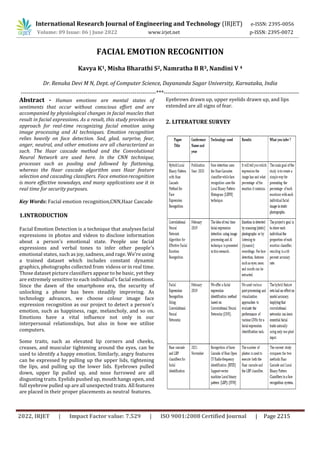
2. LITERATURE SURVEY
International Research Journal of Engineering and Technology (IRJET) e-ISSN: 2395-0056
Volume: 09 Issue: 06 | June 2022 www.irjet.net p-ISSN: 2395-0072
2022, IRJET | Impact Factor value: 7.529 | ISO 9001:2008 Certified Journal | Page 2216
3.METHODOLOGY
Image pre-processing are the steps we take to clean our
raw images into a format that best improves our model.
Image pre-processing refers to processes on images at the
most fundamental level. If strategies reduce rather than
increase image information content. Pre-processing is used
to improve image data by removing undesired distortions
or increasing specific visual features that are relevant for
further processing and analysis. The photographs'
processing steps are.
1. Look at the source image.
2. Image pre-processing (vocal elimination and
formatting).
3. In the input image, extraction functions
4. After processing, the outcome is an image
classification.
There are two forms of image processing:
1. analogue picture processing and
2. Digital picture processing.
Pre-processing, polishing, and recovering information
are all key strategies in image processing. To perform a
certain duty, an image is transformed to grayscale, then
shown in RGB (colour) for the user's viewing pleasure.
4. PROPOSED METHODOLOGY
Different algorithms are used in this project namely CNN
and Haar cascade .
4.1. CNN
The approach starts with a static input image and a
convolution layer, flatten layers, pooling layer, and dense
layer will be added to the CNN model. The dataset, fer2013,
was obtained via Kaggle.
There are 48 grayscale photos of faces in this dataset. It
includes happy, sad, and other emotions. furious, surprise,
and terror with 27,859 training images and 3765 testing
images purpose. We used a big dataset to train for
improved accuracy, and the outcome is an object class for
an object. Picture input For training and testing, we used
two picture generators.
Then all of the tests and training are pre-processed. Model
structure was designed by us. By building a model with
the.h5 extension, the features will be retrieved using the
pooling method.
The model that was built for testing purposes is then used.
For facial recognition, we use OpenCV. Real-time testing
requires recognition.
Fig-1: Block diagram of CNN
4.2. HAARCASCADE
The work starts with initializing the Haar Cascade model by
taking an input image (whether it may be static or dynamic)
by pre-processing the input images.
Two directories are available. Raw images can be found in
the images directory. These are raw materials.
The data directory contains training-related files.
A collection of photographs used to categorise facial
expressions. This repository contains a collection of face
expressions that can be used to train machine learning
algorithms.
Kaggle was used to collect the data. Now you may improve
the accuracy of this vast dataset by training it, and the
output will be the object class of the input image. The job of
the training stage is to collect samples that can be labelled
as positive or negative.
Anger, happiness, neutrality, and surprise are the four
categories here. Haar cascade classifier is used to detect the
items. This, above all, comprises the legend. csv, which
associates a face expression with an image in the photos
directory.
Local binary patterns (LBP) is a visual descriptor used to
identify image characteristics in texture form determined
by LBP.
International Research Journal of Engineering and Technology (IRJET) e-ISSN: 2395-0056
Volume: 09 Issue: 06 | June 2022 www.irjet.net p-ISSN: 2395-0072
2022, IRJET | Impact Factor value: 7.529 | ISO 9001:2008 Certified Journal | Page 2217
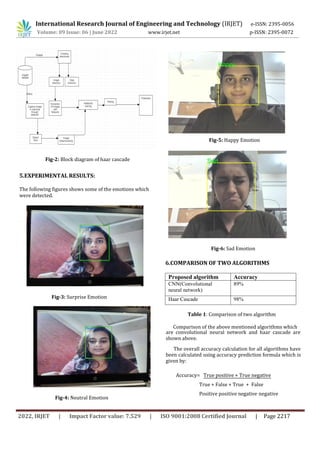
Fig-2: Block diagram of haar cascade
5.EXPERIMENTAL RESULTS:
The following figures shows some of the emotions which
were detected.
Fig-3: Surprise Emotion
Fig-4: Neutral Emotion
Fig-5: Happy Emotion
Fig-6: Sad Emotion
6.COMPARISON OF TWO ALGORITHMS
Table 1: Comparison of two algorithm
Comparison of the above mentioned algorithms which
are convolutional neural network and haar cascade are
shown above.
The overall accuracy calculation for all algorithms have
been calculated using accuracy prediction formula which is
given by:
Accuracy= True positive + True negative
True + False + True + False
Positive positive negative negative
Proposed algorithm Accuracy
CNN(Convolutional
neural network)
89%
Haar Cascade 98%
International Research Journal of Engineering and Technology (IRJET) e-ISSN: 2395-0056
Volume: 09 Issue: 06 | June 2022 www.irjet.net p-ISSN: 2395-0072
2022, IRJET | Impact Factor value: 7.529 | ISO 9001:2008 Certified Journal | Page 2218
7. CONCLUSIONS
The main conclusion of our project deals with detecting
emotions from face by using both static images and real
time videos which can be seen from the above figures.
This is achieved using CNN and Haar cascade algorithm.
Detection of emotion-The system detects the emotions
such has happy ,fear ,sad ,surprise and so on within the
images that users have uploaded along with real time
emotions also with accuracy and percentage of a
particular emotion a face has.
The system gives information that our user can
appropriately understand and gain insight from it.
REFERENCES
[1] Mingmin Zhao, FadelAdib, Dina Katabi, Emotion
Recognition using Wireless Signals, Massachusetts
Institute of Technology, 2017 4th International
Conference on Signal Processing and Integrated
Networks (SPIN)
[2] Shivam Gupta, Facial emotion recognition in real-
time and static images, Proceedings of the Second
International Conference on Inventive Systems and
Control (ICISC 2018) IEEE Xplore Compliant - Part
Number: CFP18J06-ART, ISBN:978-1-5386-0807-4;
DVD Part Number: CFP18J06DVD, ISBN:978-1-5386-
0806-7.
[3] S.Padmapriya& 2Esther Annlin KalaJames,
Government College of Technology, Real Time Smart
Car Lock Security System Using Face Detection and
Recognition, 2012 International Conference on
Computer Communication and Informatics (ICCCI -
2012), Jan. 10 – 12, 2012, Coimbatore, INDIA.
[4] Alejandro Jaimes,NicuSebeb, an IDIAP, Switzerland
b University of Amsterdam, The Netherlands,
Multimodal human-computer interaction: A survey.
Received 21 September 2005; accepted 30 October
2006, available online 31 January 2007, communicated
by MathiasKolsch.
[5] Adrian Rhesa Septian Siswanto, Anto Satriyo
Nugroho, MaulahikmahGalinium, Information
Technology, Swiss German University, Indonesia.
Implementation of Face Recognition Algorithm for
Biometrics Based Time Attendance System. Center for
Information & Communication Technology
[6] Cowie, R., Douglas-Cowie, E., Tsapatsoulis, N.,
Votsis, G., Kollias, S., Fellenz, W., Taylor, J.G.: Emotion
recognition in human-computer interaction. IEEE
Signal Process. Mag. 18(1), 32–80
(2001)CrossRefGoogle Scholar
[7] Content derived
fromhttps://www.researchgate.net/publication/26415
17 03_Region-Based_Facial_Expression_
[8] Viola, P., Jones, M.: Rapid object detection using
boosted cascade of simple features. In: IEEE Conference
on Computer Vision and Pattern Recognition (2001)

FACIAL EMOTION RECOGNITION

  • 1.
    International Research Journalof Engineering and Technology (IRJET) e-ISSN: 2395-0056 Volume: 09 Issue: 06 | June 2022 www.irjet.net p-ISSN: 2395-0072 2022, IRJET | Impact Factor value: 7.529 | ISO 9001:2008 Certified Journal | Page 2215 FACIAL EMOTION RECOGNITION Kavya K1, Misha Bharathi S2, Namratha B R3, Nandini V 4 Dr. Renuka Devi M N, Dept. of Computer Science, Dayananda Sagar University, Karnataka, India ---------------------------------------------------------------------***--------------------------------------------------------------------- Abstract - Human emotions are mental states of sentiments that occur without conscious effort and are accompanied by physiological changes in facial muscles that result in facial expressions. As a result, this study providesan approach for real-time recognizing facial emotion using image processing and AI techniques. Emotion recognition relies heavily on face detection. Sad, glad, surprise, fear, anger, neutral, and other emotions are all characterized as such. The Haar cascade method and the Convolutional Neural Network are used here. In the CNN technique, processes such as pooling and followed by flattening, whereas the Haar cascade algorithm uses Haar feature selection and cascading classifiers. Face emotionrecognition is more effective nowadays, and many applications use it in real time for security purposes. Key Words: Facial emotion recognition,CNN,Haar Cascade 1.INTRODUCTION Facial Emotion Detection is a technique that analysesfacial expressions in photos and videos to disclose information about a person's emotional state. People use facial expressions and verbal tones to infer other people's emotional states, such as joy, sadness, and rage. We're using a trained dataset which includes constant dynamic graphics, photographs collected from videos or in real time. Those dataset picture classifiers appear to be basic, yet they are extremely sensitive to each individual's facial emotions. Since the dawn of the smartphone era, the security of unlocking a phone has been steadily improving. As technology advances, we choose colour image face expression recognition as our project to detect a person's emotion, such as happiness, rage, melancholy, and so on. Emotions have a vital influence not only in our interpersonal relationships, but also in how we utilise computers. Some traits, such as elevated lip corners and cheeks, creases, and muscular tightening around the eyes, can be used to identify a happy emotion. Similarly, angry features can be expressed by pulling up the upper lids, tightening the lips, and pulling up the lower lids. Eyebrows pulled down, upper lip pulled up, and nose furrowed are all disgusting traits. Eyelids pushed up, mouth hangs open, and full eyebrow pulled up are all unexpected traits. All features are placed in their proper placements as neutral features. Eyebrows drawn up, upper eyelids drawn up, and lips extended are all signs of fear. 2. LITERATURE SURVEY
  • 2.
    International Research Journalof Engineering and Technology (IRJET) e-ISSN: 2395-0056 Volume: 09 Issue: 06 | June 2022 www.irjet.net p-ISSN: 2395-0072 2022, IRJET | Impact Factor value: 7.529 | ISO 9001:2008 Certified Journal | Page 2216 3.METHODOLOGY Image pre-processing are the steps we take to clean our raw images into a format that best improves our model. Image pre-processing refers to processes on images at the most fundamental level. If strategies reduce rather than increase image information content. Pre-processing is used to improve image data by removing undesired distortions or increasing specific visual features that are relevant for further processing and analysis. The photographs' processing steps are. 1. Look at the source image. 2. Image pre-processing (vocal elimination and formatting). 3. In the input image, extraction functions 4. After processing, the outcome is an image classification. There are two forms of image processing: 1. analogue picture processing and 2. Digital picture processing. Pre-processing, polishing, and recovering information are all key strategies in image processing. To perform a certain duty, an image is transformed to grayscale, then shown in RGB (colour) for the user's viewing pleasure. 4. PROPOSED METHODOLOGY Different algorithms are used in this project namely CNN and Haar cascade . 4.1. CNN The approach starts with a static input image and a convolution layer, flatten layers, pooling layer, and dense layer will be added to the CNN model. The dataset, fer2013, was obtained via Kaggle. There are 48 grayscale photos of faces in this dataset. It includes happy, sad, and other emotions. furious, surprise, and terror with 27,859 training images and 3765 testing images purpose. We used a big dataset to train for improved accuracy, and the outcome is an object class for an object. Picture input For training and testing, we used two picture generators. Then all of the tests and training are pre-processed. Model structure was designed by us. By building a model with the.h5 extension, the features will be retrieved using the pooling method. The model that was built for testing purposes is then used. For facial recognition, we use OpenCV. Real-time testing requires recognition. Fig-1: Block diagram of CNN 4.2. HAARCASCADE The work starts with initializing the Haar Cascade model by taking an input image (whether it may be static or dynamic) by pre-processing the input images. Two directories are available. Raw images can be found in the images directory. These are raw materials. The data directory contains training-related files. A collection of photographs used to categorise facial expressions. This repository contains a collection of face expressions that can be used to train machine learning algorithms. Kaggle was used to collect the data. Now you may improve the accuracy of this vast dataset by training it, and the output will be the object class of the input image. The job of the training stage is to collect samples that can be labelled as positive or negative. Anger, happiness, neutrality, and surprise are the four categories here. Haar cascade classifier is used to detect the items. This, above all, comprises the legend. csv, which associates a face expression with an image in the photos directory. Local binary patterns (LBP) is a visual descriptor used to identify image characteristics in texture form determined by LBP.
  • 3.
    International Research Journalof Engineering and Technology (IRJET) e-ISSN: 2395-0056 Volume: 09 Issue: 06 | June 2022 www.irjet.net p-ISSN: 2395-0072 2022, IRJET | Impact Factor value: 7.529 | ISO 9001:2008 Certified Journal | Page 2217 Fig-2: Block diagram of haar cascade 5.EXPERIMENTAL RESULTS: The following figures shows some of the emotions which were detected. Fig-3: Surprise Emotion Fig-4: Neutral Emotion Fig-5: Happy Emotion Fig-6: Sad Emotion 6.COMPARISON OF TWO ALGORITHMS Table 1: Comparison of two algorithm Comparison of the above mentioned algorithms which are convolutional neural network and haar cascade are shown above. The overall accuracy calculation for all algorithms have been calculated using accuracy prediction formula which is given by: Accuracy= True positive + True negative True + False + True + False Positive positive negative negative Proposed algorithm Accuracy CNN(Convolutional neural network) 89% Haar Cascade 98%
  • 4.
    International Research Journalof Engineering and Technology (IRJET) e-ISSN: 2395-0056 Volume: 09 Issue: 06 | June 2022 www.irjet.net p-ISSN: 2395-0072 2022, IRJET | Impact Factor value: 7.529 | ISO 9001:2008 Certified Journal | Page 2218 7. CONCLUSIONS The main conclusion of our project deals with detecting emotions from face by using both static images and real time videos which can be seen from the above figures. This is achieved using CNN and Haar cascade algorithm. Detection of emotion-The system detects the emotions such has happy ,fear ,sad ,surprise and so on within the images that users have uploaded along with real time emotions also with accuracy and percentage of a particular emotion a face has. The system gives information that our user can appropriately understand and gain insight from it. REFERENCES [1] Mingmin Zhao, FadelAdib, Dina Katabi, Emotion Recognition using Wireless Signals, Massachusetts Institute of Technology, 2017 4th International Conference on Signal Processing and Integrated Networks (SPIN) [2] Shivam Gupta, Facial emotion recognition in real- time and static images, Proceedings of the Second International Conference on Inventive Systems and Control (ICISC 2018) IEEE Xplore Compliant - Part Number: CFP18J06-ART, ISBN:978-1-5386-0807-4; DVD Part Number: CFP18J06DVD, ISBN:978-1-5386- 0806-7. [3] S.Padmapriya& 2Esther Annlin KalaJames, Government College of Technology, Real Time Smart Car Lock Security System Using Face Detection and Recognition, 2012 International Conference on Computer Communication and Informatics (ICCCI - 2012), Jan. 10 – 12, 2012, Coimbatore, INDIA. [4] Alejandro Jaimes,NicuSebeb, an IDIAP, Switzerland b University of Amsterdam, The Netherlands, Multimodal human-computer interaction: A survey. Received 21 September 2005; accepted 30 October 2006, available online 31 January 2007, communicated by MathiasKolsch. [5] Adrian Rhesa Septian Siswanto, Anto Satriyo Nugroho, MaulahikmahGalinium, Information Technology, Swiss German University, Indonesia. Implementation of Face Recognition Algorithm for Biometrics Based Time Attendance System. Center for Information & Communication Technology [6] Cowie, R., Douglas-Cowie, E., Tsapatsoulis, N., Votsis, G., Kollias, S., Fellenz, W., Taylor, J.G.: Emotion recognition in human-computer interaction. IEEE Signal Process. Mag. 18(1), 32–80 (2001)CrossRefGoogle Scholar [7] Content derived fromhttps://www.researchgate.net/publication/26415 17 03_Region-Based_Facial_Expression_ [8] Viola, P., Jones, M.: Rapid object detection using boosted cascade of simple features. In: IEEE Conference on Computer Vision and Pattern Recognition (2001)