#CLOwebinar
The presentation will begin at the top of the hour.
A dial in number will not be provided.
Listen to today’s webinar using your computer’s
speakers or headphones.
Welcome to the webinar!
#CLOwebinar


Speaker: Alex Khurgin
Director of Learning
Grovo
Moderator: Lauren Dixon
Associate Editor
Chief Learning Officer magazine
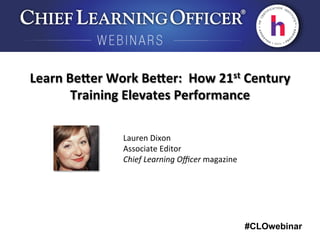
Learn Better Work Better: How 21st
Century Training Elevates Performance
#CLOwebinar


Tools You Can Use
Audio Control
–  A dial in number will not be provided.
–  Adjust the volume by sliding the
indicator in the Media Player box to the
right.
–  Also check your computer’s volume for
external speakers or headsets.
#CLOwebinar
Tools	
  You	
  Can	
  Use	
  
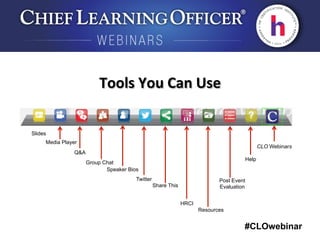
Speaker Bios
Resources
Media Player
Q&A
Slides
Twitter
Help
Post Event
EvaluationShare This
Group Chat
HRCI
CLO Webinars
#CLOwebinar


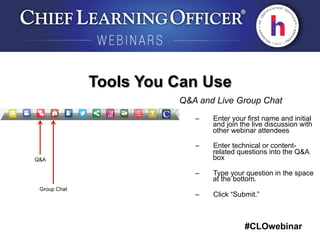
Tools You Can Use
Q&A and Live Group Chat
–  Enter your first name and initial
and join the live discussion with
other webinar attendees
–  Enter technical or content-
related questions into the Q&A
box
–  Type your question in the space
at the bottom.
–  Click “Submit.”
Q&A
Group Chat
#CLOwebinar


Tools You Can Use
Twitter
-  Click “Post” in the Twitter widget.
#CLOwebinar
@CLOmedia
#CLOwebinar


1. May I receive a copy of the slides?
YES! Click on the resource list located on the top left
portion of your screen.
2. May I review the webinar recording at a later date?
YES! You may log in again using today’s link to review the
presentation on-demand.
3. Is this webinar HRCI certified?
YES! The HRCI certification code will appear in the box to
the right of the slides after the required watch-time has
elapsed.
Frequently	
  Asked	
  Ques6ons	
  
#CLOwebinar


Lauren	
  Dixon	
  
Associate	
  Editor	
  
Chief	
  Learning	
  Officer	
  magazine	
  
Learn	
  Be9er	
  Work	
  Be9er:	
  	
  How	
  21st	
  Century	
  
Training	
  Elevates	
  Performance	
  
#CLOwebinar


Alex	
  Khurgin 	


Director,of	
  Learning	
  
Grovo	
  
Learn	
  Be9er	
  Work	
  Be9er:	
  	
  How	
  21st	
  Century	
  
Training	
  Elevates	
  Performance	
  
Learn Better, Work Better:
How 21st Century Training Elevates Performance
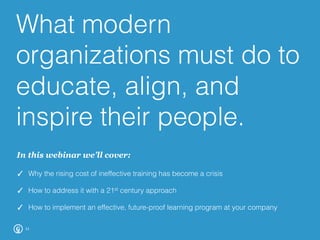
What modern
organizations must do to
educate, align, and
inspire their people.
11
In this webinar we’ll cover:
✓  Why the rising cost of ineffective training has become a crisis
✓  How to address it with a 21st century approach
✓  How to implement an effective, future-proof learning program at your company
	
  
12
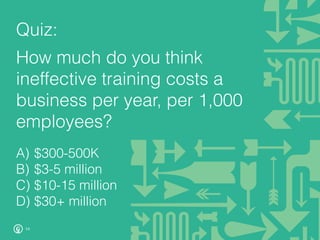
How much do you think
ineffective training costs a
business per year, per 1,000
employees?
A)  $300-500K
B)  $3-5 million
C)  $10-15 million
D)  $30+ million
Quiz:
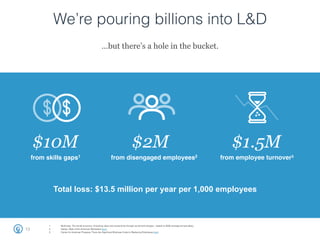
We’re pouring billions into L&D
13
1.  McKinsey: The social economy: Unlocking value and productivity through social technologies – based on $50k average annual salary
2.  Gallup, State of the American Workplace (link)
3.  Center for American Progress, There Are Significant Business Costs to Replacing Employees (link)
…but there’s a hole in the bucket.
$10M
from skills gaps1!
$1.5M
from employee turnover3!
!
$2M
from disengaged employees2!
!
Total loss: $13.5 million per year per 1,000 employees
!
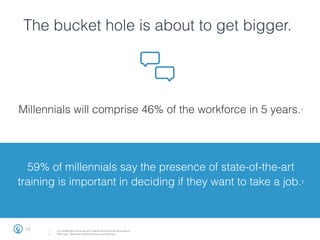
The bucket hole is about to get bigger.
14
59% of millennials say the presence of state-of-the-art
training is important in deciding if they want to take a job.2
Millennials will comprise 46% of the workforce in 5 years.1
1.  The Deloitte Millennial Survey 2014: Big Demands and High Expectations
2.  PWC report: "Millennials At Work Reshaping the Workplace"
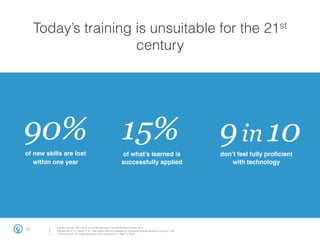
Today’s training is unsuitable for the 21st
century
15
90%
of new skills are lost !
within one year!
9in 10don’t feel fully proficient
with technology!
!
15%
of what’s learned is
successfully applied!
!
1.  Kochan, Thomas, "Who can fix the middle-skills gap?," Harvard Business Review, 2012
2.  2 Brinkerhoff, R. O., Apking, A. M; “High impact learning: Strategies for leveraging business results from training” 2001
3.  3 The Harris Poll: The Digital Skills Gap, Harris Interactive Inc., (May 14, 2014)
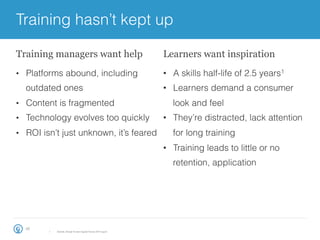
Training hasn’t kept up
16
•  Platforms abound, including
outdated ones
•  Content is fragmented
•  Technology evolves too quickly
•  ROI isn’t just unknown, it’s feared
1.  Deloitte, Global Human Capital Trends 2014 report
Training managers want help
•  A skills half-life of 2.5 years1
•  Learners demand a consumer
look and feel
•  They’re distracted, lack attention
for long training
•  Training leads to little or no
retention, application
Learners want inspiration
17
How can we create a
learning program that
meets the challenges of
training 21st century
workers?
Answer in chat
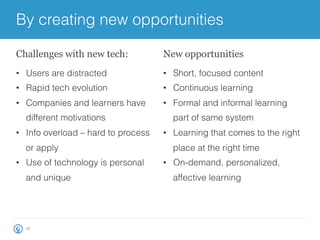
By creating new opportunities
18
•  Users are distracted
•  Rapid tech evolution
•  Companies and learners have
different motivations
•  Info overload – hard to process
or apply
•  Use of technology is personal
and unique
Challenges with new tech:
•  Short, focused content
•  Continuous learning
•  Formal and informal learning
part of same system
•  Learning that comes to the right
place at the right time
•  On-demand, personalized,
affective learning
New opportunities
We need to combine these
new opportunities with proven
strategies.
19
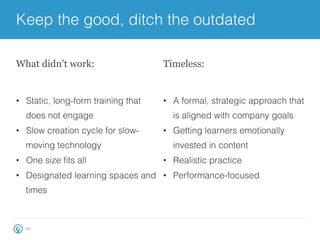
Keep the good, ditch the outdated
20
•  Static, long-form training that
does not engage
•  Slow creation cycle for slow-
moving technology
•  One size fits all
•  Designated learning spaces and
times
What didn’t work:
•  A formal, strategic approach that
is aligned with company goals
•  Getting learners emotionally
invested in content
•  Realistic practice
•  Performance-focused
Timeless:
Proven Strategies
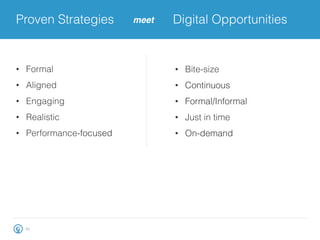
21
•  Formal
•  Aligned
•  Engaging
•  Realistic
•  Performance-focused
Digital Opportunitiesmeet!
•  Bite-size
•  Continuous
•  Formal/Informal
•  Just in time
•  On-demand
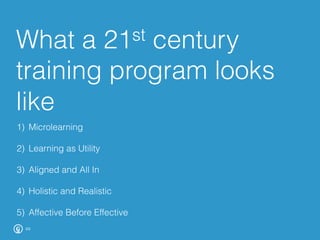
What a 21st century
training program looks
like
22
1)  Microlearning
2)  Learning as Utility
3)  Aligned and All In
4)  Holistic and Realistic
5)  Affective Before Effective
	
  
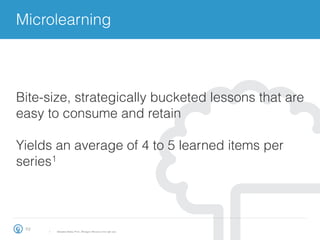
Microlearning
23
1.  Sebastian Bailey, Ph.D., Mindgym, Bite-size is the right size
Bite-size, strategically bucketed lessons that are
easy to consume and retain
Yields an average of 4 to 5 learned items per
series1
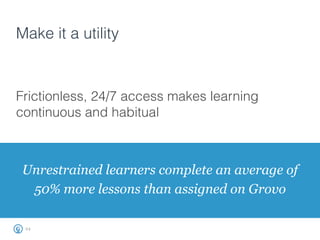
Make it a utility
24
Frictionless, 24/7 access makes learning
continuous and habitual
Unrestrained learners complete an average of
50% more lessons than assigned on Grovo
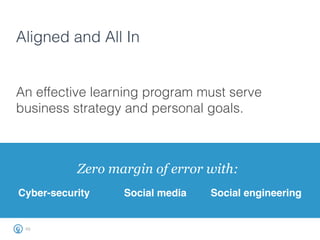
Aligned and All In
25
An effective learning program must serve
business strategy and personal goals.
Zero margin of error with:
Cyber-security! Social media! Social engineering!
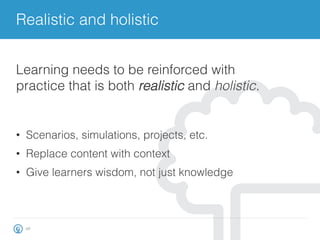
Realistic and holistic
26
•  Scenarios, simulations, projects, etc.
•  Replace content with context
•  Give learners wisdom, not just knowledge
Learning needs to be reinforced with
practice that is both realistic and holistic.
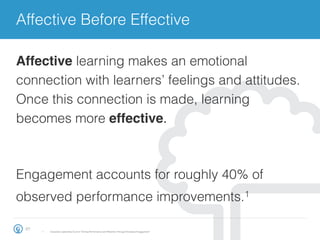
Affective Before Effective
27
Engagement accounts for roughly 40% of
observed performance improvements.1
1.  Corporate Leadership Council “Driving Performance and Retention Through Employee Engagement”
Affective learning makes an emotional
connection with learners’ feelings and attitudes.
Once this connection is made, learning
becomes more effective.!
What’s your favorite
method of checking that
your training is working?
28
Answer in chat
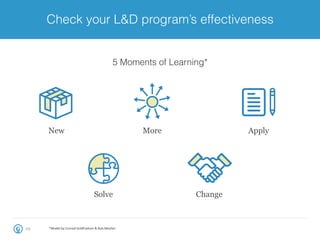
Check your L&D program’s effectiveness
29 *Model	
  by	
  Conrad	
  Go@redson	
  &	
  Bob	
  Mosher	
  
New
5 Moments of Learning*
More Apply
Solve Change
What are your biggest
takeaways from the
webinar?
30
Answer in chat
Before we continue:
Conclusion:
By creating training to meet 21st century
realities, you are preparing your
employees to learn better, work better,
and embrace continuous, performance-
based learning
31
32
How many times did I
say the word “bucket” in
this webinar?
Question Time
Thank You!
34
Alex Khurgin
Director of Learning, Grovo
alex@grovo.com
Connect:
Grovo.com/organizations
contact@grovo.com
212.924.2579
Learn more:
#CLOwebinar


Please complete the
webinar evaluation.
#CLOwebinar


Join our next Webinar!
Extended Learning: The
Importance of Engaging Your
Extended Enterprise Ecosystem
Tuesday, May 5, 2015
Webinars start at 2 p.m. Eastern / 11 a.m. Pacific
Register for all upcoming Talent Management
Webinars at www.clomedia.com/webinars
OR click the icon on the widget bar!

Learn Better Work Better: How 21st Century Training Elevates Performance

  • 1.
    #CLOwebinar The presentation willbegin at the top of the hour. A dial in number will not be provided. Listen to today’s webinar using your computer’s speakers or headphones. Welcome to the webinar!
  • 2.
    #CLOwebinar         Speaker: Alex Khurgin Director of Learning Grovo Moderator: Lauren Dixon Associate Editor Chief Learning Officer magazine Learn Better Work Better: How 21st Century Training Elevates Performance
  • 3.
    #CLOwebinar         Tools You Can Use Audio Control –  A dial in number will not be provided. –  Adjust the volume by sliding the indicator in the Media Player box to the right. –  Also check your computer’s volume for external speakers or headsets.
  • 4.
    #CLOwebinar Tools  You  Can  Use   Speaker Bios Resources Media Player Q&A Slides Twitter Help Post Event EvaluationShare This Group Chat HRCI CLO Webinars
  • 5.
    #CLOwebinar         Tools You Can Use Q&A and Live Group Chat –  Enter your first name and initial and join the live discussion with other webinar attendees –  Enter technical or content- related questions into the Q&A box –  Type your question in the space at the bottom. –  Click “Submit.” Q&A Group Chat
  • 6.
    #CLOwebinar         Tools You Can Use Twitter -  Click “Post” in the Twitter widget. #CLOwebinar @CLOmedia
  • 7.
    #CLOwebinar         1. May I receive a copy of the slides? YES! Click on the resource list located on the top left portion of your screen. 2. May I review the webinar recording at a later date? YES! You may log in again using today’s link to review the presentation on-demand. 3. Is this webinar HRCI certified? YES! The HRCI certification code will appear in the box to the right of the slides after the required watch-time has elapsed. Frequently  Asked  Ques6ons  
  • 8.
    #CLOwebinar         Lauren  Dixon   Associate  Editor   Chief  Learning  Officer  magazine   Learn  Be9er  Work  Be9er:    How  21st  Century   Training  Elevates  Performance  
  • 9.
    #CLOwebinar         Alex  Khurgin       Director,of  Learning   Grovo   Learn  Be9er  Work  Be9er:    How  21st  Century   Training  Elevates  Performance  
  • 10.
    Learn Better, WorkBetter: How 21st Century Training Elevates Performance
  • 11.
    What modern organizations mustdo to educate, align, and inspire their people. 11 In this webinar we’ll cover: ✓  Why the rising cost of ineffective training has become a crisis ✓  How to address it with a 21st century approach ✓  How to implement an effective, future-proof learning program at your company  
  • 12.
    12 How much doyou think ineffective training costs a business per year, per 1,000 employees? A)  $300-500K B)  $3-5 million C)  $10-15 million D)  $30+ million Quiz:
  • 13.
    We’re pouring billionsinto L&D 13 1.  McKinsey: The social economy: Unlocking value and productivity through social technologies – based on $50k average annual salary 2.  Gallup, State of the American Workplace (link) 3.  Center for American Progress, There Are Significant Business Costs to Replacing Employees (link) …but there’s a hole in the bucket. $10M from skills gaps1! $1.5M from employee turnover3! ! $2M from disengaged employees2! ! Total loss: $13.5 million per year per 1,000 employees !
  • 14.
    The bucket holeis about to get bigger. 14 59% of millennials say the presence of state-of-the-art training is important in deciding if they want to take a job.2 Millennials will comprise 46% of the workforce in 5 years.1 1.  The Deloitte Millennial Survey 2014: Big Demands and High Expectations 2.  PWC report: "Millennials At Work Reshaping the Workplace"
  • 15.
    Today’s training isunsuitable for the 21st century 15 90% of new skills are lost ! within one year! 9in 10don’t feel fully proficient with technology! ! 15% of what’s learned is successfully applied! ! 1.  Kochan, Thomas, "Who can fix the middle-skills gap?," Harvard Business Review, 2012 2.  2 Brinkerhoff, R. O., Apking, A. M; “High impact learning: Strategies for leveraging business results from training” 2001 3.  3 The Harris Poll: The Digital Skills Gap, Harris Interactive Inc., (May 14, 2014)
  • 16.
    Training hasn’t keptup 16 •  Platforms abound, including outdated ones •  Content is fragmented •  Technology evolves too quickly •  ROI isn’t just unknown, it’s feared 1.  Deloitte, Global Human Capital Trends 2014 report Training managers want help •  A skills half-life of 2.5 years1 •  Learners demand a consumer look and feel •  They’re distracted, lack attention for long training •  Training leads to little or no retention, application Learners want inspiration
  • 17.
    17 How can wecreate a learning program that meets the challenges of training 21st century workers? Answer in chat
  • 18.
    By creating newopportunities 18 •  Users are distracted •  Rapid tech evolution •  Companies and learners have different motivations •  Info overload – hard to process or apply •  Use of technology is personal and unique Challenges with new tech: •  Short, focused content •  Continuous learning •  Formal and informal learning part of same system •  Learning that comes to the right place at the right time •  On-demand, personalized, affective learning New opportunities
  • 19.
    We need tocombine these new opportunities with proven strategies. 19
  • 20.
    Keep the good,ditch the outdated 20 •  Static, long-form training that does not engage •  Slow creation cycle for slow- moving technology •  One size fits all •  Designated learning spaces and times What didn’t work: •  A formal, strategic approach that is aligned with company goals •  Getting learners emotionally invested in content •  Realistic practice •  Performance-focused Timeless:
  • 21.
    Proven Strategies 21 •  Formal • Aligned •  Engaging •  Realistic •  Performance-focused Digital Opportunitiesmeet! •  Bite-size •  Continuous •  Formal/Informal •  Just in time •  On-demand
  • 22.
    What a 21stcentury training program looks like 22 1)  Microlearning 2)  Learning as Utility 3)  Aligned and All In 4)  Holistic and Realistic 5)  Affective Before Effective  
  • 23.
    Microlearning 23 1.  Sebastian Bailey,Ph.D., Mindgym, Bite-size is the right size Bite-size, strategically bucketed lessons that are easy to consume and retain Yields an average of 4 to 5 learned items per series1
  • 24.
    Make it autility 24 Frictionless, 24/7 access makes learning continuous and habitual Unrestrained learners complete an average of 50% more lessons than assigned on Grovo
  • 25.
    Aligned and AllIn 25 An effective learning program must serve business strategy and personal goals. Zero margin of error with: Cyber-security! Social media! Social engineering!
  • 26.
    Realistic and holistic 26 • Scenarios, simulations, projects, etc. •  Replace content with context •  Give learners wisdom, not just knowledge Learning needs to be reinforced with practice that is both realistic and holistic.
  • 27.
    Affective Before Effective 27 Engagementaccounts for roughly 40% of observed performance improvements.1 1.  Corporate Leadership Council “Driving Performance and Retention Through Employee Engagement” Affective learning makes an emotional connection with learners’ feelings and attitudes. Once this connection is made, learning becomes more effective.!
  • 28.
    What’s your favorite methodof checking that your training is working? 28 Answer in chat
  • 29.
    Check your L&Dprogram’s effectiveness 29 *Model  by  Conrad  Go@redson  &  Bob  Mosher   New 5 Moments of Learning* More Apply Solve Change
  • 30.
    What are yourbiggest takeaways from the webinar? 30 Answer in chat Before we continue:
  • 31.
    Conclusion: By creating trainingto meet 21st century realities, you are preparing your employees to learn better, work better, and embrace continuous, performance- based learning 31
  • 32.
    32 How many timesdid I say the word “bucket” in this webinar?
  • 33.
  • 34.
    Thank You! 34 Alex Khurgin Directorof Learning, Grovo alex@grovo.com Connect: Grovo.com/organizations contact@grovo.com 212.924.2579 Learn more:
  • 35.
    #CLOwebinar         Please complete the webinar evaluation.
  • 36.
    #CLOwebinar         Join our next Webinar! Extended Learning: The Importance of Engaging Your Extended Enterprise Ecosystem Tuesday, May 5, 2015 Webinars start at 2 p.m. Eastern / 11 a.m. Pacific Register for all upcoming Talent Management Webinars at www.clomedia.com/webinars OR click the icon on the widget bar!