Oct 4, 2024 1
OBSTETRIC HYSTERECTOMY
Dr. Adaiah Soibi-Harry
Oct 4, 2024 Adaiah Soibi-Harry 2
Outline
• Introduction
• Historical Background
• Epidemiology
• Predisposing Factors
• Indications
• Management of Obstetric Heamorrhage
• Pre-operative Planning
• Surgical Challenges
• Surgical Technique
• Complications
• Conclusion
Oct 4, 2024 Adaiah Soibi-Harry 3
Introduction
Oct 4, 2024 4
Introduction
• Obstetric or Peripartum hysterectomy
• The removal of the corpus uteri alone or with the cervix at the time of a caesarean section, or shortly after a
vaginal delivery.
• Caesarean hysterectomy
• Is performed immediately after a cesarean delivery for severe hemorrhage .
• Postpartum hysterectomy
• Is performed after a vaginal delivery for delayed hemorrhage or infectious complications.
• Described as one of the riskiest and most dramatic operation in modern obstetrics and thus
associated with significant maternal morbidity and mortality.
• Meets the definition of a maternal near miss.Adaiah Soibi-Harry
Oct 4, 2024 Adaiah Soibi-Harry 5
Historical Background
• 1768- Joseph Cavallini first proposed caesarean hysterectomy in animal
experiments.
• 1869- Horatio Storer performed the first documented caesarean hysterectomy on a
patient in the United States. However the patient died 68 hours after surgery.
• 1876- Eduardo Porro of Milan described the first cesarean hysterectomy in which
both mother and baby survived and the procedure was named Porro’s technique.
• Modifications of Porro’s technique by Godson in 1884 and Lawsontait in 1890.
Oct 4, 2024 6
Epidemiology
• The reported incidence of emergency obstetric hysterectomy varies between 0.2 and
5.4 in 1000 deliveries. In general, the average incidence is put at 1 in 1000
deliveries, with higher incidences reported in developing countries.
• In a study by Olamijulo et al. in 2012: the local incidence in LUTH was 2.56 per
1000 deliveries with case fatality rate of 11.8%.
• It is associated with severe maternal morbidity, where 90% of these women may need
blood transfusion, 40% required ICU care, 24% were re-operated and 10% had
bladder or ureteric injury, maternal death ranged from 0-24%, significant emotional
stress for the patient and potential lawsuits for the doctor.
Adaiah Soibi-Harry
Oct 4, 2024 Adaiah Soibi-Harry 7
Predisposing factors
• Previous and current caesarean section
• Abnormal placentation (placenta accreta, increta and percreta)
• Multiple pregnancy (has a 2-8 fold increased risk).
• Retained placenta
• Abruptio Placentae
• Thrombocytopenia
• Multiparity
• Unbooked status
Oct 4, 2024 Adaiah Soibi-Harry 8
Indications
• Severe uterine hemorrhage that cannot be controlled by conservative measures
• Uterine atony: (30-50%)
• Abnormal placentation: (30-50%)
• Extensive uterine rupture
• Uterine vessel laceration
• Severe Uterine sepsis
• Chronic recurrent uterine inversion
• Fibroid riddled uterus
• Planned peripartum hysterectomy.
Oct 4, 2024 Adaiah Soibi-Harry 9
Management of Obstetric Hemorrhage
• Use an Algorithm
• Uterotonics, uterine tamponade (eg, intrauterine balloon), ligation of
bleeding sites, uterine artery ligation, placement of B-lynch sutures, and
transarterial embolization, if available and when patient status permits
can be used.
• Activated recombinant factor VII also has recently emerged as a
treatment for postpartum hemorrhage
Oct 4, 2024 Adaiah Soibi-Harry 10
Algorithm for Management of Obstetric Haemorrhage
Oct 4, 2024 Adaiah Soibi-Harry 11
Oct 4, 2024 Adaiah Soibi-Harry 12
Oct 4, 2024 Adaiah Soibi-Harry 13
Pre-op Management
• Call for help
• Resuscitate patient(ABC), administer oxygen, secure IV access with two wide bore cannula, group and
crossmatch blood and administer crystalloids
• Ensure urethral catheter is passed and monitor intake/output
• Counsel patient and relatives and obtain written consent.
• Inform the most experienced obstetrician in obstetric hysterectomy to be present.
• Mobilize anesthetist, theatre and blood bank team.
• Ensure availability of appropriate surgical instruments, technicians and assistants.
• Give prophylactic antibiotics
• Ensure placement of intermittent compression stockings on patient to decrease the risk for deep venous
thrombosis.
Oct 4, 2024 Adaiah Soibi-Harry 14
Surgical Challenges 1
• Difficulty with identification of external os.
• Significantly dilated blood vessels
• Massive hemorrhage may obscure the operative field and can make suturing of
pedicles more difficult.
• Bulky uterus- difficult visualization of traditional surgical landmarks and planes.
• Tissue may be friable.
Oct 4, 2024 Adaiah Soibi-Harry 15
Surgical challenges 2
• Gross distortion of pelvic anatomy
• Placenta percreta may extend into the bladder and other pelvic organs.
• Scarring from previous cesarean
• The ureters may be sectioned, clamped or stitched because often,
heavy bleeding interferes with proper exposure
Oct 4, 2024 Adaiah Soibi-Harry 16
Surgical Technique 1
Supra-cervical Hysterectomy
• With patient in supine position, under general anaesthesia, routine cleaning and draping is
done
• A vertical midline sub-umbilical abdominal incision is made through the skin, subcutaneous
tissue, to the level of the fascia using a scalpel.
• A 2-3cm vertical incision is made on the fascia and extended upwards and downwards using
a scissors. The rectus muscle is separated vertically, using the fingers
• The peritoneum is grasped around the level of the umbilicus with two Kelly's forceps, checked
to ensure no bowel entrapment, cut between the clamps and extended along the incision
carefully, using a scissors.
Oct 4, 2024 Adaiah Soibi-Harry 17
Surgical Technique 2
Supra-cervical Hysterectomy
• A self retaining retractor is placed to retract the abdomen, and a Doyen retractor is placed
over the bladder.
• If there is massive haemorrhage, the assistant should sweep the small bowel mesentery up
towards the liver and compress the aorta.
• The uterus is elevated out through the incision and the bowels packed away with warm
abdominal packs.
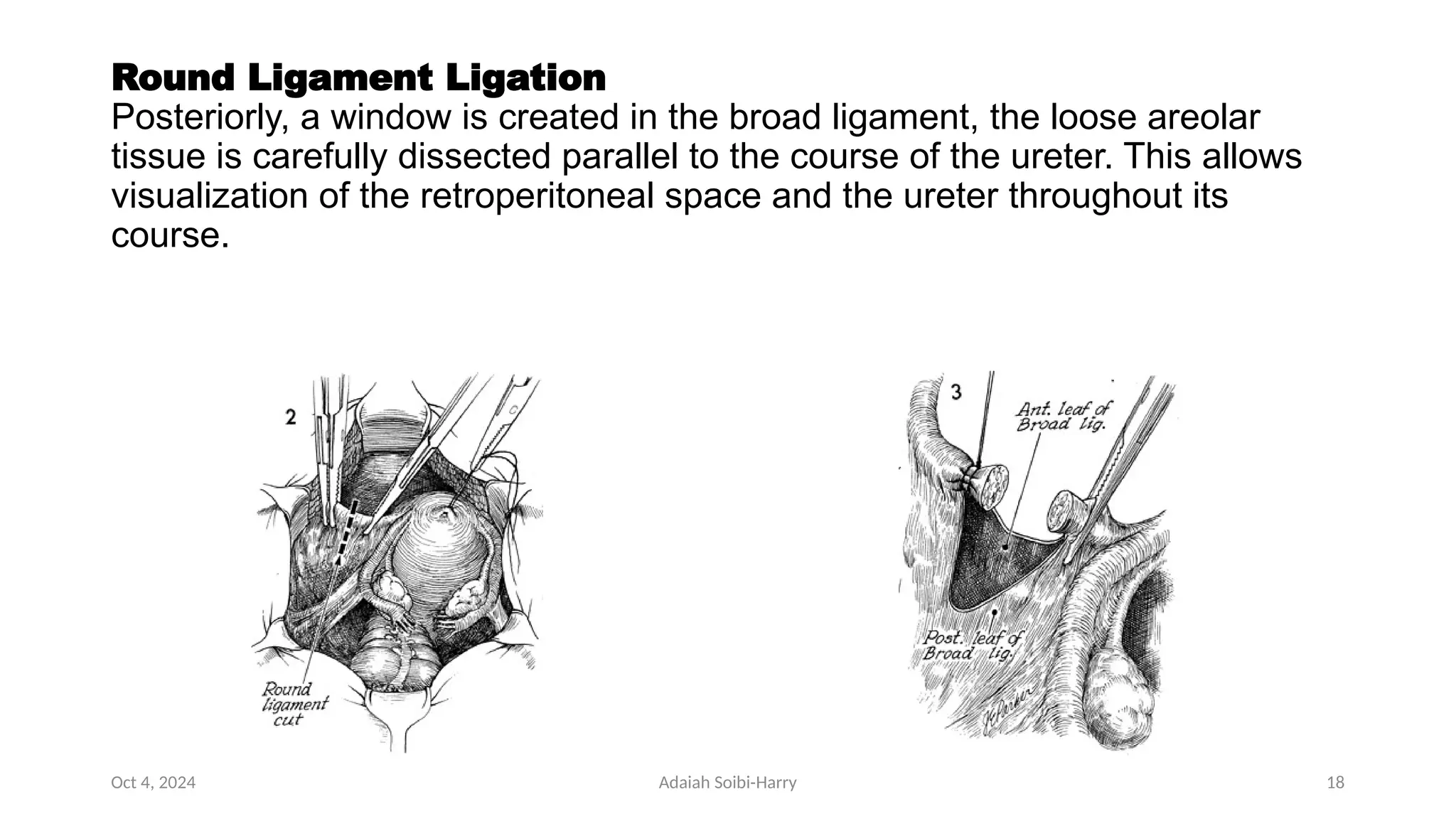
• Round Ligament Ligation
The round ligaments are identified, double clamped with Kochers’ forceps divided and suture
ligated.
Oct 4, 2024 Adaiah Soibi-Harry 18
Round Ligament Ligation
Posteriorly, a window is created in the broad ligament, the loose areolar
tissue is carefully dissected parallel to the course of the ureter. This allows
visualization of the retroperitoneal space and the ureter throughout its
course.
Oct 4, 2024 Adaiah Soibi-Harry 19
Bladder Dissection
The uterovesical fold is sharply dissected and the bladder
reflected from the lower uterine segment.
Oct 4, 2024 Adaiah Soibi-Harry 20
Tubo-ovarian Pedicle Dissection
Place two straight clamps perpendicular to the uterus incorporating the tube, utero-ovarian ligament and ovarian vessel, divide and suture ligate.
Oct 4, 2024 Adaiah Soibi-Harry 21
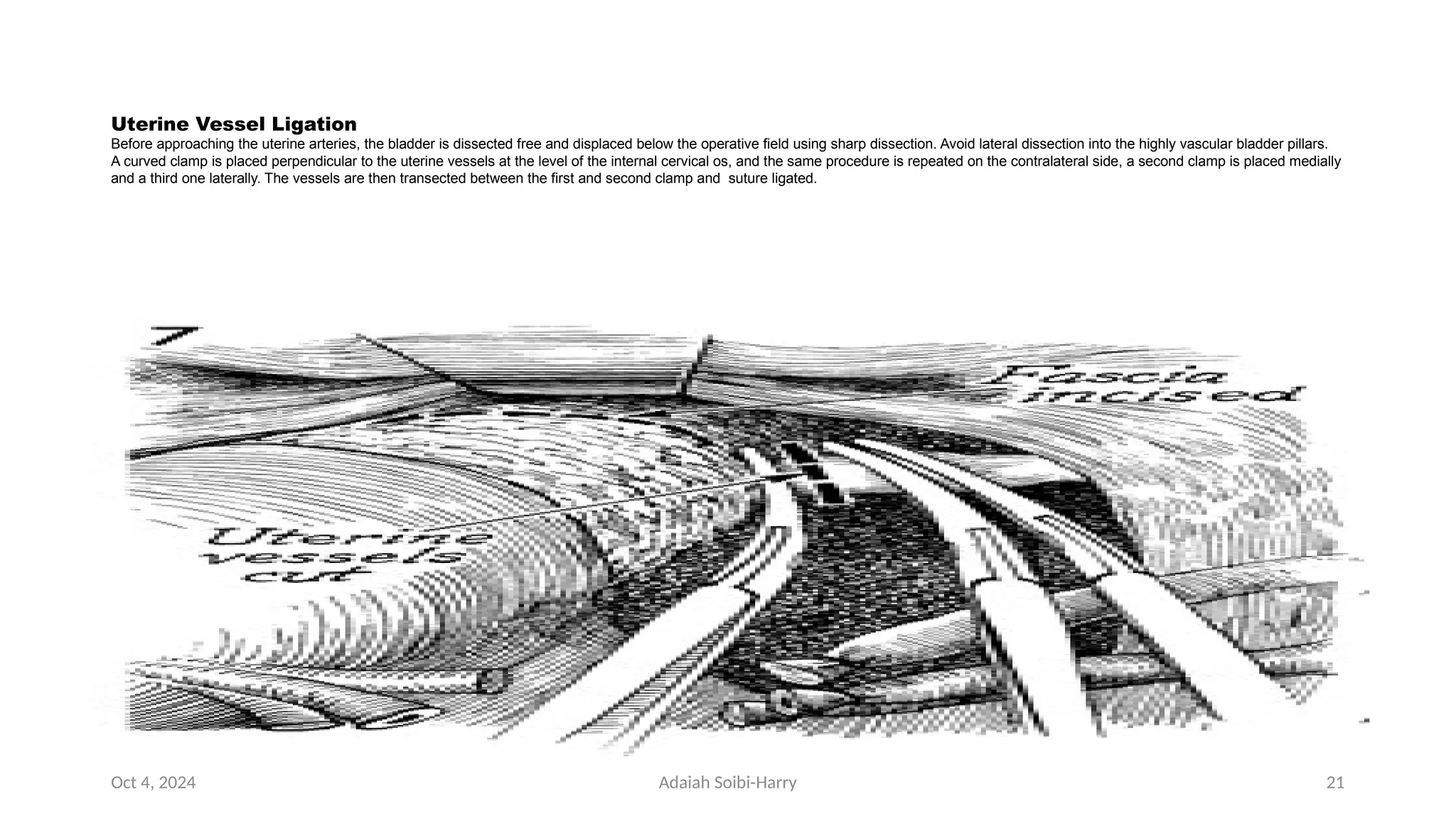
Uterine Vessel Ligation
Before approaching the uterine arteries, the bladder is dissected free and displaced below the operative field using sharp dissection. Avoid lateral dissection into the highly vascular bladder pillars.
A curved clamp is placed perpendicular to the uterine vessels at the level of the internal cervical os, and the same procedure is repeated on the contralateral side, a second clamp is placed medially
and a third one laterally. The vessels are then transected between the first and second clamp and suture ligated.
Oct 4, 2024 Adaiah Soibi-Harry 22
Uterine Amputation
• The uterus is amputated with a scalpel or diathermy by cutting
superiorly to the ligated uterine arteries while angling the scalpel or
diathermy blade medially and downward.
• The cervical stump is approximated in an anterior-to-posterior fashion
using interrupted figure-of-eight stitches. Special care should be taken
to avoid the bladder.
Oct 4, 2024 Adaiah Soibi-Harry 23
Total Abdominal Hysterectomy
• Examine the cul-de-sac to ensure that the rectum is not adherent to the posterior
aspect of the cervix and ensure that the bladder has been completely dissected away
from the anterior cervix.
• Place the heel of a curved clamp snugly, just lateral to the cervico-uterine edge and
take descending "bites" of tissue of 1.0-1.5 cm in size, divide medially with scissors
or a scalpel, and ligate the pedicle.
• When dissection of the cardinal ligaments has reached the external os, carefully
inspect the field to ensure that the ureter and bladder are outside the dissection
planes.
Oct 4, 2024 Adaiah Soibi-Harry 24
Cardinal Ligament Dissection Posterior Dissection
Oct 4, 2024 Adaiah Soibi-Harry 25
Uterosacral Ligament Dissection
Oct 4, 2024 Adaiah Soibi-Harry 26
Amputation of the Uterus
Oct 4, 2024 Adaiah Soibi-Harry 27
Oct 4, 2024 Adaiah Soibi-Harry 28
General Considerations
• Drains are not generally necessary.
• Pelvic packing can be used to control low-pressure bleeding in the deep pelvis.
Using Kerlix bandages tied together, the pelvis can be filled with dry gauze and a free
end brought through the facial incision. The skin is left open for removal or
reoperation on the next day.
• Local hemostatic agents and anti-fibrinolytics may be used to help control
generalized oozing.
Oct 4, 2024 Adaiah Soibi-Harry 29
Post Operative Care
• Monitor vital signs closely in the immediate post-op period
• Ensure parenteral antibiotics
• Ensure blood transfusion if indicated
• Institute thrombo-prophylaxis once hemostasis is secure
• When patient is stable the sequence of events should be reviewed and
discussed with her by an experienced obstetrician
Oct 4, 2024 30
Complications 1
• Hemorrhage
Adnexal pedicles
-Uterine vascular pedicles
-Cardinal ligaments
-Angles of the vagina and Uterosacral ligament
• Urinary tract injury
- Bladder injury- while dissecting the bladder from the lower uterine segment and vaginal cuff clamp or
suture
- Ureteric injury- Infundibulopelvic ligament clamping (if salpingoophorectomy), Uterine artery clamping
(ureter is about 2cm below), Cardinal ligament dissection and Uterosacral ligament.
Adaiah Soibi-Harry
Oct 4, 2024 Adaiah Soibi-Harry 31
Complications 2
• Fistula Formation
• Blood transfusion
• Coagulopathies
• Infections -Vaginal cuff cellulitis, Abdominal incision wound break down, Urinary tract
infection
• Psychological Problems
Oct 4, 2024 32
Conclusion
• Obstetric hysterectomy is often a procedure of last resort to save a mother’s
life.
• It therefore requires an understanding and anticipation of risks factors,
focused and timely decision-making, experienced and confident surgical skill,
a readily available team as well as availability of the right tools to reduce
maternal morbidity, mortality and optimize patient outcome.
• Regular simulation drills will help prepare most obstetricians and obstetric
residents for this life saving procedure.
Adaiah Soibi-Harry
Oct 4, 2024 Adaiah Soibi-Harry 33
References
1. Park RC, Duff WP: Role of cesarean hysterectomy in modern obstetric practice. Clin Obstet
Gynecol 23:(2):601, 1980
2. Porro E: Dell'amputazionne utero-ovarica come complemento di taglio cesareo. Ann Univers Med
Chir 237:289, 1876
3. Umezurike CC, Feyi-Waboso PA, Adisa CA. Peripartum hysterectomy in Aba, Southeastern
Nigeria. Australian and New Zealand Journal of Obstetrics and Gynaecology 2008; 48:580-582.
4. Zeteroglu S, Ustun Y, Engin-Ustun Y, Sahin G,Kamaci M. Peripartum hysterectomy in a teaching
hospital in the Eastern region of Turkey. Eur J Obstet Gynecol Reprod Biol 2005; 120; 57-62.
5. Okogbenin, SA., et al. "Obstetric hysterectomy: fifteen years' experience in a Nigerian tertiary
centre." Journal of Obstetrics and Gynaecology 23.4 (2003): 356-359.
6. Olamijulo, JA., et al. "Emergency obstetric hysterectomy in a Nigerian teaching hospital: a ten-
year review." Nigerian quarterly journal of hospital medicine 23.1 (2012): 69-74.
7. Jacobs AJ. Peripartum hysterectomy. UpToDate.www.utdol.com. Accessed April 12, 2010.
KEEP CALM
AND
SAVE
A MOTHER

407102189-Obstetric-Hysterectomy-pptx-Modified.pptx

  • 1.
    Oct 4, 20241 OBSTETRIC HYSTERECTOMY Dr. Adaiah Soibi-Harry
  • 2.
    Oct 4, 2024Adaiah Soibi-Harry 2 Outline • Introduction • Historical Background • Epidemiology • Predisposing Factors • Indications • Management of Obstetric Heamorrhage • Pre-operative Planning • Surgical Challenges • Surgical Technique • Complications • Conclusion
  • 3.
    Oct 4, 2024Adaiah Soibi-Harry 3 Introduction
  • 4.
    Oct 4, 20244 Introduction • Obstetric or Peripartum hysterectomy • The removal of the corpus uteri alone or with the cervix at the time of a caesarean section, or shortly after a vaginal delivery. • Caesarean hysterectomy • Is performed immediately after a cesarean delivery for severe hemorrhage . • Postpartum hysterectomy • Is performed after a vaginal delivery for delayed hemorrhage or infectious complications. • Described as one of the riskiest and most dramatic operation in modern obstetrics and thus associated with significant maternal morbidity and mortality. • Meets the definition of a maternal near miss.Adaiah Soibi-Harry
  • 5.
    Oct 4, 2024Adaiah Soibi-Harry 5 Historical Background • 1768- Joseph Cavallini first proposed caesarean hysterectomy in animal experiments. • 1869- Horatio Storer performed the first documented caesarean hysterectomy on a patient in the United States. However the patient died 68 hours after surgery. • 1876- Eduardo Porro of Milan described the first cesarean hysterectomy in which both mother and baby survived and the procedure was named Porro’s technique. • Modifications of Porro’s technique by Godson in 1884 and Lawsontait in 1890.
  • 6.
    Oct 4, 20246 Epidemiology • The reported incidence of emergency obstetric hysterectomy varies between 0.2 and 5.4 in 1000 deliveries. In general, the average incidence is put at 1 in 1000 deliveries, with higher incidences reported in developing countries. • In a study by Olamijulo et al. in 2012: the local incidence in LUTH was 2.56 per 1000 deliveries with case fatality rate of 11.8%. • It is associated with severe maternal morbidity, where 90% of these women may need blood transfusion, 40% required ICU care, 24% were re-operated and 10% had bladder or ureteric injury, maternal death ranged from 0-24%, significant emotional stress for the patient and potential lawsuits for the doctor. Adaiah Soibi-Harry
  • 7.
    Oct 4, 2024Adaiah Soibi-Harry 7 Predisposing factors • Previous and current caesarean section • Abnormal placentation (placenta accreta, increta and percreta) • Multiple pregnancy (has a 2-8 fold increased risk). • Retained placenta • Abruptio Placentae • Thrombocytopenia • Multiparity • Unbooked status
  • 8.
    Oct 4, 2024Adaiah Soibi-Harry 8 Indications • Severe uterine hemorrhage that cannot be controlled by conservative measures • Uterine atony: (30-50%) • Abnormal placentation: (30-50%) • Extensive uterine rupture • Uterine vessel laceration • Severe Uterine sepsis • Chronic recurrent uterine inversion • Fibroid riddled uterus • Planned peripartum hysterectomy.
  • 9.
    Oct 4, 2024Adaiah Soibi-Harry 9 Management of Obstetric Hemorrhage • Use an Algorithm • Uterotonics, uterine tamponade (eg, intrauterine balloon), ligation of bleeding sites, uterine artery ligation, placement of B-lynch sutures, and transarterial embolization, if available and when patient status permits can be used. • Activated recombinant factor VII also has recently emerged as a treatment for postpartum hemorrhage
  • 10.
    Oct 4, 2024Adaiah Soibi-Harry 10 Algorithm for Management of Obstetric Haemorrhage
  • 11.
    Oct 4, 2024Adaiah Soibi-Harry 11
  • 12.
    Oct 4, 2024Adaiah Soibi-Harry 12
  • 13.
    Oct 4, 2024Adaiah Soibi-Harry 13 Pre-op Management • Call for help • Resuscitate patient(ABC), administer oxygen, secure IV access with two wide bore cannula, group and crossmatch blood and administer crystalloids • Ensure urethral catheter is passed and monitor intake/output • Counsel patient and relatives and obtain written consent. • Inform the most experienced obstetrician in obstetric hysterectomy to be present. • Mobilize anesthetist, theatre and blood bank team. • Ensure availability of appropriate surgical instruments, technicians and assistants. • Give prophylactic antibiotics • Ensure placement of intermittent compression stockings on patient to decrease the risk for deep venous thrombosis.
  • 14.
    Oct 4, 2024Adaiah Soibi-Harry 14 Surgical Challenges 1 • Difficulty with identification of external os. • Significantly dilated blood vessels • Massive hemorrhage may obscure the operative field and can make suturing of pedicles more difficult. • Bulky uterus- difficult visualization of traditional surgical landmarks and planes. • Tissue may be friable.
  • 15.
    Oct 4, 2024Adaiah Soibi-Harry 15 Surgical challenges 2 • Gross distortion of pelvic anatomy • Placenta percreta may extend into the bladder and other pelvic organs. • Scarring from previous cesarean • The ureters may be sectioned, clamped or stitched because often, heavy bleeding interferes with proper exposure
  • 16.
    Oct 4, 2024Adaiah Soibi-Harry 16 Surgical Technique 1 Supra-cervical Hysterectomy • With patient in supine position, under general anaesthesia, routine cleaning and draping is done • A vertical midline sub-umbilical abdominal incision is made through the skin, subcutaneous tissue, to the level of the fascia using a scalpel. • A 2-3cm vertical incision is made on the fascia and extended upwards and downwards using a scissors. The rectus muscle is separated vertically, using the fingers • The peritoneum is grasped around the level of the umbilicus with two Kelly's forceps, checked to ensure no bowel entrapment, cut between the clamps and extended along the incision carefully, using a scissors.
  • 17.
    Oct 4, 2024Adaiah Soibi-Harry 17 Surgical Technique 2 Supra-cervical Hysterectomy • A self retaining retractor is placed to retract the abdomen, and a Doyen retractor is placed over the bladder. • If there is massive haemorrhage, the assistant should sweep the small bowel mesentery up towards the liver and compress the aorta. • The uterus is elevated out through the incision and the bowels packed away with warm abdominal packs. • Round Ligament Ligation The round ligaments are identified, double clamped with Kochers’ forceps divided and suture ligated.
  • 18.
    Oct 4, 2024Adaiah Soibi-Harry 18 Round Ligament Ligation Posteriorly, a window is created in the broad ligament, the loose areolar tissue is carefully dissected parallel to the course of the ureter. This allows visualization of the retroperitoneal space and the ureter throughout its course.
  • 19.
    Oct 4, 2024Adaiah Soibi-Harry 19 Bladder Dissection The uterovesical fold is sharply dissected and the bladder reflected from the lower uterine segment.
  • 20.
    Oct 4, 2024Adaiah Soibi-Harry 20 Tubo-ovarian Pedicle Dissection Place two straight clamps perpendicular to the uterus incorporating the tube, utero-ovarian ligament and ovarian vessel, divide and suture ligate.
  • 21.
    Oct 4, 2024Adaiah Soibi-Harry 21 Uterine Vessel Ligation Before approaching the uterine arteries, the bladder is dissected free and displaced below the operative field using sharp dissection. Avoid lateral dissection into the highly vascular bladder pillars. A curved clamp is placed perpendicular to the uterine vessels at the level of the internal cervical os, and the same procedure is repeated on the contralateral side, a second clamp is placed medially and a third one laterally. The vessels are then transected between the first and second clamp and suture ligated.
  • 22.
    Oct 4, 2024Adaiah Soibi-Harry 22 Uterine Amputation • The uterus is amputated with a scalpel or diathermy by cutting superiorly to the ligated uterine arteries while angling the scalpel or diathermy blade medially and downward. • The cervical stump is approximated in an anterior-to-posterior fashion using interrupted figure-of-eight stitches. Special care should be taken to avoid the bladder.
  • 23.
    Oct 4, 2024Adaiah Soibi-Harry 23 Total Abdominal Hysterectomy • Examine the cul-de-sac to ensure that the rectum is not adherent to the posterior aspect of the cervix and ensure that the bladder has been completely dissected away from the anterior cervix. • Place the heel of a curved clamp snugly, just lateral to the cervico-uterine edge and take descending "bites" of tissue of 1.0-1.5 cm in size, divide medially with scissors or a scalpel, and ligate the pedicle. • When dissection of the cardinal ligaments has reached the external os, carefully inspect the field to ensure that the ureter and bladder are outside the dissection planes.
  • 24.
    Oct 4, 2024Adaiah Soibi-Harry 24 Cardinal Ligament Dissection Posterior Dissection
  • 25.
    Oct 4, 2024Adaiah Soibi-Harry 25 Uterosacral Ligament Dissection
  • 26.
    Oct 4, 2024Adaiah Soibi-Harry 26 Amputation of the Uterus
  • 27.
    Oct 4, 2024Adaiah Soibi-Harry 27
  • 28.
    Oct 4, 2024Adaiah Soibi-Harry 28 General Considerations • Drains are not generally necessary. • Pelvic packing can be used to control low-pressure bleeding in the deep pelvis. Using Kerlix bandages tied together, the pelvis can be filled with dry gauze and a free end brought through the facial incision. The skin is left open for removal or reoperation on the next day. • Local hemostatic agents and anti-fibrinolytics may be used to help control generalized oozing.
  • 29.
    Oct 4, 2024Adaiah Soibi-Harry 29 Post Operative Care • Monitor vital signs closely in the immediate post-op period • Ensure parenteral antibiotics • Ensure blood transfusion if indicated • Institute thrombo-prophylaxis once hemostasis is secure • When patient is stable the sequence of events should be reviewed and discussed with her by an experienced obstetrician
  • 30.
    Oct 4, 202430 Complications 1 • Hemorrhage Adnexal pedicles -Uterine vascular pedicles -Cardinal ligaments -Angles of the vagina and Uterosacral ligament • Urinary tract injury - Bladder injury- while dissecting the bladder from the lower uterine segment and vaginal cuff clamp or suture - Ureteric injury- Infundibulopelvic ligament clamping (if salpingoophorectomy), Uterine artery clamping (ureter is about 2cm below), Cardinal ligament dissection and Uterosacral ligament. Adaiah Soibi-Harry
  • 31.
    Oct 4, 2024Adaiah Soibi-Harry 31 Complications 2 • Fistula Formation • Blood transfusion • Coagulopathies • Infections -Vaginal cuff cellulitis, Abdominal incision wound break down, Urinary tract infection • Psychological Problems
  • 32.
    Oct 4, 202432 Conclusion • Obstetric hysterectomy is often a procedure of last resort to save a mother’s life. • It therefore requires an understanding and anticipation of risks factors, focused and timely decision-making, experienced and confident surgical skill, a readily available team as well as availability of the right tools to reduce maternal morbidity, mortality and optimize patient outcome. • Regular simulation drills will help prepare most obstetricians and obstetric residents for this life saving procedure. Adaiah Soibi-Harry
  • 33.
    Oct 4, 2024Adaiah Soibi-Harry 33 References 1. Park RC, Duff WP: Role of cesarean hysterectomy in modern obstetric practice. Clin Obstet Gynecol 23:(2):601, 1980 2. Porro E: Dell'amputazionne utero-ovarica come complemento di taglio cesareo. Ann Univers Med Chir 237:289, 1876 3. Umezurike CC, Feyi-Waboso PA, Adisa CA. Peripartum hysterectomy in Aba, Southeastern Nigeria. Australian and New Zealand Journal of Obstetrics and Gynaecology 2008; 48:580-582. 4. Zeteroglu S, Ustun Y, Engin-Ustun Y, Sahin G,Kamaci M. Peripartum hysterectomy in a teaching hospital in the Eastern region of Turkey. Eur J Obstet Gynecol Reprod Biol 2005; 120; 57-62. 5. Okogbenin, SA., et al. "Obstetric hysterectomy: fifteen years' experience in a Nigerian tertiary centre." Journal of Obstetrics and Gynaecology 23.4 (2003): 356-359. 6. Olamijulo, JA., et al. "Emergency obstetric hysterectomy in a Nigerian teaching hospital: a ten- year review." Nigerian quarterly journal of hospital medicine 23.1 (2012): 69-74. 7. Jacobs AJ. Peripartum hysterectomy. UpToDate.www.utdol.com. Accessed April 12, 2010.
  • 34.

Editor's Notes

  • #3 Obstetric hysterectomy is always a dilemma for every obstetrician as on one hand it is the last resort to save a mother’s life, and on the other hand, the mother’s reproductive capability is about to be sacrificed.
  • #4 It is often reserved for situations in which severe obstetric hemorrhage has failed to respond to conservative treatment . It is often unplanned, must be performed expeditiously and in patients that are generally in less than ideal conditions to withstand anesthesia and trauma of surgery
  • #6 phenomenon of unbooked emergencies the earlier recourse to hysterectomy due to the lack of adequate cross matched blood and other blood products which limit the time available for examining the effectiveness of other conservative procedures. certain modern conservative procedures involving interventional radiology are not practicable in most developing world settings due to lack of human and material resources involved.
  • #7 -Multiple pregnancies are associated with higher rates of premature labour requiring tocolysis and uterine distension with greater total fetal weight at delivery. All these predispose to uterine atony that can lead to peripartum hysterectomy. - concealed abruptio placentae may be associated with extravasation of blood into and through the full thickness of the myometrium (Couvelaire uterus) to such an extent as to make it unresponsive to oxytocic drugs, thus necessitating hysterectomy. It must be emphasized, however, that in the majority of cases of abruptio placentae with Couvelaire uterus, the response to oxytocic drugs is appropriate and the hemorrhage is due to DIC rather than failure of the uterus to contract.)
  • #8 The most common indication for obstetric hysterectomy is esp. after prolonged labour, chorioamnionitis and leiomyomas (fibroid riddled uterus, unable to hold sutures) may be performed in patients with an antepartum diagnosis of placenta accreta or stage IA2 and IB1 cervical carcinoma
  • #9 Follow a methodic and focused approach to the diagnosis, rapid application and evaluation of available treatment modalities. Vit K-dependent glycoprotein, similar to human plasma derived factor viia.
  • #12 Pregnant uterus receives 500mls of blood per minute
  • #14  Supracervical hysterectomy may be safer than total hysterectomy and should be initially considered unless otherwise indicated (ie, cervical neoplasia, cervical bleeding, or placenta previa with accreta). particularly at the site of previous surgeries in the lower uterine segment or if chorioamnionitis is present.
  • #15 Trauma of extensive uterine rupture gives rise to gross distortion of the anatomy and oedema of the area surrounding the site of rupture. Scarring from previous cesarean sections obliterates the utero-vesical space and makes the separation of the bladder from the uterus difficult and injury prone.
  • #24 Place the heel of a curved clamp snugly, just lateral to the cervico-uterine edge and take descending "bites" of tissue of 1.0-1.5 cm in size, divide medially with scissors or a scalpel, and ligate the pedicle. When dissection of the cardinal ligaments has reached the external os, carefully inspect the field to ensure that the ureter and bladder are outside the dissection planes.
  • #25 The vaginal angle and uterosacral ligament on each side are clamped into a bundle with a large curved clamp, severed and suture ligated. The resulting pedicle is sutured to the distal cardinal ligament pedicle to provide support for the vaginal cuff. The remainder of the vaginal cuff is closed from anterior to posterior with a continuous suture or figure of eight suture.
  • #26 The uterus is amputated with a scalpel or diathermy by cutting superiorly to the ligated uterine arteries while angling the scalpel or diathermy blade medially and downward. The cervical stump is approximated in an anterior-to-posterior fashion using interrupted figure-of-eight stitches. Special care should be taken to avoid the bladder.
  • #30 (These edematous pedicles are under considerable tension, which causes vessels to retract and escape their ligatures) Most arise at the time of bladder dissection. When dissecting the bladder inferiorly, the surgeon is cautioned to avoid lateral dissection, which may disrupt dilated veins of the plexus of Santorini). The principles of skeletonizing and transfixing the uterine vessels has reduced the incidence of postoperative retroperitoneal bleeding from retracted uterine vessels.
  • #31 Coagulopathies- may be present when the patient is first encountered or may develop as the case progresses.