THE NEXT GENERATION UTEROTONIC-
CARBETOCIN
DISCLAIMER
• I do not have any conflict of interest and I have not received any grant, this presentation is
only for academic purposes.
DR. NIRANJAN CHAVAN
MD, FCPS, DGO, MICOG, DICOG, FICOG, DFP,
DIPLOMA IN ENDOSCOPY (USA)
Professor and Unit Chief, L.T.M.M.C & L.T.M.G.H, Sion Hospital
Joint Treasurer Elect, FOGSI (2021-2024)
Vice President, MOGS (2021-2022)
Member Oncology Committee, SAFOG (2020-2022)
Dean AGOG & Chief Content Director, HIGHGRAD & FEMAS Courses
Editor-in-Chief, FEMAS & JGOG Journal
National Co-Ordinator, FOGSI Medical Disorders in Pregnancy Committee (2019-2021)
Chair & Convener, FOGSI Cell Violence Against Doctors (2015-16)
Member, Oncology Committee AOFOG (2013-2015)
Co-Ordinator of 11 batches of MUHS recognized Certificate Course of B.I.M.I.E at
L.T.M.G.H (2010-16)
Member, Managing Committee IAGE (2013-17), (2018-20)
Editorial Board, European Journal of Gynaec. Oncology (Italy)
Course Co-Ordinator of 3 batches of Advanced Minimal Access Gynaec Surgery (AMAS) at LTMGH
(2018-19)
Postpartum haemorrhage or PPH is defined as a cumulative blood loss
• ≥500ml following vaginal delivery or
• ≥1000ml following cesarean delivery
• or any amount of blood loss within 24hours after birth evidenced by a rise in pulse rate, and falling
blood pressure
• Primary PPH: First 24 hrs of delivery
• Secondary PPH: 24 hrs to 12 weeks after delivery
POSTPARTUM HAEMORRHAGE (PPH)
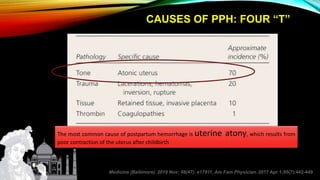
CAUSES OF PPH: FOUR “T”
Medicine (Baltimore). 2019 Nov; 98(47): e17911, Am Fam Physician. 2017 Apr 1;95(7):442-449
The most common cause of postpartum hemorrhage is uterine atony, which results from
poor contraction of the uterus after childbirth
RISK FACTORS OF PPH
• Prolonged labor
• Grand-multipara
• Augmented &/ Precipitated labor
• History of PPH
• Overdistended uterus (Macrosomia, Twins, Polyhydrominos)
• Operative delivery
• Chorioamnionitis
CASE 1
• 33 yr G4P3L3, Previous 3 normal deliveries with 37.5 weeks
gestation came with c/o pain in abdomen and leaking PV since
2 hours.
• On examination –
• Patient was vitally stable, afebrile
• P/A- Uterus full term size, Cephalic floating, FHS present,
140bpm, regular.
• P/V- Cervical os 8cm dilated, 80% effaced, Vertex, Station +2,
Liquor clear.
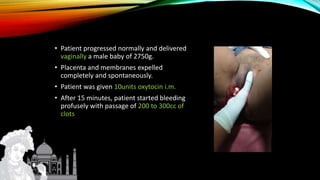
• Patient progressed normally and delivered
vaginally a male baby of 2750g.
• Placenta and membranes expelled
completely and spontaneously.
• Patient was given 10units oxytocin i.m.
• After 15 minutes, patient started bleeding
profusely with passage of 200 to 300cc of
clots
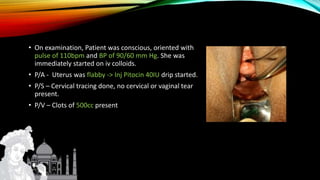
• On examination, Patient was conscious, oriented with
pulse of 110bpm and BP of 90/60 mm Hg. She was
immediately started on iv colloids.
• P/A - Uterus was flabby -> Inj Pitocin 40IU drip started.
• P/S – Cervical tracing done, no cervical or vaginal tear
present.
• P/V – Clots of 500cc present
• Uterus was still flabby
• Inj Carbetocin 100microgram 1 dose iv given
• Continuous Bimanual Uterine Massage given.
• Uterus tone gained back.
• Patient vitally stable.
• Patient observed for every 15minutes for 2 hours to watch for
any bleeding
ACTIVE MANAGEMENT OF 3RD STAGE OF
LABOUR
• Active management of Third Stage of labour includes:
• Administration of uterotonics after delivery of anterior
shoulder i.e. Inj Oxytocin 10 IU i.m. stat
• Controlled cord traction
• Bimanual uterine massage
CASE 2
• 25year old, G2P1L1prev 1 FTND with DCDA twins with 36.5 weeks gestation came with c/o
Pain Abdomen with scan showing 1st twin in breech.
• On Examination
• Patient was conscious, oriented, afebrile, vitally stable
• P/A- Uterus was fullterm size, multiple fetal parts felt, FHS 1 present/150bpm/regular, FHS 2
present/138bpm/regular, Activity ++
• P/V – Cervical os 3 cm dilated, 40% effaced, breech, station +1, No leak
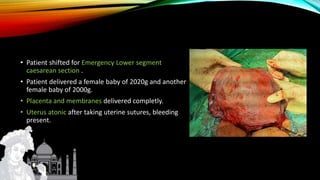
• Patient shifted for Emergency Lower segment
caesarean section .
• Patient delivered a female baby of 2020g and another
female baby of 2000g.
• Placenta and membranes delivered completly.
• Uterus atonic after taking uterine sutures, bleeding
present.
• Inj Oxytocin 10 IU i.m. and 40 IU iv infusion started
• Uterus tone not regained
• B Lynch sutures taken and concomitantly Inj Carbetocin 100micro gram slow iv given
• Bleeding controlled, Patient stable
B LYNCH SUTURES
PPH AFTER CAESAREAN DELIVERY
 PPH is more likely to happen after caesarean as compared to vaginal deliveries
 Approx 36% of caesarean deliveries are complicated by PPH1
1. BMC Pregnancy Childbirth 17, 399 (2017)
2. Anaesthesia 2019; 74: 1219–22,
It is common practice to give a uterotonic drug following delivery of the neonate during caesarean
section
And therefore….
International consensus
statement on the use of
uterotonic agents during
caesarean section
2019
Uterotonic agents like Oxytocin/ Carbetocin are recommended for routine
administration immediately after delivery of the fetus during caesarean section
to prevent postpartum haemorrhage2
UTEROTONIC DRUGS
Posterior pituitary hormone &
analogues
Ergot alkaloids Prostaglandins $ analogues
• Oxytocin
• Carbetocin
• Ergometrine
• Methylergometrine
• PGE2
• Misopristol
• Carboprost
First-Line Agents Second-Line Agents
Oxytocin considered as a gold standard
treatment for the prevention of PPH
OXYTOCIN IS…
half-life of 4–10 min;
Duration of action: 15-20 mins
It must be administered as a continuous
intravenous infusion to attain sustained
uterotonic activity throughout the surgical
procedure & immediate postpartum period
Short acting
Oxytocin is used for inducing or augmenting
labour may desensitize the oxytocin receptors,
thereby impairing oxytocin’s post-delivery effects
on uterine contractility
Causes Receptor desensitization
BMC Pregnancy Childbirth. 2017; 17: 399
WHO recommendations: Uterotonics for the prevention of postpartum haemorrhage.
Geneva: World Health Organization; 2018. Web annex 7, Choice of uterotonic agents
Various International bodies and trials have used/
recommended different doses of Oxytocin, thus
there is no consistency in dosage regimen, which
results into errors in its administration
Variation in dosage
The Institute for Safe Medication Practices (ISMP)
added IV oxytocin to their list of high-alert
medications meaning minor errors can cause
significant harm to patient
Oxytocin: High alert medication
NEED OF THE HOUR..
 Longer acting
 Single dose of administration-No variation in dosage regimens
 Devoid of repeated administration, Ease of one time administration
 Superior efficacy or similar efficacy as that of Oxytocin
 Devoid of receptor desensitization
 Superior side effect profile over oxytocin
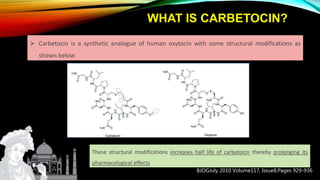
WHAT IS CARBETOCIN?
 Carbetocin is a synthetic analogue of human oxytocin with some structural modifications as
shown below
These structural modifications increases half life of carbetocin thereby prolonging its
pharmacological effects
BJOGJuly 2010 Volume117, Issue8,Pages 929-936
WHAT IS CARBETOCIN??
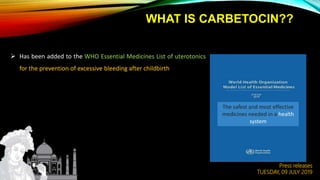
 Has been added to the WHO Essential Medicines List of uterotonics
for the prevention of excessive bleeding after childbirth
Press releases
TUESDAY, 09 JULY 2019
The safest and most effective
medicines needed in a health
system
It acts by acting through Oxytocin receptors which causes the Uterus to contract
1. Oxytocic
2. Uterotonic
3. Antihaemorrhagic (causes slight thickening of blood)
HOW CARBETOCIN WORKS?
CARBETOCIN VS OXYTOCIN
 Half life for carbetocin (40 mins) is 10 folds higher than Oxytocin (4mins)
 Duration of action of carbetocin longer than IV & IM oxytocin
(It was found that a single intravenous bolus injection of carbetocin was at least as effective
as 16 hours of continuous oxytocin infusion)
 Carbetocin need no repeated administration
 No dose variation/ single dose of carbetocin is found to be effective in controlling PPH,
unlike oxytocin
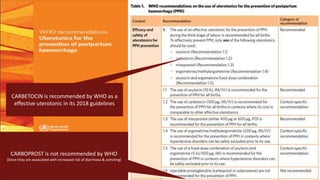
CARBETOCIN is recommended by WHO as a
effective uterotonic in its 2018 guidelines
CARBOPROST is not recommended by WHO
(Since they are associated with increased risk of diarrhoea & vomiting)
CONTRAINDICATION
• Epilepsy
• Eclampsia
• Before delivery(May cause respiratory or cardiac distress in mother or
baby)
• To be used with caution in Hypertensive patients
Clinical studies: Oxytocin Vs. Carbetocin
A. Management of 3rd stage of labor
During vaginal delivery
B. Prevention of PPH following
caesarean delivery
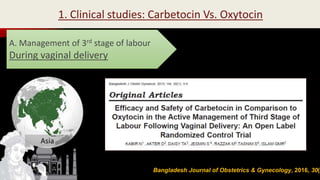
Bangladesh Journal of Obstetrics & Gynecology, 2016, 30(1
A. Management of 3rd stage of labour
During vaginal delivery
1. Clinical studies: Carbetocin Vs. Oxytocin
Asia
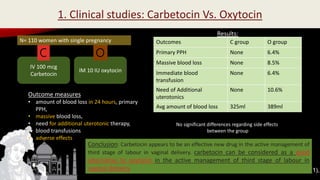
N= 110 women with single pregnancy
IV 100 mcg
Carbetocin
IM 10 IU oxytocin
C O
Outcome measures
• amount of blood loss in 24 hours, primary
PPH,
• massive blood loss,
• need for additional uterotonic therapy,
blood transfusions
• adverse effects
Results:
Outcomes C group O group
Primary PPH None 6.4%
Massive blood loss None 8.5%
Immediate blood
transfusion
None 6.4%
Need of Additional
uterotonics
None 10.6%
Avg amount of blood loss 325ml 389ml
No significant differences regarding side effects
between the group
Bangladesh Journal of Obstetrics & Gynaecology, 2016, 30(1),
1. Clinical studies: Carbetocin Vs. Oxytocin
Conclusion: Carbetocin appears to be an effective new drug in the active management of
third stage of labour in vaginal delivery. carbetocin can be considered as a good
alternative to oxytocin in the active management of third stage of labour in
vaginal delivery
Clinical studies: Oxytocin Vs. Carbetocin
B. Prevention of PPH following
caesarean delivery
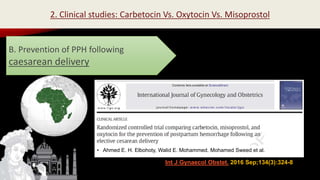
Int J Gynaecol Obstet. 2016 Sep;134(3):324-8
2. Clinical studies: Carbetocin Vs. Oxytocin Vs. Misoprostol
B. Prevention of PPH following
caesarean delivery
Africa • Ahmed E. H. Elbohoty, Walid E. Mohammed, Mohamed Sweed et al.
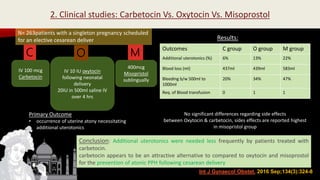
N= 263patients with a singleton pregnancy scheduled
for an elective cesarean deliver
IV 100 mcg
Carbetocin
IV 10 IU oxytocin
following neonatal
delivery
20IU in 500ml saline IV
over 4 hrs
C O
Primary Outcome
• occurrence of uterine atony necessitating
additional uterotonics
Results:
Outcomes C group O group M group
Additional uterotonics (%) 6% 13% 22%
Blood loss (ml) 437ml 439ml 583ml
Bleeding b/w 500ml to
1000ml
20% 34% 47%
Req. of Blood transfusion 0 1 1
Conclusion: Additional uterotonics were needed less frequently by patients treated with
carbetocin.
carbetocin appears to be an attractive alternative to compared to oxytocin and misoprostol
for the prevention of atonic PPH following cesarean delivery
No significant differences regarding side effects
between Oxytocin & carbetocin, sides effects are reported highest
in misopristol group
400mcg
Misopristol
sublingually
M
Int J Gynaecol Obstet. 2016 Sep;134(3):324-8
2. Clinical studies: Carbetocin Vs. Oxytocin Vs. Misoprostol
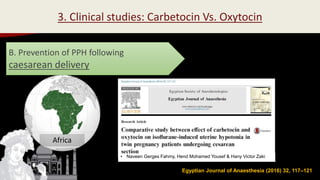
Egyptian Journal of Anaesthesia (2016) 32, 117–121
B. Prevention of PPH following
caesarean delivery
3. Clinical studies: Carbetocin Vs. Oxytocin
Africa
• Naveen Gerges Fahmy, Hend Mohamed Yousef & Hany Victor Zaki
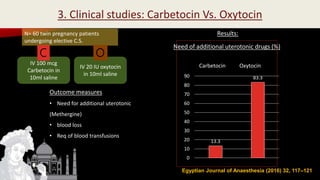
N= 60 twin pregnancy patients
undergoing elective C.S.
IV 100 mcg
Carbetocin in
10ml saline
IV 20 IU oxytocin
in 10ml saline
C O
Outcome measures
• Need for additional uterotonic
(Methergine)
• blood loss
• Req of blood transfusions
Results:
13.3
83.3
0
10
20
30
40
50
60
70
80
90
Need of additional uterotonic drugs (%)
Carbetocin Oxytocin
Egyptian Journal of Anaesthesia (2016) 32, 117–121
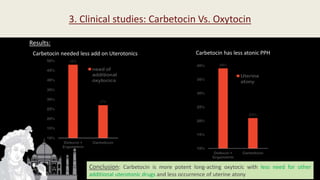
3. Clinical studies: Carbetocin Vs. Oxytocin
Results:
Carbetocin needed less add on Uterotonics Carbetocin has less atonic PPH
Conclusion: Carbetocin is more potent long-acting oxytocic with less need for other
additional uterotonic drugs and less occurrence of uterine atony
3. Clinical studies: Carbetocin Vs. Oxytocin
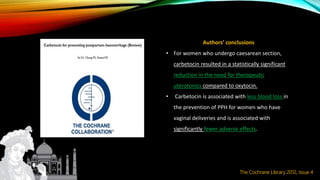
Authors’ conclusions
• For women who undergo caesarean section,
carbetocin resulted in a statistically significant
reduction in the need for therapeutic
uterotonics compared to oxytocin.
• Carbetocin is associated with less blood loss in
the prevention of PPH for women who have
vaginal deliveries and is associated with
significantly fewer adverse effects.
The Cochrane Library 2012, Issue 4
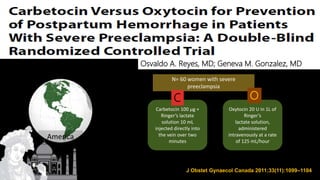
J Obstet Gynaecol Canada 2011;33(11):1099–1104
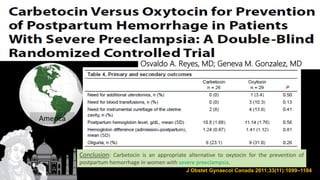
N= 60 women with severe
preeclampsia
Carbetocin 100 μg +
Ringer’s lactate
solution 10 mL
injected directly into
the vein over two
minutes
Oxytocin 20 U in 1L of
Ringer’s
lactate solution,
administered
intravenously at a rate
of 125 mL/hour
C O
Result:
America
Osvaldo A. Reyes, MD; Geneva M. Gonzalez, MD
J Obstet Gynaecol Canada 2011;33(11):1099–1104
Result:
Conclusion: Carbetocin is an appropriate alternative to oxytocin for the prevention of
postpartum hemorrhage in women with severe preeclampsia.
America
Osvaldo A. Reyes, MD; Geneva M. Gonzalez, MD
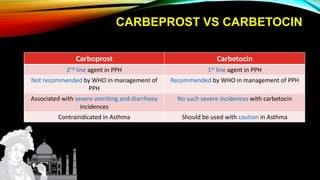
CARBEPROST VS CARBETOCIN
Carboprost Carbetocin
2nd line agent in PPH 1st line agent in PPH
Not recommended by WHO in management of
PPH
Recommended by WHO in management of PPH
Associated with severe vomiting and diarrhoea
incidences
No such severe incidences with carbetocin
Contraindicated in Asthma Should be used with caution in Asthma
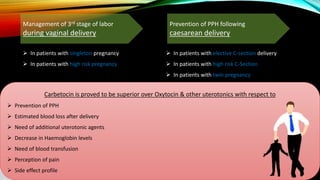
Management of 3rd stage of labor
during vaginal delivery
Prevention of PPH following
caesarean delivery
 In patients with singleton pregnancy
 In patients with high risk pregnancy
 In patients with elective C-section delivery
 In patients with high risk C-Section
 In patients with twin pregnancy
Carbetocin is proved to be superior over Oxytocin & other uterotonics with respect to
 Prevention of PPH
 Estimated blood loss after delivery
 Need of additional uterotonic agents
 Decrease in Haemoglobin levels
 Need of blood transfusion
 Perception of pain
 Side effect profile
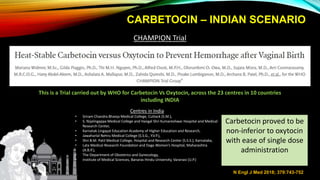
CARBETOCIN – INDIAN SCENARIO
N Engl J Med 2018; 379:743-752
CHAMPION Trial
This is a Trial carried out by WHO for Carbetocin Vs Oxytocin, across the 23 centres in 10 countries
including INDIA
Centres in India
• Sriram Chandra Bhanja Medical College, Cuttack (S.M.),
• S. Nijalingappa Medical College and Hangal Shri Kumareshwar Hospital and Medical
Research Center,
• Karnatak Lingayat Education Academy of Higher Education and Research,
• Jawaharlal Nehru Medical College (S.S.G., Y.V.P.),
• Shri B.M. Patil Medical College, Hospital and Research Center (S.S.S.), Karnataka,
• Lata Medical Research Foundation and Daga Women’s Hospital, Maharashtra
(A.B.P.),
• The Department of Obstetrics and Gynecology,
• Institute of Medical Sciences, Banaras Hindu University, Varanasi (U.P.)
Carbetocin proved to be
non-inferior to oxytocin
with ease of single dose
administration
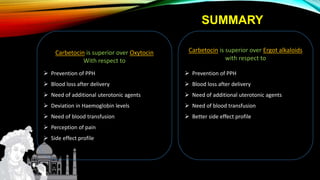
Carbetocin is superior over Oxytocin
With respect to
 Prevention of PPH
 Blood loss after delivery
 Need of additional uterotonic agents
 Deviation in Haemoglobin levels
 Need of blood transfusion
 Perception of pain
 Side effect profile
Carbetocin is superior over Ergot alkaloids
with respect to
 Prevention of PPH
 Blood loss after delivery
 Need of additional uterotonic agents
 Need of blood transfusion
 Better side effect profile
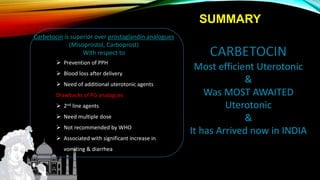
SUMMARY
Carbetocin is superior over prostaglandin analogues
(Misoprostol, Carboprost)
With respect to
 Prevention of PPH
 Blood loss after delivery
 Need of additional uterotonic agents
Drawbacks of PG analogues
 2nd line agents
 Need multiple dose
 Not recommended by WHO
 Associated with significant increase in
vomiting & diarrhea
Most efficient Uterotonic
&
Was MOST AWAITED
Uterotonic
&
It has Arrived now in INDIA
SUMMARY
Carbetocin in PPH
Carbetocin in PPH

Carbetocin in PPH

  • 1.
    THE NEXT GENERATIONUTEROTONIC- CARBETOCIN
  • 2.
    DISCLAIMER • I donot have any conflict of interest and I have not received any grant, this presentation is only for academic purposes.
  • 3.
    DR. NIRANJAN CHAVAN MD,FCPS, DGO, MICOG, DICOG, FICOG, DFP, DIPLOMA IN ENDOSCOPY (USA) Professor and Unit Chief, L.T.M.M.C & L.T.M.G.H, Sion Hospital Joint Treasurer Elect, FOGSI (2021-2024) Vice President, MOGS (2021-2022) Member Oncology Committee, SAFOG (2020-2022) Dean AGOG & Chief Content Director, HIGHGRAD & FEMAS Courses Editor-in-Chief, FEMAS & JGOG Journal National Co-Ordinator, FOGSI Medical Disorders in Pregnancy Committee (2019-2021) Chair & Convener, FOGSI Cell Violence Against Doctors (2015-16) Member, Oncology Committee AOFOG (2013-2015) Co-Ordinator of 11 batches of MUHS recognized Certificate Course of B.I.M.I.E at L.T.M.G.H (2010-16) Member, Managing Committee IAGE (2013-17), (2018-20) Editorial Board, European Journal of Gynaec. Oncology (Italy) Course Co-Ordinator of 3 batches of Advanced Minimal Access Gynaec Surgery (AMAS) at LTMGH (2018-19)
  • 4.
    Postpartum haemorrhage orPPH is defined as a cumulative blood loss • ≥500ml following vaginal delivery or • ≥1000ml following cesarean delivery • or any amount of blood loss within 24hours after birth evidenced by a rise in pulse rate, and falling blood pressure • Primary PPH: First 24 hrs of delivery • Secondary PPH: 24 hrs to 12 weeks after delivery POSTPARTUM HAEMORRHAGE (PPH)
  • 5.
    CAUSES OF PPH:FOUR “T” Medicine (Baltimore). 2019 Nov; 98(47): e17911, Am Fam Physician. 2017 Apr 1;95(7):442-449 The most common cause of postpartum hemorrhage is uterine atony, which results from poor contraction of the uterus after childbirth
  • 6.
    RISK FACTORS OFPPH • Prolonged labor • Grand-multipara • Augmented &/ Precipitated labor • History of PPH • Overdistended uterus (Macrosomia, Twins, Polyhydrominos) • Operative delivery • Chorioamnionitis
  • 7.
    CASE 1 • 33yr G4P3L3, Previous 3 normal deliveries with 37.5 weeks gestation came with c/o pain in abdomen and leaking PV since 2 hours. • On examination – • Patient was vitally stable, afebrile • P/A- Uterus full term size, Cephalic floating, FHS present, 140bpm, regular. • P/V- Cervical os 8cm dilated, 80% effaced, Vertex, Station +2, Liquor clear.
  • 8.
    • Patient progressednormally and delivered vaginally a male baby of 2750g. • Placenta and membranes expelled completely and spontaneously. • Patient was given 10units oxytocin i.m. • After 15 minutes, patient started bleeding profusely with passage of 200 to 300cc of clots
  • 9.
    • On examination,Patient was conscious, oriented with pulse of 110bpm and BP of 90/60 mm Hg. She was immediately started on iv colloids. • P/A - Uterus was flabby -> Inj Pitocin 40IU drip started. • P/S – Cervical tracing done, no cervical or vaginal tear present. • P/V – Clots of 500cc present
  • 10.
    • Uterus wasstill flabby • Inj Carbetocin 100microgram 1 dose iv given • Continuous Bimanual Uterine Massage given.
  • 11.
    • Uterus tonegained back. • Patient vitally stable. • Patient observed for every 15minutes for 2 hours to watch for any bleeding
  • 12.
    ACTIVE MANAGEMENT OF3RD STAGE OF LABOUR • Active management of Third Stage of labour includes: • Administration of uterotonics after delivery of anterior shoulder i.e. Inj Oxytocin 10 IU i.m. stat • Controlled cord traction • Bimanual uterine massage
  • 13.
    CASE 2 • 25yearold, G2P1L1prev 1 FTND with DCDA twins with 36.5 weeks gestation came with c/o Pain Abdomen with scan showing 1st twin in breech. • On Examination • Patient was conscious, oriented, afebrile, vitally stable • P/A- Uterus was fullterm size, multiple fetal parts felt, FHS 1 present/150bpm/regular, FHS 2 present/138bpm/regular, Activity ++ • P/V – Cervical os 3 cm dilated, 40% effaced, breech, station +1, No leak
  • 14.
    • Patient shiftedfor Emergency Lower segment caesarean section . • Patient delivered a female baby of 2020g and another female baby of 2000g. • Placenta and membranes delivered completly. • Uterus atonic after taking uterine sutures, bleeding present.
  • 15.
    • Inj Oxytocin10 IU i.m. and 40 IU iv infusion started • Uterus tone not regained • B Lynch sutures taken and concomitantly Inj Carbetocin 100micro gram slow iv given • Bleeding controlled, Patient stable
  • 16.
  • 17.
    PPH AFTER CAESAREANDELIVERY  PPH is more likely to happen after caesarean as compared to vaginal deliveries  Approx 36% of caesarean deliveries are complicated by PPH1 1. BMC Pregnancy Childbirth 17, 399 (2017) 2. Anaesthesia 2019; 74: 1219–22, It is common practice to give a uterotonic drug following delivery of the neonate during caesarean section And therefore…. International consensus statement on the use of uterotonic agents during caesarean section 2019 Uterotonic agents like Oxytocin/ Carbetocin are recommended for routine administration immediately after delivery of the fetus during caesarean section to prevent postpartum haemorrhage2
  • 18.
    UTEROTONIC DRUGS Posterior pituitaryhormone & analogues Ergot alkaloids Prostaglandins $ analogues • Oxytocin • Carbetocin • Ergometrine • Methylergometrine • PGE2 • Misopristol • Carboprost First-Line Agents Second-Line Agents Oxytocin considered as a gold standard treatment for the prevention of PPH
  • 19.
    OXYTOCIN IS… half-life of4–10 min; Duration of action: 15-20 mins It must be administered as a continuous intravenous infusion to attain sustained uterotonic activity throughout the surgical procedure & immediate postpartum period Short acting Oxytocin is used for inducing or augmenting labour may desensitize the oxytocin receptors, thereby impairing oxytocin’s post-delivery effects on uterine contractility Causes Receptor desensitization BMC Pregnancy Childbirth. 2017; 17: 399 WHO recommendations: Uterotonics for the prevention of postpartum haemorrhage. Geneva: World Health Organization; 2018. Web annex 7, Choice of uterotonic agents
  • 20.
    Various International bodiesand trials have used/ recommended different doses of Oxytocin, thus there is no consistency in dosage regimen, which results into errors in its administration Variation in dosage The Institute for Safe Medication Practices (ISMP) added IV oxytocin to their list of high-alert medications meaning minor errors can cause significant harm to patient Oxytocin: High alert medication
  • 21.
    NEED OF THEHOUR..  Longer acting  Single dose of administration-No variation in dosage regimens  Devoid of repeated administration, Ease of one time administration  Superior efficacy or similar efficacy as that of Oxytocin  Devoid of receptor desensitization  Superior side effect profile over oxytocin
  • 22.
    WHAT IS CARBETOCIN? Carbetocin is a synthetic analogue of human oxytocin with some structural modifications as shown below These structural modifications increases half life of carbetocin thereby prolonging its pharmacological effects BJOGJuly 2010 Volume117, Issue8,Pages 929-936
  • 23.
    WHAT IS CARBETOCIN?? Has been added to the WHO Essential Medicines List of uterotonics for the prevention of excessive bleeding after childbirth Press releases TUESDAY, 09 JULY 2019 The safest and most effective medicines needed in a health system
  • 24.
    It acts byacting through Oxytocin receptors which causes the Uterus to contract 1. Oxytocic 2. Uterotonic 3. Antihaemorrhagic (causes slight thickening of blood) HOW CARBETOCIN WORKS?
  • 25.
    CARBETOCIN VS OXYTOCIN Half life for carbetocin (40 mins) is 10 folds higher than Oxytocin (4mins)  Duration of action of carbetocin longer than IV & IM oxytocin (It was found that a single intravenous bolus injection of carbetocin was at least as effective as 16 hours of continuous oxytocin infusion)  Carbetocin need no repeated administration  No dose variation/ single dose of carbetocin is found to be effective in controlling PPH, unlike oxytocin
  • 26.
    CARBETOCIN is recommendedby WHO as a effective uterotonic in its 2018 guidelines CARBOPROST is not recommended by WHO (Since they are associated with increased risk of diarrhoea & vomiting)
  • 27.
    CONTRAINDICATION • Epilepsy • Eclampsia •Before delivery(May cause respiratory or cardiac distress in mother or baby) • To be used with caution in Hypertensive patients
  • 28.
    Clinical studies: OxytocinVs. Carbetocin A. Management of 3rd stage of labor During vaginal delivery B. Prevention of PPH following caesarean delivery
  • 29.
    Bangladesh Journal ofObstetrics & Gynecology, 2016, 30(1 A. Management of 3rd stage of labour During vaginal delivery 1. Clinical studies: Carbetocin Vs. Oxytocin Asia
  • 30.
    N= 110 womenwith single pregnancy IV 100 mcg Carbetocin IM 10 IU oxytocin C O Outcome measures • amount of blood loss in 24 hours, primary PPH, • massive blood loss, • need for additional uterotonic therapy, blood transfusions • adverse effects Results: Outcomes C group O group Primary PPH None 6.4% Massive blood loss None 8.5% Immediate blood transfusion None 6.4% Need of Additional uterotonics None 10.6% Avg amount of blood loss 325ml 389ml No significant differences regarding side effects between the group Bangladesh Journal of Obstetrics & Gynaecology, 2016, 30(1), 1. Clinical studies: Carbetocin Vs. Oxytocin Conclusion: Carbetocin appears to be an effective new drug in the active management of third stage of labour in vaginal delivery. carbetocin can be considered as a good alternative to oxytocin in the active management of third stage of labour in vaginal delivery
  • 31.
    Clinical studies: OxytocinVs. Carbetocin B. Prevention of PPH following caesarean delivery
  • 32.
    Int J GynaecolObstet. 2016 Sep;134(3):324-8 2. Clinical studies: Carbetocin Vs. Oxytocin Vs. Misoprostol B. Prevention of PPH following caesarean delivery Africa • Ahmed E. H. Elbohoty, Walid E. Mohammed, Mohamed Sweed et al.
  • 33.
    N= 263patients witha singleton pregnancy scheduled for an elective cesarean deliver IV 100 mcg Carbetocin IV 10 IU oxytocin following neonatal delivery 20IU in 500ml saline IV over 4 hrs C O Primary Outcome • occurrence of uterine atony necessitating additional uterotonics Results: Outcomes C group O group M group Additional uterotonics (%) 6% 13% 22% Blood loss (ml) 437ml 439ml 583ml Bleeding b/w 500ml to 1000ml 20% 34% 47% Req. of Blood transfusion 0 1 1 Conclusion: Additional uterotonics were needed less frequently by patients treated with carbetocin. carbetocin appears to be an attractive alternative to compared to oxytocin and misoprostol for the prevention of atonic PPH following cesarean delivery No significant differences regarding side effects between Oxytocin & carbetocin, sides effects are reported highest in misopristol group 400mcg Misopristol sublingually M Int J Gynaecol Obstet. 2016 Sep;134(3):324-8 2. Clinical studies: Carbetocin Vs. Oxytocin Vs. Misoprostol
  • 34.
    Egyptian Journal ofAnaesthesia (2016) 32, 117–121 B. Prevention of PPH following caesarean delivery 3. Clinical studies: Carbetocin Vs. Oxytocin Africa • Naveen Gerges Fahmy, Hend Mohamed Yousef & Hany Victor Zaki
  • 35.
    N= 60 twinpregnancy patients undergoing elective C.S. IV 100 mcg Carbetocin in 10ml saline IV 20 IU oxytocin in 10ml saline C O Outcome measures • Need for additional uterotonic (Methergine) • blood loss • Req of blood transfusions Results: 13.3 83.3 0 10 20 30 40 50 60 70 80 90 Need of additional uterotonic drugs (%) Carbetocin Oxytocin Egyptian Journal of Anaesthesia (2016) 32, 117–121 3. Clinical studies: Carbetocin Vs. Oxytocin
  • 36.
    Results: Carbetocin needed lessadd on Uterotonics Carbetocin has less atonic PPH Conclusion: Carbetocin is more potent long-acting oxytocic with less need for other additional uterotonic drugs and less occurrence of uterine atony 3. Clinical studies: Carbetocin Vs. Oxytocin
  • 37.
    Authors’ conclusions • Forwomen who undergo caesarean section, carbetocin resulted in a statistically significant reduction in the need for therapeutic uterotonics compared to oxytocin. • Carbetocin is associated with less blood loss in the prevention of PPH for women who have vaginal deliveries and is associated with significantly fewer adverse effects. The Cochrane Library 2012, Issue 4
  • 38.
    J Obstet GynaecolCanada 2011;33(11):1099–1104 N= 60 women with severe preeclampsia Carbetocin 100 μg + Ringer’s lactate solution 10 mL injected directly into the vein over two minutes Oxytocin 20 U in 1L of Ringer’s lactate solution, administered intravenously at a rate of 125 mL/hour C O Result: America Osvaldo A. Reyes, MD; Geneva M. Gonzalez, MD
  • 39.
    J Obstet GynaecolCanada 2011;33(11):1099–1104 Result: Conclusion: Carbetocin is an appropriate alternative to oxytocin for the prevention of postpartum hemorrhage in women with severe preeclampsia. America Osvaldo A. Reyes, MD; Geneva M. Gonzalez, MD
  • 40.
    CARBEPROST VS CARBETOCIN CarboprostCarbetocin 2nd line agent in PPH 1st line agent in PPH Not recommended by WHO in management of PPH Recommended by WHO in management of PPH Associated with severe vomiting and diarrhoea incidences No such severe incidences with carbetocin Contraindicated in Asthma Should be used with caution in Asthma
  • 41.
    Management of 3rdstage of labor during vaginal delivery Prevention of PPH following caesarean delivery  In patients with singleton pregnancy  In patients with high risk pregnancy  In patients with elective C-section delivery  In patients with high risk C-Section  In patients with twin pregnancy Carbetocin is proved to be superior over Oxytocin & other uterotonics with respect to  Prevention of PPH  Estimated blood loss after delivery  Need of additional uterotonic agents  Decrease in Haemoglobin levels  Need of blood transfusion  Perception of pain  Side effect profile
  • 42.
    CARBETOCIN – INDIANSCENARIO N Engl J Med 2018; 379:743-752 CHAMPION Trial This is a Trial carried out by WHO for Carbetocin Vs Oxytocin, across the 23 centres in 10 countries including INDIA Centres in India • Sriram Chandra Bhanja Medical College, Cuttack (S.M.), • S. Nijalingappa Medical College and Hangal Shri Kumareshwar Hospital and Medical Research Center, • Karnatak Lingayat Education Academy of Higher Education and Research, • Jawaharlal Nehru Medical College (S.S.G., Y.V.P.), • Shri B.M. Patil Medical College, Hospital and Research Center (S.S.S.), Karnataka, • Lata Medical Research Foundation and Daga Women’s Hospital, Maharashtra (A.B.P.), • The Department of Obstetrics and Gynecology, • Institute of Medical Sciences, Banaras Hindu University, Varanasi (U.P.) Carbetocin proved to be non-inferior to oxytocin with ease of single dose administration
  • 43.
    Carbetocin is superiorover Oxytocin With respect to  Prevention of PPH  Blood loss after delivery  Need of additional uterotonic agents  Deviation in Haemoglobin levels  Need of blood transfusion  Perception of pain  Side effect profile Carbetocin is superior over Ergot alkaloids with respect to  Prevention of PPH  Blood loss after delivery  Need of additional uterotonic agents  Need of blood transfusion  Better side effect profile SUMMARY
  • 44.
    Carbetocin is superiorover prostaglandin analogues (Misoprostol, Carboprost) With respect to  Prevention of PPH  Blood loss after delivery  Need of additional uterotonic agents Drawbacks of PG analogues  2nd line agents  Need multiple dose  Not recommended by WHO  Associated with significant increase in vomiting & diarrhea Most efficient Uterotonic & Was MOST AWAITED Uterotonic & It has Arrived now in INDIA SUMMARY

Editor's Notes

  • #23 https://obgyn.onlinelibrary.wiley.com/doi/full/10.1111/j.1471-0528.2010.02585.x
  • #24 https://www.ferring.com/en/media/press-releases/heat-stable-carbetocin-has-been-added-to-the-who-essential-medicines-list-for-the-prevention-of-excessive-bleeding-after-childbirth/
  • #27 https://apps.who.int/iris/bitstream/handle/10665/277276/9789241550420-eng.pdf?ua=1