
HYSTERECTOMY
IN
FIBROID
A SIMPLIFIED
VERSION..
By :
Thamizhmaran
Final year MBBS
GMC,OGE
DEFINITION
TYPES:
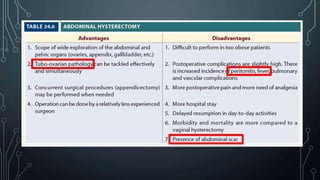
ABDOMINAL HYSTERECTOMY
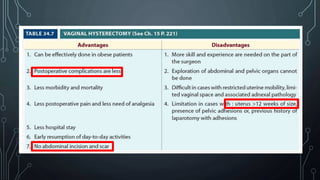
VAGINAL HYSTERECTOMY
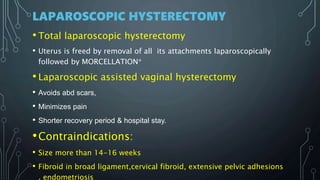
LAPAROSCOPIC HYSTERECTOMY
It is a surgical removal of uterus is indicated in
a women
over 40 yrs of age ;
multiparous women; or
associated with malignancy.
WHY HYSTERECTOMY IN FIBROIDS……
Indications
• Above 40 yrs age- finished child bearing function.
• Failure of MEDICAL treatment.
• Large fibroid with PRESSURE symptoms.
• Fibroids with malignancy-LEIOMYOSARCOMA.
• For permanent cure in SYMPTOMATIC fibroids.
• Complications –primary hemorrhage in myomectomy*
*(prior consent before
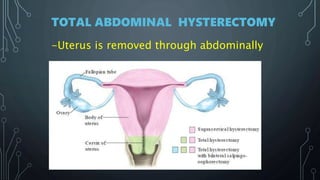
TOTAL ABDOMINAL HYSTERECTOMY
-Uterus is removed through abdominally
INDICATIONS - ABDOMINAL
HYSTERECTOMY..
•Fibroid Uterus is not mobile
•Size > 14 weeks
•h/o pelvic pathology/ adnexal mass present.
•h/o previous surgeries
FIRST myomectomy…..THEN Total abd hysterectomy
Indications-
 Cervical low anterior and posterior fibroid
 Fibroid encroaching to broad ligament, bladder, ureter,
rectum,
 Central cervical fibroid & massive posterior fibroid -
*hemisection of uterus
Aim-
To have a clear view of vaginal vault
Safeguards against bladder injury
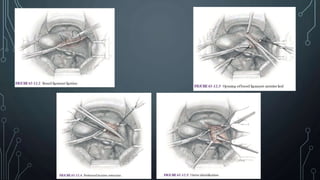
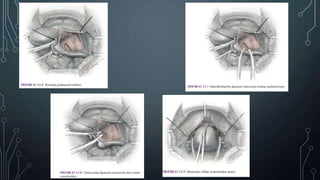
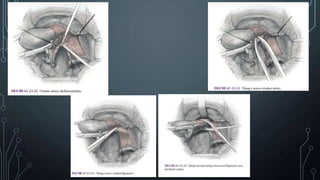
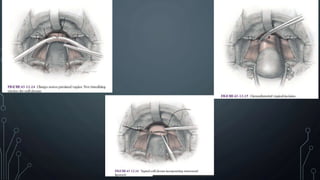
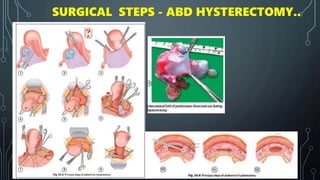
Surgical Steps - abd hysterectomy..
Anaesthesia and patient positioning
Incision and entry in to pelvic cavity.
If ovaries to be preserved-ovarian ligament
If ovaries are to be removed-infundibulo pelvic
ligament.
Fallopian tube – clamp, cut ,ligate
Round ligament- clamp, cut ,ligate
Incision over Uterovesical fold
Clamps on parametrium containing uterine artery,
descending cervical artery
Uterosacral ligaments-clamp,cut ,ligate
Mackenrodtz ligament-clamp,cut ,ligate
Incision over vault of vagina at cervicovaginal
junction.
SURGICAL STEPS - ABD HYSTERECTOMY..
HYSTERECTOMY SURGICAL
VIDEO
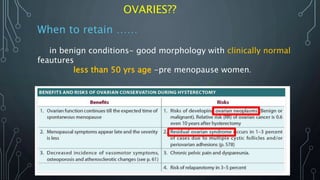
OVARIES??
When to retain ……
in benign conditions- good morphology with clinically normal
feautures
less than 50 yrs age -pre menopause women.
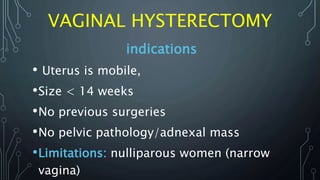
VAGINAL HYSTERECTOMY
indications
• Uterus is mobile,
•Size < 14 weeks
•No previous surgeries
•No pelvic pathology/adnexal mass
•Limitations: nulliparous women (narrow
vagina)
Surgical Steps – Vaginal hysterectomy..
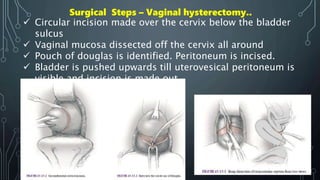
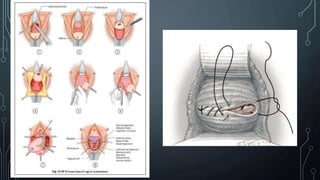
 Circular incision made over the cervix below the bladder
sulcus
 Vaginal mucosa dissected off the cervix all around
 Pouch of douglas is identified. Peritoneum is incised.
 Bladder is pushed upwards till uterovesical peritoneum is
visible and incision is made out.
Surgical Steps – Vaginal hysterectomy..
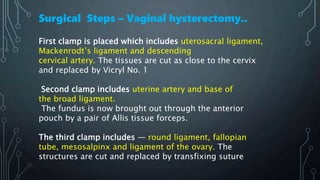
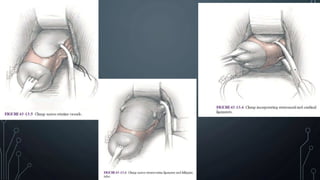
First clamp is placed which includes uterosacral ligament,
Mackenrodt’s ligament and descending
cervical artery. The tissues are cut as close to the cervix
and replaced by Vicryl No. 1
Second clamp includes uterine artery and base of
the broad ligament.
The fundus is now brought out through the anterior
pouch by a pair of Allis tissue forceps.
The third clamp includes — round ligament, fallopian
tube, mesosalpinx and ligament of the ovary. The
structures are cut and replaced by transfixing suture
LAPAROSCOPIC HYSTERECTOMY
• Total laparoscopic hysterectomy
• Uterus is freed by removal of all its attachments laparoscopically
followed by MORCELLATION*
• Laparoscopic assisted vaginal hysterectomy
• Avoids abd scars,
• Minimizes pain
• Shorter recovery period & hospital stay.
•Contraindications:
• Size more than 14-16 weeks
• Fibroid in broad ligament,cervical fibroid, extensive pelvic adhesions
, endometriosis
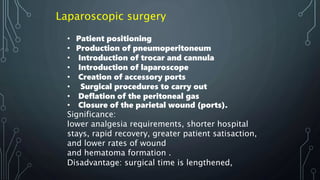
• Patient positioning
• Production of pneumoperitoneum
• Introduction of trocar and cannula
• Introduction of laparoscope
• Creation of accessory ports
• Surgical procedures to carry out
• Deflation of the peritoneal gas
• Closure of the parietal wound (ports).
Significance:
lower analgesia requirements, shorter hospital
stays, rapid recovery, greater patient satisaction,
and lower rates of wound
and hematoma formation .
Disadvantage: surgical time is lengthened,
Laparoscopic surgery
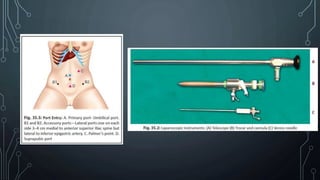
 Three or four puncture sites are made.
 One 10 mm umbilical port is used for the laparoscope, connected to the
video camera.
 Three other secondary ports are made, each of 5 mm size .
 Two of them are placed on the ipsilateral side and the third on the
opposite side.
 These are placed lateral to the inferior epigastric artery or in the mid-
line above the bladder.
 The left lower puncture is the major portal for operative manipulation.
Laparascopic assisted vaginal hysterectomy -
LAVH-
 Bipolar coagulation or Harmonic Scalpel are used to transect pelvic
ligaments and to achieve hemostasis.
 Bipolar coagulation desiccates the blood vessels.
 Scissors are used to transect the pedicles following coagulation.
 The round ligament, infundibulopelvic ligament are similarly
coagulated and transected.
 Sutures, staples or clips can also be used.
 The leaves of the broad ligament are opened up with the scissors.
 The peritoneum of the vesicouterine pouch is dissected with the
scissors.
Laparascopic assisted vaginal hysterectomy
-LAVH-
Total Laparoscopic Hysterectomy (TLH)
 Dissection is continued to expose the uterine vessels.
 After careful identification of the uterine vessels and the ureter, the uterine vessels
are desiccated using bipolar diathermy and then cut.
 Harmonic Scalpel use causes coagulation and cutting simultaneously.
 Uterus is then freed from the rest of attachment.
 The cardinal ligaments on each side are divided.
 Colpotomy device and vaginal occluding device (Colpotomizer system) help to
detect the site of colpotomy and maintain pneumoperitoneum simultaneously.
 Vagina is transected using monopolar energy or by harmonic.
 Bipolar cautery is used for hemostasis.
Postoperative Care
(a) Prophylactic antibiotics are used in a case of
Hysterectomy
(b) Laparoscopic ports should be kept clean and dry
for next 7–10 days.
(c) Diet may be started by next 12 hours.
(d) Discharge: Patient may be discharged by next
48–72 hours.
(e) Daytoday physical activity may be started by
10-12 days time.
(f) Intercourse should be avoided for next 6 weeks.
Intraoperative
•• Hemorrhage
•• Visceral injury: Intestine, bladder or ureter
Anesthetic hazard: atelectasis, pulmonary edema,
embolism.
Postoperative:
Immediate:
Hypovolemia (hemorrhagic) → shock
Urinary:
Retention due to pain and spasm
Cystitis
Anuria may be due to inadequate fluid replacement
(prerenal) or ureteric obstruction (postrenal)
COMPLICATIONS OF
HYSTERECTOMY
LATE COMPLICATIONS:
Incontinence
Pyrexia
Hemorrhage- primary, secondary,
reactionary
Paralytic ileus and intestinal obstruction
Necrotizing fasciitis
Phlebitis
Deep vein thrombosis
Pulmonary embolism
Thank you…

Hysterectomy simplified@ maran

  • 1.
  • 2.
    DEFINITION TYPES: ABDOMINAL HYSTERECTOMY VAGINAL HYSTERECTOMY LAPAROSCOPICHYSTERECTOMY It is a surgical removal of uterus is indicated in a women over 40 yrs of age ; multiparous women; or associated with malignancy.
  • 3.
    WHY HYSTERECTOMY INFIBROIDS…… Indications • Above 40 yrs age- finished child bearing function. • Failure of MEDICAL treatment. • Large fibroid with PRESSURE symptoms. • Fibroids with malignancy-LEIOMYOSARCOMA. • For permanent cure in SYMPTOMATIC fibroids. • Complications –primary hemorrhage in myomectomy* *(prior consent before
  • 4.
    TOTAL ABDOMINAL HYSTERECTOMY -Uterusis removed through abdominally
  • 5.
    INDICATIONS - ABDOMINAL HYSTERECTOMY.. •FibroidUterus is not mobile •Size > 14 weeks •h/o pelvic pathology/ adnexal mass present. •h/o previous surgeries
  • 6.
    FIRST myomectomy…..THEN Totalabd hysterectomy Indications-  Cervical low anterior and posterior fibroid  Fibroid encroaching to broad ligament, bladder, ureter, rectum,  Central cervical fibroid & massive posterior fibroid - *hemisection of uterus Aim- To have a clear view of vaginal vault Safeguards against bladder injury
  • 7.
    Surgical Steps -abd hysterectomy.. Anaesthesia and patient positioning Incision and entry in to pelvic cavity. If ovaries to be preserved-ovarian ligament If ovaries are to be removed-infundibulo pelvic ligament. Fallopian tube – clamp, cut ,ligate Round ligament- clamp, cut ,ligate Incision over Uterovesical fold Clamps on parametrium containing uterine artery, descending cervical artery Uterosacral ligaments-clamp,cut ,ligate Mackenrodtz ligament-clamp,cut ,ligate Incision over vault of vagina at cervicovaginal junction.
  • 12.
    SURGICAL STEPS -ABD HYSTERECTOMY..
  • 13.
  • 14.
    OVARIES?? When to retain…… in benign conditions- good morphology with clinically normal feautures less than 50 yrs age -pre menopause women.
  • 16.
    VAGINAL HYSTERECTOMY indications • Uterusis mobile, •Size < 14 weeks •No previous surgeries •No pelvic pathology/adnexal mass •Limitations: nulliparous women (narrow vagina)
  • 17.
    Surgical Steps –Vaginal hysterectomy..  Circular incision made over the cervix below the bladder sulcus  Vaginal mucosa dissected off the cervix all around  Pouch of douglas is identified. Peritoneum is incised.  Bladder is pushed upwards till uterovesical peritoneum is visible and incision is made out.
  • 18.
    Surgical Steps –Vaginal hysterectomy.. First clamp is placed which includes uterosacral ligament, Mackenrodt’s ligament and descending cervical artery. The tissues are cut as close to the cervix and replaced by Vicryl No. 1 Second clamp includes uterine artery and base of the broad ligament. The fundus is now brought out through the anterior pouch by a pair of Allis tissue forceps. The third clamp includes — round ligament, fallopian tube, mesosalpinx and ligament of the ovary. The structures are cut and replaced by transfixing suture
  • 22.
    LAPAROSCOPIC HYSTERECTOMY • Totallaparoscopic hysterectomy • Uterus is freed by removal of all its attachments laparoscopically followed by MORCELLATION* • Laparoscopic assisted vaginal hysterectomy • Avoids abd scars, • Minimizes pain • Shorter recovery period & hospital stay. •Contraindications: • Size more than 14-16 weeks • Fibroid in broad ligament,cervical fibroid, extensive pelvic adhesions , endometriosis
  • 24.
    • Patient positioning •Production of pneumoperitoneum • Introduction of trocar and cannula • Introduction of laparoscope • Creation of accessory ports • Surgical procedures to carry out • Deflation of the peritoneal gas • Closure of the parietal wound (ports). Significance: lower analgesia requirements, shorter hospital stays, rapid recovery, greater patient satisaction, and lower rates of wound and hematoma formation . Disadvantage: surgical time is lengthened, Laparoscopic surgery
  • 25.
     Three orfour puncture sites are made.  One 10 mm umbilical port is used for the laparoscope, connected to the video camera.  Three other secondary ports are made, each of 5 mm size .  Two of them are placed on the ipsilateral side and the third on the opposite side.  These are placed lateral to the inferior epigastric artery or in the mid- line above the bladder.  The left lower puncture is the major portal for operative manipulation. Laparascopic assisted vaginal hysterectomy - LAVH-
  • 26.
     Bipolar coagulationor Harmonic Scalpel are used to transect pelvic ligaments and to achieve hemostasis.  Bipolar coagulation desiccates the blood vessels.  Scissors are used to transect the pedicles following coagulation.  The round ligament, infundibulopelvic ligament are similarly coagulated and transected.  Sutures, staples or clips can also be used.  The leaves of the broad ligament are opened up with the scissors.  The peritoneum of the vesicouterine pouch is dissected with the scissors. Laparascopic assisted vaginal hysterectomy -LAVH-
  • 27.
    Total Laparoscopic Hysterectomy(TLH)  Dissection is continued to expose the uterine vessels.  After careful identification of the uterine vessels and the ureter, the uterine vessels are desiccated using bipolar diathermy and then cut.  Harmonic Scalpel use causes coagulation and cutting simultaneously.  Uterus is then freed from the rest of attachment.  The cardinal ligaments on each side are divided.  Colpotomy device and vaginal occluding device (Colpotomizer system) help to detect the site of colpotomy and maintain pneumoperitoneum simultaneously.  Vagina is transected using monopolar energy or by harmonic.  Bipolar cautery is used for hemostasis.
  • 28.
    Postoperative Care (a) Prophylacticantibiotics are used in a case of Hysterectomy (b) Laparoscopic ports should be kept clean and dry for next 7–10 days. (c) Diet may be started by next 12 hours. (d) Discharge: Patient may be discharged by next 48–72 hours. (e) Daytoday physical activity may be started by 10-12 days time. (f) Intercourse should be avoided for next 6 weeks.
  • 29.
    Intraoperative •• Hemorrhage •• Visceralinjury: Intestine, bladder or ureter Anesthetic hazard: atelectasis, pulmonary edema, embolism. Postoperative: Immediate: Hypovolemia (hemorrhagic) → shock Urinary: Retention due to pain and spasm Cystitis Anuria may be due to inadequate fluid replacement (prerenal) or ureteric obstruction (postrenal) COMPLICATIONS OF HYSTERECTOMY
  • 30.
    LATE COMPLICATIONS: Incontinence Pyrexia Hemorrhage- primary,secondary, reactionary Paralytic ileus and intestinal obstruction Necrotizing fasciitis Phlebitis Deep vein thrombosis Pulmonary embolism
  • 31.