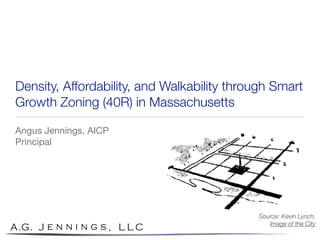
Density, Affordability, and Walkability through Smart
Growth Zoning (40R) in Massachusetts
Angus Jennings, AICP
Principal
Source: Kevin Lynch,
Image of the City
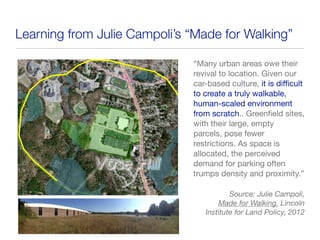
Learning from Julie Campoli’s “Made for Walking”
“Many urban areas owe their
revival to location. Given our
car-based culture, it is difficult
to create a truly walkable,
human-scaled environment
from scratch.. Greenfield sites,
with their large, empty
parcels, pose fewer
restrictions. As space is
allocated, the perceived
demand for parking often
trumps density and proximity.”
Source: Julie Campoli,
Made for Walking, Lincoln
Institute for Land Policy, 2012
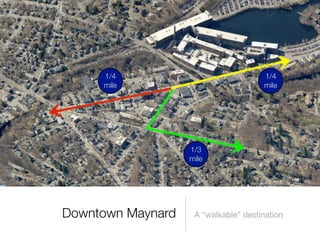
Downtown Maynard A “walkable” destination
1/4
mile
1/4
mile
1/3
mile
Incentive-based zoning
• Structural and perpetuating housing
affordability problem due to shortage of
land appropriately zoned for higher
density residential; supply lagging – and
misplaced
• Concept: economic incentives for
communities to voluntarily adopt higher
density zoning in smart growth locations
• Creation of “zoned land” resulting in
market-driven site selection among
smart growth / incentive housing zones
• Out-migration of young professionals
was a driving concern leading to new
legislation
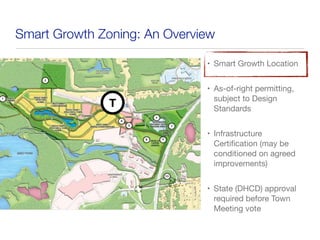
Smart Growth Zoning: An Overview
• Smart Growth Location
• As-of-right permitting,
subject to Design
Standards
• Infrastructure
Certification (may be
conditioned on agreed
improvements)
• State (DHCD) approval
required before Town
Meeting vote
T
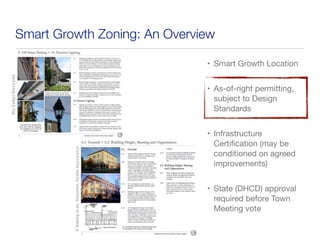
Smart Growth Zoning: An Overview
• Smart Growth Location
• As-of-right permitting,
subject to Design
Standards
• Infrastructure
Certification (may be
conditioned on agreed
improvements)
• State (DHCD) approval
required before Town
Meeting vote
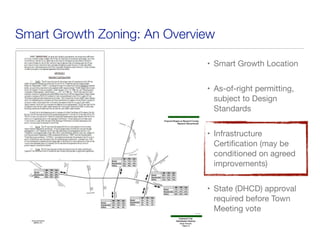
Smart Growth Zoning: An Overview
• Smart Growth Location
• As-of-right permitting,
subject to Design
Standards
• Infrastructure
Certification (may be
conditioned on agreed
improvements)
• State (DHCD) approval
required before Town
Meeting vote
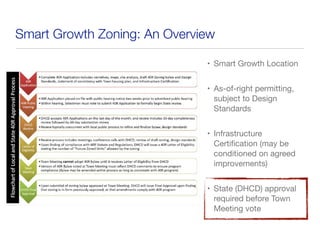
Smart Growth Zoning: An Overview
• Smart Growth Location
• As-of-right permitting,
subject to Design
Standards
• Infrastructure
Certification (may be
conditioned on agreed
improvements)
• State (DHCD) approval
required before Town
Meeting vote
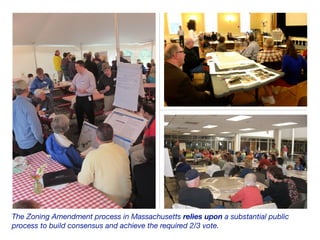
The Zoning Amendment process in Massachusetts relies upon a substantial public
process to build consensus and achieve the required 2/3 vote.
Practical aspects: Tips for Scoping the Work
• Key aspects of work:
• Conceptual planning -
consensus based vision for
where we’re hoping to get
• Mapping - district and sub-
district boundaries
• Density calculations
• Zoning and Design Standards
• Process to secure approval by
DHCD
• Infrastructure evaluation;
planning for potential public
improvements, including
strategies for financing
• Where applicable, execution of
development agreements
• Several successful Smart Growth
Districts in Massachusetts have
relied upon private investment for
some or all of required steps
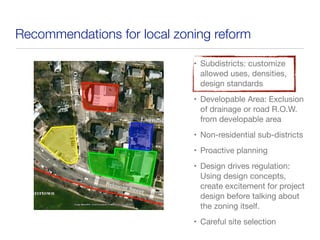
Recommendations for local zoning reform
• Subdistricts: customize
allowed uses, densities,
design standards
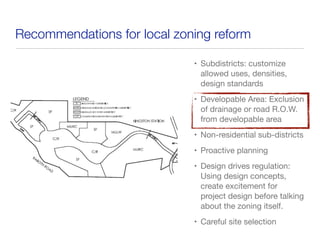
• Developable Area: Exclusion
of drainage or road R.O.W.
from developable area
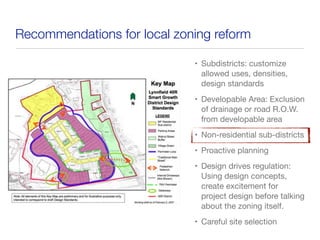
• Non-residential sub-districts
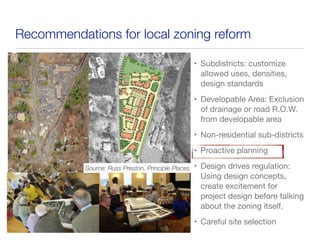
• Proactive planning
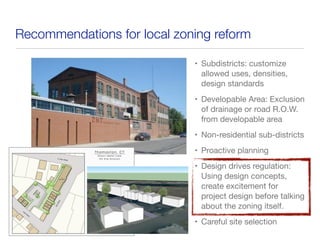
• Design drives regulation:
Using design concepts,
create excitement for project
design before talking about
the zoning itself.
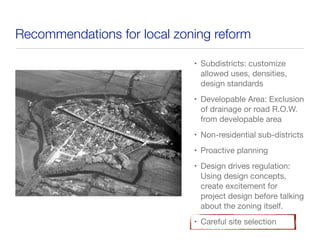
• Careful site selection
Recommendations for local zoning reform
• Subdistricts: customize
allowed uses, densities,
design standards
• Developable Area: Exclusion
of drainage or road R.O.W.
from developable area
• Non-residential sub-districts
• Proactive planning
• Design drives regulation:
Using design concepts,
create excitement for
project design before talking
about the zoning itself.
• Careful site selection
Recommendations for local zoning reform
• Subdistricts: customize
allowed uses, densities,
design standards
• Developable Area: Exclusion
of drainage or road R.O.W.
from developable area
• Non-residential sub-districts
• Proactive planning
• Design drives regulation:
Using design concepts,
create excitement for
project design before talking
about the zoning itself.
• Careful site selection
Recommendations for local zoning reform
• Subdistricts: customize
allowed uses, densities,
design standards
• Developable Area: Exclusion
of drainage or road R.O.W.
from developable area
• Non-residential sub-districts
• Proactive planning
• Design drives regulation:
Using design concepts,
create excitement for
project design before talking
about the zoning itself.
• Careful site selection
Source: Russ Preston, Principle Places
Recommendations for local zoning reform
• Subdistricts: customize
allowed uses, densities,
design standards
• Developable Area: Exclusion
of drainage or road R.O.W.
from developable area
• Non-residential sub-districts
• Proactive planning
• Design drives regulation:
Using design concepts,
create excitement for
project design before talking
about the zoning itself.
• Careful site selection
Recommendations for local zoning reform
• Subdistricts: customize
allowed uses, densities,
design standards
• Developable Area: Exclusion
of drainage or road R.O.W.
from developable area
• Non-residential sub-districts
• Proactive planning
• Design drives regulation:
Using design concepts,
create excitement for
project design before talking
about the zoning itself.
• Careful site selection
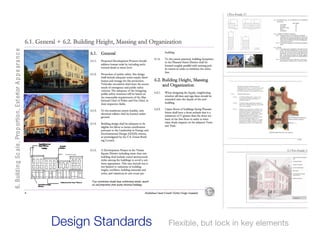
Design Standards Flexible, but lock in key elements
Grassroots processes have - in many cases - led to local
reforms. Day 1 opponents sometimes became advocates.
Prime mover sometimes Town, sometimes landowner or
developer, sometimes residents...
Successful initiatives included a clear statement of policy
intent, and regulations to achieve it.
Closing
• Massachusetts Town Meeting voters
have enacted Smart Growth Zoning -
by a 2/3 vote - in many locations
• Many more innovative zoning
amendments intended to foster
investment in village centers, through
home rule, are also on the books
• Local motivations range from proactive
to strategic / defensive; but regardless
of initial motivation, intent is to
influence private investment patterns
• Favorable zoning aligns a developer’s
interest in predictability with the public
interest of advancing a publicly
endorsed vision for the future
Angus Jennings, AICP
Principal
128 Belknap Street, Concord, MA
www.agjennings.com
agjennings@icloud.com

Density, Affordability, and Walkability through Smart Growth (40R)

  • 1.
    Density, Affordability, andWalkability through Smart Growth Zoning (40R) in Massachusetts Angus Jennings, AICP Principal Source: Kevin Lynch, Image of the City
  • 2.
    Learning from JulieCampoli’s “Made for Walking” “Many urban areas owe their revival to location. Given our car-based culture, it is difficult to create a truly walkable, human-scaled environment from scratch.. Greenfield sites, with their large, empty parcels, pose fewer restrictions. As space is allocated, the perceived demand for parking often trumps density and proximity.” Source: Julie Campoli, Made for Walking, Lincoln Institute for Land Policy, 2012
  • 3.
    Downtown Maynard A“walkable” destination 1/4 mile 1/4 mile 1/3 mile
  • 4.
    Incentive-based zoning • Structuraland perpetuating housing affordability problem due to shortage of land appropriately zoned for higher density residential; supply lagging – and misplaced • Concept: economic incentives for communities to voluntarily adopt higher density zoning in smart growth locations • Creation of “zoned land” resulting in market-driven site selection among smart growth / incentive housing zones • Out-migration of young professionals was a driving concern leading to new legislation
  • 5.
    Smart Growth Zoning:An Overview • Smart Growth Location • As-of-right permitting, subject to Design Standards • Infrastructure Certification (may be conditioned on agreed improvements) • State (DHCD) approval required before Town Meeting vote T
  • 6.
    Smart Growth Zoning:An Overview • Smart Growth Location • As-of-right permitting, subject to Design Standards • Infrastructure Certification (may be conditioned on agreed improvements) • State (DHCD) approval required before Town Meeting vote
  • 7.
    Smart Growth Zoning:An Overview • Smart Growth Location • As-of-right permitting, subject to Design Standards • Infrastructure Certification (may be conditioned on agreed improvements) • State (DHCD) approval required before Town Meeting vote
  • 8.
    Smart Growth Zoning:An Overview • Smart Growth Location • As-of-right permitting, subject to Design Standards • Infrastructure Certification (may be conditioned on agreed improvements) • State (DHCD) approval required before Town Meeting vote
  • 9.
    The Zoning Amendmentprocess in Massachusetts relies upon a substantial public process to build consensus and achieve the required 2/3 vote.
  • 10.
    Practical aspects: Tipsfor Scoping the Work • Key aspects of work: • Conceptual planning - consensus based vision for where we’re hoping to get • Mapping - district and sub- district boundaries • Density calculations • Zoning and Design Standards • Process to secure approval by DHCD • Infrastructure evaluation; planning for potential public improvements, including strategies for financing • Where applicable, execution of development agreements • Several successful Smart Growth Districts in Massachusetts have relied upon private investment for some or all of required steps
  • 11.
    Recommendations for localzoning reform • Subdistricts: customize allowed uses, densities, design standards • Developable Area: Exclusion of drainage or road R.O.W. from developable area • Non-residential sub-districts • Proactive planning • Design drives regulation: Using design concepts, create excitement for project design before talking about the zoning itself. • Careful site selection
  • 12.
    Recommendations for localzoning reform • Subdistricts: customize allowed uses, densities, design standards • Developable Area: Exclusion of drainage or road R.O.W. from developable area • Non-residential sub-districts • Proactive planning • Design drives regulation: Using design concepts, create excitement for project design before talking about the zoning itself. • Careful site selection
  • 13.
    Recommendations for localzoning reform • Subdistricts: customize allowed uses, densities, design standards • Developable Area: Exclusion of drainage or road R.O.W. from developable area • Non-residential sub-districts • Proactive planning • Design drives regulation: Using design concepts, create excitement for project design before talking about the zoning itself. • Careful site selection
  • 14.
    Recommendations for localzoning reform • Subdistricts: customize allowed uses, densities, design standards • Developable Area: Exclusion of drainage or road R.O.W. from developable area • Non-residential sub-districts • Proactive planning • Design drives regulation: Using design concepts, create excitement for project design before talking about the zoning itself. • Careful site selection Source: Russ Preston, Principle Places
  • 15.
    Recommendations for localzoning reform • Subdistricts: customize allowed uses, densities, design standards • Developable Area: Exclusion of drainage or road R.O.W. from developable area • Non-residential sub-districts • Proactive planning • Design drives regulation: Using design concepts, create excitement for project design before talking about the zoning itself. • Careful site selection
  • 16.
    Recommendations for localzoning reform • Subdistricts: customize allowed uses, densities, design standards • Developable Area: Exclusion of drainage or road R.O.W. from developable area • Non-residential sub-districts • Proactive planning • Design drives regulation: Using design concepts, create excitement for project design before talking about the zoning itself. • Careful site selection
  • 17.
    Design Standards Flexible,but lock in key elements
  • 18.
    Grassroots processes have- in many cases - led to local reforms. Day 1 opponents sometimes became advocates. Prime mover sometimes Town, sometimes landowner or developer, sometimes residents... Successful initiatives included a clear statement of policy intent, and regulations to achieve it.
  • 19.
    Closing • Massachusetts TownMeeting voters have enacted Smart Growth Zoning - by a 2/3 vote - in many locations • Many more innovative zoning amendments intended to foster investment in village centers, through home rule, are also on the books • Local motivations range from proactive to strategic / defensive; but regardless of initial motivation, intent is to influence private investment patterns • Favorable zoning aligns a developer’s interest in predictability with the public interest of advancing a publicly endorsed vision for the future Angus Jennings, AICP Principal 128 Belknap Street, Concord, MA www.agjennings.com agjennings@icloud.com