Innovation District
Vision
The vision for the Innovation District
you are about to see will be forever
evolving.
Our goal is to successfully execute
key projects over the next four
years to set the vision for the future
of the District. We want to ensure
that the momentum we all build is
sustainable and stays on course
until completion.
The first 100 years of our country's history
were about who could build the biggest,
most efficient farms.
The second 100 years were about the race
to build efficient factories.
Welcome to the third century:
This one's about ideas.
-Seth Godin
Our
motivation
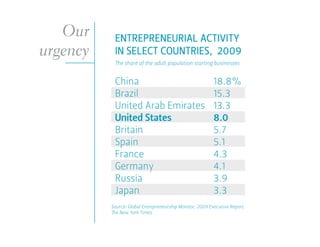
Our
urgency
Our people
… results in excess
patent growth of
approximately 9%.
Innovation comes from smart
people working together.
A 10% percent increase in
college graduates who are
retained in a given location…
40.3% of Bostonians hold Bachelor degrees
Over 80 metro-Boston colleges are educating
330,874 higher education students annually
And graduating 22,198 Master’s Degrees and
2,836 Doctoral Degrees each year.
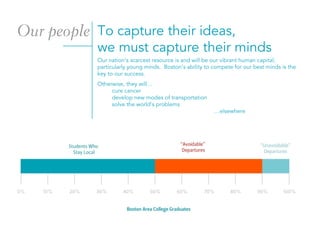
Our nation’s scarcest resource is and will be our vibrant human capital,
particularly young minds. Boston’s ability to compete for our best minds is the
key to our success.
To capture their ideas,
we must capture their minds
Otherwise, they will…
cure cancer
develop new modes of transportation
solve the world’s problems
…elsewhere
Our people
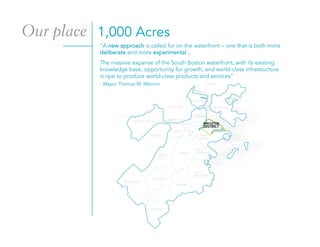
1,000 Acres
“A new approach is called for on the waterfront – one that is both more
deliberate and more experimental...
- Mayor Thomas M. Menino
The massive expanse of the South Boston waterfront, with its existing
knowledge base, opportunity for growth, and world-class infrastructure
is ripe to produce world-class products and services”
Our place
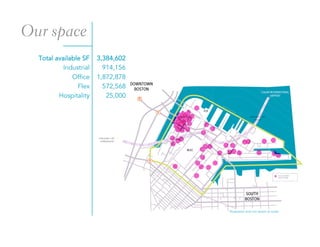
Total available SF 3,384,602
Industrial 914,156
Office 1,872,878
Flex 572,568
Hospitality 25,000
Our space
Illustration and not drawn to scale
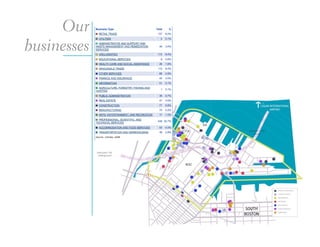
Our
businesses
Imagine a place…
… where an entrepreneur creates a new product while drinking coffee with a
friend from the nearby university. After developing her vision with the help
of local talent, the venture capitalist across the street fund’s her vision,
allowing it to become a reality. In collaboration with the anchor firm down
the street, that product is scaled and changes the face of the industry…
Our place
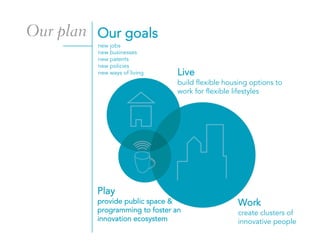
Live
build flexible housing options to
work for flexible lifestyles
Play
provide public space &
programming to foster an
innovation ecosystem
Work
create clusters of
innovative people
new jobs
new businesses
new patents
new policies
new ways of living
Our plan Our goals
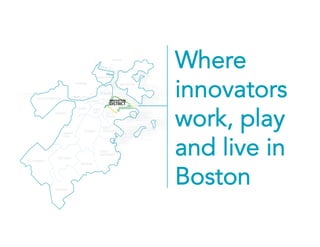
Where
innovators
work, play
and live in
Boston
Why create create
clusters of
innovative people?
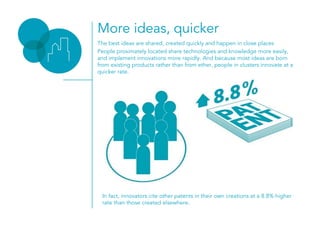
The best ideas are shared, created quickly and happen in close places
People proximately located share technologies and knowledge more easily,
and implement innovations more rapidly. And because most ideas are born
from existing products rather than from ether, people in clusters innovate at a
quicker rate.
In fact, innovators cite other patents in their own creations at a 8.8% higher
rate than those created elsewhere.
More ideas, quicker
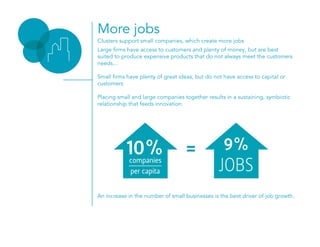
More jobs
Large firms have access to customers and plenty of money, but are best
suited to produce expensive products that do not always meet the customers
needs…
Small firms have plenty of great ideas, but do not have access to capital or
customers
Placing small and large companies together results in a sustaining, symbiotic
relationship that feeds innovation.
Clusters support small companies, which create more jobs
An increase in the number of small businesses is the best driver of job growth.
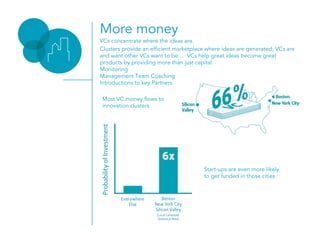
VCs concentrate where the ideas are.
Clusters provide an efficient marketplace where ideas are generated, VCs are
and want other VCs want to be… VCs help great ideas become great
products by providing more than just capital:
Monitoring
Management Team Coaching
Introductions to key Partners
More money
Most VC money flows to
innovation clusters
Start-ups are even more likely
to get funded in those cities
Why build flexible
housing options to work
for flexible lifestyles?
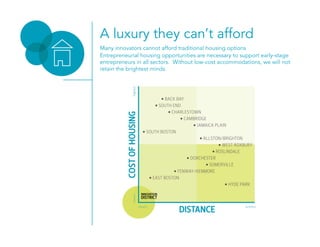
A luxury they can’t afford
Many innovators cannot afford traditional housing options
Entrepreneurial housing opportunities are necessary to support early-stage
entrepreneurs in all sectors. Without low-cost accommodations, we will not
retain the brightest minds.
Different lifestyles
We must “continue to develop [Boston’s] urban vitality, ensuring that it is the
kind of place that people from across the country, and around the world,
want to live” and offer a complete suite of options.
For the entrepreneur who is never at home because she’s at the lab all night
or developing a new program with her co-founders, an apartment near the
office would be a great solution.
Entrepreneurs are constantly moving. Gaining access to housing comes at
the cost of losing the flexibility entrepreneurial lifestyles require.
Why provide
public space and
programming to
foster an
innovation
ecosystem?
9am-5pm to 24/7
Today’s entrepreneurs do not work nine to five—they work intensely and
erratically. Much of the entrepreneur’s “work” is done outside of the
office. In fact, creative workers spend as much as half of their work
schedule out of their offices.
Whether grabbing a drink or dinner, going for a run, or relaxing in the park,
these knowledge workers are constantly exchanging information and
examining collaboration opportunities.
An abundance of collaborative venues and open spaces is critical to
fostering the creative process.
Innovators are redefining the term “day job”
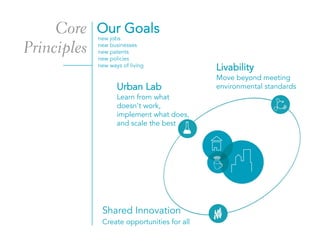
Core
Principles
Shared Innovation
Create opportunities for all
Livability
Move beyond meeting
environmental standardsUrban Lab
Learn from what
doesn’t work,
implement what does,
and scale the best
new jobs
new businesses
new patents
new policies
new ways of living
Our Goals
Urban lab
Learn from what doesn’t work, implement what does, and scale the best
Those cities that are best able to adapt to changing conditions are the
ones that thrive. Given that more educated people better adapt to a
changing environment, Boston’s highly educated workforce is perfectly
suited to lead us in the 21st century. 1
This experiment concentrates rapid prototyping and quicker iterations,
allowing our innovators to find the right answers, quicker.
The Innovation District, a concentration of talent and ideas, will harvest
key lessons for the city and where relevant, apply them.
Move beyond meeting environmental standards toward livability
Better ventilation, lighting and general environment result in increased
productivity from less sick time and greater worker productivity and increase
the value of real estate from $37 to $55 dollars per square foot.
We are well placed to lead the world in coastal zone climate change
mitigation and adaptation. We will test urgent methods and share key
practices, while creating a market for successful technologies and products.
Toward livability
Shared Innovation
For sustainable growth, there must be opportunities for all
For the Innovation District to be relevant for our entire City, the lessons
must, in part, be relevant to all people. We believe that the innovation
economy provides new opportunities to people of all backgrounds and
education levels.
One does not need a Ph.D., lab or computer to develop new products and
processes for the 21st century. We welcome the newest construction
techniques, baking recipes, and craftspeople, all of which will help create
to the Innovation District.
SLIDE 3
Seth Godin. Fast Company Unleash Your Ideavirus July 31, 2000
SLIDE 5
Edward L. Glaeser and Albert Saiz, “Rise of the Skilled City,” Harvard Institute of Economic Research Discussion Paper, 2025 (December 2003): 38-9
SLIDE 6
The Boston Consulting Group for The Boston Foundation, “Preventing a Brain Drain: Talent retention in Greater Boston?,” (October 2003): 5
MORE IDEAS, QUICKER
Edward L . Glaeser and William R. Kerr, “Local Industrial Conditions and Entrepreneurship: How Much of the Spatial Distribution Can We
Explain?,” Journal of Economics & Management Strategy 18, No. 3 (Fall 2009).
Adam B. Jaffee and Manuel Trajtenberg and Rebecca Henderson, “Geographic Localization of Knowledge Spillovers As Evidenced by Patent
Citations,” The Quarterly Journal of Economics (August 1993):594-5.
MORE JOBS
Henry Chen, Paul Gompers, Anna Kovner and Josh Lerner, “Buy Local? The Geography of successful and Unsuccessful Venture Capital Expansion,”
Harvard Business School Working Paper 09-143 (June 2009): 2.
Henry Chen, Paul Gompers, Anna Kovner and Josh Lerner, “Buy Local? The Geography of successful and Unsuccessful Venture Capital Expansion,”
Harvard Business School Working Paper 09-143 (June 2009): 16. (in relation to their local combined statistical area)
Henry Chen, Paul Gompers, Anna Kovner and Josh Lerner, “Buy Local? The Geography of successful and Unsuccessful Venture Capital Expansion,”
Harvard Business School Working Paper 09-143 (June 2009): 20-21.
Edward Glaeser and William Kerr, “What Makes A City Entrepreneurial?,” Rappaport Institute for Greater Boston and Taubman Center for State
and Local Government, Policy Briefs (Febrauary, 2010), 3.
MORE MONEY
Henry Chen, Paul Gompers, Anna Kovner and Josh Lerner, “Buy Local? The Geography of successful and Unsuccessful Venture Capital Expansion,”
Harvard Business School Working Paper 09-143 (June 2009.
LUXURY CAN’T AFFORD
Entry Level Data, provided by Salary.com
DIFFERENT NEEDS
Edward Glaeser and William Kerr, “What Makes A City Entrepreneurial?,” Rappaport Institute for Greater Boston and Taubman Center for State
and Local Government, Policy Briefs (Febrauary, 2010), 3.
Edward L. Glaeser and Albert Saiz, “Rise of the Skilled City,” Harvard Institute of Economic Research Discussion Paper, 2025 (December 2003): 25.
The difference in numbers is is a result of controlling for the initial house price in each community.
NINE TO FIVE
“Why Office Design Matters,” HBS Working Knowledge, 9/12/2005
URBAN EXPERIMENT
Edward L. Glaeser and Albert Saiz, “Rise of the Skilled City,” Harvard Institute of Economic Research Discussion Paper, 2025 (December 2003): 1-2.
Research
Boston Innovation District Vision 2010

Boston Innovation District Vision 2010

  • 1.
  • 2.
    The vision forthe Innovation District you are about to see will be forever evolving. Our goal is to successfully execute key projects over the next four years to set the vision for the future of the District. We want to ensure that the momentum we all build is sustainable and stays on course until completion.
  • 3.
    The first 100years of our country's history were about who could build the biggest, most efficient farms. The second 100 years were about the race to build efficient factories. Welcome to the third century: This one's about ideas. -Seth Godin Our motivation
  • 4.
  • 5.
    Our people … resultsin excess patent growth of approximately 9%. Innovation comes from smart people working together. A 10% percent increase in college graduates who are retained in a given location… 40.3% of Bostonians hold Bachelor degrees Over 80 metro-Boston colleges are educating 330,874 higher education students annually And graduating 22,198 Master’s Degrees and 2,836 Doctoral Degrees each year.
  • 6.
    Our nation’s scarcestresource is and will be our vibrant human capital, particularly young minds. Boston’s ability to compete for our best minds is the key to our success. To capture their ideas, we must capture their minds Otherwise, they will… cure cancer develop new modes of transportation solve the world’s problems …elsewhere Our people
  • 7.
    1,000 Acres “A newapproach is called for on the waterfront – one that is both more deliberate and more experimental... - Mayor Thomas M. Menino The massive expanse of the South Boston waterfront, with its existing knowledge base, opportunity for growth, and world-class infrastructure is ripe to produce world-class products and services” Our place
  • 9.
    Total available SF3,384,602 Industrial 914,156 Office 1,872,878 Flex 572,568 Hospitality 25,000 Our space Illustration and not drawn to scale
  • 10.
  • 11.
    Imagine a place… …where an entrepreneur creates a new product while drinking coffee with a friend from the nearby university. After developing her vision with the help of local talent, the venture capitalist across the street fund’s her vision, allowing it to become a reality. In collaboration with the anchor firm down the street, that product is scaled and changes the face of the industry… Our place
  • 12.
    Live build flexible housingoptions to work for flexible lifestyles Play provide public space & programming to foster an innovation ecosystem Work create clusters of innovative people new jobs new businesses new patents new policies new ways of living Our plan Our goals
  • 13.
  • 14.
    Why create create clustersof innovative people?
  • 15.
    The best ideasare shared, created quickly and happen in close places People proximately located share technologies and knowledge more easily, and implement innovations more rapidly. And because most ideas are born from existing products rather than from ether, people in clusters innovate at a quicker rate. In fact, innovators cite other patents in their own creations at a 8.8% higher rate than those created elsewhere. More ideas, quicker
  • 16.
    More jobs Large firmshave access to customers and plenty of money, but are best suited to produce expensive products that do not always meet the customers needs… Small firms have plenty of great ideas, but do not have access to capital or customers Placing small and large companies together results in a sustaining, symbiotic relationship that feeds innovation. Clusters support small companies, which create more jobs An increase in the number of small businesses is the best driver of job growth.
  • 17.
    VCs concentrate wherethe ideas are. Clusters provide an efficient marketplace where ideas are generated, VCs are and want other VCs want to be… VCs help great ideas become great products by providing more than just capital: Monitoring Management Team Coaching Introductions to key Partners More money Most VC money flows to innovation clusters Start-ups are even more likely to get funded in those cities
  • 18.
    Why build flexible housingoptions to work for flexible lifestyles?
  • 19.
    A luxury theycan’t afford Many innovators cannot afford traditional housing options Entrepreneurial housing opportunities are necessary to support early-stage entrepreneurs in all sectors. Without low-cost accommodations, we will not retain the brightest minds.
  • 20.
    Different lifestyles We must“continue to develop [Boston’s] urban vitality, ensuring that it is the kind of place that people from across the country, and around the world, want to live” and offer a complete suite of options. For the entrepreneur who is never at home because she’s at the lab all night or developing a new program with her co-founders, an apartment near the office would be a great solution. Entrepreneurs are constantly moving. Gaining access to housing comes at the cost of losing the flexibility entrepreneurial lifestyles require.
  • 21.
    Why provide public spaceand programming to foster an innovation ecosystem?
  • 22.
    9am-5pm to 24/7 Today’sentrepreneurs do not work nine to five—they work intensely and erratically. Much of the entrepreneur’s “work” is done outside of the office. In fact, creative workers spend as much as half of their work schedule out of their offices. Whether grabbing a drink or dinner, going for a run, or relaxing in the park, these knowledge workers are constantly exchanging information and examining collaboration opportunities. An abundance of collaborative venues and open spaces is critical to fostering the creative process. Innovators are redefining the term “day job”
  • 23.
    Core Principles Shared Innovation Create opportunitiesfor all Livability Move beyond meeting environmental standardsUrban Lab Learn from what doesn’t work, implement what does, and scale the best new jobs new businesses new patents new policies new ways of living Our Goals
  • 24.
    Urban lab Learn fromwhat doesn’t work, implement what does, and scale the best Those cities that are best able to adapt to changing conditions are the ones that thrive. Given that more educated people better adapt to a changing environment, Boston’s highly educated workforce is perfectly suited to lead us in the 21st century. 1 This experiment concentrates rapid prototyping and quicker iterations, allowing our innovators to find the right answers, quicker. The Innovation District, a concentration of talent and ideas, will harvest key lessons for the city and where relevant, apply them.
  • 25.
    Move beyond meetingenvironmental standards toward livability Better ventilation, lighting and general environment result in increased productivity from less sick time and greater worker productivity and increase the value of real estate from $37 to $55 dollars per square foot. We are well placed to lead the world in coastal zone climate change mitigation and adaptation. We will test urgent methods and share key practices, while creating a market for successful technologies and products. Toward livability
  • 26.
    Shared Innovation For sustainablegrowth, there must be opportunities for all For the Innovation District to be relevant for our entire City, the lessons must, in part, be relevant to all people. We believe that the innovation economy provides new opportunities to people of all backgrounds and education levels. One does not need a Ph.D., lab or computer to develop new products and processes for the 21st century. We welcome the newest construction techniques, baking recipes, and craftspeople, all of which will help create to the Innovation District.
  • 27.
    SLIDE 3 Seth Godin.Fast Company Unleash Your Ideavirus July 31, 2000 SLIDE 5 Edward L. Glaeser and Albert Saiz, “Rise of the Skilled City,” Harvard Institute of Economic Research Discussion Paper, 2025 (December 2003): 38-9 SLIDE 6 The Boston Consulting Group for The Boston Foundation, “Preventing a Brain Drain: Talent retention in Greater Boston?,” (October 2003): 5 MORE IDEAS, QUICKER Edward L . Glaeser and William R. Kerr, “Local Industrial Conditions and Entrepreneurship: How Much of the Spatial Distribution Can We Explain?,” Journal of Economics & Management Strategy 18, No. 3 (Fall 2009). Adam B. Jaffee and Manuel Trajtenberg and Rebecca Henderson, “Geographic Localization of Knowledge Spillovers As Evidenced by Patent Citations,” The Quarterly Journal of Economics (August 1993):594-5. MORE JOBS Henry Chen, Paul Gompers, Anna Kovner and Josh Lerner, “Buy Local? The Geography of successful and Unsuccessful Venture Capital Expansion,” Harvard Business School Working Paper 09-143 (June 2009): 2. Henry Chen, Paul Gompers, Anna Kovner and Josh Lerner, “Buy Local? The Geography of successful and Unsuccessful Venture Capital Expansion,” Harvard Business School Working Paper 09-143 (June 2009): 16. (in relation to their local combined statistical area) Henry Chen, Paul Gompers, Anna Kovner and Josh Lerner, “Buy Local? The Geography of successful and Unsuccessful Venture Capital Expansion,” Harvard Business School Working Paper 09-143 (June 2009): 20-21. Edward Glaeser and William Kerr, “What Makes A City Entrepreneurial?,” Rappaport Institute for Greater Boston and Taubman Center for State and Local Government, Policy Briefs (Febrauary, 2010), 3. MORE MONEY Henry Chen, Paul Gompers, Anna Kovner and Josh Lerner, “Buy Local? The Geography of successful and Unsuccessful Venture Capital Expansion,” Harvard Business School Working Paper 09-143 (June 2009. LUXURY CAN’T AFFORD Entry Level Data, provided by Salary.com DIFFERENT NEEDS Edward Glaeser and William Kerr, “What Makes A City Entrepreneurial?,” Rappaport Institute for Greater Boston and Taubman Center for State and Local Government, Policy Briefs (Febrauary, 2010), 3. Edward L. Glaeser and Albert Saiz, “Rise of the Skilled City,” Harvard Institute of Economic Research Discussion Paper, 2025 (December 2003): 25. The difference in numbers is is a result of controlling for the initial house price in each community. NINE TO FIVE “Why Office Design Matters,” HBS Working Knowledge, 9/12/2005 URBAN EXPERIMENT Edward L. Glaeser and Albert Saiz, “Rise of the Skilled City,” Harvard Institute of Economic Research Discussion Paper, 2025 (December 2003): 1-2. Research