“Keeping the lights on….”
How planning can help
Updated June 2015 www.pas.gov.uk
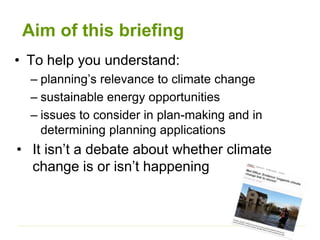
Aim of this briefing
• To help you understand:
– planning’s relevance to climate change
– sustainable energy opportunities
– issues to consider in plan-making and in
determining planning applications
• It isn’t a debate about whether climate
change is or isn’t happening
Why bother?
• Maximise economic benefits: reduce cost of buying
energy; cheaper fuel for communities
• Help meet UK commitment to reducing emissions
target
• Build in resilience to extreme weather
• Support community based development and
community rewards
• Make spatial policies and decisions that reduce
dependency of fossil fuels
• Provide green infrastructure with benefits such as
cooling, flood resilience and access to green space
and wildlife
Issues for residents?
– When can I move back home after the flood?
Will I be able to get house insurance?
– I’ve lost all my photos in the flood
– I have to drive my kids to school but petrol is
so expensive
– I can’t afford to heat my house
– I was so sick in the heat wave
– The railway line is down again
– I’m worried that sea level rise will threaten my
home.
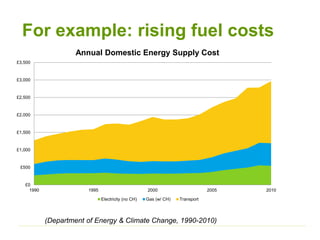
For example: rising fuel costs
£0
£500
£1,000
£1,500
£2,000
£2,500
£3,000
£3,500
1990 1995 2000 2005 2010
Annual Domestic Energy Supply Cost
Electricity (no CH) Gas (w/ CH) Transport
(Department of Energy & Climate Change, 1990-2010)
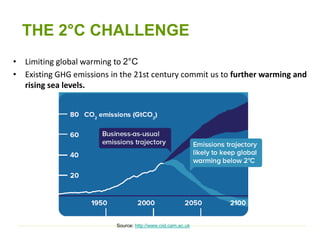
THE 2°C CHALLENGE
• Limiting global warming to 2°C
• Existing GHG emissions in the 21st century commit us to further warming and
rising sea levels.
Source: http://www.cisl.cam.ac.uk
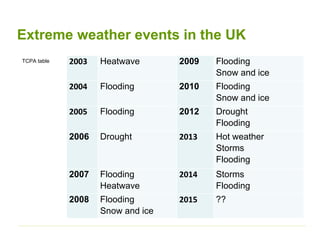
Extreme weather events in the UK
2003 Heatwave 2009 Flooding
Snow and ice
2004 Flooding 2010 Flooding
Snow and ice
2005 Flooding 2012 Drought
Flooding
2006 Drought 2013 Hot weather
Storms
Flooding
2007 Flooding
Heatwave
2014 Storms
Flooding
2008 Flooding
Snow and ice
2015 ??
TCPA table
2007 floods
• 13 deaths
• 7,000 rescued by emergency services
• 55,000 properties flooded
• Half a million people without mains
water or electricity
• £3.2 bn cost to the economy
How can planning adapt to and
mitigate against climate change?
Photo credit: telex4
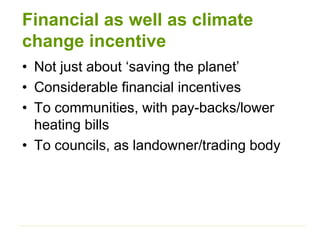
Financial as well as climate
change incentive
• Not just about ‘saving the planet’
• Considerable financial incentives
• To communities, with pay-backs/lower
heating bills
• To councils, as landowner/trading body
National policy
Planning plays a key role in
helping shape places to secure
radical reductions in
greenhouse gas emissions,
minimising vulnerability and
providing resilience to the
impacts of climate change; and
supporting the delivery of
renewable and low carbon
energy and associated
infrastructure. This is central to
the economic, social and
environmental dimensions of
sustainable development.’
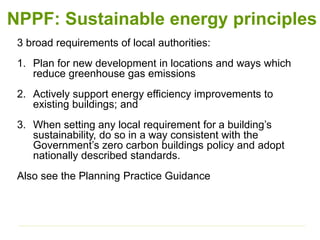
NPPF: Sustainable energy principles
3 broad requirements of local authorities:
1. Plan for new development in locations and ways which
reduce greenhouse gas emissions
2. Actively support energy efficiency improvements to
existing buildings; and
3. When setting any local requirement for a building’s
sustainability, do so in a way consistent with the
Government’s zero carbon buildings policy and adopt
nationally described standards.
Also see the Planning Practice Guidance
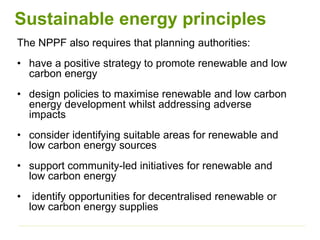
The NPPF also requires that planning authorities:
• have a positive strategy to promote renewable and low
carbon energy
• design policies to maximise renewable and low carbon
energy development whilst addressing adverse
impacts
• consider identifying suitable areas for renewable and
low carbon energy sources
• support community-led initiatives for renewable and
low carbon energy
• identify opportunities for decentralised renewable or
low carbon energy supplies
Sustainable energy principles
Deliver via local plan policies
Explore spatial and infrastructure questions such as:
• Where should new employment and housing be located?
• Can development be located to reduce travel?
• What flood defences are needed?
• Can development reduce the need for engineered drainage
infrastructure and minimise water demand?
• Can green infrastructure mitigate heat or flooding and
maximise biodiversity?
• What energy provision will we need in the future, such as
district heating schemes?
• Is there potential for new markets and supply chains as a
result of moving to a low carbon economy?
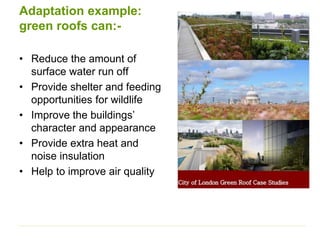
Adaptation example:
green roofs can:-
• Reduce the amount of
surface water run off
• Provide shelter and feeding
opportunities for wildlife
• Improve the buildings’
character and appearance
• Provide extra heat and
noise insulation
• Help to improve air quality
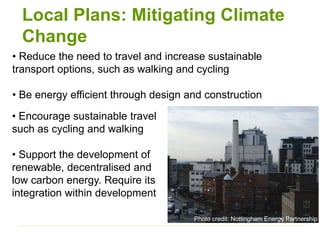
• Reduce the need to travel and increase sustainable
transport options, such as walking and cycling
• Be energy efficient through design and construction
Local Plans: Mitigating Climate
Change
Photo credit: Nottingham Energy Partnership
• Encourage sustainable travel
such as cycling and walking
• Support the development of
renewable, decentralised and
low carbon energy. Require its
integration within development
Provide guidance to developers
• Orientation, avoiding solar gain in summer
• Layout, using the natural landform, positioning of
adjacent buildings
• Cycle parking
• Waste recycling
• Sustainable drainage and landscaping (green roof)
Housing Standards Review
• Code for Sustainable Homes withdrawn
• Restriction on new and emerging local plans should not
require standards exceeding the building regulations
• Small sites (>10 houses) exempt from Allowable
Solutions payments, but not Zero Carbon homes
requirements
• Optional new national technical standards should only be
required through new Local Plan policies if they address
a clearly evidenced need
• Interim measures – apply existing standards, where
adopted policy in place. Energy Performance
requirements should not exceed outgoing Code level 4.
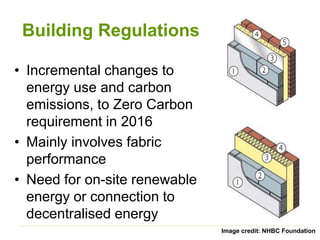
Building Regulations
• Incremental changes to
energy use and carbon
emissions, to Zero Carbon
requirement in 2016
• Mainly involves fabric
performance
• Need for on-site renewable
energy or connection to
decentralised energy
Image credit: NHBC Foundation
Photo credit: Vargklo
Zero Carbon Homes - hierarchy
1. energy efficiency: a high level of energy efficiency in
the fabric and design of the dwelling.
2. carbon compliance: a minimum level of carbon
reduction to be achieved from energy efficient fabric
and on-site technologies (including direct connection
to a heat network).
3. allowable solutions: a range of measures available
for achieving zero carbon beyond the minimum carbon
compliance requirements.
Sustainable Urban Drainage
Schemes (SUDs)
• Local planning policy and decisions on
major developments to ensure SuDS are
used, unless demonstrated inappropriate
• Current requirement to prioritise use of
SuDS for all development in areas at risk
of flooding still applies
So for an LPA
• Consult the Lead Local Flood Authority
and satisfy themselves that:
– The proposed minimum standards of
operation are appropriate
– Through planning conditions and planning
obligations that there are clear arrangements
in place for ongoing maintenance for the
lifetime of the development
– Ensure that the SuDS are designed to have
maintenance and operational requirements
which are economically proportionate.
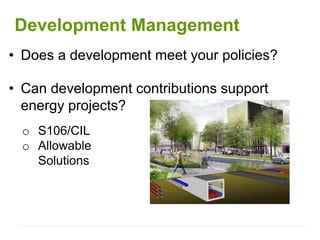
Development Management
• Does a development meet your policies?
• Can development contributions support
energy projects?
o S106/CIL
o Allowable
Solutions
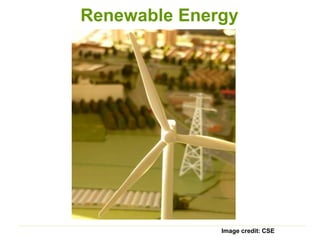
Renewable Energy
Photo credit: telex4 Image credit: CSE
Renewable Energy
The NPPF requires that local authorities:
• have a positive strategy to promote renewable
and low carbon energy
• design policies to maximise renewable and low
carbon energy development whilst addressing
adverse impacts
• consider identifying suitable areas for renewable
and low carbon energy sources
• support community-led initiatives for renewable
and low carbon energy
• identify opportunities for decentralised
renewable or low carbon energy supplies
What does renewable energy
offer?
• Job creation during construction, cheaper fuel bills,
community pride, educational opportunities, improved air
quality (eg from Combined Heat and Power projects).
• An opportunity for community ownership in the project,
and funds for community initiatives.
• Increased security of supply from a more distributed
energy system.
• Less exposure to cost fluctuations of fossil fuels.
• Biodiversity improvements with renewable energy
projects (wind and solar), eg gapping up of hedgerows
with native species, management of land to maximise
biodiversity,
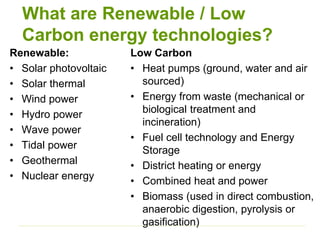
What are Renewable / Low
Carbon energy technologies?
Renewable:
• Solar photovoltaic
• Solar thermal
• Wind power
• Hydro power
• Wave power
• Tidal power
• Geothermal
• Nuclear energy
Low Carbon
• Heat pumps (ground, water and air
sourced)
• Energy from waste (mechanical or
biological treatment and
incineration)
• Fuel cell technology and Energy
Storage
• District heating or energy
• Combined heat and power
• Biomass (used in direct combustion,
anaerobic digestion, pyrolysis or
gasification)
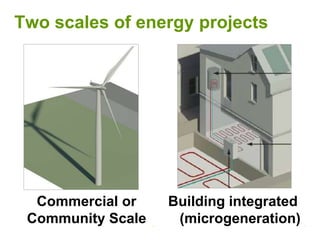
Two scales of energy projects
Commercial or
Community Scale
Building integrated
(microgeneration)
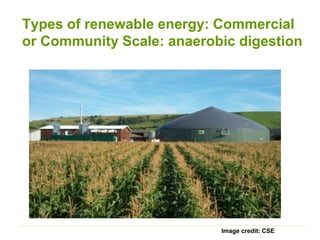
Types of renewable energy: Commercial
or Community Scale: anaerobic digestion
Image credit: CSE
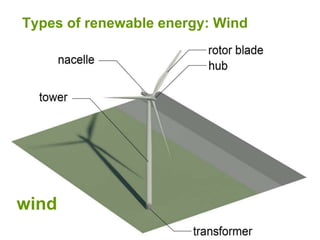
wind
Types of renewable energy: Wind
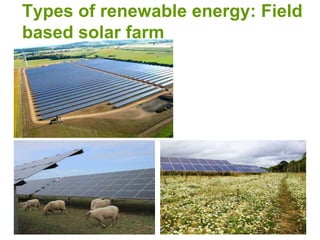
Types of renewable energy: Field
based solar farm
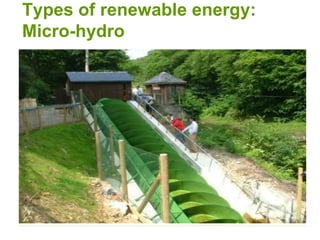
Types of renewable energy:
Micro-hydro
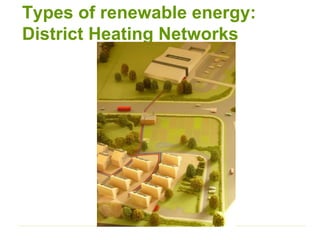
Types of renewable energy:
District Heating Networks
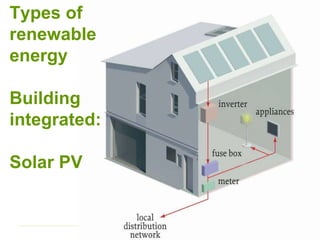
Types of
renewable
energy
Building
integrated:
Solar PV
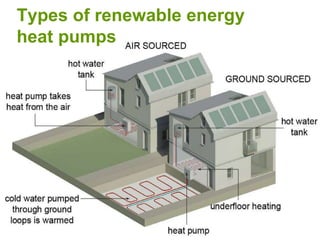
Types of renewable energy
heat pumps
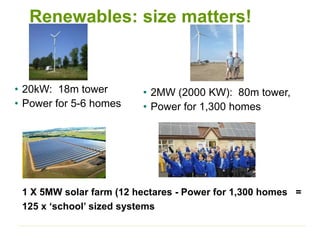
Renewables: size matters!
• 20kW: 18m tower
• Power for 5-6 homes
• 2MW (2000 KW): 80m tower,
• Power for 1,300 homes
1 X 5MW solar farm (12 hectares - Power for 1,300 homes =
125 x ‘school’ sized systems
The cost of renewable energy is
falling
• .. particularly solar energy which will soon
become competitive with electricity from the
National Grid, and to a lesser extent, wind.
• “Despite the recent drop in oil price, we expect
solar electricity to become competitive with
retail electricity in an increasing number of
markets globally due to declining solar panel
costs as well as improving financing and
customer acquisition costs.”
Deutsche Bank Market Report: Solar – Feb 2015
• Significant ambition / potential for
community generation – upper end
= enough to power 1 million homes
• LPA’s to give more weight to
positive benefits of community
energy and a step-change in the
support offered to projects
• Stresses importance of
partnerships
• New £10 million Urban Community
Energy Fund to complement
existing £15 million rural fund
Community-Led Renewable Energy
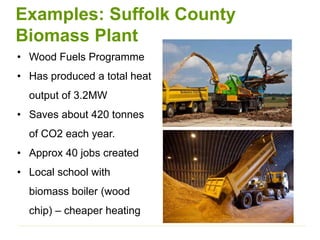
Examples: Suffolk County
Biomass Plant
• Wood Fuels Programme
• Has produced a total heat
output of 3.2MW
• Saves about 420 tonnes
of CO2 each year.
• Approx 40 jobs created
• Local school with
biomass boiler (wood
chip) – cheaper heating
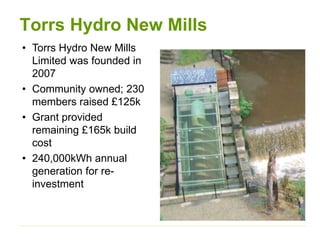
• Torrs Hydro New Mills
Limited was founded in
2007
• Community owned; 230
members raised £125k
• Grant provided
remaining £165k build
cost
• 240,000kWh annual
generation for re-
investment
Torrs Hydro New Mills
Fintry Wind Farm, (shared ownership)
• Community owned Turbine, as part of
a commercial wind farm
• Feed-in Tariff payments have funded:
• Energy advice line for residents
• Energy efficiency upgrade of
community buildings
• Installation of 91 renewable
energy installations so far,
including domestic systems at 22
properties.
• Energy efficiency grants
• Village community car club
• Community Orchard
• Draught-proofing workshops
• Fintry Renewable Energy Show! Image credit: http://www.fintrydt.org.uk/
Lessons from Germany
•It can pay!
•Since 2007 about 170 municipalities have bought
back from the grid from private companies
•Over 50% total investment in renewable energy
comes from private individuals and farmers
•650 energy cooperatives
•New income streams for councils, eg Munich
municipal ‘Cities Utility’ made profits over 200
million Euros in 2012
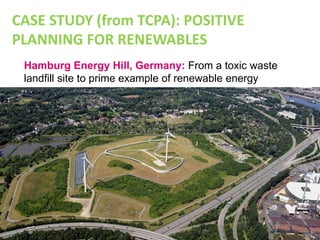
Hamburg Energy Hill, Germany: From a toxic waste
landfill site to prime example of renewable energy
generation
CASE STUDY (from TCPA): POSITIVE
PLANNING FOR RENEWABLES
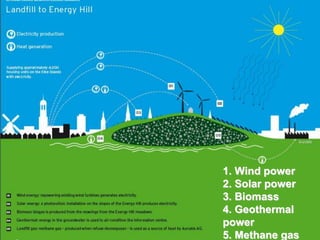
1. Wind power
2. Solar power
3. Biomass
4. Geothermal
power
5. Methane gas
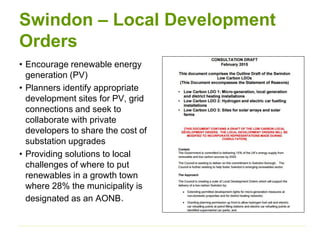
Swindon – Local Development
Orders
• Encourage renewable energy
generation (PV)
• Planners identify appropriate
development sites for PV, grid
connections and seek to
collaborate with private
developers to share the cost of
substation upgrades
• Providing solutions to local
challenges of where to put
renewables in a growth town
where 28% the municipality is
designated as an AONB.
Cornwall – renewable energy
policies .
“Community ownership of
renewable energy offers a
significant opportunity for local
communities in tackling many of
the challenges which face them
today and in the future. The
opportunities for communities to
take a share of the benefits from
renewable energy are increasing.
The SPD provides clarity for
communities who wish to bring
forward such proposals”
Renewable Energy applications
• Do you have policies supporting community-
led renewables?
• What are the environmental, landscape,
social and economic impacts of the proposal,
both positive and negative?
• Can impacts be minimised by conditions?
• Can additional mitigation make the proposals
acceptable?
• How can community benefits be secured?
Who deals with what?
• Local authorities - renewable energy projects of up to 50
megawatts and all onshore wind farms
• National Infrastructure Planning - projects larger than 50
MW (except for onshore wind) and all offshore wind
applications.
• The government announced that local communities are to
have the 'final say' on all onshore wind applications, with all
onshore wind applications to be determined locally.
• New requirements are that authorities should only grant
planning permission for onshore wind turbines if the
development site is allocated clearly for wind development
in the local/neighbourhood plan; and the proposal has the
backing of the affected local community.
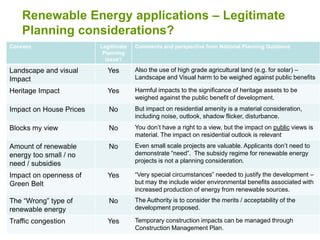
Renewable Energy applications – Legitimate
Planning considerations?
Concern Legitimate
Planning
issue?
Comments and perspective from National Planning Guidance
Landscape and visual
Impact
Yes Also the use of high grade agricultural land (e.g. for solar) –
Landscape and Visual harm to be weighed against public benefits
Heritage Impact Yes Harmful impacts to the significance of heritage assets to be
weighed against the public benefit of development.
Impact on House Prices No But impact on residential amenity is a material consideration,
including noise, outlook, shadow flicker, disturbance.
Blocks my view No You don’t have a right to a view, but the impact on public views is
material. The impact on residential outlook is relevant
Amount of renewable
energy too small / no
need / subsidies
No Even small scale projects are valuable. Applicants don’t need to
demonstrate “need”. The subsidy regime for renewable energy
projects is not a planning consideration.
Impact on openness of
Green Belt
Yes “Very special circumstances” needed to justify the development –
but may the include wider environmental benefits associated with
increased production of energy from renewable sources.
The “Wrong” type of
renewable energy
No The Authority is to consider the merits / acceptability of the
development proposed.
Traffic congestion Yes Temporary construction impacts can be managed through
Construction Management Plan.
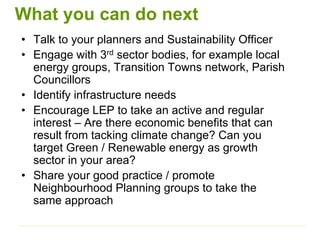
What you can do next
• Talk to your planners and Sustainability Officer
• Engage with 3rd sector bodies, for example local
energy groups, Transition Towns network, Parish
Councillors
• Identify infrastructure needs
• Encourage LEP to take an active and regular
interest – Are there economic benefits that can
result from tacking climate change? Can you
target Green / Renewable energy as growth
sector in your area?
• Share your good practice / promote
Neighbourhood Planning groups to take the
same approach
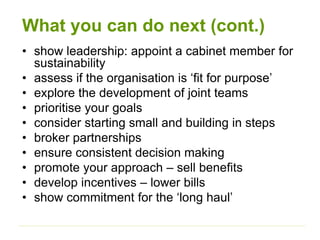
What you can do next (cont.)
• show leadership: appoint a cabinet member for
sustainability
• assess if the organisation is ‘fit for purpose’
• explore the development of joint teams
• prioritise your goals
• consider starting small and building in steps
• broker partnerships
• ensure consistent decision making
• promote your approach – sell benefits
• develop incentives – lower bills
• show commitment for the ‘long haul’
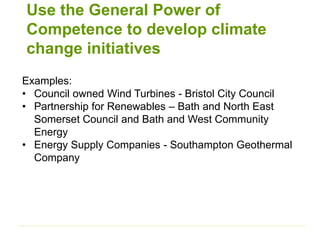
Use the General Power of
Competence to develop climate
change initiatives
Examples:
• Council owned Wind Turbines - Bristol City Council
• Partnership for Renewables – Bath and North East
Somerset Council and Bath and West Community
Energy
• Energy Supply Companies - Southampton Geothermal
Company
Conclusions
• Climate Change is the challenge for our
generation / age.
• Wholesale changes are needed to mitigate it
and adapt to it.
• The planning system is central to progress.
• Sustainability and climate change adaptation
and mitigation should be central to your Local
Plan.
PAS support
•Compare Renewables information on 8
sustainable energy technologies, 25 case
studies, introductory material to energy
issues http://www.local.gov.uk/compare-
renewables
•And TCPA led Climate Change Coalition –
guidance for local authorities
http://www.tcpa.org.uk/data/files/PCC_Gui
de_April_2012.pdf

Planning and sustainability v3

  • 1.
    “Keeping the lightson….” How planning can help Updated June 2015 www.pas.gov.uk
  • 2.
    Aim of thisbriefing • To help you understand: – planning’s relevance to climate change – sustainable energy opportunities – issues to consider in plan-making and in determining planning applications • It isn’t a debate about whether climate change is or isn’t happening
  • 3.
    Why bother? • Maximiseeconomic benefits: reduce cost of buying energy; cheaper fuel for communities • Help meet UK commitment to reducing emissions target • Build in resilience to extreme weather • Support community based development and community rewards • Make spatial policies and decisions that reduce dependency of fossil fuels • Provide green infrastructure with benefits such as cooling, flood resilience and access to green space and wildlife
  • 4.
    Issues for residents? –When can I move back home after the flood? Will I be able to get house insurance? – I’ve lost all my photos in the flood – I have to drive my kids to school but petrol is so expensive – I can’t afford to heat my house – I was so sick in the heat wave – The railway line is down again – I’m worried that sea level rise will threaten my home.
  • 5.
    For example: risingfuel costs £0 £500 £1,000 £1,500 £2,000 £2,500 £3,000 £3,500 1990 1995 2000 2005 2010 Annual Domestic Energy Supply Cost Electricity (no CH) Gas (w/ CH) Transport (Department of Energy & Climate Change, 1990-2010)
  • 6.
    THE 2°C CHALLENGE •Limiting global warming to 2°C • Existing GHG emissions in the 21st century commit us to further warming and rising sea levels. Source: http://www.cisl.cam.ac.uk
  • 7.
    Extreme weather eventsin the UK 2003 Heatwave 2009 Flooding Snow and ice 2004 Flooding 2010 Flooding Snow and ice 2005 Flooding 2012 Drought Flooding 2006 Drought 2013 Hot weather Storms Flooding 2007 Flooding Heatwave 2014 Storms Flooding 2008 Flooding Snow and ice 2015 ?? TCPA table
  • 8.
    2007 floods • 13deaths • 7,000 rescued by emergency services • 55,000 properties flooded • Half a million people without mains water or electricity • £3.2 bn cost to the economy
  • 9.
    How can planningadapt to and mitigate against climate change? Photo credit: telex4
  • 10.
    Financial as wellas climate change incentive • Not just about ‘saving the planet’ • Considerable financial incentives • To communities, with pay-backs/lower heating bills • To councils, as landowner/trading body
  • 11.
    National policy Planning playsa key role in helping shape places to secure radical reductions in greenhouse gas emissions, minimising vulnerability and providing resilience to the impacts of climate change; and supporting the delivery of renewable and low carbon energy and associated infrastructure. This is central to the economic, social and environmental dimensions of sustainable development.’
  • 12.
    NPPF: Sustainable energyprinciples 3 broad requirements of local authorities: 1. Plan for new development in locations and ways which reduce greenhouse gas emissions 2. Actively support energy efficiency improvements to existing buildings; and 3. When setting any local requirement for a building’s sustainability, do so in a way consistent with the Government’s zero carbon buildings policy and adopt nationally described standards. Also see the Planning Practice Guidance
  • 13.
    The NPPF alsorequires that planning authorities: • have a positive strategy to promote renewable and low carbon energy • design policies to maximise renewable and low carbon energy development whilst addressing adverse impacts • consider identifying suitable areas for renewable and low carbon energy sources • support community-led initiatives for renewable and low carbon energy • identify opportunities for decentralised renewable or low carbon energy supplies Sustainable energy principles
  • 14.
    Deliver via localplan policies Explore spatial and infrastructure questions such as: • Where should new employment and housing be located? • Can development be located to reduce travel? • What flood defences are needed? • Can development reduce the need for engineered drainage infrastructure and minimise water demand? • Can green infrastructure mitigate heat or flooding and maximise biodiversity? • What energy provision will we need in the future, such as district heating schemes? • Is there potential for new markets and supply chains as a result of moving to a low carbon economy?
  • 15.
    Adaptation example: green roofscan:- • Reduce the amount of surface water run off • Provide shelter and feeding opportunities for wildlife • Improve the buildings’ character and appearance • Provide extra heat and noise insulation • Help to improve air quality
  • 16.
    • Reduce theneed to travel and increase sustainable transport options, such as walking and cycling • Be energy efficient through design and construction Local Plans: Mitigating Climate Change Photo credit: Nottingham Energy Partnership • Encourage sustainable travel such as cycling and walking • Support the development of renewable, decentralised and low carbon energy. Require its integration within development
  • 17.
    Provide guidance todevelopers • Orientation, avoiding solar gain in summer • Layout, using the natural landform, positioning of adjacent buildings • Cycle parking • Waste recycling • Sustainable drainage and landscaping (green roof)
  • 18.
    Housing Standards Review •Code for Sustainable Homes withdrawn • Restriction on new and emerging local plans should not require standards exceeding the building regulations • Small sites (>10 houses) exempt from Allowable Solutions payments, but not Zero Carbon homes requirements • Optional new national technical standards should only be required through new Local Plan policies if they address a clearly evidenced need • Interim measures – apply existing standards, where adopted policy in place. Energy Performance requirements should not exceed outgoing Code level 4.
  • 19.
    Building Regulations • Incrementalchanges to energy use and carbon emissions, to Zero Carbon requirement in 2016 • Mainly involves fabric performance • Need for on-site renewable energy or connection to decentralised energy Image credit: NHBC Foundation
  • 20.
    Photo credit: Vargklo ZeroCarbon Homes - hierarchy 1. energy efficiency: a high level of energy efficiency in the fabric and design of the dwelling. 2. carbon compliance: a minimum level of carbon reduction to be achieved from energy efficient fabric and on-site technologies (including direct connection to a heat network). 3. allowable solutions: a range of measures available for achieving zero carbon beyond the minimum carbon compliance requirements.
  • 21.
    Sustainable Urban Drainage Schemes(SUDs) • Local planning policy and decisions on major developments to ensure SuDS are used, unless demonstrated inappropriate • Current requirement to prioritise use of SuDS for all development in areas at risk of flooding still applies
  • 22.
    So for anLPA • Consult the Lead Local Flood Authority and satisfy themselves that: – The proposed minimum standards of operation are appropriate – Through planning conditions and planning obligations that there are clear arrangements in place for ongoing maintenance for the lifetime of the development – Ensure that the SuDS are designed to have maintenance and operational requirements which are economically proportionate.
  • 23.
    Development Management • Doesa development meet your policies? • Can development contributions support energy projects? o S106/CIL o Allowable Solutions
  • 24.
    Renewable Energy Photo credit:telex4 Image credit: CSE
  • 25.
    Renewable Energy The NPPFrequires that local authorities: • have a positive strategy to promote renewable and low carbon energy • design policies to maximise renewable and low carbon energy development whilst addressing adverse impacts • consider identifying suitable areas for renewable and low carbon energy sources • support community-led initiatives for renewable and low carbon energy • identify opportunities for decentralised renewable or low carbon energy supplies
  • 26.
    What does renewableenergy offer? • Job creation during construction, cheaper fuel bills, community pride, educational opportunities, improved air quality (eg from Combined Heat and Power projects). • An opportunity for community ownership in the project, and funds for community initiatives. • Increased security of supply from a more distributed energy system. • Less exposure to cost fluctuations of fossil fuels. • Biodiversity improvements with renewable energy projects (wind and solar), eg gapping up of hedgerows with native species, management of land to maximise biodiversity,
  • 27.
    What are Renewable/ Low Carbon energy technologies? Renewable: • Solar photovoltaic • Solar thermal • Wind power • Hydro power • Wave power • Tidal power • Geothermal • Nuclear energy Low Carbon • Heat pumps (ground, water and air sourced) • Energy from waste (mechanical or biological treatment and incineration) • Fuel cell technology and Energy Storage • District heating or energy • Combined heat and power • Biomass (used in direct combustion, anaerobic digestion, pyrolysis or gasification)
  • 28.
    Two scales ofenergy projects Commercial or Community Scale Building integrated (microgeneration)
  • 29.
    Types of renewableenergy: Commercial or Community Scale: anaerobic digestion Image credit: CSE
  • 30.
  • 31.
    Types of renewableenergy: Field based solar farm
  • 32.
    Types of renewableenergy: Micro-hydro
  • 33.
    Types of renewableenergy: District Heating Networks
  • 34.
  • 35.
    Types of renewableenergy heat pumps
  • 36.
    Renewables: size matters! •20kW: 18m tower • Power for 5-6 homes • 2MW (2000 KW): 80m tower, • Power for 1,300 homes 1 X 5MW solar farm (12 hectares - Power for 1,300 homes = 125 x ‘school’ sized systems
  • 37.
    The cost ofrenewable energy is falling • .. particularly solar energy which will soon become competitive with electricity from the National Grid, and to a lesser extent, wind. • “Despite the recent drop in oil price, we expect solar electricity to become competitive with retail electricity in an increasing number of markets globally due to declining solar panel costs as well as improving financing and customer acquisition costs.” Deutsche Bank Market Report: Solar – Feb 2015
  • 38.
    • Significant ambition/ potential for community generation – upper end = enough to power 1 million homes • LPA’s to give more weight to positive benefits of community energy and a step-change in the support offered to projects • Stresses importance of partnerships • New £10 million Urban Community Energy Fund to complement existing £15 million rural fund Community-Led Renewable Energy
  • 39.
    Examples: Suffolk County BiomassPlant • Wood Fuels Programme • Has produced a total heat output of 3.2MW • Saves about 420 tonnes of CO2 each year. • Approx 40 jobs created • Local school with biomass boiler (wood chip) – cheaper heating
  • 40.
    • Torrs HydroNew Mills Limited was founded in 2007 • Community owned; 230 members raised £125k • Grant provided remaining £165k build cost • 240,000kWh annual generation for re- investment Torrs Hydro New Mills
  • 41.
    Fintry Wind Farm,(shared ownership) • Community owned Turbine, as part of a commercial wind farm • Feed-in Tariff payments have funded: • Energy advice line for residents • Energy efficiency upgrade of community buildings • Installation of 91 renewable energy installations so far, including domestic systems at 22 properties. • Energy efficiency grants • Village community car club • Community Orchard • Draught-proofing workshops • Fintry Renewable Energy Show! Image credit: http://www.fintrydt.org.uk/
  • 42.
    Lessons from Germany •Itcan pay! •Since 2007 about 170 municipalities have bought back from the grid from private companies •Over 50% total investment in renewable energy comes from private individuals and farmers •650 energy cooperatives •New income streams for councils, eg Munich municipal ‘Cities Utility’ made profits over 200 million Euros in 2012
  • 43.
    Hamburg Energy Hill,Germany: From a toxic waste landfill site to prime example of renewable energy generation CASE STUDY (from TCPA): POSITIVE PLANNING FOR RENEWABLES
  • 44.
    1. Wind power 2.Solar power 3. Biomass 4. Geothermal power 5. Methane gas
  • 45.
    Swindon – LocalDevelopment Orders • Encourage renewable energy generation (PV) • Planners identify appropriate development sites for PV, grid connections and seek to collaborate with private developers to share the cost of substation upgrades • Providing solutions to local challenges of where to put renewables in a growth town where 28% the municipality is designated as an AONB.
  • 46.
    Cornwall – renewableenergy policies . “Community ownership of renewable energy offers a significant opportunity for local communities in tackling many of the challenges which face them today and in the future. The opportunities for communities to take a share of the benefits from renewable energy are increasing. The SPD provides clarity for communities who wish to bring forward such proposals”
  • 47.
    Renewable Energy applications •Do you have policies supporting community- led renewables? • What are the environmental, landscape, social and economic impacts of the proposal, both positive and negative? • Can impacts be minimised by conditions? • Can additional mitigation make the proposals acceptable? • How can community benefits be secured?
  • 48.
    Who deals withwhat? • Local authorities - renewable energy projects of up to 50 megawatts and all onshore wind farms • National Infrastructure Planning - projects larger than 50 MW (except for onshore wind) and all offshore wind applications. • The government announced that local communities are to have the 'final say' on all onshore wind applications, with all onshore wind applications to be determined locally. • New requirements are that authorities should only grant planning permission for onshore wind turbines if the development site is allocated clearly for wind development in the local/neighbourhood plan; and the proposal has the backing of the affected local community.
  • 49.
    Renewable Energy applications– Legitimate Planning considerations? Concern Legitimate Planning issue? Comments and perspective from National Planning Guidance Landscape and visual Impact Yes Also the use of high grade agricultural land (e.g. for solar) – Landscape and Visual harm to be weighed against public benefits Heritage Impact Yes Harmful impacts to the significance of heritage assets to be weighed against the public benefit of development. Impact on House Prices No But impact on residential amenity is a material consideration, including noise, outlook, shadow flicker, disturbance. Blocks my view No You don’t have a right to a view, but the impact on public views is material. The impact on residential outlook is relevant Amount of renewable energy too small / no need / subsidies No Even small scale projects are valuable. Applicants don’t need to demonstrate “need”. The subsidy regime for renewable energy projects is not a planning consideration. Impact on openness of Green Belt Yes “Very special circumstances” needed to justify the development – but may the include wider environmental benefits associated with increased production of energy from renewable sources. The “Wrong” type of renewable energy No The Authority is to consider the merits / acceptability of the development proposed. Traffic congestion Yes Temporary construction impacts can be managed through Construction Management Plan.
  • 50.
    What you cando next • Talk to your planners and Sustainability Officer • Engage with 3rd sector bodies, for example local energy groups, Transition Towns network, Parish Councillors • Identify infrastructure needs • Encourage LEP to take an active and regular interest – Are there economic benefits that can result from tacking climate change? Can you target Green / Renewable energy as growth sector in your area? • Share your good practice / promote Neighbourhood Planning groups to take the same approach
  • 51.
    What you cando next (cont.) • show leadership: appoint a cabinet member for sustainability • assess if the organisation is ‘fit for purpose’ • explore the development of joint teams • prioritise your goals • consider starting small and building in steps • broker partnerships • ensure consistent decision making • promote your approach – sell benefits • develop incentives – lower bills • show commitment for the ‘long haul’
  • 52.
    Use the GeneralPower of Competence to develop climate change initiatives Examples: • Council owned Wind Turbines - Bristol City Council • Partnership for Renewables – Bath and North East Somerset Council and Bath and West Community Energy • Energy Supply Companies - Southampton Geothermal Company
  • 53.
    Conclusions • Climate Changeis the challenge for our generation / age. • Wholesale changes are needed to mitigate it and adapt to it. • The planning system is central to progress. • Sustainability and climate change adaptation and mitigation should be central to your Local Plan.
  • 54.
    PAS support •Compare Renewablesinformation on 8 sustainable energy technologies, 25 case studies, introductory material to energy issues http://www.local.gov.uk/compare- renewables •And TCPA led Climate Change Coalition – guidance for local authorities http://www.tcpa.org.uk/data/files/PCC_Gui de_April_2012.pdf