Delivering Sustainable, Livable CommunitiesSupporting the USDOT-HUD-EPA Partnership
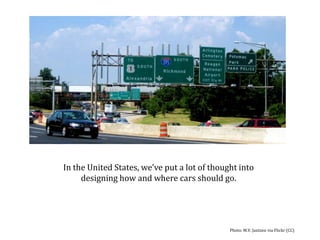
In the United States, a lot of thought goes into designing how and where cars should go.  Photo: M.VJantzen via Flickr (CC)
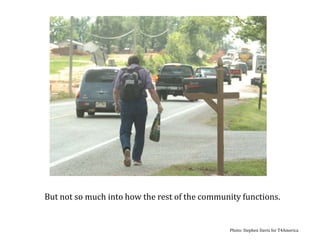
But not so much into how the rest of the community functions.Photo: Stephen Davis for T4America
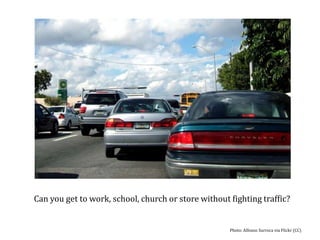
Can you get to work, school, church or store without fighting traffic?Photo: Alfonso Surroca via Flickr (CC)
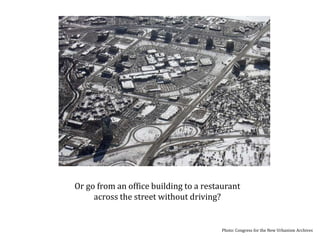
Or even cross the street from an office building to a restaurant without driving? Photo: Oak Brook, Illinois, Congress for the New Urbanism Archives
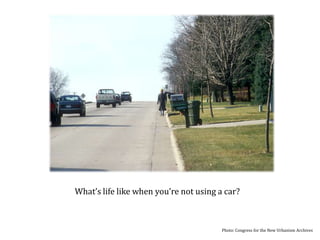
What’s life like when you’re not using a car?Photo: Congress for the New Urbanism Archives
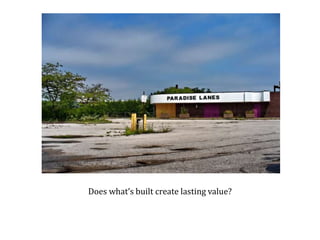
Does what’s built create lasting value?
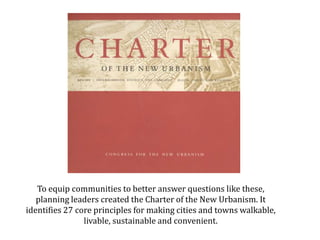
To equip communities with better solutions, planning leaders created the Charter of the New Urbanism. It identifies 27 core principles for making cities and towns walkable, livable, sustainable and convenient.
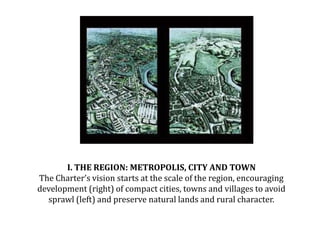
I. THE REGION: METROPOLIS, CITY AND TOWNThe Charter’s vision starts at the scale of the region, encouraging development (right) of compact cities, towns and villages to avoid sprawl (left) and to preserve natural lands and rural character. Image: The Neighborhood Model,  Albemarle County, Virginia
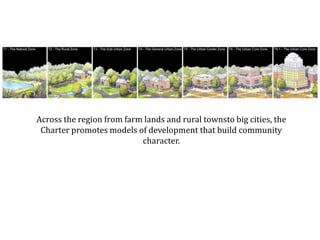
Across the region from farm lands and rural towns to big cities, the Charter promotes models of development that build community character and value.  Image: Transect diagram for Fayetteville, Arkansas
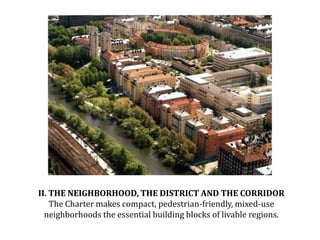
II. THE NEIGHBORHOOD, THE DISTRICT AND THE CORRIDORThe Charter makes compact, pedestrian-friendly, mixed-use neighborhoods the essential building blocks of livable regions.  Image: Sankt Erik infill development, Stockholm
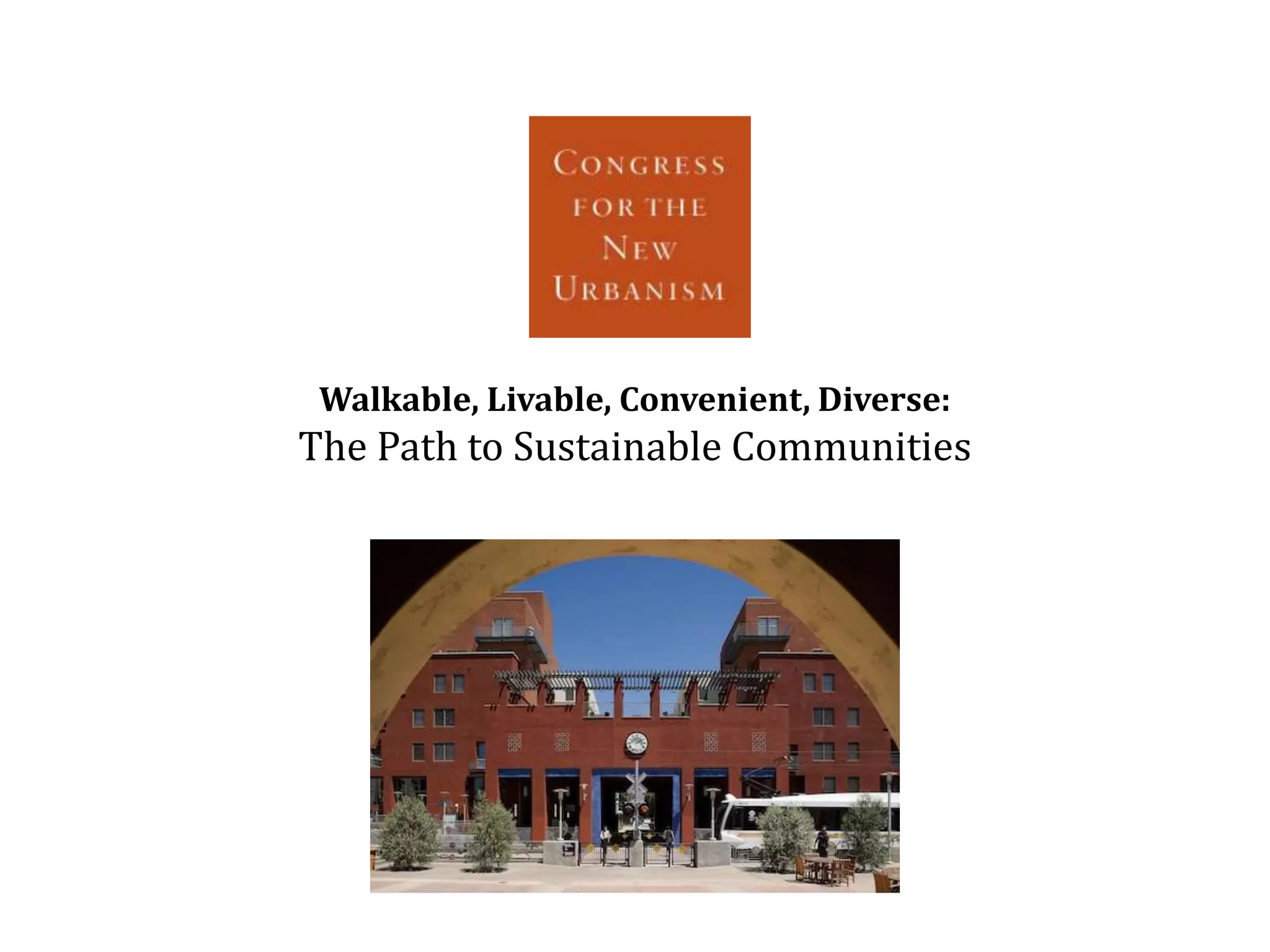
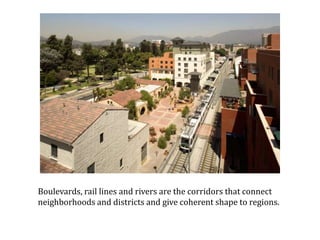
Boulevards, rail lines and rivers are the corridors that connect neighborhoods and districts and give coherent shape to regions.   Image: Del Mar Transit Village, Pasadena, CA, photo by Tom Bonner
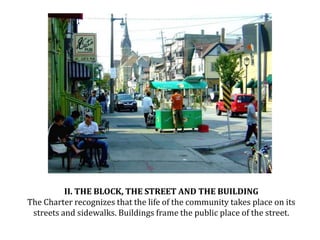
II. THE BLOCK, THE STREET AND THE BUILDINGThe Charter recognizes that the life of the community takes place on its streets and sidewalks. Buildings frame the public place of the street.Image: Brady Street, Milwaukee, CNU
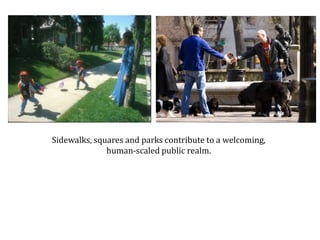
Sidewalks, squares and parks contribute to a welcoming, human-scaled public realm.
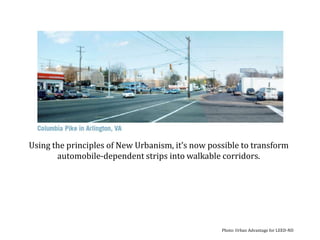
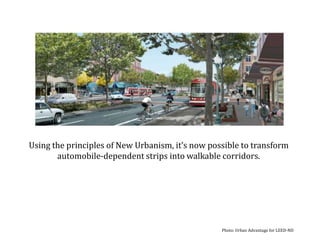
Using the principles of New Urbanism, it’s now possible to transformautomobile-dependent strips into walkable corridors. Photo: Urban Advantage for LEED-ND
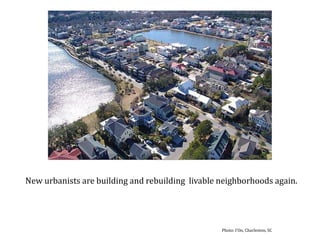
New urbanists are building and rebuilding  livable neighborhoods again.Photo: I’On, Charleston, SC
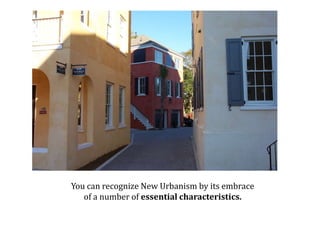
You can recognize New Urbanism by its embrace of a half-dozen essential characteristics. Image: Kentlands in Gaithersburg, Maryland
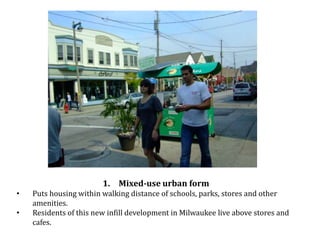
Mixed-use urban formPuts housing within walking distance of schools, parks, stores and other amenities.
Residents of the new infill development in Milwaukee (background) live above stores and cafes. Image: The Passeggio, Brady Street, Milwaukee
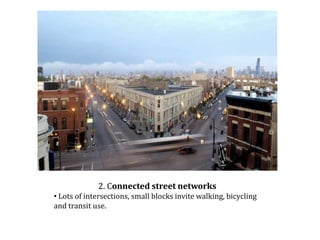
2. Connected street networks Lots of intersections, small blocks invite walking, bicycling and transit use. Image: Wicker Park, Chicago
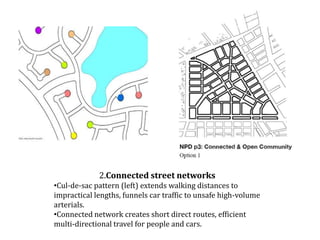
2. Connected street networks Cul-de-sac pattern (left) extends walking distances to impractical lengths, funnels car traffic to unsafe high-volume arterials.
Connected network creates short direct routes, efficient multi-directional travel for people and cars.Images:  Keep Houston Houston (l), LEED for Neighborhood Development (r)
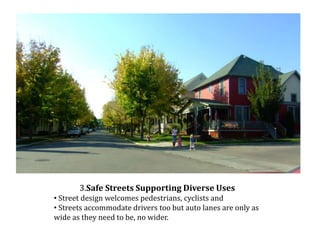
3. Safe streets supporting diverse uses Street design welcomes pedestrians and cyclists.
 Streets accommodate drivers too but auto lanes are only as wide as they need to be, no wider.  Image: Prospect New Town,Longmont, Colorado
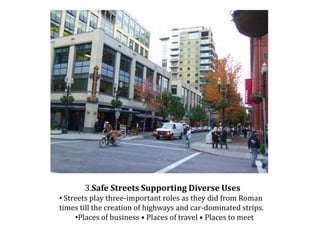
3. Safe streets that multi-task Streets play three-important roles as they did from Roman times till the creation of highways and car-dominated strips.Places of business • Places of travel • Places to meet   Image: Pearl District, Portland, Oregon
4. Livable residential density Enough nearby households to support vibrant retail & good transit service
 Ample squares and parks enhance livability Image: Chatham Square, Alexandria, Virginia; photo by Boris Feldbluym
5. Human-Scale Design  Doors and windows greet pedestrians and enhance vitality of streets.
 Blank walls and surface parking lots are avoided.
 Buildings gracefully frame public spaces.   Image: Rockville Town Square, Rockville, Maryland
5.  Human-Scale Design Architecture engages those experiencing place on foot (left).
Sprawl is designed to be experienced at 40 miles per hour (right).Images: Soleil Court, San Diego; Orlando Sprawl via EPA Smart Growth
6. A Range of Housing Types Urban neighborhoods accommodate an array of housing — lofts, townhouses, homes, cottages, garage apartments — to serve diverse populations across a range of ages.
This project in Montgomery, Alabama features apartments over stores (left) and cottage homes (right).Image: A&P Development, Montgomery, AL
These neighborhoods have many benefits. People walk more, bike more and lead more active and healthy lives with lower carbon footprints. They have more places to come together as friends and neighbors. Photo: The Cap, Columbus, Ohio; Larry Hammill Photography
Connected networks of walkable streets have been shown to dramatically lower traffic injury and fatality rates. And they speed emergency response times and help cities safely provide emergency services at reduced cost. In Charlotte, the city serves almost five times as many households per station in its most connected neighborhoods than in its most sprawling areas, at an annual cost of $159 per person versus $740.   Photo: Lake Oswego, Oregon; courtesy of Dan Burden
Unfortunately,  zoning regulations and transportation practices in many parts of the country make it impossible or illegal to develop sustainable communities.The Congress for the New Urbanism has tools and reforms to help overcome these barriers.   Photo: Brookline, Massachusetts; via Flickr byAbby Ladybug
Form-based codes replace the conventional separate-use zoning codesthat spread housing from jobs, shops, schools and other uses, inducing sprawl.In 2009, Miami became the largest city to replace its sprawl zoning code with a new urbanist form-based code.
CNU partnered to create the nation’s first rating system for green neighborhood development.Under LEED-ND, sustainable communities incorporate efficient green buildings, smart locationsand the urban design principles of New Urbanism.
LEED-ND is now certifying green neighborhoods and providing standards to shapesustainable communities everywhere. To qualify as green, developments must have a residential density of at least 9 units per acre, the lowest at which transit service can be maintained.  And projects get additional credits for higher densities. Similarly, cul-de-sac developments cannot meet the green standard. Developments must have connected street networks with at least 140 intersections per square mile to meet the green standard. Pictured above, after being transformed from a shopping mall to a mixed-use neighborhood, Belmar meets the connectivity standard. Read more about LEED-ND prerequisites and credits at cnu.org/leed-nd.
Another major partnership, this one with the Institute of Transportation Engineers, has created a much-needed manual with design guidelines for context-sensitive urbanthoroughfares — avenues and boulevards — as alternatives to standard high-volume, automobile-dominated arterial streets.
In the CNU-ITE guide, thoroughfare design changes as context changes. The thoroughfareboth responds to and shapes the context and helps to define the place.
All of the roadway elements are designed in relation to the pedestrian realm, areas where bicycle and transit use are priorities and the nearby buildings that frame the public space of the street. These thoroughfares create a strong sense of place.
Is your community at a crossroads about how to grow?
If you accept the status quo, you’ll have cul-de-sac subdivisionsfeeding widely spaced arterial streets.

CNU Sustainable Communities

  • 1.
    Delivering Sustainable, LivableCommunitiesSupporting the USDOT-HUD-EPA Partnership
  • 2.
    In the UnitedStates, a lot of thought goes into designing how and where cars should go. Photo: M.VJantzen via Flickr (CC)
  • 3.
    But not somuch into how the rest of the community functions.Photo: Stephen Davis for T4America
  • 4.
    Can you getto work, school, church or store without fighting traffic?Photo: Alfonso Surroca via Flickr (CC)
  • 5.
    Or even crossthe street from an office building to a restaurant without driving? Photo: Oak Brook, Illinois, Congress for the New Urbanism Archives
  • 6.
    What’s life likewhen you’re not using a car?Photo: Congress for the New Urbanism Archives
  • 7.
    Does what’s builtcreate lasting value?
  • 8.
    To equip communitieswith better solutions, planning leaders created the Charter of the New Urbanism. It identifies 27 core principles for making cities and towns walkable, livable, sustainable and convenient.
  • 9.
    I. THE REGION:METROPOLIS, CITY AND TOWNThe Charter’s vision starts at the scale of the region, encouraging development (right) of compact cities, towns and villages to avoid sprawl (left) and to preserve natural lands and rural character. Image: The Neighborhood Model, Albemarle County, Virginia
  • 10.
    Across the regionfrom farm lands and rural towns to big cities, the Charter promotes models of development that build community character and value. Image: Transect diagram for Fayetteville, Arkansas
  • 11.
    II. THE NEIGHBORHOOD,THE DISTRICT AND THE CORRIDORThe Charter makes compact, pedestrian-friendly, mixed-use neighborhoods the essential building blocks of livable regions. Image: Sankt Erik infill development, Stockholm
  • 12.
    Boulevards, rail linesand rivers are the corridors that connect neighborhoods and districts and give coherent shape to regions. Image: Del Mar Transit Village, Pasadena, CA, photo by Tom Bonner
  • 13.
    II. THE BLOCK,THE STREET AND THE BUILDINGThe Charter recognizes that the life of the community takes place on its streets and sidewalks. Buildings frame the public place of the street.Image: Brady Street, Milwaukee, CNU
  • 14.
    Sidewalks, squares andparks contribute to a welcoming, human-scaled public realm.
  • 15.
    Using the principlesof New Urbanism, it’s now possible to transformautomobile-dependent strips into walkable corridors. Photo: Urban Advantage for LEED-ND
  • 16.
    Using the principlesof New Urbanism, it’s now possible to transformautomobile-dependent strips into walkable corridors. Photo: Urban Advantage for LEED-ND
  • 17.
    New urbanists arebuilding and rebuilding livable neighborhoods again.Photo: I’On, Charleston, SC
  • 18.
    You can recognizeNew Urbanism by its embrace of a half-dozen essential characteristics. Image: Kentlands in Gaithersburg, Maryland
  • 19.
    Mixed-use urban formPutshousing within walking distance of schools, parks, stores and other amenities.
  • 20.
    Residents of thenew infill development in Milwaukee (background) live above stores and cafes. Image: The Passeggio, Brady Street, Milwaukee
  • 21.
    2. Connected streetnetworks Lots of intersections, small blocks invite walking, bicycling and transit use. Image: Wicker Park, Chicago
  • 22.
    2. Connected streetnetworks Cul-de-sac pattern (left) extends walking distances to impractical lengths, funnels car traffic to unsafe high-volume arterials.
  • 23.
    Connected network createsshort direct routes, efficient multi-directional travel for people and cars.Images: Keep Houston Houston (l), LEED for Neighborhood Development (r)
  • 24.
    3. Safe streetssupporting diverse uses Street design welcomes pedestrians and cyclists.
  • 25.
    Streets accommodatedrivers too but auto lanes are only as wide as they need to be, no wider. Image: Prospect New Town,Longmont, Colorado
  • 26.
    3. Safe streetsthat multi-task Streets play three-important roles as they did from Roman times till the creation of highways and car-dominated strips.Places of business • Places of travel • Places to meet Image: Pearl District, Portland, Oregon
  • 27.
    4. Livable residentialdensity Enough nearby households to support vibrant retail & good transit service
  • 28.
    Ample squaresand parks enhance livability Image: Chatham Square, Alexandria, Virginia; photo by Boris Feldbluym
  • 29.
    5. Human-Scale Design Doors and windows greet pedestrians and enhance vitality of streets.
  • 30.
    Blank wallsand surface parking lots are avoided.
  • 31.
    Buildings gracefullyframe public spaces. Image: Rockville Town Square, Rockville, Maryland
  • 32.
    5. Human-ScaleDesign Architecture engages those experiencing place on foot (left).
  • 33.
    Sprawl is designedto be experienced at 40 miles per hour (right).Images: Soleil Court, San Diego; Orlando Sprawl via EPA Smart Growth
  • 34.
    6. A Rangeof Housing Types Urban neighborhoods accommodate an array of housing — lofts, townhouses, homes, cottages, garage apartments — to serve diverse populations across a range of ages.
  • 35.
    This project inMontgomery, Alabama features apartments over stores (left) and cottage homes (right).Image: A&P Development, Montgomery, AL
  • 36.
    These neighborhoods havemany benefits. People walk more, bike more and lead more active and healthy lives with lower carbon footprints. They have more places to come together as friends and neighbors. Photo: The Cap, Columbus, Ohio; Larry Hammill Photography
  • 37.
    Connected networks ofwalkable streets have been shown to dramatically lower traffic injury and fatality rates. And they speed emergency response times and help cities safely provide emergency services at reduced cost. In Charlotte, the city serves almost five times as many households per station in its most connected neighborhoods than in its most sprawling areas, at an annual cost of $159 per person versus $740. Photo: Lake Oswego, Oregon; courtesy of Dan Burden
  • 38.
    Unfortunately, zoningregulations and transportation practices in many parts of the country make it impossible or illegal to develop sustainable communities.The Congress for the New Urbanism has tools and reforms to help overcome these barriers. Photo: Brookline, Massachusetts; via Flickr byAbby Ladybug
  • 39.
    Form-based codes replacethe conventional separate-use zoning codesthat spread housing from jobs, shops, schools and other uses, inducing sprawl.In 2009, Miami became the largest city to replace its sprawl zoning code with a new urbanist form-based code.
  • 40.
    CNU partnered tocreate the nation’s first rating system for green neighborhood development.Under LEED-ND, sustainable communities incorporate efficient green buildings, smart locationsand the urban design principles of New Urbanism.
  • 41.
    LEED-ND is nowcertifying green neighborhoods and providing standards to shapesustainable communities everywhere. To qualify as green, developments must have a residential density of at least 9 units per acre, the lowest at which transit service can be maintained. And projects get additional credits for higher densities. Similarly, cul-de-sac developments cannot meet the green standard. Developments must have connected street networks with at least 140 intersections per square mile to meet the green standard. Pictured above, after being transformed from a shopping mall to a mixed-use neighborhood, Belmar meets the connectivity standard. Read more about LEED-ND prerequisites and credits at cnu.org/leed-nd.
  • 42.
    Another major partnership,this one with the Institute of Transportation Engineers, has created a much-needed manual with design guidelines for context-sensitive urbanthoroughfares — avenues and boulevards — as alternatives to standard high-volume, automobile-dominated arterial streets.
  • 43.
    In the CNU-ITEguide, thoroughfare design changes as context changes. The thoroughfareboth responds to and shapes the context and helps to define the place.
  • 44.
    All of theroadway elements are designed in relation to the pedestrian realm, areas where bicycle and transit use are priorities and the nearby buildings that frame the public space of the street. These thoroughfares create a strong sense of place.
  • 45.
    Is your communityat a crossroads about how to grow?
  • 46.
    If you acceptthe status quo, you’ll have cul-de-sac subdivisionsfeeding widely spaced arterial streets.
  • 47.
    coAs this patternof development spreads, pressure grows to widen thearterials so they accommodate more car traffic and become less safe for pedestrians and cyclists.
  • 48.
    Your community willlikely wind up like this, a better place for cars than for people.Photo: Northbrook, Illinois; courtesy of EPA Smart Growth
  • 49.
    Or you mayuse CNU’s tools for context-sensitive streets and networks…
  • 50.
    …and create theframework for a sustainable community.
  • 51.
    Like this.Photo: GlenwoodPark, Atlanta, Georgia
  • 52.
    Using this rangeof tools and resources, it’s now possibleto transform a completely automobile-oriented area such as Crystal City in Arlington, Virginia…Photo: Crystal City, Arlington, Virginia (current condition)
  • 53.
    …into a valuablelivable community as Crystal City’s principal owner and the municipal government in Arlington now plan to do.
  • 54.
    Join us inthe revival of sustainable communities. Visit cnu.org.

Editor's Notes

  • #16 …into this instead. Here, in this visualization, Urban Advantage shows an economically strong, vibrant streetscape, complete with many modes of transportation and an obvious character and charm. Communities like this are what LEED-ND is all about. [Presenter note: it may be helpful to flip back and forth to show different elements of the image changing.]
  • #17 …into this instead. Here, in this visualization, Urban Advantage shows an economically strong, vibrant streetscape, complete with many modes of transportation and an obvious character and charm. Communities like this are what LEED-ND is all about. [Presenter note: it may be helpful to flip back and forth to show different elements of the image changing.]
  • #33 The LEED for Neighborhood Development (LEED-ND) rating system is the result of a partnership between the U.S. Green Building Council (USGBC), the Natural Resources Defense Council (NRDC), and the Congress for the New Urbanism (CNU). First conceived in 2002, the rating system integrates the principles of smart growth, New Urbanism, and green building into the first national standard for green neighborhood development.