Mansionization
Lexington's Experience
Mansionization
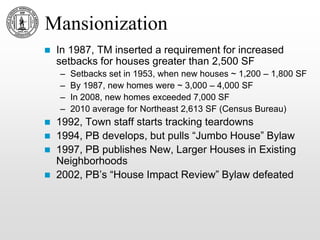
 In 1987, TM inserted a requirement for increased
setbacks for houses greater than 2,500 SF
– Setbacks set in 1953, when new houses ~ 1,200 – 1,800 SF
– By 1987, new homes were ~ 3,000 – 4,000 SF
– In 2008, new homes exceeded 7,000 SF
– 2010 average for Northeast 2,613 SF (Census Bureau)
 1992, Town staff starts tracking teardowns
 1994, PB develops, but pulls “Jumbo House” Bylaw
 1997, PB publishes New, Larger Houses in Existing
Neighborhoods
 2002, PB’s “House Impact Review” Bylaw defeated
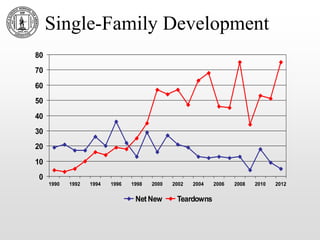
Single-Family Development
0
10
20
30
40
50
60
70
80
1990 1992 1994 1996 1998 2000 2002 2004 2006 2008 2010 2012
Net New Teardowns
Conflict & Resentment
 Character (Scale & Aesthetics)
 Diminished Economic Diversity
 Loss of affordable housing
 Anti-development
Potential Positive Effects
 Increased property values
 Encourages and increases viability of
further development
 Increases consumer purchasing power
at local businesses
 Invisible to MGL 40B denominator
Unclear Effects
 Reduction of suburban sprawl
elsewhere in the region
 Increased/decreased incentive to
invest in existing housing stock
 Costs/changes to local services
 Population increased/decreased
 Increased/decreased diversity
Conclusion
 Fiscally beneficial
 Driven by high property values
 Related to our proximity to build out
– This magnifies character issues, because
it’s happening in developed areas
 Town Meeting has been ambivalent, but
 Stirs up enough interest to keep it on a
slow boil
– Focus now turning to Residential FARs

Mansionization: Lexington's Experience

  • 1.
  • 2.
    Mansionization  In 1987,TM inserted a requirement for increased setbacks for houses greater than 2,500 SF – Setbacks set in 1953, when new houses ~ 1,200 – 1,800 SF – By 1987, new homes were ~ 3,000 – 4,000 SF – In 2008, new homes exceeded 7,000 SF – 2010 average for Northeast 2,613 SF (Census Bureau)  1992, Town staff starts tracking teardowns  1994, PB develops, but pulls “Jumbo House” Bylaw  1997, PB publishes New, Larger Houses in Existing Neighborhoods  2002, PB’s “House Impact Review” Bylaw defeated
  • 3.
    Single-Family Development 0 10 20 30 40 50 60 70 80 1990 19921994 1996 1998 2000 2002 2004 2006 2008 2010 2012 Net New Teardowns
  • 4.
    Conflict & Resentment Character (Scale & Aesthetics)  Diminished Economic Diversity  Loss of affordable housing  Anti-development
  • 5.
    Potential Positive Effects Increased property values  Encourages and increases viability of further development  Increases consumer purchasing power at local businesses  Invisible to MGL 40B denominator
  • 6.
    Unclear Effects  Reductionof suburban sprawl elsewhere in the region  Increased/decreased incentive to invest in existing housing stock  Costs/changes to local services  Population increased/decreased  Increased/decreased diversity
  • 7.
    Conclusion  Fiscally beneficial Driven by high property values  Related to our proximity to build out – This magnifies character issues, because it’s happening in developed areas  Town Meeting has been ambivalent, but  Stirs up enough interest to keep it on a slow boil – Focus now turning to Residential FARs