Linking Economic
Development
& Social Equity. . .
. . . THROUGH BETTER ZONING
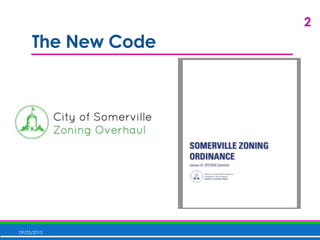
The New Code
09/25/2015
2
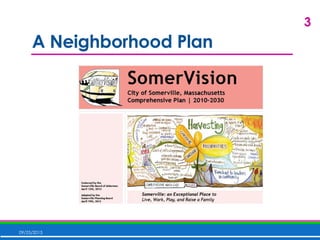
A Neighborhood Plan
09/25/2015
3
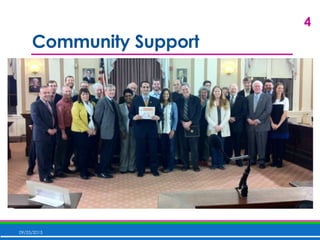
Community Support
09/25/2015
4
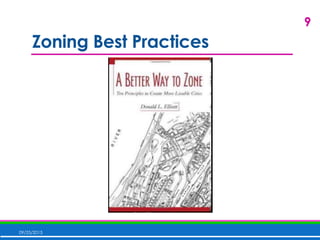
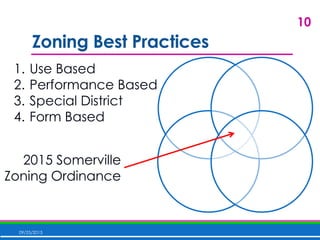
Zoning Best Practices
09/25/2015
9
Zoning Best Practices
09/25/2015
10
1. Use Based
2. Performance Based
3. Special District
4. Form Based
2015 Somerville
Zoning Ordinance
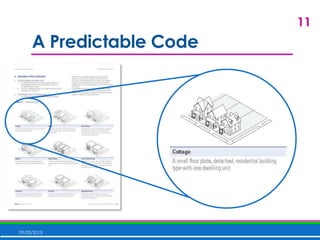
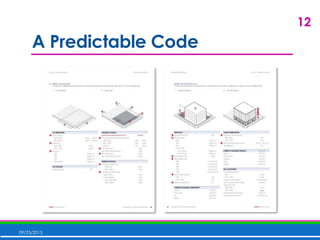
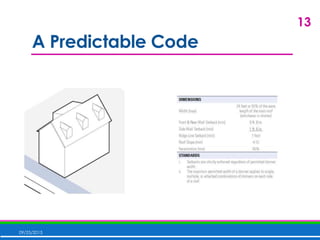
A Predictable Code
09/25/2015
11
A Predictable Code
09/25/2015
12
A Predictable Code
09/25/2015
13
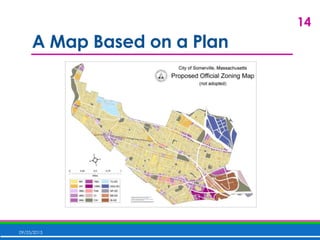
A Map Based on a Plan
09/25/2015
14
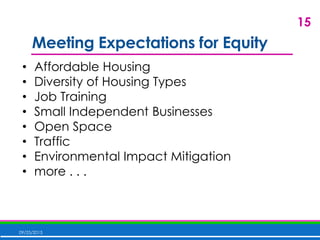
Meeting Expectations for Equity
09/25/2015
15
• Affordable Housing
• Diversity of Housing Types
• Job Training
• Small Independent Businesses
• Open Space
• Traffic
• Environmental Impact Mitigation
• more . . .
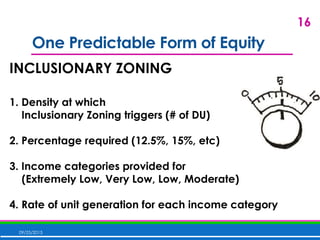
One Predictable Form of Equity
09/25/2015
16
INCLUSIONARY ZONING
1. Density at which
Inclusionary Zoning triggers (# of DU)
2. Percentage required (12.5%, 15%, etc)
3. Income categories provided for
(Extremely Low, Very Low, Low, Moderate)
4. Rate of unit generation for each income category
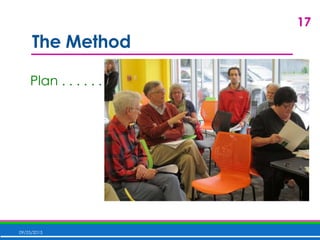
The Method
09/25/2015
17
Plan . . . . . . . .
The Method
09/25/2015
18
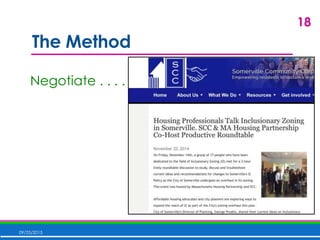
Negotiate . . . . . . . .
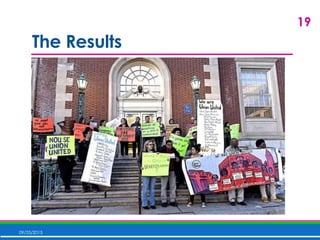
The Results
09/25/2015
19
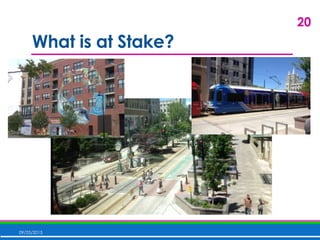
What is at Stake?
09/25/2015
20
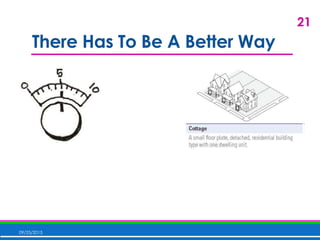
There Has To Be A Better Way
09/25/2015
21
09/25/2015
22
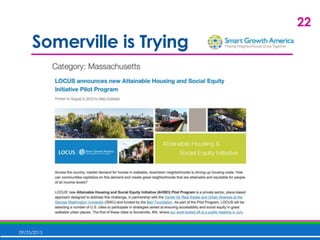
Somerville is Trying
09/25/2015
23
A Developer’s Perspective
 Real Estate is a Business
 Large investments in land, buildings, and regulatory entitlement
 Must pay a return for investors, commensurate with risk
 Must make more than you pay your workers, taxes, insurance, debts, etc.
 Competition
 Profit commensurate with creating a valuable good/service for a low cost
 Limits to transparency—If I show the city my pro forma, my competitors see it too
 Real Estate is Very Risky
 Uncertainty about future markets, costs, & regulation
 You may lose all your money
 Must generate a “risk-adjusted” return (10-20%+/-)
Predictability and Flexibility
 Predictability
 Reducing risk is very important
 Any thing that I can make more predictable helps reduce risk, improve profits—and
lower necessary risk adjusted returns
 Permitting can be a major source of risk: 3 months or 3 years? Every month we may
be spending $10k-100k’s (holding costs, consultant services, permitting fees)
 Discretionary review is amongst the highest risks in development
 Flexibility
 Flexibility is not the opposite of predictability
 Flexibility is important because real estate markets are constantly changing
 My originally intended use may no longer work, can I change? Bigger building?
Smaller building? Etc.
 Take particular care of use regulations, you might be zoning out the things you want
The Pro Forma
 Caveat: the development pro forma could easily be a whole session on it’s
own
 Essentially:
 The pro forma is a model of the expenses and revenues of a project, conducted
prior to starting a project, to understand if it is financially viable
 We make many assumptions, grounded in experience, about expected costs,
revenues, and risks
 If we are wrong about the assumptions—costs more than expected, or revenues
less—the overall profitability suffers, potentially causing the project to fail
 Where community benefits fit in:
 Money spent on “community benefits” comes from bottom line project viability
 Depending on the overall profitability of the project, it may be able to bear some
amount of community benefits, particularly if it improves the value
 Large projects are typically much more able than small infill projects.
Thoughts on Community Benefits
 Some philosophical problems I have with the CB approach:
 Implication that new development is per se bad
 Must be ameliorated with community benefits
 Relatedly, assumption that our existing city/town is what we want, and therefore
change is more likely to be bad than good
 Private developers, typically operating before zoning, built that vast majority of the
places that we love
 Places the costs of fixing problems on new arrivals
 Often fixing existing problems
 Where are my (higher) property taxes going?
 Free-rider problem—existing property owners who are not reinvesting benefit
 Reduces the attractiveness of reinvestment, and puts drag on increasing tax base
 Having all effected properties contribute would be fairer
COMMUNITY
BENEFITS
TOOLS
FAIR AND EFFECTIVE
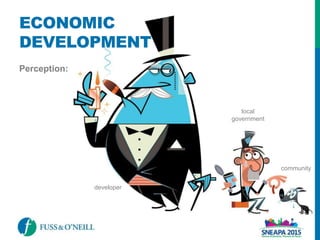
Perception:
ECONOMIC
DEVELOPMENT
local
government
community
developer
COMMUNITY
REQUESTS
Trip Reduction and Traffic
Management
– Bicycle facilities;
– Dedicated shuttles;
– Car-sharing;
– Transit passes;
– Shared parking; and
– Pricing parking separately from housing units (i.e.
unbundling parking)
Affordable and Workforce
Housing
– Housing affordable to households earning up to 80
percent of adjusted median income (AMI) and work force
housing; and
– Located near transit, services and existing job centers
Community Physical
Improvements
– Reconnecting the street grid;
– Quality pedestrian, biking, and Green connections;
– Community gathering and green open spaces;
– Recreational open space; and
– Neighborhood-serving retail and services
Social and Cultural Facilities
– Arts and cultural facilities and uses such as providing
public art and/or gallery space within building; and
– Child-care, senior, or youth facilities as part of the
project
Historic Preservation
– Preservation of historic structures or adaptive reuse to
conserve exterior features
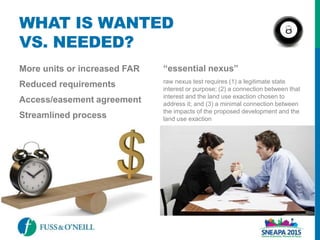
WHAT IS WANTED
VS. NEEDED?
More units or increased FAR
Reduced requirements
Access/easement agreement
Streamlined process
“essential nexus”
raw nexus test requires (1) a legitimate state
interest or purpose; (2) a connection between that
interest and the land use exaction chosen to
address it; and (3) a minimal connection between
the impacts of the proposed development and the
land use exaction
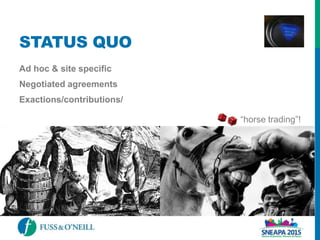
STATUS QUO
Ad hoc & site specific
Negotiated agreements
Exactions/contributions/
“horse trading”!
SITE-SPECIFIC COMMUNITY
BENEFITS AGREEMENTS (CBAS)
Community benefits tools maximize returns on local government investment in
development.
Community benefits programs can transform regions through stronger, more
equitable economies.
Community benefits help generate public support for economic development
projects.
Delivering community benefits is smart business.
CBAs hold developers accountable for their promises to local governments and
residents.
Public input results in better projects that benefit the whole community and attract
local customers.
Community benefits are part of a smart growth agenda.
Time is money, and projects with CBAs often enjoy a faster, smoother entitlement
process.
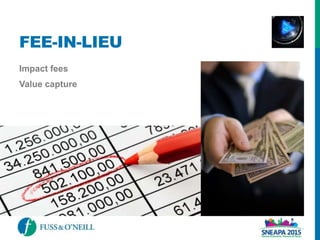
FEE-IN-LIEU
Impact fees
Value capture
BENEFIT DISTRICTS
CBDs differ from Business Improvement Districts (BID) in that they are easier to create
and dissolve, emphasize mixed-use districts, and require the participation of all property
owners including those which are public or tax-exempt. CBDs do not require renewal,
and involve the creation of a nonprofit board to guide and implement the Management
Plan, which is the locally defined revitalization strategy. This bill does not replace the
existing BID statute and represents another option for communities to pursue.
MA House Bill 144 & Senate Bill 1070
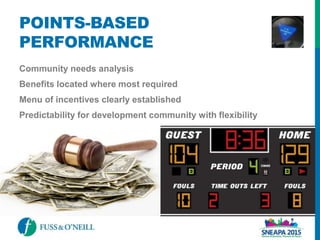
POINTS-BASED
PERFORMANCE
Community needs analysis
Benefits located where most required
Menu of incentives clearly established
Predictability for development community with flexibility
POINTS-BASED
PERFORMANCE

F5 Linking Economic Development and Social Equity

  • 1.
    Linking Economic Development & SocialEquity. . . . . . THROUGH BETTER ZONING
  • 2.
  • 3.
  • 4.
  • 9.
  • 10.
    Zoning Best Practices 09/25/2015 10 1.Use Based 2. Performance Based 3. Special District 4. Form Based 2015 Somerville Zoning Ordinance
  • 11.
  • 12.
  • 13.
  • 14.
    A Map Basedon a Plan 09/25/2015 14
  • 15.
    Meeting Expectations forEquity 09/25/2015 15 • Affordable Housing • Diversity of Housing Types • Job Training • Small Independent Businesses • Open Space • Traffic • Environmental Impact Mitigation • more . . .
  • 16.
    One Predictable Formof Equity 09/25/2015 16 INCLUSIONARY ZONING 1. Density at which Inclusionary Zoning triggers (# of DU) 2. Percentage required (12.5%, 15%, etc) 3. Income categories provided for (Extremely Low, Very Low, Low, Moderate) 4. Rate of unit generation for each income category
  • 17.
  • 18.
  • 19.
  • 20.
    What is atStake? 09/25/2015 20
  • 21.
    There Has ToBe A Better Way 09/25/2015 21
  • 22.
  • 23.
  • 24.
    A Developer’s Perspective Real Estate is a Business  Large investments in land, buildings, and regulatory entitlement  Must pay a return for investors, commensurate with risk  Must make more than you pay your workers, taxes, insurance, debts, etc.  Competition  Profit commensurate with creating a valuable good/service for a low cost  Limits to transparency—If I show the city my pro forma, my competitors see it too  Real Estate is Very Risky  Uncertainty about future markets, costs, & regulation  You may lose all your money  Must generate a “risk-adjusted” return (10-20%+/-)
  • 25.
    Predictability and Flexibility Predictability  Reducing risk is very important  Any thing that I can make more predictable helps reduce risk, improve profits—and lower necessary risk adjusted returns  Permitting can be a major source of risk: 3 months or 3 years? Every month we may be spending $10k-100k’s (holding costs, consultant services, permitting fees)  Discretionary review is amongst the highest risks in development  Flexibility  Flexibility is not the opposite of predictability  Flexibility is important because real estate markets are constantly changing  My originally intended use may no longer work, can I change? Bigger building? Smaller building? Etc.  Take particular care of use regulations, you might be zoning out the things you want
  • 26.
    The Pro Forma Caveat: the development pro forma could easily be a whole session on it’s own  Essentially:  The pro forma is a model of the expenses and revenues of a project, conducted prior to starting a project, to understand if it is financially viable  We make many assumptions, grounded in experience, about expected costs, revenues, and risks  If we are wrong about the assumptions—costs more than expected, or revenues less—the overall profitability suffers, potentially causing the project to fail  Where community benefits fit in:  Money spent on “community benefits” comes from bottom line project viability  Depending on the overall profitability of the project, it may be able to bear some amount of community benefits, particularly if it improves the value  Large projects are typically much more able than small infill projects.
  • 27.
    Thoughts on CommunityBenefits  Some philosophical problems I have with the CB approach:  Implication that new development is per se bad  Must be ameliorated with community benefits  Relatedly, assumption that our existing city/town is what we want, and therefore change is more likely to be bad than good  Private developers, typically operating before zoning, built that vast majority of the places that we love  Places the costs of fixing problems on new arrivals  Often fixing existing problems  Where are my (higher) property taxes going?  Free-rider problem—existing property owners who are not reinvesting benefit  Reduces the attractiveness of reinvestment, and puts drag on increasing tax base  Having all effected properties contribute would be fairer
  • 28.
  • 29.
  • 30.
    COMMUNITY REQUESTS Trip Reduction andTraffic Management – Bicycle facilities; – Dedicated shuttles; – Car-sharing; – Transit passes; – Shared parking; and – Pricing parking separately from housing units (i.e. unbundling parking) Affordable and Workforce Housing – Housing affordable to households earning up to 80 percent of adjusted median income (AMI) and work force housing; and – Located near transit, services and existing job centers Community Physical Improvements – Reconnecting the street grid; – Quality pedestrian, biking, and Green connections; – Community gathering and green open spaces; – Recreational open space; and – Neighborhood-serving retail and services Social and Cultural Facilities – Arts and cultural facilities and uses such as providing public art and/or gallery space within building; and – Child-care, senior, or youth facilities as part of the project Historic Preservation – Preservation of historic structures or adaptive reuse to conserve exterior features
  • 31.
    WHAT IS WANTED VS.NEEDED? More units or increased FAR Reduced requirements Access/easement agreement Streamlined process “essential nexus” raw nexus test requires (1) a legitimate state interest or purpose; (2) a connection between that interest and the land use exaction chosen to address it; and (3) a minimal connection between the impacts of the proposed development and the land use exaction
  • 32.
    STATUS QUO Ad hoc& site specific Negotiated agreements Exactions/contributions/ “horse trading”!
  • 33.
    SITE-SPECIFIC COMMUNITY BENEFITS AGREEMENTS(CBAS) Community benefits tools maximize returns on local government investment in development. Community benefits programs can transform regions through stronger, more equitable economies. Community benefits help generate public support for economic development projects. Delivering community benefits is smart business. CBAs hold developers accountable for their promises to local governments and residents. Public input results in better projects that benefit the whole community and attract local customers. Community benefits are part of a smart growth agenda. Time is money, and projects with CBAs often enjoy a faster, smoother entitlement process.
  • 34.
  • 35.
    BENEFIT DISTRICTS CBDs differfrom Business Improvement Districts (BID) in that they are easier to create and dissolve, emphasize mixed-use districts, and require the participation of all property owners including those which are public or tax-exempt. CBDs do not require renewal, and involve the creation of a nonprofit board to guide and implement the Management Plan, which is the locally defined revitalization strategy. This bill does not replace the existing BID statute and represents another option for communities to pursue. MA House Bill 144 & Senate Bill 1070
  • 36.
    POINTS-BASED PERFORMANCE Community needs analysis Benefitslocated where most required Menu of incentives clearly established Predictability for development community with flexibility
  • 37.

Editor's Notes

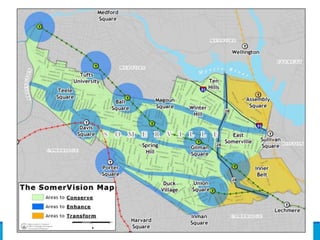
  • #6 It even came with a map (click through this one fast)
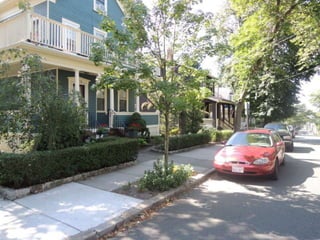
  • #7 Conserve our neighborhoods
  • #8 Enhance our Squares
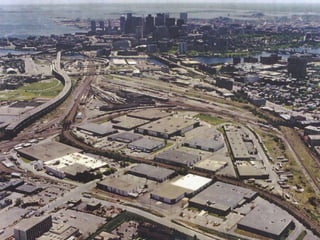
  • #9 And Transform underutilized land
  • #32 WANT is different than NEED Needed by development project and needed by the community
  • #33 “rough proportionality”
  • #34 To minimize subjectivity, an incentive program incorporated in the zoning approval process should avoid the type of project-by-project negotiations that typically apply to development agreements. http://www.forworkingfamilies.org/resources/policy-tools-community-benefits-agreements-and-policies
  • #35 Fixed cost i.e. fee per unit type Value capture is a type of public financing that recovers some or all of the value that public infrastructure generates for private landowners Stops construction? Who actually builds the affordable units . . . Government as developer?
  • #36 a defined area within which businesses are required to pay an additional tax (or levy) in order to fund projects within the district's boundaries