ANDREW	

Age: 25	

Architecture	

KAREN	

Age: 27	

Interiors	

JUSTIN	

Age: 29	

Graphics	

MicroHousing:
Who needs it???
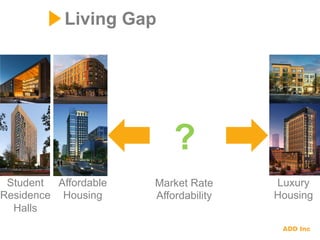
Luxury
Housing
Student
Residence
Halls
Affordable
Housing
Living Gap
Market Rate
Affordability
?
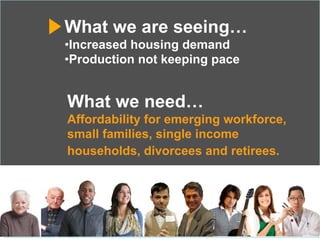
What we are seeing…
• Increased housing demand
• Production not keeping pace
What we need…
Affordability for emerging workforce,
small families, single income
households, divorcees and retirees.
today’s focus
• who needs it?
• what is micro-housing?
• how planning can help
Amsterdam experience
Micro-Housing:	

Who Needs It?
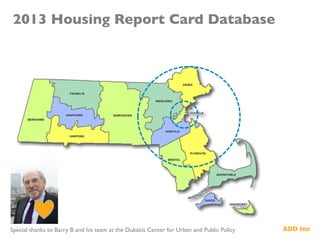
2013 Housing Report Card Database	

Special thanks to Barry B and his team at the Dukakis Center for Urban and Public Policy
100%	

50%	

0%	

Housing 	

Child Care 	

 Food College
Health 	


Care	

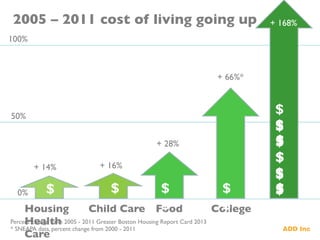
2005 – 2011 cost of living going up	

Percent change from 2005 - 2011 Greater Boston Housing Report Card 2013
* SNEAPA data, percent change from 2000 - 2011	

+ 14%	

$	

+ 16%	

$	

+ 28%	

$
$	

+ 168%	

$
$	

$
$	

$
$	

$
$	

$
$	

$
$	

+ 66%*	

$
$
$1500	

$ 1000	

$ 500	

1990 	


2000 	


 2010	

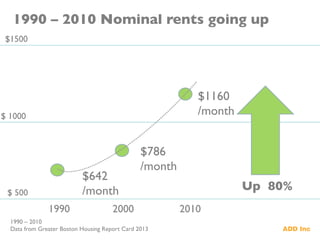
1990 – 2010 Nominal rents going up 	

1990 – 2010 	

Data from Greater Boston Housing Report Card 2013	

Up 80%	

$642	

/month	

$786	

/month	

$1160	

/month
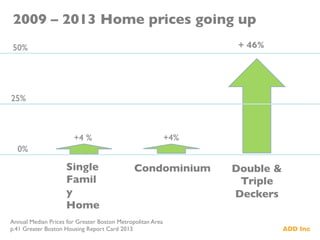
2009 – 2013 Home prices going up	

Single
Famil
y
Home	

+4 %	

 +4%	

Condominium	

Annual Median Prices for Greater Boston Metropolitan Area	

p.41 Greater Boston Housing Report Card 2013	

+ 46%	

Double &
Triple
Deckers	

50%	

25%	

0%
+15%	

0%	

-15%	

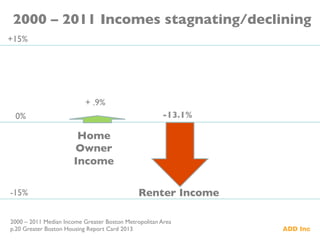
2000 – 2011 Incomes stagnating/declining	

Home	

Owner	

Income	

+ .9%	

-13.1%	

Renter Income	

2000 – 2011 Median Income Greater Boston Metropolitan Area	

p.20 Greater Boston Housing Report Card 2013
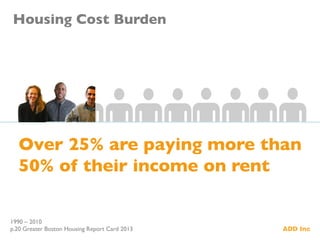
Housing Cost Burden	

Over 25% are paying more than 	

50% of their income on rent	

1990 – 2010 	

p.20 Greater Boston Housing Report Card 2013
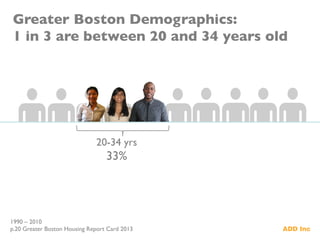
Greater Boston Demographics:	

1 in 3 are between 20 and 34 years old	

1990 – 2010 	

p.20 Greater Boston Housing Report Card 2013	

20-34 yrs	

33%
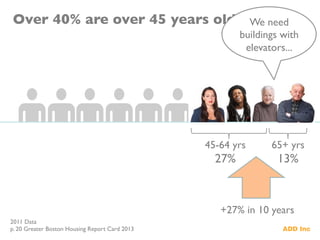
Over 40% are over 45 years old	

45-64 yrs	

27%	

+27% in 10 years	

65+ yrs	

13%	

2011 Data	

p. 20 Greater Boston Housing Report Card 2013	

We need
buildings with
elevators...
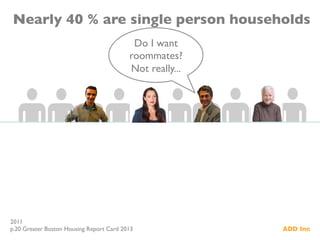
Nearly 40 % are single person households	

2011	

p.20 Greater Boston Housing Report Card 2013	

Do I want
roommates?
Not really...
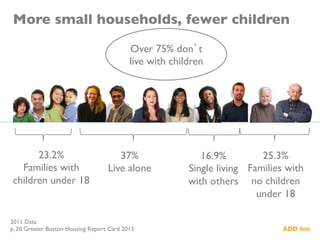
More small households, fewer children	

16.9%	

Single living
with others	

37%	

Live alone	

25.3%	

Families with
no children
under 18	

23.2%	

Families with
children under 18	

2011 Data	

p. 20 Greater Boston Housing Report Card 2013	

Over 75% don’t
live with children
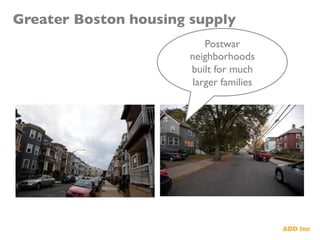
Greater Boston housing supply	

Postwar
neighborhoods
built for much
larger families
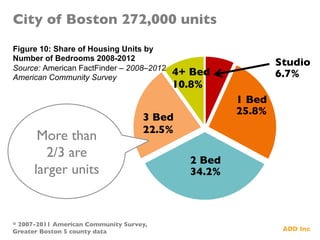
City of Boston 272,000 units	

* 2007-2011 American Community Survey,
Greater Boston 5 county data	

1 Bed	

25.8%	

2 Bed	

34.2%	

3 Bed	

22.5%	

4+ Bed	

10.8%	

Studio	

6.7%	

More than
2/3 are
larger units	

Figure 10: Share of Housing Units by
Number of Bedrooms 2008-2012
Source: American FactFinder – 2008–2012
American Community Survey
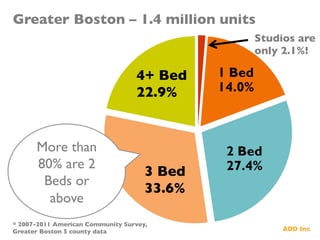
Greater Boston – 1.4 million units	

3 Bed	

33.6%	

4+ Bed	

22.9%	

Studios are
only 2.1%!	

* 2007-2011 American Community Survey,
Greater Boston 5 county data	

More than
80% are 2
Beds or
above
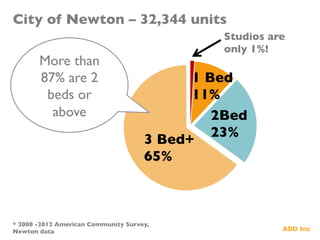
City of Newton – 32,344 units	

3 Bed+	

65%	

2Bed	

23%	

Studios are
only 1%!	

* 2008 -2012 American Community Survey,
Newton data	

More than
87% are 2
beds or
above	

1 Bed	

11%
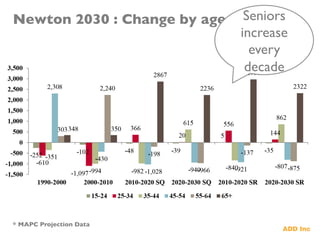
Newton 2030 : Change by age	

 Seniors
increase
every
decade	

* MAPC Projection Data
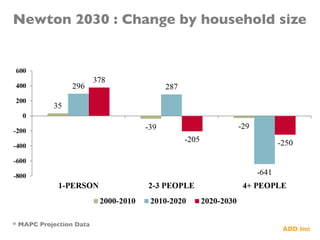
Newton 2030 : Change by household size	

* MAPC Projection Data
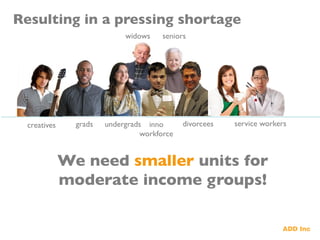
seniors	

widows	

We need smaller units for
moderate income groups!	

divorcees	

inno	

workforce	

service workers	

creatives	

 grads	

 undergrads	

Resulting in a pressing shortage
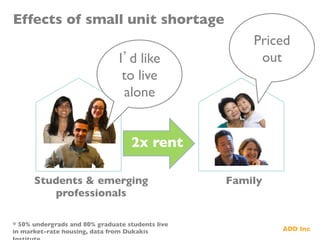
Effects of small unit shortage	

Students & emerging
professionals	

2x rent	

I’d like
to live
alone	

* 50% undergrads and 80% graduate students live
in market-rate housing, data from Dukakis
Family	

Priced
out
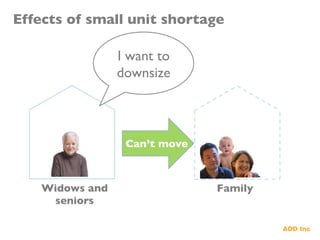
Widows and
seniors	

I want to
downsize	

Can’t move	

Family	

Effects of small unit shortage
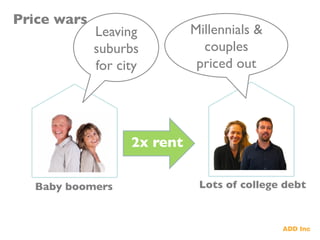
Price wars	

2x rent	

Baby boomers	

 Lots of college debt	

Leaving
suburbs
for city	

Millennials &
couples
priced out
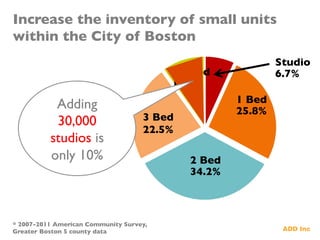
Increase the inventory of small units 	

within the City of Boston	

* 2007-2011 American Community Survey,
Greater Boston 5 county data	

1 Bed	

25.8%	

2 Bed	

34.2%	

3 Bed	

22.5%	

4+ Bed	

10.8%	

Studio	

6.7%	

Adding	

30,000
studios is
only 10%
What is micro-
housing?
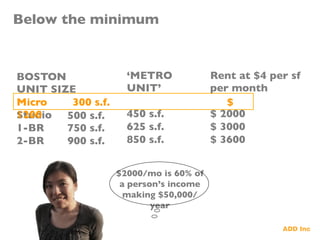
Below the minimum 	

500 s.f. 	

750 s.f. 	

900 s.f. 	

BOSTON 	

UNIT SIZE	


Studio	

1-BR	

2-BR	

‘METRO 	

UNIT’	


450 s.f.	

625 s.f.	

850 s.f. 	

Rent at $4 per sf 	

per month	


$ 2000	

$ 3000	

$ 3600	

Micro 300 s.f. $
1200 	

$2000/mo is 60% of
a person’s income
making $50,000/
year
ADD Inc research initiative	

Proprietary Research Studies
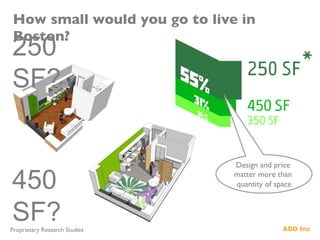
How small would you go to live in
Boston?	

250
SF?
450
SF?
Design and price
matter more than
quantity of space	

Proprietary Research Studies
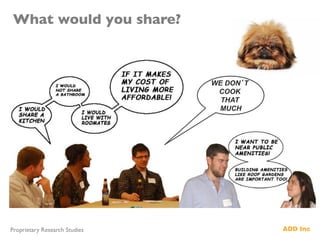
What would you share?	

WE DON’T
COOK
THAT
MUCH
Proprietary Research Studies
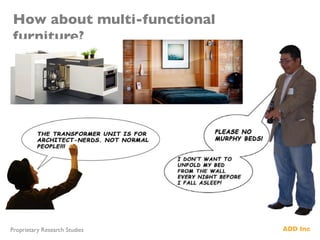
How about multi-functional
furniture?	

Proprietary Research Studies
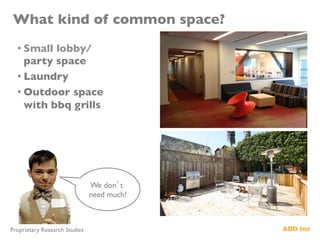
What kind of common space?	

• Small lobby/
party space	

• Laundry	

• Outdoor space
with bbq grills	

We don’t
need much!	

Proprietary Research Studies
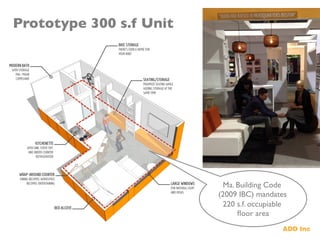
Prototype 300 s.f Unit	

Ma. Building Code
(2009 IBC) mandates
220 s.f. occupiable
floor area
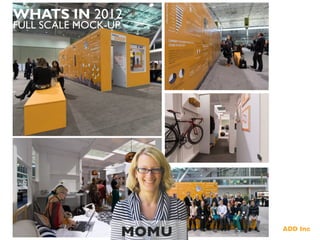
WHATS IN 2012
FULL SCALE MOCK-UP
MOMU
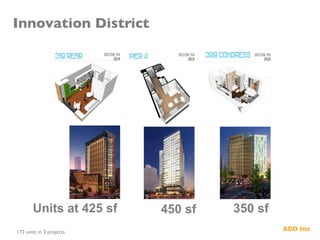
172 units in 3 projects	

KAREN	


Units at 425 sf 450 sf 350 sf
Innovation District
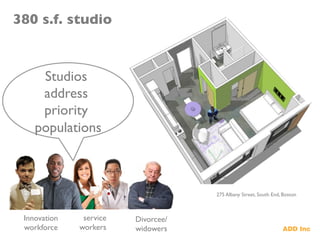
380 s.f. studio	

service 	

workers	

Divorcee/
widowers	

Innovation
workforce	

Studios
address
priority
populations	

275 Albany Street, South End, Boston
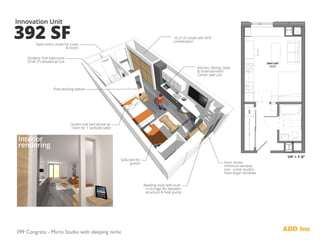
399 Congress - Micro Studio with sleeping niche	

330 sf
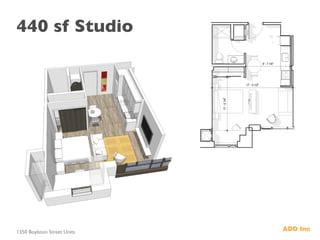
1350 Boylston Street Units	

440 sf Studio
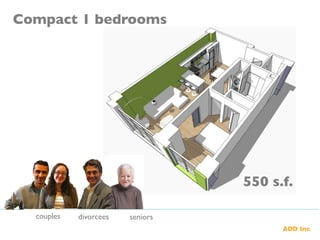
Compact 1 bedrooms	

550 s.f. 	

seniors	

couples	

 divorcees
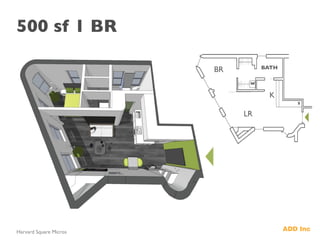
Harvard Square Micros	

500 sf 1 BR	

K
LR
BR BATH
w
s
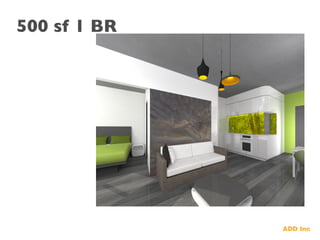
500 sf 1 BR
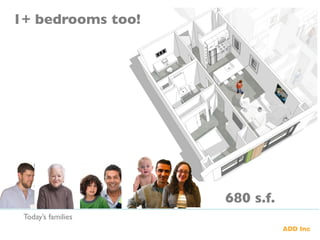
1+ bedrooms too!	

Today’s families	

680 s.f.
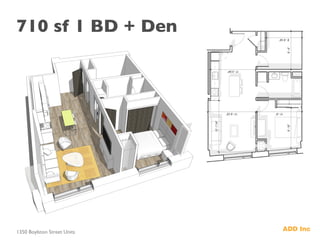
710 sf 1 BD + Den	

1350 Boylston Street Units
How planning can
help
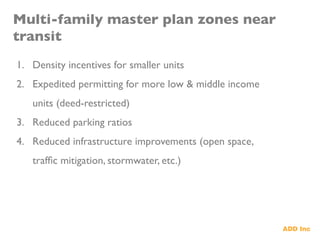
Multi-family master plan zones near
transit	

1.  Density incentives for smaller units	

2.  Expedited permitting for more low & middle income
units (deed-restricted)	

3.  Reduced parking ratios	

4.  Reduced infrastructure improvements (open space,
traffic mitigation, stormwater, etc.)
Educate your town	

Data is
compelling	

So is design!
Your ideas?

Micro Housing: Who Needs It?

  • 1.
    ANDREW Age: 25 Architecture KAREN Age: 27 Interiors JUSTIN Age:29 Graphics MicroHousing: Who needs it???
  • 2.
  • 3.
    What we areseeing… • Increased housing demand • Production not keeping pace What we need… Affordability for emerging workforce, small families, single income households, divorcees and retirees.
  • 4.
    today’s focus • who needsit? • what is micro-housing? • how planning can help
  • 5.
  • 6.
  • 7.
    2013 Housing ReportCard Database Special thanks to Barry B and his team at the Dukakis Center for Urban and Public Policy
  • 8.
    100% 50% 0% Housing Child Care Food College Health Care 2005 – 2011 cost of living going up Percent change from 2005 - 2011 Greater Boston Housing Report Card 2013 * SNEAPA data, percent change from 2000 - 2011 + 14% $ + 16% $ + 28% $ $ + 168% $ $ $ $ $ $ $ $ $ $ $ $ + 66%* $ $
  • 9.
    $1500 $ 1000 $ 500 1990 2000 2010 1990 – 2010 Nominal rents going up 1990 – 2010 Data from Greater Boston Housing Report Card 2013 Up 80% $642 /month $786 /month $1160 /month
  • 10.
    2009 – 2013Home prices going up Single Famil y Home +4 % +4% Condominium Annual Median Prices for Greater Boston Metropolitan Area p.41 Greater Boston Housing Report Card 2013 + 46% Double & Triple Deckers 50% 25% 0%
  • 11.
    +15% 0% -15% 2000 – 2011Incomes stagnating/declining Home Owner Income + .9% -13.1% Renter Income 2000 – 2011 Median Income Greater Boston Metropolitan Area p.20 Greater Boston Housing Report Card 2013
  • 12.
    Housing Cost Burden Over25% are paying more than 50% of their income on rent 1990 – 2010 p.20 Greater Boston Housing Report Card 2013
  • 13.
    Greater Boston Demographics: 1in 3 are between 20 and 34 years old 1990 – 2010 p.20 Greater Boston Housing Report Card 2013 20-34 yrs 33%
  • 14.
    Over 40% areover 45 years old 45-64 yrs 27% +27% in 10 years 65+ yrs 13% 2011 Data p. 20 Greater Boston Housing Report Card 2013 We need buildings with elevators...
  • 15.
    Nearly 40 %are single person households 2011 p.20 Greater Boston Housing Report Card 2013 Do I want roommates? Not really...
  • 16.
    More small households,fewer children 16.9% Single living with others 37% Live alone 25.3% Families with no children under 18 23.2% Families with children under 18 2011 Data p. 20 Greater Boston Housing Report Card 2013 Over 75% don’t live with children
  • 17.
    Greater Boston housingsupply Postwar neighborhoods built for much larger families
  • 18.
    City of Boston272,000 units * 2007-2011 American Community Survey, Greater Boston 5 county data 1 Bed 25.8% 2 Bed 34.2% 3 Bed 22.5% 4+ Bed 10.8% Studio 6.7% More than 2/3 are larger units Figure 10: Share of Housing Units by Number of Bedrooms 2008-2012 Source: American FactFinder – 2008–2012 American Community Survey
  • 19.
    Greater Boston –1.4 million units 3 Bed 33.6% 4+ Bed 22.9% Studios are only 2.1%! * 2007-2011 American Community Survey, Greater Boston 5 county data More than 80% are 2 Beds or above
  • 20.
    City of Newton– 32,344 units 3 Bed+ 65% 2Bed 23% Studios are only 1%! * 2008 -2012 American Community Survey, Newton data More than 87% are 2 beds or above 1 Bed 11%
  • 21.
    Newton 2030 :Change by age Seniors increase every decade * MAPC Projection Data
  • 22.
    Newton 2030 :Change by household size * MAPC Projection Data
  • 23.
    seniors widows We need smallerunits for moderate income groups! divorcees inno workforce service workers creatives grads undergrads Resulting in a pressing shortage
  • 24.
    Effects of smallunit shortage Students & emerging professionals 2x rent I’d like to live alone * 50% undergrads and 80% graduate students live in market-rate housing, data from Dukakis Family Priced out
  • 25.
    Widows and seniors I wantto downsize Can’t move Family Effects of small unit shortage
  • 26.
    Price wars 2x rent Babyboomers Lots of college debt Leaving suburbs for city Millennials & couples priced out
  • 27.
    Increase the inventoryof small units within the City of Boston * 2007-2011 American Community Survey, Greater Boston 5 county data 1 Bed 25.8% 2 Bed 34.2% 3 Bed 22.5% 4+ Bed 10.8% Studio 6.7% Adding 30,000 studios is only 10%
  • 28.
  • 29.
    Below the minimum 500 s.f. 750 s.f. 900 s.f. BOSTON UNIT SIZE Studio 1-BR 2-BR ‘METRO UNIT’ 450 s.f. 625 s.f. 850 s.f. Rent at $4 per sf per month $ 2000 $ 3000 $ 3600 Micro 300 s.f. $ 1200 $2000/mo is 60% of a person’s income making $50,000/ year
  • 30.
    ADD Inc researchinitiative Proprietary Research Studies
  • 31.
    How small wouldyou go to live in Boston? 250 SF? 450 SF? Design and price matter more than quantity of space Proprietary Research Studies
  • 32.
    What would youshare? WE DON’T COOK THAT MUCH Proprietary Research Studies
  • 33.
  • 34.
    What kind ofcommon space? • Small lobby/ party space • Laundry • Outdoor space with bbq grills We don’t need much! Proprietary Research Studies
  • 35.
    Prototype 300 s.fUnit Ma. Building Code (2009 IBC) mandates 220 s.f. occupiable floor area
  • 36.
    WHATS IN 2012 FULLSCALE MOCK-UP MOMU
  • 37.
    172 units in3 projects KAREN Units at 425 sf 450 sf 350 sf Innovation District
  • 38.
    380 s.f. studio service workers Divorcee/ widowers Innovation workforce Studios address priority populations 275 Albany Street, South End, Boston
  • 39.
    399 Congress -Micro Studio with sleeping niche 330 sf
  • 40.
    1350 Boylston StreetUnits 440 sf Studio
  • 41.
    Compact 1 bedrooms 550s.f. seniors couples divorcees
  • 42.
    Harvard Square Micros 500sf 1 BR K LR BR BATH w s
  • 43.
  • 44.
    1+ bedrooms too! Today’sfamilies 680 s.f.
  • 45.
    710 sf 1BD + Den 1350 Boylston Street Units
  • 46.
  • 47.
    Multi-family master planzones near transit 1.  Density incentives for smaller units 2.  Expedited permitting for more low & middle income units (deed-restricted) 3.  Reduced parking ratios 4.  Reduced infrastructure improvements (open space, traffic mitigation, stormwater, etc.)
  • 48.
    Educate your town Datais compelling So is design!
  • 49.