Local Economic Development Strategies
to Channel the Manufacturing
Renaissance
MAPD Annual Conference
6/6/2013
The Manufacturing RenaissanceThe Manufacturing Renaissance
2
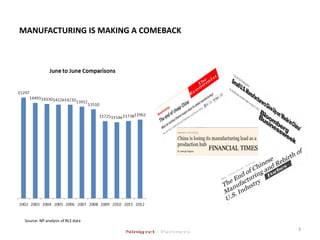
MANUFACTURING IS MAKING A COMEBACK
3
Source: NP analysis of BLS data
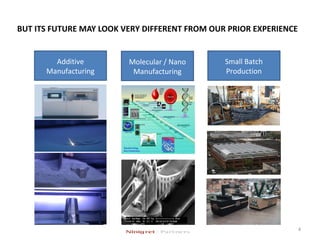
BUT ITS FUTURE MAY LOOK VERY DIFFERENT FROM OUR PRIOR EXPERIENCE
Additive
Manufacturing
Molecular / Nano
Manufacturing
Small Batch
Production
4
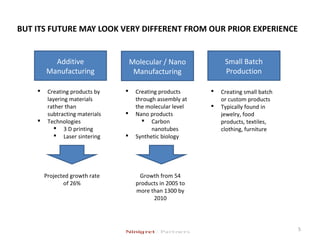
BUT ITS FUTURE MAY LOOK VERY DIFFERENT FROM OUR PRIOR EXPERIENCE
Additive
Manufacturing
Molecular / Nano
Manufacturing
Small Batch
Production
 Creating products
through assembly at
the molecular level
 Nano products
 Carbon
nanotubes
 Synthetic biology
 Creating products by
layering materials
rather than
subtracting materials
 Technologies
 3 D printing
 Laser sintering
 Creating small batch
or custom products
 Typically found in
jewelry, food
products, textiles,
clothing, furniture
5
Projected growth rate
of 26%
Growth from 54
products in 2005 to
more than 1300 by
2010
6
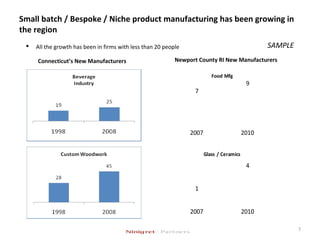
Small batch / Bespoke / Niche product manufacturing has been growing in
the region
7
Connecticut’s New Manufacturers
7
9
2007 2010
Food Mfg
Newport County RI New Manufacturers
1
4
2007 2010
Glass / Ceramics
SAMPLE All the growth has been in firms with less than 20 people
Manufacturing, Economic Development and Implications forPlannersManufacturing, Economic Development and Implications forPlanners
8
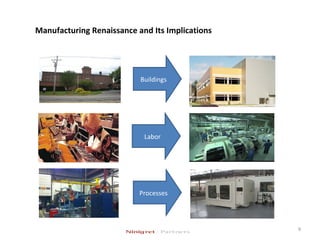
Manufacturing Renaissance and Its Implications
Buildings
Processes
Labor
9
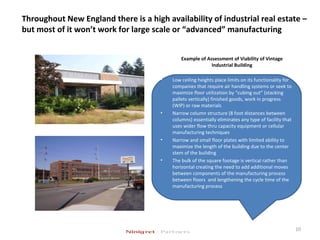
Throughout New England there is a high availability of industrial real estate –
but most of it won’t work for large scale or “advanced” manufacturing
Example of Assessment of Viability of Vintage
Industrial Building
10
• Low ceiling heights place limits on its functionality for
companies that require air handling systems or seek to
maximize floor utilization by “cubing out” (stacking
pallets vertically) finished goods, work in progress
(WIP) or raw materials
• Narrow column structure (8 foot distances between
columns) essentially eliminates any type of facility that
uses wider flow thru capacity equipment or cellular
manufacturing techniques
• Narrow and small floor plates with limited ability to
maximize the length of the building due to the center
stem of the building
• The bulk of the square footage is vertical rather than
horizontal creating the need to add additional moves
between components of the manufacturing process
between floors and lengthening the cycle time of the
manufacturing process
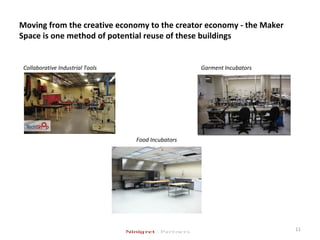
Moving from the creative economy to the creator economy - the Maker
Space is one method of potential reuse of these buildings
11
Collaborative Industrial Tools
Food Incubators
Garment Incubators
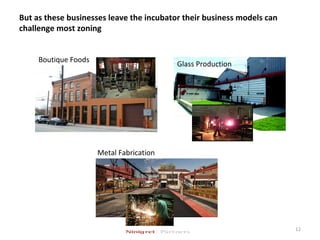
But as these businesses leave the incubator their business models can
challenge most zoning
12
Boutique Foods
Glass Production
Metal Fabrication
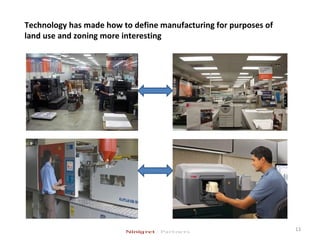
Technology has made how to define manufacturing for purposes of
land use and zoning more interesting
13
Time for “New Industrialism” zoning ?
 Euclidean zoning was designed to
minimize conflict
 Better to address the real conflict issues
through performance-based approach
 Noise, smell, light, air, vibration,
traffic, hazard materials
 Impractical to list every manufacturing
use type and technology is making a
NAICS approach obsolete
 Emerging business models challenge the
fundamental separation
 The manufacturing service bureau –
think Kinkos for products
 Retail front end / manufacturing back
end sites commonly found in food,
industrial arts, garment products
 Logistics for some looks more like
UPS than 18 wheelers
 Manufacturing & industry has 3 potential
impacts on a neighborhood
 Building form and activity issues
 Can make it cool & trendy – think LA
Garment District, Brooklyn
Greenpoint, emerging area around
Avenue of Arts in Philly,
Promenade/Eagle Square Providence
 Is neutral to a neighborhood due to
the nature of the businesses but
important from a source of jobs for
nearby residents– Mill River New
Haven, Newmarket Boston
 Is not so good for a neighborhood
because of the nature of the
businesses – think asphalt, concrete,
paper, refining
14
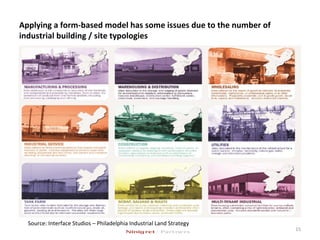
Applying a form-based model has some issues due to the number of
industrial building / site typologies
15
Source: Interface Studios – Philadelphia Industrial Land Strategy
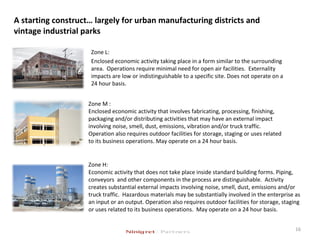
A starting construct… largely for urban manufacturing districts and
vintage industrial parks
16
Zone L:
Enclosed economic activity taking place in a form similar to the surrounding
area. Operations require minimal need for open air facilities. Externality
impacts are low or indistinguishable to a specific site. Does not operate on a
24 hour basis.
Zone M :
Enclosed economic activity that involves fabricating, processing, finishing,
packaging and/or distributing activities that may have an external impact
involving noise, smell, dust, emissions, vibration and/or truck traffic.
Operation also requires outdoor facilities for storage, staging or uses related
to its business operations. May operate on a 24 hour basis.
Zone H:
Economic activity that does not take place inside standard building forms. Piping,
conveyors and other components in the process are distinguishable. Activity
creates substantial external impacts involving noise, smell, dust, emissions and/or
truck traffic. Hazardous materials may be substantially involved in the enterprise as
an input or an output. Operation also requires outdoor facilities for storage, staging
or uses related to its business operations. May operate on a 24 hour basis.
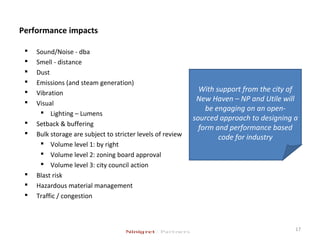
Performance impacts
 Sound/Noise - dba
 Smell - distance
 Dust
 Emissions (and steam generation)
 Vibration
 Visual
 Lighting – Lumens
 Setback & buffering
 Bulk storage are subject to stricter levels of review
 Volume level 1: by right
 Volume level 2: zoning board approval
 Volume level 3: city council action
 Blast risk
 Hazardous material management
 Traffic / congestion
17
With support from the city of
New Haven – NP and Utile will
be engaging on an open-
sourced approach to designing a
form and performance based
code for industry
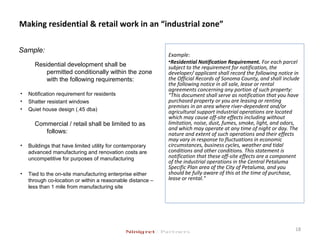
Making residential & retail work in an “industrial zone”
18
Example:
•Residential Notification Requirement. For each parcel
subject to the requirement for notification, the
developer/ applicant shall record the following notice in
the Official Records of Sonoma County, and shall include
the following notice in all sale, lease or rental
agreements concerning any portion of such property:
"This document shall serve as notification that you have
purchased property or you are leasing or renting
premises in an area where river-dependent and/or
agricultural support industrial operations are located
which may cause off-site effects including without
limitation, noise, dust, fumes, smoke, light, and odors,
and which may operate at any time of night or day. The
nature and extent of such operations and their effects
may vary in response to fluctuations in economic
circumstances, business cycles, weather and tidal
conditions and other conditions. This statement is
notification that these off-site effects are a component
of the industrial operations in the Central Petaluma
Specific Plan area of the City of Petaluma, and you
should be fully aware of this at the time of purchase,
lease or rental."
Sample:
Residential development shall be
permitted conditionally within the zone
with the following requirements:
• Notification requirement for residents
• Shatter resistant windows
• Quiet house design (.45 dba)
Commercial / retail shall be limited to as
follows:
• Buildings that have limited utility for contemporary
advanced manufacturing and renovation costs are
uncompetitive for purposes of manufacturing
• Tied to the on-site manufacturing enterprise either
through co-location or within a reasonable distance –
less than 1 mile from manufacturing site
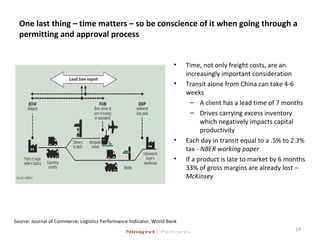
One last thing – time matters – so be conscience of it when going through a
permitting and approval process
• Time, not only freight costs, are an
increasingly important consideration
• Transit alone from China can take 4-6
weeks
– A client has a lead time of 7 months
– Drives carrying excess inventory
which negatively impacts capital
productivity
• Each day in transit equal to a .5% to 2.3%
tax - NBER working paper
• If a product is late to market by 6 months
33% of gross margins are already lost –
McKinsey
Source: Journal of Commerce; Logistics Performance Indicator, World Bank
19
So what?
• Manufacturing is coming back but it will different from our father’s manufacturing
– Doubtful that it will ever employ 10,000 people in one factory again
– Won’t all be high tech products but a mix of products made viable by technology
• Think about how to protect manufacturing sites
– We all can’t live and work in a mixed use world
– And mixed use in your creative districts may take on a manufactured product
flavor creating tensions in your zoning
– Maybe some of our office parks and vintage industrial parks should be rethought
as mixed enterprise villages
• Working regionally on locations, infrastructure and workforce is critical
– Not every community is competitive for every segment of manufacturing because
of site and infrastructure limitation
– Manufacturing casts a regional footprint in terms of employment
– Every community in a region can benefit from a healthy industrial base
20

Local Economic Development Strategies to Channel the Manufacturing Renaissance

  • 1.
    Local Economic DevelopmentStrategies to Channel the Manufacturing Renaissance MAPD Annual Conference 6/6/2013
  • 2.
    The Manufacturing RenaissanceTheManufacturing Renaissance 2
  • 3.
    MANUFACTURING IS MAKINGA COMEBACK 3 Source: NP analysis of BLS data
  • 4.
    BUT ITS FUTUREMAY LOOK VERY DIFFERENT FROM OUR PRIOR EXPERIENCE Additive Manufacturing Molecular / Nano Manufacturing Small Batch Production 4
  • 5.
    BUT ITS FUTUREMAY LOOK VERY DIFFERENT FROM OUR PRIOR EXPERIENCE Additive Manufacturing Molecular / Nano Manufacturing Small Batch Production  Creating products through assembly at the molecular level  Nano products  Carbon nanotubes  Synthetic biology  Creating products by layering materials rather than subtracting materials  Technologies  3 D printing  Laser sintering  Creating small batch or custom products  Typically found in jewelry, food products, textiles, clothing, furniture 5 Projected growth rate of 26% Growth from 54 products in 2005 to more than 1300 by 2010
  • 6.
  • 7.
    Small batch /Bespoke / Niche product manufacturing has been growing in the region 7 Connecticut’s New Manufacturers 7 9 2007 2010 Food Mfg Newport County RI New Manufacturers 1 4 2007 2010 Glass / Ceramics SAMPLE All the growth has been in firms with less than 20 people
  • 8.
    Manufacturing, Economic Developmentand Implications forPlannersManufacturing, Economic Development and Implications forPlanners 8
  • 9.
    Manufacturing Renaissance andIts Implications Buildings Processes Labor 9
  • 10.
    Throughout New Englandthere is a high availability of industrial real estate – but most of it won’t work for large scale or “advanced” manufacturing Example of Assessment of Viability of Vintage Industrial Building 10 • Low ceiling heights place limits on its functionality for companies that require air handling systems or seek to maximize floor utilization by “cubing out” (stacking pallets vertically) finished goods, work in progress (WIP) or raw materials • Narrow column structure (8 foot distances between columns) essentially eliminates any type of facility that uses wider flow thru capacity equipment or cellular manufacturing techniques • Narrow and small floor plates with limited ability to maximize the length of the building due to the center stem of the building • The bulk of the square footage is vertical rather than horizontal creating the need to add additional moves between components of the manufacturing process between floors and lengthening the cycle time of the manufacturing process
  • 11.
    Moving from thecreative economy to the creator economy - the Maker Space is one method of potential reuse of these buildings 11 Collaborative Industrial Tools Food Incubators Garment Incubators
  • 12.
    But as thesebusinesses leave the incubator their business models can challenge most zoning 12 Boutique Foods Glass Production Metal Fabrication
  • 13.
    Technology has madehow to define manufacturing for purposes of land use and zoning more interesting 13
  • 14.
    Time for “NewIndustrialism” zoning ?  Euclidean zoning was designed to minimize conflict  Better to address the real conflict issues through performance-based approach  Noise, smell, light, air, vibration, traffic, hazard materials  Impractical to list every manufacturing use type and technology is making a NAICS approach obsolete  Emerging business models challenge the fundamental separation  The manufacturing service bureau – think Kinkos for products  Retail front end / manufacturing back end sites commonly found in food, industrial arts, garment products  Logistics for some looks more like UPS than 18 wheelers  Manufacturing & industry has 3 potential impacts on a neighborhood  Building form and activity issues  Can make it cool & trendy – think LA Garment District, Brooklyn Greenpoint, emerging area around Avenue of Arts in Philly, Promenade/Eagle Square Providence  Is neutral to a neighborhood due to the nature of the businesses but important from a source of jobs for nearby residents– Mill River New Haven, Newmarket Boston  Is not so good for a neighborhood because of the nature of the businesses – think asphalt, concrete, paper, refining 14
  • 15.
    Applying a form-basedmodel has some issues due to the number of industrial building / site typologies 15 Source: Interface Studios – Philadelphia Industrial Land Strategy
  • 16.
    A starting construct…largely for urban manufacturing districts and vintage industrial parks 16 Zone L: Enclosed economic activity taking place in a form similar to the surrounding area. Operations require minimal need for open air facilities. Externality impacts are low or indistinguishable to a specific site. Does not operate on a 24 hour basis. Zone M : Enclosed economic activity that involves fabricating, processing, finishing, packaging and/or distributing activities that may have an external impact involving noise, smell, dust, emissions, vibration and/or truck traffic. Operation also requires outdoor facilities for storage, staging or uses related to its business operations. May operate on a 24 hour basis. Zone H: Economic activity that does not take place inside standard building forms. Piping, conveyors and other components in the process are distinguishable. Activity creates substantial external impacts involving noise, smell, dust, emissions and/or truck traffic. Hazardous materials may be substantially involved in the enterprise as an input or an output. Operation also requires outdoor facilities for storage, staging or uses related to its business operations. May operate on a 24 hour basis.
  • 17.
    Performance impacts  Sound/Noise- dba  Smell - distance  Dust  Emissions (and steam generation)  Vibration  Visual  Lighting – Lumens  Setback & buffering  Bulk storage are subject to stricter levels of review  Volume level 1: by right  Volume level 2: zoning board approval  Volume level 3: city council action  Blast risk  Hazardous material management  Traffic / congestion 17 With support from the city of New Haven – NP and Utile will be engaging on an open- sourced approach to designing a form and performance based code for industry
  • 18.
    Making residential &retail work in an “industrial zone” 18 Example: •Residential Notification Requirement. For each parcel subject to the requirement for notification, the developer/ applicant shall record the following notice in the Official Records of Sonoma County, and shall include the following notice in all sale, lease or rental agreements concerning any portion of such property: "This document shall serve as notification that you have purchased property or you are leasing or renting premises in an area where river-dependent and/or agricultural support industrial operations are located which may cause off-site effects including without limitation, noise, dust, fumes, smoke, light, and odors, and which may operate at any time of night or day. The nature and extent of such operations and their effects may vary in response to fluctuations in economic circumstances, business cycles, weather and tidal conditions and other conditions. This statement is notification that these off-site effects are a component of the industrial operations in the Central Petaluma Specific Plan area of the City of Petaluma, and you should be fully aware of this at the time of purchase, lease or rental." Sample: Residential development shall be permitted conditionally within the zone with the following requirements: • Notification requirement for residents • Shatter resistant windows • Quiet house design (.45 dba) Commercial / retail shall be limited to as follows: • Buildings that have limited utility for contemporary advanced manufacturing and renovation costs are uncompetitive for purposes of manufacturing • Tied to the on-site manufacturing enterprise either through co-location or within a reasonable distance – less than 1 mile from manufacturing site
  • 19.
    One last thing– time matters – so be conscience of it when going through a permitting and approval process • Time, not only freight costs, are an increasingly important consideration • Transit alone from China can take 4-6 weeks – A client has a lead time of 7 months – Drives carrying excess inventory which negatively impacts capital productivity • Each day in transit equal to a .5% to 2.3% tax - NBER working paper • If a product is late to market by 6 months 33% of gross margins are already lost – McKinsey Source: Journal of Commerce; Logistics Performance Indicator, World Bank 19
  • 20.
    So what? • Manufacturingis coming back but it will different from our father’s manufacturing – Doubtful that it will ever employ 10,000 people in one factory again – Won’t all be high tech products but a mix of products made viable by technology • Think about how to protect manufacturing sites – We all can’t live and work in a mixed use world – And mixed use in your creative districts may take on a manufactured product flavor creating tensions in your zoning – Maybe some of our office parks and vintage industrial parks should be rethought as mixed enterprise villages • Working regionally on locations, infrastructure and workforce is critical – Not every community is competitive for every segment of manufacturing because of site and infrastructure limitation – Manufacturing casts a regional footprint in terms of employment – Every community in a region can benefit from a healthy industrial base 20