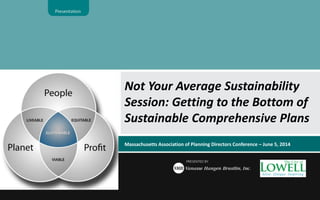
Not Your Average Sustainability
Session: Getting to the Bottom of
Sustainable Comprehensive Plans
Massachusetts Association of Planning Directors Conference – June 5, 2014
Agenda
 Sustainability Master Plan Defined
 Why?
 Principles
 Process
 Attributes and Elements
 Implementation and Evaluation
 Discussion and Questions
 Deep Thoughts
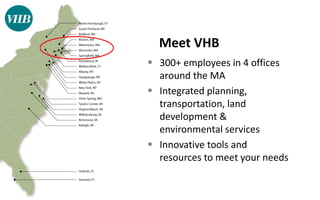
Meet VHB
 300+ employees in 4 offices
around the MA
 Integrated planning,
transportation, land
development &
environmental services
 Innovative tools and
resources to meet your needs
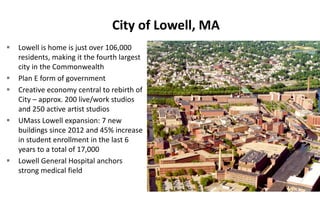
City of Lowell, MA
 Lowell is home is just over 106,000
residents, making it the fourth largest
city in the Commonwealth
 Plan E form of government
 Creative economy central to rebirth of
City – approx. 200 live/work studios
and 250 active artist studios
 UMass Lowell expansion: 7 new
buildings since 2012 and 45% increase
in student enrollment in the last 6
years to a total of 17,000
 Lowell General Hospital anchors
strong medical field
Two Terms Defined:
 A Sustainability Comprehensive Plan focuses on the long-term viability of
the economic, environmental, social and cultural aspects of communities and
regions.
• APA provides one definition, “…[a] plan to meet the needs of current and
future generations without compromising the ecosystems upon which
they depend by balancing social, economic, and environmental resources,
incorporating resilience, and linking local actions to regional and global
concerns.”
 A Sustainable Comprehensive Plan is an active, living document with
engaged stakeholders and active projects that remains at the forefront of
development and planning actions.
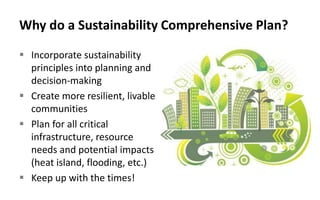
Why do a Sustainability Comprehensive Plan?
 Incorporate sustainability
principles into planning and
decision-making
 Create more resilient, livable
communities
 Plan for all critical
infrastructure, resource
needs and potential impacts
(heat island, flooding, etc.)
 Keep up with the times!
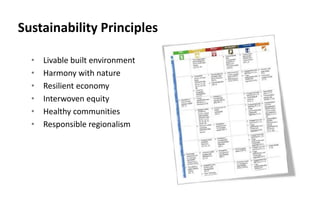
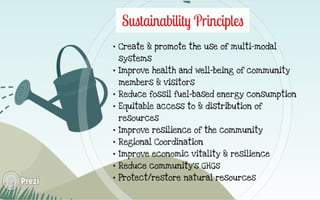
Sustainability Principles
• Livable built environment
• Harmony with nature
• Resilient economy
• Interwoven equity
• Healthy communities
• Responsible regionalism
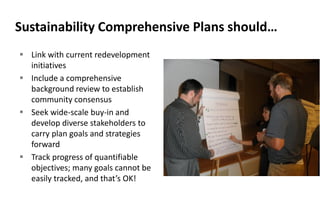
Sustainability Comprehensive Plans should…
 Link with current redevelopment
initiatives
 Include a comprehensive
background review to establish
community consensus
 Seek wide-scale buy-in and
develop diverse stakeholders to
carry plan goals and strategies
forward
 Track progress of quantifiable
objectives; many goals cannot be
easily tracked, and that’s OK!
Our Experiences
Greenfield
 2012-2013
 Builds upon existing planning
efforts including Sustainable
Franklin County
 250+ people attended workshops
 550+ ideas generated
 40+ Master Plan Advisory
Committee meetings
 Used MindMixer for ongoing,
virtual participation
Lowell
 2010-2013
 Update to 2003 Master Plan with
a comprehensive sustainability
vision
 Engaged 800+ people in data
collection, 175+ in innovative
planning tool (Community PlanIt)
 Multi-language visioning sessions
attended by more than 160
stakeholders
 Approved by Council Spring 2013
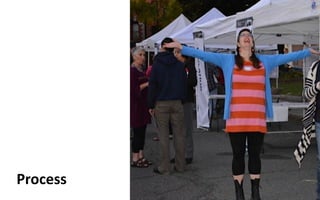
Process
Engagement
• Diverse participation
• Departments and municipal staff
• Transparent decisions
• Disadvantaged leadership
• Ongoing information
• Community-wide & neighborhood
involvement
• Social media use
• Mix it up!
Authentic Participation Build Lasting Buy-In
Design the plan development
process to link with implementation
• Think about critical stakeholders and
have them help shape the vision from
the start
• Look for ways to integrate with
emerging initiatives
• Engaged stakeholders and links to
new initiatives create built-in
implementation oversight and
actions
Process – Do your Homework
 What other planning processes
are currently happening?
– Understand planning
environment
– Beware planning fatigue!
 What has your community/region
engaged in recently?
 What other entities may be
embarking on a similar process?
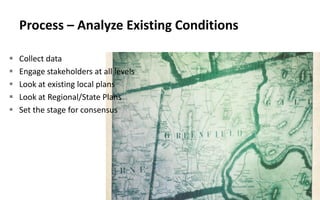
Process – Analyze Existing Conditions
 Collect data
 Engage stakeholders at all levels
 Look at existing local plans
 Look at Regional/State Plans
 Set the stage for consensus
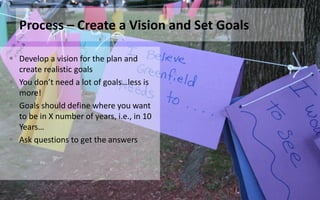
Process – Create a Vision and Set Goals
 Develop a vision for the plan and
create realistic goals
 You don’t need a lot of goals…less is
more!
 Goals should define where you want
to be in X number of years, i.e., in 10
Years…
 Ask questions to get the answers
Process – Develop Realistic Strategies
 Strategies achieve the goals
 Keep it simple
 Remember – you want to be able to
implement these
 Are they conflicting with other
strategies in the plan?
 What does this look like in 5-10
years?
Process – Create Meaningful, Accountable
Implementation Plan
 Use indicators and metrics
 Monitor outcomes and goal progress
 Commit resources
 Assign responsibilities
 Communicate your success!
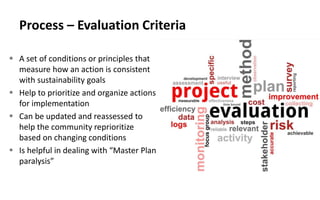
Process – Evaluation Criteria
 A set of conditions or principles that
measure how an action is consistent
with sustainability goals
 Help to prioritize and organize actions
for implementation
 Can be updated and reassessed to
help the community reprioritize
based on changing conditions
 Is helpful in dealing with “Master Plan
paralysis”
AttributesandElements
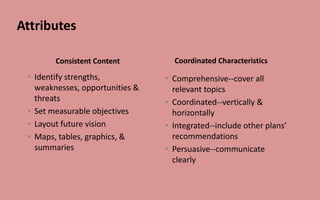
Attributes
Consistent Content
• Identify strengths,
weaknesses, opportunities &
threats
• Set measurable objectives
• Layout future vision
• Maps, tables, graphics, &
summaries
Coordinated Characteristics
• Comprehensive--cover all
relevant topics
• Coordinated--vertically &
horizontally
• Integrated--include other plans’
recommendations
• Persuasive--communicate
clearly
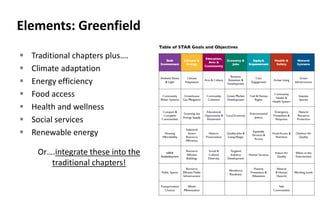
Elements: Greenfield
 Traditional chapters plus….
 Climate adaptation
 Energy efficiency
 Food access
 Health and wellness
 Social services
 Renewable energy
Or….integrate these into the
traditional chapters!
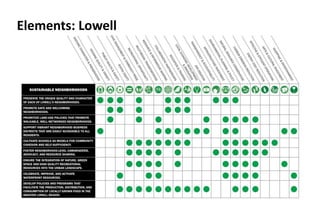
Elements: Lowell
Implementation & Evaluation
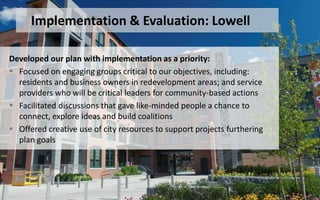
Developed our plan with implementation as a priority:
 Focused on engaging groups critical to our objectives, including:
residents and business owners in redevelopment areas; and service
providers who will be critical leaders for community-based actions
 Facilitated discussions that gave like-minded people a chance to
connect, explore ideas and build coalitions
 Offered creative use of city resources to support projects furthering
plan goals
Implementation & Evaluation: Lowell
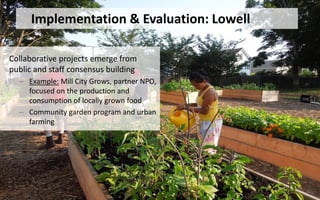
Collaborative projects emerge from
public and staff consensus building
– Example: Mill City Grows, partner NPO,
focused on the production and
consumption of locally grown food
– Community garden program and urban
farming
Implementation & Evaluation: Lowell
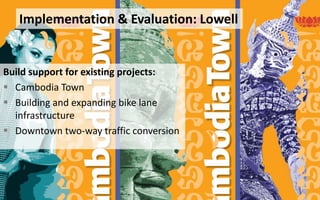
Build support for existing projects:
 Cambodia Town
 Building and expanding bike lane
infrastructure
 Downtown two-way traffic conversion
Implementation & Evaluation: Lowell
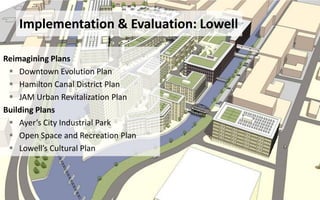
Reimagining Plans
 Downtown Evolution Plan
 Hamilton Canal District Plan
 JAM Urban Revitalization Plan
Building Plans
 Ayer’s City Industrial Park
 Open Space and Recreation Plan
 Lowell’s Cultural Plan
Implementation & Evaluation: Lowell
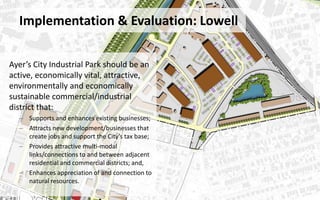
Ayer’s City Industrial Park should be an
active, economically vital, attractive,
environmentally and economically
sustainable commercial/industrial
district that:
– Supports and enhances existing businesses;
– Attracts new development/businesses that
create jobs and support the City’s tax base;
– Provides attractive multi-modal
links/connections to and between adjacent
residential and commercial districts; and,
– Enhances appreciation of and connection to
natural resources.
Implementation & Evaluation: Lowell
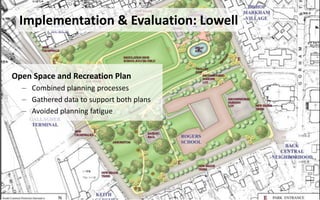
Open Space and Recreation Plan
– Combined planning processes
– Gathered data to support both plans
– Avoided planning fatigue
Implementation & Evaluation: Lowell
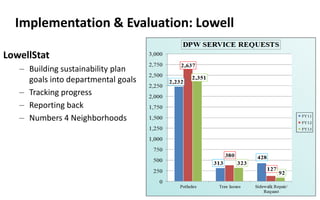
LowellStat
– Building sustainability plan
goals into departmental goals
– Tracking progress
– Reporting back
– Numbers 4 Neighborhoods
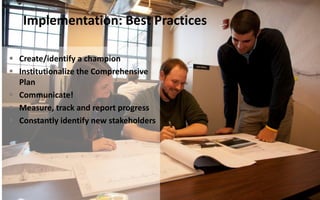
 Create/identify a champion
 Institutionalize the Comprehensive
Plan
 Communicate!
 Measure, track and report progress
 Constantly identify new stakeholders
Implementation: Best Practices
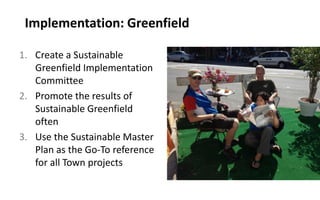
Implementation: Greenfield
1. Create a Sustainable
Greenfield Implementation
Committee
2. Promote the results of
Sustainable Greenfield
often
3. Use the Sustainable Master
Plan as the Go-To reference
for all Town projects
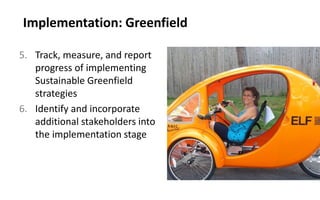
Implementation: Greenfield
5. Track, measure, and report
progress of implementing
Sustainable Greenfield
strategies
6. Identify and incorporate
additional stakeholders into
the implementation stage
Discussion and Questions
Discussion
 What are obstacles to
creating a:
– Sustainable Comp Plan
– Sustainability Comp Plan?
 What elements are the most
challenging?
 How do we ensure
implementation?
 What resources/information
do you need?
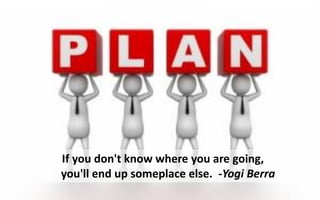
If you don't know where you are going,
you'll end up someplace else. -Yogi Berra
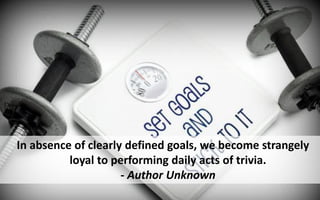
In absence of clearly defined goals, we become strangely
loyal to performing daily acts of trivia.
- Author Unknown
Angela Vincent | avincent@vhb.com | 603.305.5385
Craig Thomas | cthomas@lowellma.gov | 978.674.1445
Yovani Baez | ybaez@lowellma.gov | 978.674.1413

Getting to the Bottom of Sustainable Comprehensive Plans

  • 1.
    Not Your AverageSustainability Session: Getting to the Bottom of Sustainable Comprehensive Plans Massachusetts Association of Planning Directors Conference – June 5, 2014
  • 2.
    Agenda  Sustainability MasterPlan Defined  Why?  Principles  Process  Attributes and Elements  Implementation and Evaluation  Discussion and Questions  Deep Thoughts
  • 3.
    Meet VHB  300+employees in 4 offices around the MA  Integrated planning, transportation, land development & environmental services  Innovative tools and resources to meet your needs
  • 4.
    City of Lowell,MA  Lowell is home is just over 106,000 residents, making it the fourth largest city in the Commonwealth  Plan E form of government  Creative economy central to rebirth of City – approx. 200 live/work studios and 250 active artist studios  UMass Lowell expansion: 7 new buildings since 2012 and 45% increase in student enrollment in the last 6 years to a total of 17,000  Lowell General Hospital anchors strong medical field
  • 5.
    Two Terms Defined: A Sustainability Comprehensive Plan focuses on the long-term viability of the economic, environmental, social and cultural aspects of communities and regions. • APA provides one definition, “…[a] plan to meet the needs of current and future generations without compromising the ecosystems upon which they depend by balancing social, economic, and environmental resources, incorporating resilience, and linking local actions to regional and global concerns.”  A Sustainable Comprehensive Plan is an active, living document with engaged stakeholders and active projects that remains at the forefront of development and planning actions.
  • 6.
    Why do aSustainability Comprehensive Plan?  Incorporate sustainability principles into planning and decision-making  Create more resilient, livable communities  Plan for all critical infrastructure, resource needs and potential impacts (heat island, flooding, etc.)  Keep up with the times!
  • 7.
    Sustainability Principles • Livablebuilt environment • Harmony with nature • Resilient economy • Interwoven equity • Healthy communities • Responsible regionalism
  • 9.
    Sustainability Comprehensive Plansshould…  Link with current redevelopment initiatives  Include a comprehensive background review to establish community consensus  Seek wide-scale buy-in and develop diverse stakeholders to carry plan goals and strategies forward  Track progress of quantifiable objectives; many goals cannot be easily tracked, and that’s OK!
  • 10.
    Our Experiences Greenfield  2012-2013 Builds upon existing planning efforts including Sustainable Franklin County  250+ people attended workshops  550+ ideas generated  40+ Master Plan Advisory Committee meetings  Used MindMixer for ongoing, virtual participation Lowell  2010-2013  Update to 2003 Master Plan with a comprehensive sustainability vision  Engaged 800+ people in data collection, 175+ in innovative planning tool (Community PlanIt)  Multi-language visioning sessions attended by more than 160 stakeholders  Approved by Council Spring 2013
  • 11.
  • 12.
    Engagement • Diverse participation •Departments and municipal staff • Transparent decisions • Disadvantaged leadership • Ongoing information • Community-wide & neighborhood involvement • Social media use • Mix it up! Authentic Participation Build Lasting Buy-In Design the plan development process to link with implementation • Think about critical stakeholders and have them help shape the vision from the start • Look for ways to integrate with emerging initiatives • Engaged stakeholders and links to new initiatives create built-in implementation oversight and actions
  • 13.
    Process – Doyour Homework  What other planning processes are currently happening? – Understand planning environment – Beware planning fatigue!  What has your community/region engaged in recently?  What other entities may be embarking on a similar process?
  • 14.
    Process – AnalyzeExisting Conditions  Collect data  Engage stakeholders at all levels  Look at existing local plans  Look at Regional/State Plans  Set the stage for consensus
  • 15.
    Process – Createa Vision and Set Goals  Develop a vision for the plan and create realistic goals  You don’t need a lot of goals…less is more!  Goals should define where you want to be in X number of years, i.e., in 10 Years…  Ask questions to get the answers
  • 16.
    Process – DevelopRealistic Strategies  Strategies achieve the goals  Keep it simple  Remember – you want to be able to implement these  Are they conflicting with other strategies in the plan?  What does this look like in 5-10 years?
  • 17.
    Process – CreateMeaningful, Accountable Implementation Plan  Use indicators and metrics  Monitor outcomes and goal progress  Commit resources  Assign responsibilities  Communicate your success!
  • 18.
    Process – EvaluationCriteria  A set of conditions or principles that measure how an action is consistent with sustainability goals  Help to prioritize and organize actions for implementation  Can be updated and reassessed to help the community reprioritize based on changing conditions  Is helpful in dealing with “Master Plan paralysis”
  • 19.
  • 20.
    Attributes Consistent Content • Identifystrengths, weaknesses, opportunities & threats • Set measurable objectives • Layout future vision • Maps, tables, graphics, & summaries Coordinated Characteristics • Comprehensive--cover all relevant topics • Coordinated--vertically & horizontally • Integrated--include other plans’ recommendations • Persuasive--communicate clearly
  • 21.
    Elements: Greenfield  Traditionalchapters plus….  Climate adaptation  Energy efficiency  Food access  Health and wellness  Social services  Renewable energy Or….integrate these into the traditional chapters!
  • 22.
  • 23.
  • 24.
    Developed our planwith implementation as a priority:  Focused on engaging groups critical to our objectives, including: residents and business owners in redevelopment areas; and service providers who will be critical leaders for community-based actions  Facilitated discussions that gave like-minded people a chance to connect, explore ideas and build coalitions  Offered creative use of city resources to support projects furthering plan goals Implementation & Evaluation: Lowell
  • 25.
    Collaborative projects emergefrom public and staff consensus building – Example: Mill City Grows, partner NPO, focused on the production and consumption of locally grown food – Community garden program and urban farming Implementation & Evaluation: Lowell
  • 26.
    Implementation & Evaluation:Lowell Build support for existing projects:  Cambodia Town  Building and expanding bike lane infrastructure  Downtown two-way traffic conversion Implementation & Evaluation: Lowell
  • 27.
    Implementation & Evaluation:Lowell Reimagining Plans  Downtown Evolution Plan  Hamilton Canal District Plan  JAM Urban Revitalization Plan Building Plans  Ayer’s City Industrial Park  Open Space and Recreation Plan  Lowell’s Cultural Plan
  • 28.
    Implementation & Evaluation:Lowell Ayer’s City Industrial Park should be an active, economically vital, attractive, environmentally and economically sustainable commercial/industrial district that: – Supports and enhances existing businesses; – Attracts new development/businesses that create jobs and support the City’s tax base; – Provides attractive multi-modal links/connections to and between adjacent residential and commercial districts; and, – Enhances appreciation of and connection to natural resources.
  • 29.
    Implementation & Evaluation:Lowell Open Space and Recreation Plan – Combined planning processes – Gathered data to support both plans – Avoided planning fatigue
  • 30.
    Implementation & Evaluation:Lowell LowellStat – Building sustainability plan goals into departmental goals – Tracking progress – Reporting back – Numbers 4 Neighborhoods
  • 31.
     Create/identify achampion  Institutionalize the Comprehensive Plan  Communicate!  Measure, track and report progress  Constantly identify new stakeholders Implementation: Best Practices
  • 32.
    Implementation: Greenfield 1. Createa Sustainable Greenfield Implementation Committee 2. Promote the results of Sustainable Greenfield often 3. Use the Sustainable Master Plan as the Go-To reference for all Town projects
  • 33.
    Implementation: Greenfield 5. Track,measure, and report progress of implementing Sustainable Greenfield strategies 6. Identify and incorporate additional stakeholders into the implementation stage
  • 34.
  • 35.
    Discussion  What areobstacles to creating a: – Sustainable Comp Plan – Sustainability Comp Plan?  What elements are the most challenging?  How do we ensure implementation?  What resources/information do you need?
  • 36.
    If you don'tknow where you are going, you'll end up someplace else. -Yogi Berra
  • 37.
    In absence ofclearly defined goals, we become strangely loyal to performing daily acts of trivia. - Author Unknown
  • 38.
    Angela Vincent |avincent@vhb.com | 603.305.5385 Craig Thomas | cthomas@lowellma.gov | 978.674.1445 Yovani Baez | ybaez@lowellma.gov | 978.674.1413