Climate Change Adaptation Planning &
Massachusetts Policy Updates
MassachusettsAssociation of Planning Directors
AnnualConference, Amherst, MA
June5, 2014
E. Heidi Ricci, Mass Audubon
Shapingthe Future of Your Community Program
Working in the state’s
fastest developing
regions to provide
community leaders and
concerned citizens with
tools and support to
chart a more sustainable
future
www.massaudubon.org/shapingthefuture
ClimateChange and Adaptation Planning for
Community Resiliency
• Climate Changes in the Northeast – Impacts
• Landscape-level Planning for Resiliency
• Infrastructure – Opportunities to Improve
Resiliency
• Building More Sustainably – Conservation
Design, LID
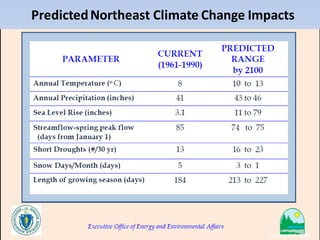
PredictedNortheast Climate Change Impacts
2014 National Climate Assessment
• Climate change is already affecting the
American people in far-reaching ways…
extreme weather events … have become more
frequent and/or intense, including prolonged
periods of heat, heavy downpours,and, in
some regions, floods and droughts…These and
other aspects of climate change are disrupting
people’s lives and damaging some sectors of
our economy.
Impacts of Climate Change
• Natural Resources and Habitat
– Forestsstressed by drought, insects, diseases;
loss of fish, increase in pollutionandtoxic algal
blooms
• HumanHealth and Welfare:
– Heat, air quality,mosquito-borne disease,
flooding
• Key Infrastructure
– Roads,water and wastewater plantsvulnerable
to flooding
• Local Economy (including Government, Land
Use)
– Costsof constantrebuilding, choices in land use
• CoastalZone and Oceans
– Barrier beaches and salt marshes inundated,
lobsterand other cold water fisheries impacted
Adaptation
• ADAPTATION means increasing resiliency and
reducing vulnerability of our natural and built
systems, and better preparing our response
capabilities
Bill S.2028 An Act providing for the establishment of a
comprehensiveadaptation managementplan [CAMP] in
response to climate change
Urban Climate Change Governance Survey
350 cities participated in the survey
73%are conducting both adaptation and mitigationplanning
75%report that climate change is being mainstreamedinto planning
across their local government
56%have mitigation targets and actions address community as well as
local governmentemissions
21%- mitigation efforts have significantly contributed to other local
developmentpriorities
Key barriers:
• Insufficient funding for implementationor staff
• Difficulty mainstreaming climate change and coordinating collaborative
action across silos
• Lack of informationonlocal impacts and responses
ICLEI - Local Governments for Sustainability www.urbanclimatesurvey.com
Imagecredit: U.S. Global ChangeResearch Program (www.globalchange.gov).
Climate Change Paradox
More Floods More Droughts
Mass Rivers Alliance 2009
Westfield RiverHousatonic River
Resiliency
“A Resilient City is one that has developed
capacities to help absorb future shocks and
stresses to its social, economic, and technical
systems and infrastructures so as to still be able
to maintain essentially the same functions,
structures, systems, and identity.”
Source: ResilientCity.org
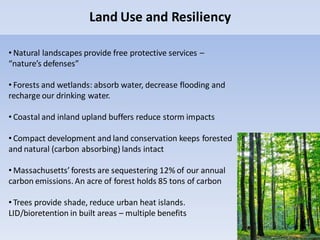
Land Use and Resiliency
• Natural landscapes provide free protective services –
“nature’s defenses”
• Forests and wetlands: absorb water, decrease flooding and
recharge our drinking water.
• Coastal and inland upland buffers reduce storm impacts
• Compact development and land conservation keeps forested
and natural (carbon absorbing) lands intact
• Massachusetts’ forests are sequestering 12% of our annual
carbon emissions. An acre of forest holds 85 tons of carbon
• Trees provide shade, reduce urban heat islands.
LID/bioretention in built areas – multiple benefits
Landscape Planning
• Protect highly resilient lands
• Concentrate development
away from vulnerable areas
• Align local plans and zoning
• Look beyond parcel and
municipal boundaries
TNC Resilient Lands (Losing Ground 2014
Prioritize Protection:
Important habitat and
Green Infrastructure
Prioritize Development:
Concentrate near infrastructure
and away from important natural
resources
Planning Ahead for Growth and Development
RegionalPlans – Toolkitfor Implementing
• Priority Protection Areas
• Priority DevelopmentAreas
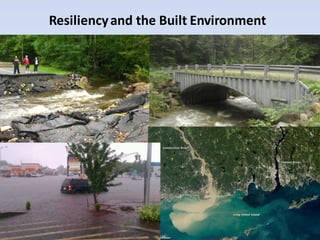
Resiliencyand the Built Environment
10
years
10
years
10
years
10
years
10 +
years
Estimate for Stream Crossing Span:
Cost of Two Replacements in 6 years:
$130k
$300-400k
Comparison of Estimated
Crossing Lifespan and Costs
River process slides courtesy Carrie Banks, MA Division of Ecological Restoration
Remove Obsolete, Hazardous Dams
Whittenton Dam, Taunton - DER
Taunton River after dam removal – H. Ricci
Benefits of Green Infrastructure and LID
• Environmental
• Aesthetics and market value
• Avoided costs
• Meeting regulatory requirements
• Adapting to Climate Change
Gap in water infrastructure funding over next 20 years, Water Infrastructure
Finance Commission, 2012. Slide by Martin Pillsbury, MAPC
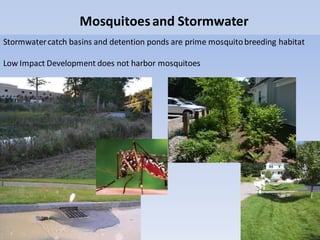
Mosquitoesand Stormwater
Stormwatercatch basins and detention ponds are prime mosquitobreeding habitat
Low Impact Development does not harbor mosquitoes
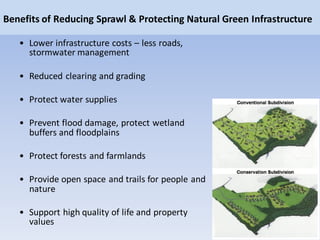
• Lower infrastructure costs – less roads,
stormwater management
• Reduced clearing and grading
• Protect water supplies
• Prevent flood damage, protect wetland
buffers and floodplains
• Protect forests and farmlands
• Provide open space and trails for people and
nature
• Support high quality of life and property
values
Benefits of Reducing Sprawl & Protecting Natural Green Infrastructure
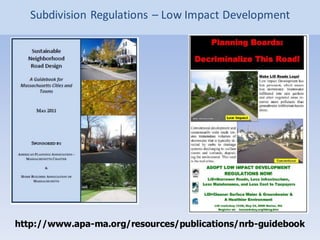
http://www.apa-ma.org/resources/publications/nrb-guidebook
Subdivision Regulations – Low Impact Development
LIDAR mapping, other technical support
Regulatory incentives e.g. Water Management Act
Division of Ecological Restoration
Pending Legislation:
Comprehensive Adaptation and Management Plan
Environmental Bond
Water Infrastructure Finance bill
State Support for Adaptation Planning
and Green Infrastructure
www.massaudubon.org/shapingthefuture
Heidi Ricci
hricci@massaudubon.org
781-259-2172

Climate Change Adaption Planning & MA Policy Updates

  • 1.
    Climate Change AdaptationPlanning & Massachusetts Policy Updates MassachusettsAssociation of Planning Directors AnnualConference, Amherst, MA June5, 2014 E. Heidi Ricci, Mass Audubon
  • 2.
    Shapingthe Future ofYour Community Program Working in the state’s fastest developing regions to provide community leaders and concerned citizens with tools and support to chart a more sustainable future www.massaudubon.org/shapingthefuture
  • 4.
    ClimateChange and AdaptationPlanning for Community Resiliency • Climate Changes in the Northeast – Impacts • Landscape-level Planning for Resiliency • Infrastructure – Opportunities to Improve Resiliency • Building More Sustainably – Conservation Design, LID
  • 5.
  • 6.
    2014 National ClimateAssessment • Climate change is already affecting the American people in far-reaching ways… extreme weather events … have become more frequent and/or intense, including prolonged periods of heat, heavy downpours,and, in some regions, floods and droughts…These and other aspects of climate change are disrupting people’s lives and damaging some sectors of our economy.
  • 7.
    Impacts of ClimateChange • Natural Resources and Habitat – Forestsstressed by drought, insects, diseases; loss of fish, increase in pollutionandtoxic algal blooms • HumanHealth and Welfare: – Heat, air quality,mosquito-borne disease, flooding • Key Infrastructure – Roads,water and wastewater plantsvulnerable to flooding • Local Economy (including Government, Land Use) – Costsof constantrebuilding, choices in land use • CoastalZone and Oceans – Barrier beaches and salt marshes inundated, lobsterand other cold water fisheries impacted
  • 8.
    Adaptation • ADAPTATION meansincreasing resiliency and reducing vulnerability of our natural and built systems, and better preparing our response capabilities Bill S.2028 An Act providing for the establishment of a comprehensiveadaptation managementplan [CAMP] in response to climate change
  • 9.
    Urban Climate ChangeGovernance Survey 350 cities participated in the survey 73%are conducting both adaptation and mitigationplanning 75%report that climate change is being mainstreamedinto planning across their local government 56%have mitigation targets and actions address community as well as local governmentemissions 21%- mitigation efforts have significantly contributed to other local developmentpriorities Key barriers: • Insufficient funding for implementationor staff • Difficulty mainstreaming climate change and coordinating collaborative action across silos • Lack of informationonlocal impacts and responses ICLEI - Local Governments for Sustainability www.urbanclimatesurvey.com
  • 10.
    Imagecredit: U.S. GlobalChangeResearch Program (www.globalchange.gov).
  • 11.
    Climate Change Paradox MoreFloods More Droughts Mass Rivers Alliance 2009 Westfield RiverHousatonic River
  • 12.
    Resiliency “A Resilient Cityis one that has developed capacities to help absorb future shocks and stresses to its social, economic, and technical systems and infrastructures so as to still be able to maintain essentially the same functions, structures, systems, and identity.” Source: ResilientCity.org
  • 13.
    Land Use andResiliency • Natural landscapes provide free protective services – “nature’s defenses” • Forests and wetlands: absorb water, decrease flooding and recharge our drinking water. • Coastal and inland upland buffers reduce storm impacts • Compact development and land conservation keeps forested and natural (carbon absorbing) lands intact • Massachusetts’ forests are sequestering 12% of our annual carbon emissions. An acre of forest holds 85 tons of carbon • Trees provide shade, reduce urban heat islands. LID/bioretention in built areas – multiple benefits
  • 14.
    Landscape Planning • Protecthighly resilient lands • Concentrate development away from vulnerable areas • Align local plans and zoning • Look beyond parcel and municipal boundaries TNC Resilient Lands (Losing Ground 2014
  • 15.
    Prioritize Protection: Important habitatand Green Infrastructure Prioritize Development: Concentrate near infrastructure and away from important natural resources Planning Ahead for Growth and Development RegionalPlans – Toolkitfor Implementing • Priority Protection Areas • Priority DevelopmentAreas
  • 16.
  • 17.
    10 years 10 years 10 years 10 years 10 + years Estimate forStream Crossing Span: Cost of Two Replacements in 6 years: $130k $300-400k Comparison of Estimated Crossing Lifespan and Costs River process slides courtesy Carrie Banks, MA Division of Ecological Restoration
  • 18.
    Remove Obsolete, HazardousDams Whittenton Dam, Taunton - DER Taunton River after dam removal – H. Ricci
  • 19.
    Benefits of GreenInfrastructure and LID • Environmental • Aesthetics and market value • Avoided costs • Meeting regulatory requirements • Adapting to Climate Change Gap in water infrastructure funding over next 20 years, Water Infrastructure Finance Commission, 2012. Slide by Martin Pillsbury, MAPC
  • 20.
    Mosquitoesand Stormwater Stormwatercatch basinsand detention ponds are prime mosquitobreeding habitat Low Impact Development does not harbor mosquitoes
  • 21.
    • Lower infrastructurecosts – less roads, stormwater management • Reduced clearing and grading • Protect water supplies • Prevent flood damage, protect wetland buffers and floodplains • Protect forests and farmlands • Provide open space and trails for people and nature • Support high quality of life and property values Benefits of Reducing Sprawl & Protecting Natural Green Infrastructure
  • 22.
  • 23.
    LIDAR mapping, othertechnical support Regulatory incentives e.g. Water Management Act Division of Ecological Restoration Pending Legislation: Comprehensive Adaptation and Management Plan Environmental Bond Water Infrastructure Finance bill State Support for Adaptation Planning and Green Infrastructure
  • 24.