COMMUNICATION CLIENT TEACHING & DOCUMENTATION
COMMUNICATION:  What is it? Exchange of information, ideas, feelings Very important to nursing Failure to communicate causes serious difficulties, increases liability, threatens professional credibility Is a skill learned.  Takes many years to master
Levels of Communication Intrapersonal:  Interpersonal:  Transpersonal:
Basic Elements of the Process
Communication leads to Interpersonal Relationships The nurses ability includes: Taking initiative in establishing and maintaining communication To be authentic (one’s self, sincere) To respond appropriately to the other person Develop mutuality (pt./nurse relationship is a partnership, both are equal) Respect and honor the differences
Zones of personal space Intimate:  0-18 inches
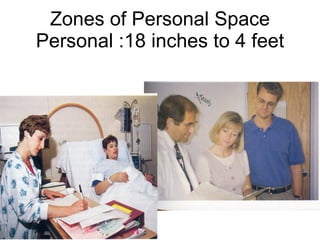
Zones of Personal Space Personal :18 inches to 4 feet
Zones of touch Social Zone (permission not needed) Hands, arms, shoulders, back Consent Zone (permission needed) Mouth, wrists, feet Vulnerable zone (special care needed) Face, neck, front of body Intimate Zone (great sensitivity needed) Genitalia, rectum
Zones of Personal Space: Social Zone:  4-12 feet
Zones of Personal Space: Public Zone:  12 feet +
Thoughts on Communication All communication contains stimuli with the potential to influence others (Curtis,et al l997)
Levels, continued Small group:  goal directed, understands group dynamics.  Task forces, client support groups, workable size, suitable seating, commitment. Public:  interaction with an audience, use of eye contact, gestures, voice inflections, media materials,  for teaching, increasing public knowledge
Nurse as a small group leader
Forms of Communication Verbal:  spoken or written words  Vocabulary (7%), connotative meaning, pacing, intonation (38%) clarity, and brevity, timing and relevance Non-verbal:  55% personal appearance, posture and gait, facial expression, eye contact, gestures, sounds, territoriality and personal space, symbolic, most accurate
Nurse-Client Helping Relationships Therapeutic Promotes a climate that facilitates positive change and growth.  The nurse establishes, directs, and takes responsibility for the interaction.  Time-frame, goal-oriented approach  Highly confidential.  The client needs take priority over nurse’s needs.  Built on trust and ability to comfort.
Phases of the Helping Relationship Pre-interaction phase   Orientation phase Working phase Termination phase
Elements of Professional Communication Courtesy Use of names Privacy and Confidentiality Trustworthiness Autonomy and Responsibility Assertiveness
Therapeutic Communication Techniques Active listening Sharing Observations Sharing Empathy Sharing Hope Sharing Humor Sharing Feelings Using Touch
Therapeutic, continued Using Silence Asking Relevant Questions: open-ended, general leads, paraphrasing, focusing, making observation Providing Information: health teaching Clarifying, summarizing, confronting Self-disclosure: intent to help the other person, not the nurse
Non-therapeutic Communication Techniques Asking personal questions Giving personal opinions Changing the subject Automatic responses: stereotyping or cliché` False Reassurance Sympathy Asking for Explanations:  Why? Questions
Non-therapeutic, continued Approval or Disapproval: judgmental Defensive Responses Passive or Aggressive Responses Arguing or Challenging
 
Blocks to Effective Communication Language barriers, different perceptions Unresponsive, comatose persons Elderly, or loss of senses, dementia Persons in extreme pain, or grieving Persons with behavioral problems Depression, or other psychiatric disorders
Exercise #1 Mrs. Maria Ramirez, an American of Puerto Rican descent, is faced with the difficult decision of whether to continue chemotherapy in the face of a rapidly spreading malignancy.  What communication techniques could the nurse use to help her at this point, and what traps must the nurse avoid in such situations?
Exercise #2 Jan, a nurse colleague, is having difficulty standing up to a physician who has an abrupt, intimidating communication style.  She often ends up with a lot of unspoken anger, developing tension headaches, and easily becoming tearful.  What could the nurse do to help.
Exercise #3 Mr. Hess, a client with Parkinson’s disease living at an extended care facility, has a stiff, expressionless face.  He sits slumped in a recliner chair all day and seems lost in his own world, rarely looking at or interacting with anyone.  When he does talk, he mumbles in a soft voice, and his words are difficult to understand.  What kinds of things could the nurse do to establish a helping/healing relationship with Mr. Hess?
Exercise #4 Jennifer Hughes, a new graduate, is very discouraged.  In school, she had felt a great deal of anxiety about her own performance, and even now she finds it difficult to be positive about herself or her job.  What knowledge about communication could she use to help improve her situation?
Exercise #5 Mrs. Esther Larson, a client who has been recently admitted to a hospice program, confides in the nurse that she feels overwhelmed with the number of things she must attend to now that she’s facing the possibility of death.  She says, “My thoughts are all over the place.  I don’t know where to start.”  What communication techniques, based on the critical thinking model, could the nurse use to help her at this point?
Teaching
Teaching & Learning:  What is it? Interactive  Conscious, deliberate actions that help individuals gain new knowledge, change attitudes, adopt new behaviors, or perform new skills. Learning is the purposeful acquisition of new knowledge, attitudes, behaviors and skills Usually involves demonstration Learning objective:  “will be able to…..”
The Teaching Role of the Nurse Teaching plan important because: Short stays, impact client outcomes Need knowledge concerning their illness, condition or prevention Need to make informed decisions  Improve overall health and wellness Coping with impaired functioning, restoration of health
Standards for Client Education Joint Commission on Accreditation of Healthcare Organizations (JCAHO) “Goal 2000 of client and family education is to promote healthy behaviors and encourage the client’s involvement both in the delivery of health care and in health care decisions; to improve outcomes.”
Domains of Learning Cognitive (understand) Affective (attitudes) Psychomotor (Motor skills)
How do we learn? Attentional set:  (pain, anxiety, environment, distractions etc.)  Motivation:  may result from a social,(connection, self-esteem) task,(achieve, competence) or physical motive,(survival) from within Compliance is the client’s adherence to the prescribed plan of therapy
Ability to Learn Developmental capability, cognitive function Learning in Children  Adult learning, can identify own learning needs, draws on prior experiences, set mutual goals Physical capabilities, size, strength, coordination, sensory acuity, energy, illness, pain Learning Environment
Adult/Adolescent Learning
Child Learning
Teaching incorporates what client already knows Children  Learn by  Exploration, Touch, trust, imitation
 
 
Case Study Mrs. S has a 10-year-history of HTN and a 5-year-history of DM.  Recently her HTN has become uncontrolled, and she has been diagnosed with depression.  Her medications, which have recently been changed, include captopril (Capoten), 25 mg 3 times a day; diltiazem (Cardizem), 240 mg. every morning; metformin (Glucophage XR), 1500 mg before the evening meal; and sertraline (Zoloft), 100 mg. at bedtime.  The nurse identifies the priority nursing diagnosis as “Deficient knowledge R/T change in medications”.  The nurse wants to develop a plan of care that uses the three domains of learning.  What are the client’s teaching priorities?  Which learning needs would require a cognitive method?  Which need would be more appropriate to satisfy through affective or psychomotor methods?
DOCUMENTATION
What it must be……. Documentation is a vital aspect of nursing practice. It must be comprehensive, a legal record flexible enough to retrieve critical data, Maintain quality and continuity of care Track client outcomes, for reimbursement Reflect current standards
Multidisciplinary team
Guidelines for Charting Factual:  descriptive  objective information about what the nurse sees, hears, feels, and smells, direct observation and measurement  do not use words like, appears, seems, apparently,  (they suggest the nurse did not know the facts).  Subjective data needs to be in quotation marks.
Guidelines for Charting, cont. Accurate:  exact TPR B/P, I&O, measurements of all types  Dated and timed  Use of standardized abbreviations, symbols, system of measures Spelling, complete, current, organized
Charting Chart according to hospital policy JCAHO guidelines:  client outcomes, response to treatment, teaching, or preventive care Reflects the nursing process Expects a multidisciplinary care plan
 
 
Chart Record Contains admission sheet Physician’s orders sheets Nurse’s admission assessment Graphic sheet and flow sheets Medical history and examination (H&P) Nurses’ notes Health card discipline's records Discharge summary
Charting by Exception Used to streamline documentation Check-off method Standards integrated into forms Predefined assessment findings, interventions for normal recovery, expected outcomes, provides consistency If goals not met, variance documentation needed
Critical Pathways Standardized by disease or condition Multidisciplinary:  PT, OT, RT, Dietary, Psychosocial, discharge planning, medicine, nursing, etc. Reduce duplication, amount of charting Generally cover 24 hours or more of care Easily defined variances, negative (or complications) unexpected outcome: (positive), would be an early outcome, before average time
Other types of records Acuity recording systems Standardized care plans Discharge summary forms  Home health care (medicare guidelines) Long-term health care documentation:  weekly summaries, resident activity notebooks Computerized documentation:  RTs and discharge planners, others Change of shift report:  for communication Telephone orders/Incident reports
Telephone Orders
Doctors’ orders
Exercise You have just followed an order that stated “Insert a 16 Fr. Foley catheter” Following insertion, what does your charting state???
Exercise You just followed an order that stated, “Give Demerol 75 mg IM q4h and prn” What will your charting state?
The End

Therapeutic Comm. & Teaching

  • 1.
  • 2.
    COMMUNICATION: Whatis it? Exchange of information, ideas, feelings Very important to nursing Failure to communicate causes serious difficulties, increases liability, threatens professional credibility Is a skill learned. Takes many years to master
  • 3.
    Levels of CommunicationIntrapersonal: Interpersonal: Transpersonal:
  • 4.
    Basic Elements ofthe Process
  • 5.
    Communication leads toInterpersonal Relationships The nurses ability includes: Taking initiative in establishing and maintaining communication To be authentic (one’s self, sincere) To respond appropriately to the other person Develop mutuality (pt./nurse relationship is a partnership, both are equal) Respect and honor the differences
  • 6.
    Zones of personalspace Intimate: 0-18 inches
  • 7.
    Zones of PersonalSpace Personal :18 inches to 4 feet
  • 8.
    Zones of touchSocial Zone (permission not needed) Hands, arms, shoulders, back Consent Zone (permission needed) Mouth, wrists, feet Vulnerable zone (special care needed) Face, neck, front of body Intimate Zone (great sensitivity needed) Genitalia, rectum
  • 9.
    Zones of PersonalSpace: Social Zone: 4-12 feet
  • 10.
    Zones of PersonalSpace: Public Zone: 12 feet +
  • 11.
    Thoughts on CommunicationAll communication contains stimuli with the potential to influence others (Curtis,et al l997)
  • 12.
    Levels, continued Smallgroup: goal directed, understands group dynamics. Task forces, client support groups, workable size, suitable seating, commitment. Public: interaction with an audience, use of eye contact, gestures, voice inflections, media materials, for teaching, increasing public knowledge
  • 13.
    Nurse as asmall group leader
  • 14.
    Forms of CommunicationVerbal: spoken or written words Vocabulary (7%), connotative meaning, pacing, intonation (38%) clarity, and brevity, timing and relevance Non-verbal: 55% personal appearance, posture and gait, facial expression, eye contact, gestures, sounds, territoriality and personal space, symbolic, most accurate
  • 15.
    Nurse-Client Helping RelationshipsTherapeutic Promotes a climate that facilitates positive change and growth. The nurse establishes, directs, and takes responsibility for the interaction. Time-frame, goal-oriented approach Highly confidential. The client needs take priority over nurse’s needs. Built on trust and ability to comfort.
  • 16.
    Phases of theHelping Relationship Pre-interaction phase Orientation phase Working phase Termination phase
  • 17.
    Elements of ProfessionalCommunication Courtesy Use of names Privacy and Confidentiality Trustworthiness Autonomy and Responsibility Assertiveness
  • 18.
    Therapeutic Communication TechniquesActive listening Sharing Observations Sharing Empathy Sharing Hope Sharing Humor Sharing Feelings Using Touch
  • 19.
    Therapeutic, continued UsingSilence Asking Relevant Questions: open-ended, general leads, paraphrasing, focusing, making observation Providing Information: health teaching Clarifying, summarizing, confronting Self-disclosure: intent to help the other person, not the nurse
  • 20.
    Non-therapeutic Communication TechniquesAsking personal questions Giving personal opinions Changing the subject Automatic responses: stereotyping or cliché` False Reassurance Sympathy Asking for Explanations: Why? Questions
  • 21.
    Non-therapeutic, continued Approvalor Disapproval: judgmental Defensive Responses Passive or Aggressive Responses Arguing or Challenging
  • 22.
  • 23.
    Blocks to EffectiveCommunication Language barriers, different perceptions Unresponsive, comatose persons Elderly, or loss of senses, dementia Persons in extreme pain, or grieving Persons with behavioral problems Depression, or other psychiatric disorders
  • 24.
    Exercise #1 Mrs.Maria Ramirez, an American of Puerto Rican descent, is faced with the difficult decision of whether to continue chemotherapy in the face of a rapidly spreading malignancy. What communication techniques could the nurse use to help her at this point, and what traps must the nurse avoid in such situations?
  • 25.
    Exercise #2 Jan,a nurse colleague, is having difficulty standing up to a physician who has an abrupt, intimidating communication style. She often ends up with a lot of unspoken anger, developing tension headaches, and easily becoming tearful. What could the nurse do to help.
  • 26.
    Exercise #3 Mr.Hess, a client with Parkinson’s disease living at an extended care facility, has a stiff, expressionless face. He sits slumped in a recliner chair all day and seems lost in his own world, rarely looking at or interacting with anyone. When he does talk, he mumbles in a soft voice, and his words are difficult to understand. What kinds of things could the nurse do to establish a helping/healing relationship with Mr. Hess?
  • 27.
    Exercise #4 JenniferHughes, a new graduate, is very discouraged. In school, she had felt a great deal of anxiety about her own performance, and even now she finds it difficult to be positive about herself or her job. What knowledge about communication could she use to help improve her situation?
  • 28.
    Exercise #5 Mrs.Esther Larson, a client who has been recently admitted to a hospice program, confides in the nurse that she feels overwhelmed with the number of things she must attend to now that she’s facing the possibility of death. She says, “My thoughts are all over the place. I don’t know where to start.” What communication techniques, based on the critical thinking model, could the nurse use to help her at this point?
  • 29.
  • 30.
    Teaching & Learning: What is it? Interactive Conscious, deliberate actions that help individuals gain new knowledge, change attitudes, adopt new behaviors, or perform new skills. Learning is the purposeful acquisition of new knowledge, attitudes, behaviors and skills Usually involves demonstration Learning objective: “will be able to…..”
  • 31.
    The Teaching Roleof the Nurse Teaching plan important because: Short stays, impact client outcomes Need knowledge concerning their illness, condition or prevention Need to make informed decisions Improve overall health and wellness Coping with impaired functioning, restoration of health
  • 32.
    Standards for ClientEducation Joint Commission on Accreditation of Healthcare Organizations (JCAHO) “Goal 2000 of client and family education is to promote healthy behaviors and encourage the client’s involvement both in the delivery of health care and in health care decisions; to improve outcomes.”
  • 33.
    Domains of LearningCognitive (understand) Affective (attitudes) Psychomotor (Motor skills)
  • 34.
    How do welearn? Attentional set: (pain, anxiety, environment, distractions etc.) Motivation: may result from a social,(connection, self-esteem) task,(achieve, competence) or physical motive,(survival) from within Compliance is the client’s adherence to the prescribed plan of therapy
  • 35.
    Ability to LearnDevelopmental capability, cognitive function Learning in Children Adult learning, can identify own learning needs, draws on prior experiences, set mutual goals Physical capabilities, size, strength, coordination, sensory acuity, energy, illness, pain Learning Environment
  • 36.
  • 37.
  • 38.
    Teaching incorporates whatclient already knows Children Learn by Exploration, Touch, trust, imitation
  • 39.
  • 40.
  • 41.
    Case Study Mrs.S has a 10-year-history of HTN and a 5-year-history of DM. Recently her HTN has become uncontrolled, and she has been diagnosed with depression. Her medications, which have recently been changed, include captopril (Capoten), 25 mg 3 times a day; diltiazem (Cardizem), 240 mg. every morning; metformin (Glucophage XR), 1500 mg before the evening meal; and sertraline (Zoloft), 100 mg. at bedtime. The nurse identifies the priority nursing diagnosis as “Deficient knowledge R/T change in medications”. The nurse wants to develop a plan of care that uses the three domains of learning. What are the client’s teaching priorities? Which learning needs would require a cognitive method? Which need would be more appropriate to satisfy through affective or psychomotor methods?
  • 42.
  • 43.
    What it mustbe……. Documentation is a vital aspect of nursing practice. It must be comprehensive, a legal record flexible enough to retrieve critical data, Maintain quality and continuity of care Track client outcomes, for reimbursement Reflect current standards
  • 44.
  • 45.
    Guidelines for ChartingFactual: descriptive objective information about what the nurse sees, hears, feels, and smells, direct observation and measurement do not use words like, appears, seems, apparently, (they suggest the nurse did not know the facts). Subjective data needs to be in quotation marks.
  • 46.
    Guidelines for Charting,cont. Accurate: exact TPR B/P, I&O, measurements of all types Dated and timed Use of standardized abbreviations, symbols, system of measures Spelling, complete, current, organized
  • 47.
    Charting Chart accordingto hospital policy JCAHO guidelines: client outcomes, response to treatment, teaching, or preventive care Reflects the nursing process Expects a multidisciplinary care plan
  • 48.
  • 49.
  • 50.
    Chart Record Containsadmission sheet Physician’s orders sheets Nurse’s admission assessment Graphic sheet and flow sheets Medical history and examination (H&P) Nurses’ notes Health card discipline's records Discharge summary
  • 51.
    Charting by ExceptionUsed to streamline documentation Check-off method Standards integrated into forms Predefined assessment findings, interventions for normal recovery, expected outcomes, provides consistency If goals not met, variance documentation needed
  • 52.
    Critical Pathways Standardizedby disease or condition Multidisciplinary: PT, OT, RT, Dietary, Psychosocial, discharge planning, medicine, nursing, etc. Reduce duplication, amount of charting Generally cover 24 hours or more of care Easily defined variances, negative (or complications) unexpected outcome: (positive), would be an early outcome, before average time
  • 53.
    Other types ofrecords Acuity recording systems Standardized care plans Discharge summary forms Home health care (medicare guidelines) Long-term health care documentation: weekly summaries, resident activity notebooks Computerized documentation: RTs and discharge planners, others Change of shift report: for communication Telephone orders/Incident reports
  • 54.
  • 55.
  • 56.
    Exercise You havejust followed an order that stated “Insert a 16 Fr. Foley catheter” Following insertion, what does your charting state???
  • 57.
    Exercise You justfollowed an order that stated, “Give Demerol 75 mg IM q4h and prn” What will your charting state?
  • 58.