1
Background & Introduction
• Reconstruction refers to the period following the
Civil War of rebuilding the United States.
• It was a time of great pain and endless questions.
• On what terms would the Confederacy be allowed
back into the Union?
• Who would establish the terms, Congress or the
President?
2
• (1863-1865) Moderates, like Presidents Abraham
Lincoln (16th pres.) and Andrew Johnson (17th
pres.), wanted to bring the South back to normal
as quickly as possible.
• Moderates- a person who holds moderate (less
extreme) views, especially in politics
• However, Radical Republicans used Congress to
block any moderate approaches, impose harsh
terms, and upgrade the rights of the freedmen.
• Radical Republicans- demanded harsh policies
for punishing the former rebels, and
emphasizing equality, civil rights, and voting
rights for the "freedmen" (recently freed slaves)
3
• The end of Reconstruction was a staggered
process, and the period of Republican control
ended at different times in different states. With the
Compromise of 1877.
• This was followed by a period that white
Southerners labeled Redemption, during which
white-dominated state legislatures enacted Jim
Crow laws and, beginning in 1890, disenfranchised
most blacks and many poor whites through a
combination of constitutional amendments and
electoral laws.
4
Purpose of Reconstruction
• Reconstruction addressed how the eleven
seceding states would:
• regain what the Constitution calls a
"republican form of government" and be
reseated in Congress
• address the civil status of the former leaders
of the Confederacy, and the Constitutional
and legal status of freedmen, especially their
civil rights and whether they should be given
the right to vote. Intense controversy erupted
throughout the South over these issues
5
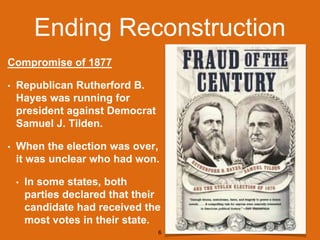
Ending Reconstruction
Compromise of 1877
• Republican Rutherford B.
Hayes was running for
president against Democrat
Samuel J. Tilden.
• When the election was over,
it was unclear who had won.
• In some states, both
parties declared that their
candidate had received the
most votes in their state.
6
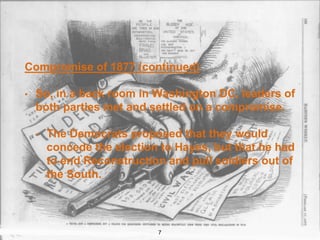
Compromise of 1877 (continued)
• So, in a back room in Washington DC, leaders of
both parties met and settled on a compromise.
• The Democrats proposed that they would
concede the election to Hayes, but that he had
to end Reconstruction and pull soldiers out of
the South.
7
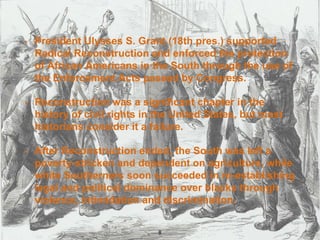
• President Ulysses S. Grant (18th pres.) supported
Radical Reconstruction and enforced the protection
of African Americans in the South through the use of
the Enforcement Acts passed by Congress.
• Reconstruction was a significant chapter in the
history of civil rights in the United States, but most
historians consider it a failure.
• After Reconstruction ended, the South was left a
poverty-stricken and dependent on agriculture, while
white Southerners soon succeeded in re-establishing
legal and political dominance over blacks through
violence, intimidation and discrimination.
8
Arkansas &
Ending of Civil War
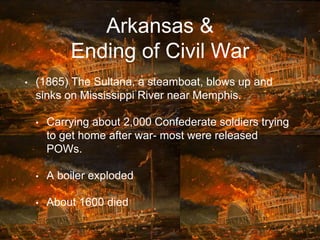
• (1865) The Sultana, a steamboat, blows up and
sinks on Mississippi River near Memphis.
• Carrying about 2,000 Confederate soldiers trying
to get home after war- most were released
POWs.
• A boiler exploded
• About 1600 died
9
Ending of Civil War
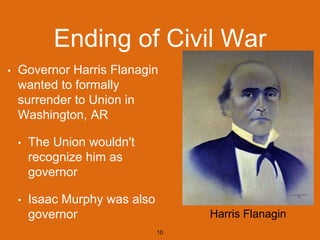
• Governor Harris Flanagin
wanted to formally
surrender to Union in
Washington, AR
• The Union wouldn't
recognize him as
governor
• Isaac Murphy was also
governor
10
Harris Flanagin
Aftermath
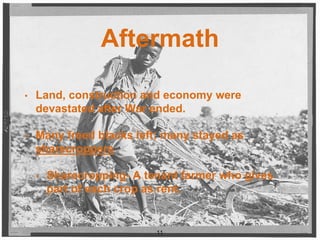
• Land, construction and economy were
devastated after War ended.
• Many freed blacks left; many stayed as
sharecroppers
• Sharecropping- A tenant farmer who gives
part of each crop as rent.
11
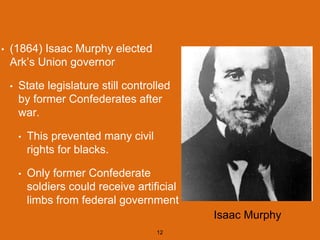
• (1864) Isaac Murphy elected
Ark’s Union governor
• State legislature still controlled
by former Confederates after
war.
• This prevented many civil
rights for blacks.
• Only former Confederate
soldiers could receive artificial
limbs from federal government
12
Isaac Murphy
Reconstruction
• (1865-1866) Freedman’s Bureau
• Founded to improve working conditions for blacks
• (1867) US Congress passes the first Reconstruction Act
• Ark. and Mississippi put under martial law
• State legislatures could not meet
• Military oversaw voter registration
• Former confederates not allowed to vote or hold office
13
New order in Arkansas
• (Summer & Fall of 1867) Arkansans debated over
writing a new state Constitution to get back in the Union
• Republican party was running things; 3 groups of
Republicans
1. Scalawags- Southern Union supporters
2. Carpet baggers- People who moved from the North
in hopes of economic advantages
3. Blacks
14
• (1868) Arkansas writes a new state
Constitution
• 4 year term for governor (lots of
power)
• Protected blacks’ and women’s
rights
• Made new Amendments hard to
pass
• Promoted education, railroads, and
immigration
• Very small percentage of population
voted for it b/c ex-Confederates were
not allowed to vote
15
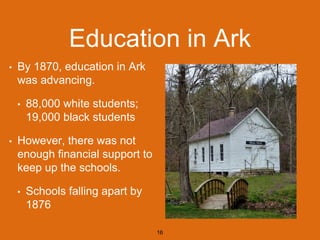
Education in Ark
• By 1870, education in Ark
was advancing.
• 88,000 white students;
19,000 black students
• However, there was not
enough financial support to
keep up the schools.
• Schools falling apart by
1876
16
17
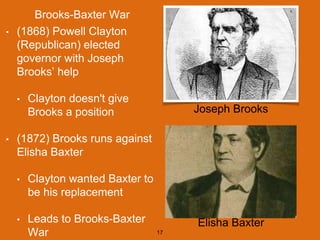
Joseph Brooks
Elisha Baxter
• (1868) Powell Clayton
(Republican) elected
governor with Joseph
Brooks’ help
• Clayton doesn't give
Brooks a position
• (1872) Brooks runs against
Elisha Baxter
• Clayton wanted Baxter to
be his replacement
• Leads to Brooks-Baxter
War
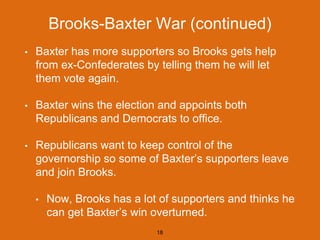
Brooks-Baxter War
• Baxter has more supporters so Brooks gets help
from ex-Confederates by telling them he will let
them vote again.
• Baxter wins the election and appoints both
Republicans and Democrats to office.
• Republicans want to keep control of the
governorship so some of Baxter’s supporters leave
and join Brooks.
• Now, Brooks has a lot of supporters and thinks he
can get Baxter’s win overturned.
18
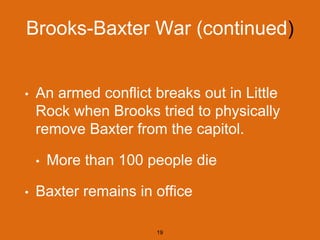
Brooks-Baxter War (continued)
• An armed conflict breaks out in Little
Rock when Brooks tried to physically
remove Baxter from the capitol.
• More than 100 people die
• Baxter remains in office
19
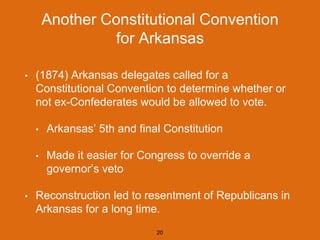
Another Constitutional Convention
for Arkansas
• (1874) Arkansas delegates called for a
Constitutional Convention to determine whether or
not ex-Confederates would be allowed to vote.
• Arkansas’ 5th and final Constitution
• Made it easier for Congress to override a
governor’s veto
• Reconstruction led to resentment of Republicans in
Arkansas for a long time.
20

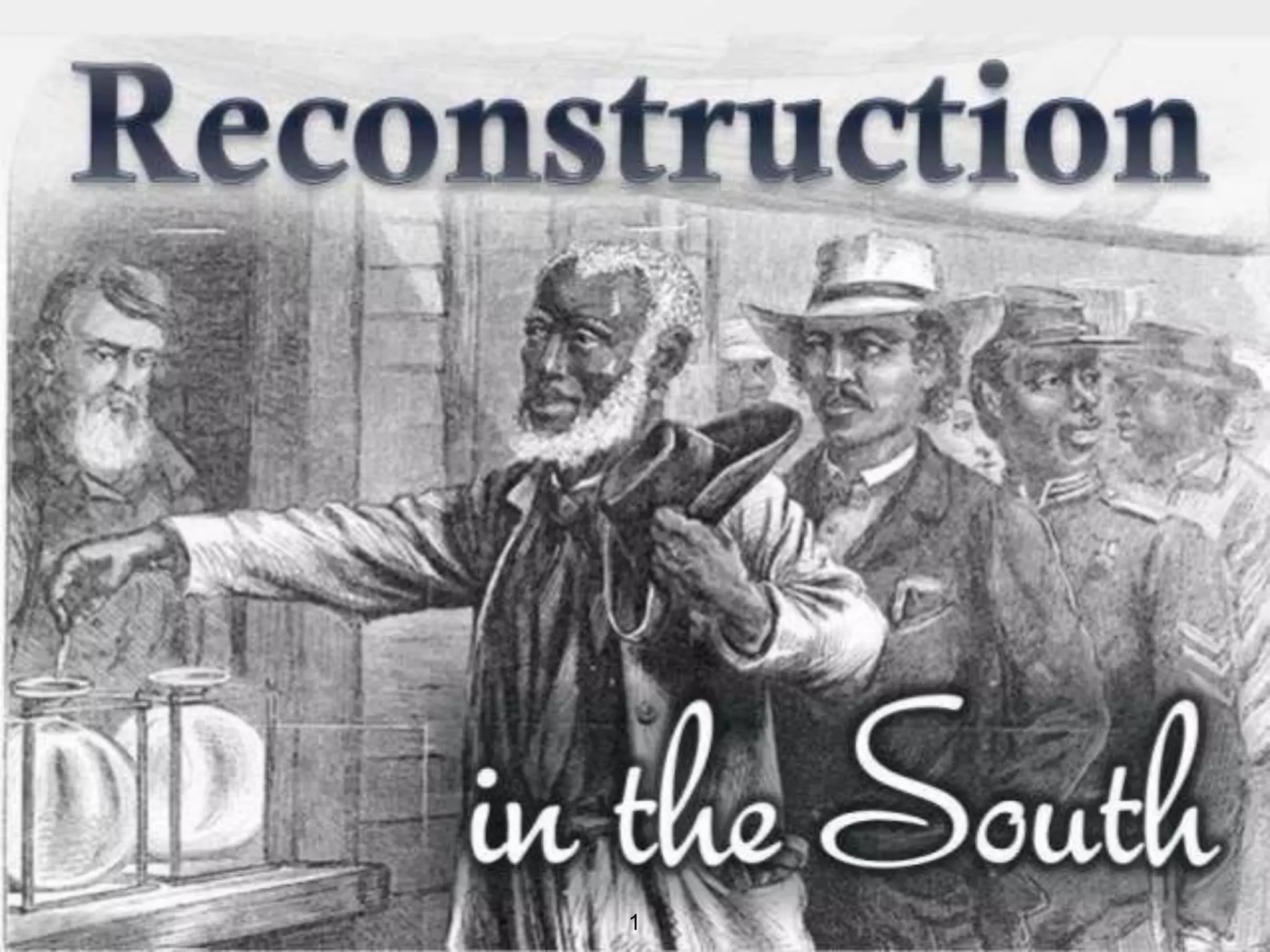
Reconstruction ppt

  • 1.
  • 2.
    Background & Introduction •Reconstruction refers to the period following the Civil War of rebuilding the United States. • It was a time of great pain and endless questions. • On what terms would the Confederacy be allowed back into the Union? • Who would establish the terms, Congress or the President? 2
  • 3.
    • (1863-1865) Moderates,like Presidents Abraham Lincoln (16th pres.) and Andrew Johnson (17th pres.), wanted to bring the South back to normal as quickly as possible. • Moderates- a person who holds moderate (less extreme) views, especially in politics • However, Radical Republicans used Congress to block any moderate approaches, impose harsh terms, and upgrade the rights of the freedmen. • Radical Republicans- demanded harsh policies for punishing the former rebels, and emphasizing equality, civil rights, and voting rights for the "freedmen" (recently freed slaves) 3
  • 4.
    • The endof Reconstruction was a staggered process, and the period of Republican control ended at different times in different states. With the Compromise of 1877. • This was followed by a period that white Southerners labeled Redemption, during which white-dominated state legislatures enacted Jim Crow laws and, beginning in 1890, disenfranchised most blacks and many poor whites through a combination of constitutional amendments and electoral laws. 4
  • 5.
    Purpose of Reconstruction •Reconstruction addressed how the eleven seceding states would: • regain what the Constitution calls a "republican form of government" and be reseated in Congress • address the civil status of the former leaders of the Confederacy, and the Constitutional and legal status of freedmen, especially their civil rights and whether they should be given the right to vote. Intense controversy erupted throughout the South over these issues 5
  • 6.
    Ending Reconstruction Compromise of1877 • Republican Rutherford B. Hayes was running for president against Democrat Samuel J. Tilden. • When the election was over, it was unclear who had won. • In some states, both parties declared that their candidate had received the most votes in their state. 6
  • 7.
    Compromise of 1877(continued) • So, in a back room in Washington DC, leaders of both parties met and settled on a compromise. • The Democrats proposed that they would concede the election to Hayes, but that he had to end Reconstruction and pull soldiers out of the South. 7
  • 8.
    • President UlyssesS. Grant (18th pres.) supported Radical Reconstruction and enforced the protection of African Americans in the South through the use of the Enforcement Acts passed by Congress. • Reconstruction was a significant chapter in the history of civil rights in the United States, but most historians consider it a failure. • After Reconstruction ended, the South was left a poverty-stricken and dependent on agriculture, while white Southerners soon succeeded in re-establishing legal and political dominance over blacks through violence, intimidation and discrimination. 8
  • 9.
    Arkansas & Ending ofCivil War • (1865) The Sultana, a steamboat, blows up and sinks on Mississippi River near Memphis. • Carrying about 2,000 Confederate soldiers trying to get home after war- most were released POWs. • A boiler exploded • About 1600 died 9
  • 10.
    Ending of CivilWar • Governor Harris Flanagin wanted to formally surrender to Union in Washington, AR • The Union wouldn't recognize him as governor • Isaac Murphy was also governor 10 Harris Flanagin
  • 11.
    Aftermath • Land, constructionand economy were devastated after War ended. • Many freed blacks left; many stayed as sharecroppers • Sharecropping- A tenant farmer who gives part of each crop as rent. 11
  • 12.
    • (1864) IsaacMurphy elected Ark’s Union governor • State legislature still controlled by former Confederates after war. • This prevented many civil rights for blacks. • Only former Confederate soldiers could receive artificial limbs from federal government 12 Isaac Murphy
  • 13.
    Reconstruction • (1865-1866) Freedman’sBureau • Founded to improve working conditions for blacks • (1867) US Congress passes the first Reconstruction Act • Ark. and Mississippi put under martial law • State legislatures could not meet • Military oversaw voter registration • Former confederates not allowed to vote or hold office 13
  • 14.
    New order inArkansas • (Summer & Fall of 1867) Arkansans debated over writing a new state Constitution to get back in the Union • Republican party was running things; 3 groups of Republicans 1. Scalawags- Southern Union supporters 2. Carpet baggers- People who moved from the North in hopes of economic advantages 3. Blacks 14
  • 15.
    • (1868) Arkansaswrites a new state Constitution • 4 year term for governor (lots of power) • Protected blacks’ and women’s rights • Made new Amendments hard to pass • Promoted education, railroads, and immigration • Very small percentage of population voted for it b/c ex-Confederates were not allowed to vote 15
  • 16.
    Education in Ark •By 1870, education in Ark was advancing. • 88,000 white students; 19,000 black students • However, there was not enough financial support to keep up the schools. • Schools falling apart by 1876 16
  • 17.
    17 Joseph Brooks Elisha Baxter •(1868) Powell Clayton (Republican) elected governor with Joseph Brooks’ help • Clayton doesn't give Brooks a position • (1872) Brooks runs against Elisha Baxter • Clayton wanted Baxter to be his replacement • Leads to Brooks-Baxter War Brooks-Baxter War
  • 18.
    • Baxter hasmore supporters so Brooks gets help from ex-Confederates by telling them he will let them vote again. • Baxter wins the election and appoints both Republicans and Democrats to office. • Republicans want to keep control of the governorship so some of Baxter’s supporters leave and join Brooks. • Now, Brooks has a lot of supporters and thinks he can get Baxter’s win overturned. 18 Brooks-Baxter War (continued)
  • 19.
    Brooks-Baxter War (continued) •An armed conflict breaks out in Little Rock when Brooks tried to physically remove Baxter from the capitol. • More than 100 people die • Baxter remains in office 19
  • 20.
    Another Constitutional Convention forArkansas • (1874) Arkansas delegates called for a Constitutional Convention to determine whether or not ex-Confederates would be allowed to vote. • Arkansas’ 5th and final Constitution • Made it easier for Congress to override a governor’s veto • Reconstruction led to resentment of Republicans in Arkansas for a long time. 20