
Bootstrapping serious games to assess
learning through analytics
Freire-Morán, Manuel; Calvo-Morata, Antonio; Martinez-Ortiz, Ivan;
Fernández-Manjón, Baltasar
balta@fdi.ucm.es
Dept. of Software Engineering and Artificial Intelligence
Complutense University of Madrid
EDUCON 2023 | May 1-4 2023 | Salmiya, Kuwait
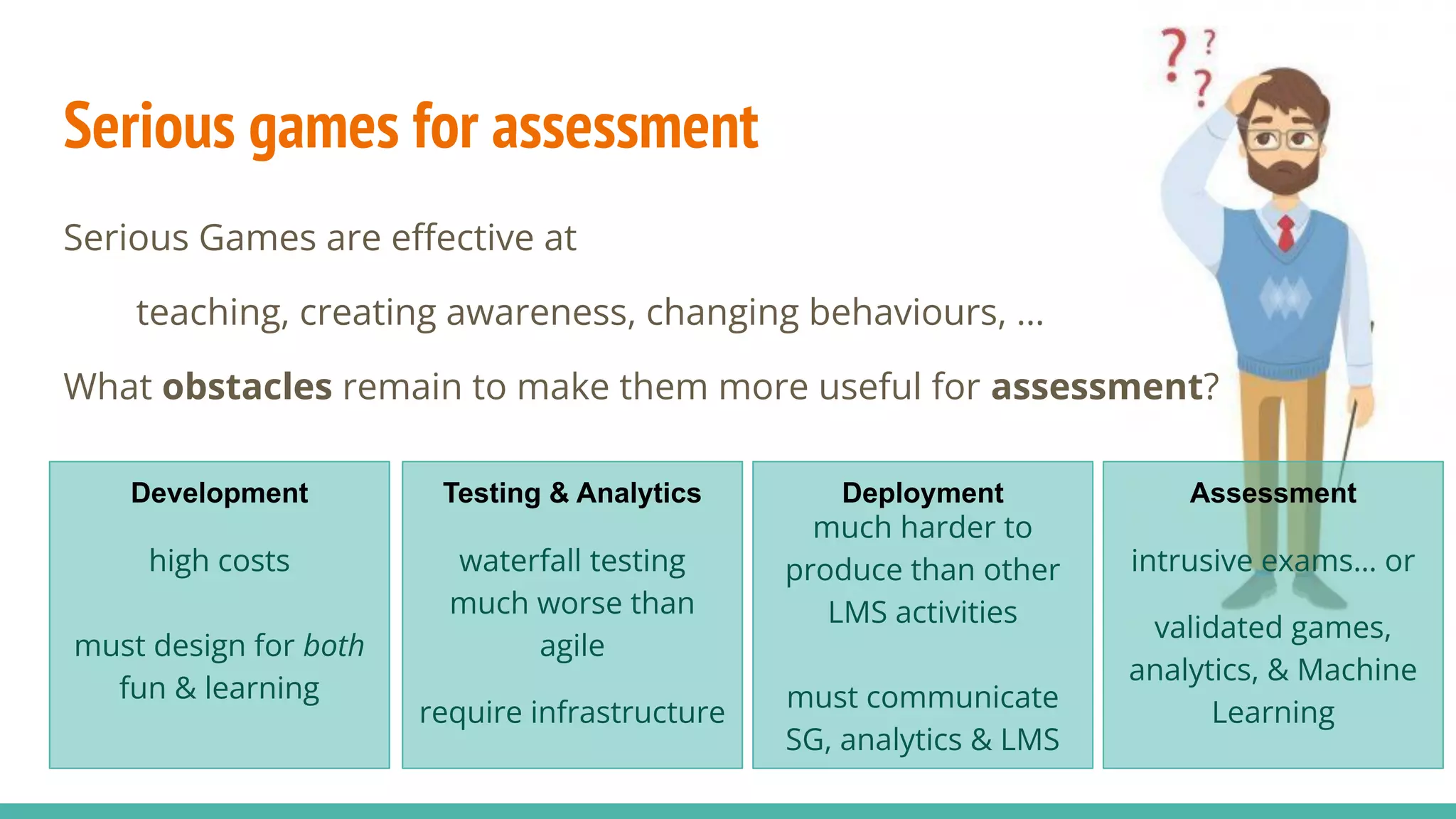
Serious games for assessment
Serious Games are effective at
teaching, creating awareness, changing behaviours, …
What obstacles remain to make them more useful for assessment?
Development
high costs
must design for both
fun & learning
Testing & Analytics
waterfall testing
much worse than
agile
require infrastructure
Deployment
much harder to
produce than other
LMS activities
must communicate
SG, analytics & LMS
Assessment
intrusive exams… or
validated games,
analytics, & Machine
Learning
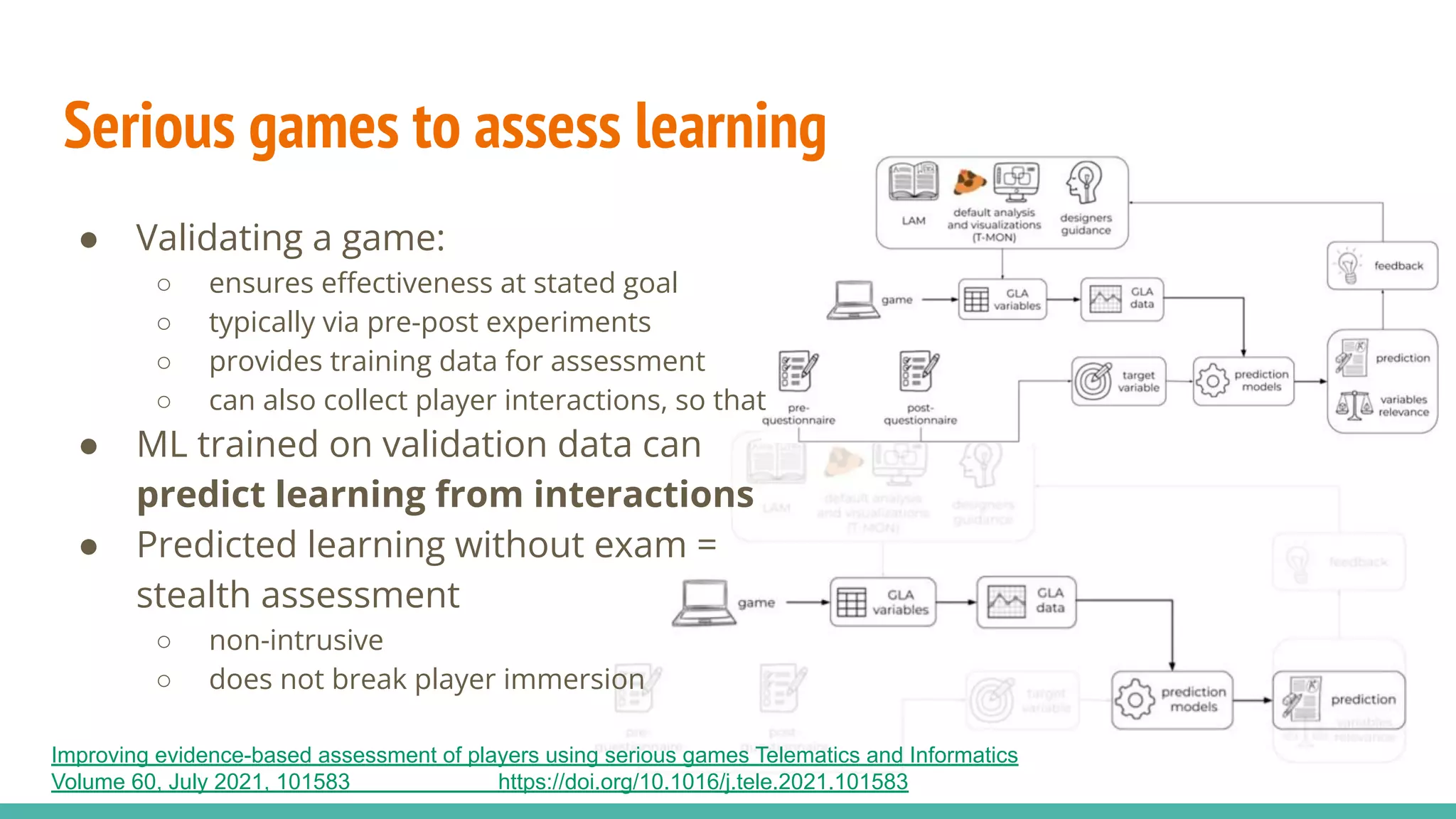
● Validating a game:
○ ensures effectiveness at stated goal
○ typically via pre-post experiments
○ provides training data for assessment
○ can also collect player interactions, so that
● ML trained on validation data can
predict learning from interactions
● Predicted learning without exam =
stealth assessment
○ non-intrusive
○ does not break player immersion
Serious games to assess learning
Improving evidence-based assessment of players using serious games Telematics and Informatics
Volume 60, July 2021, 101583 https://doi.org/10.1016/j.tele.2021.101583
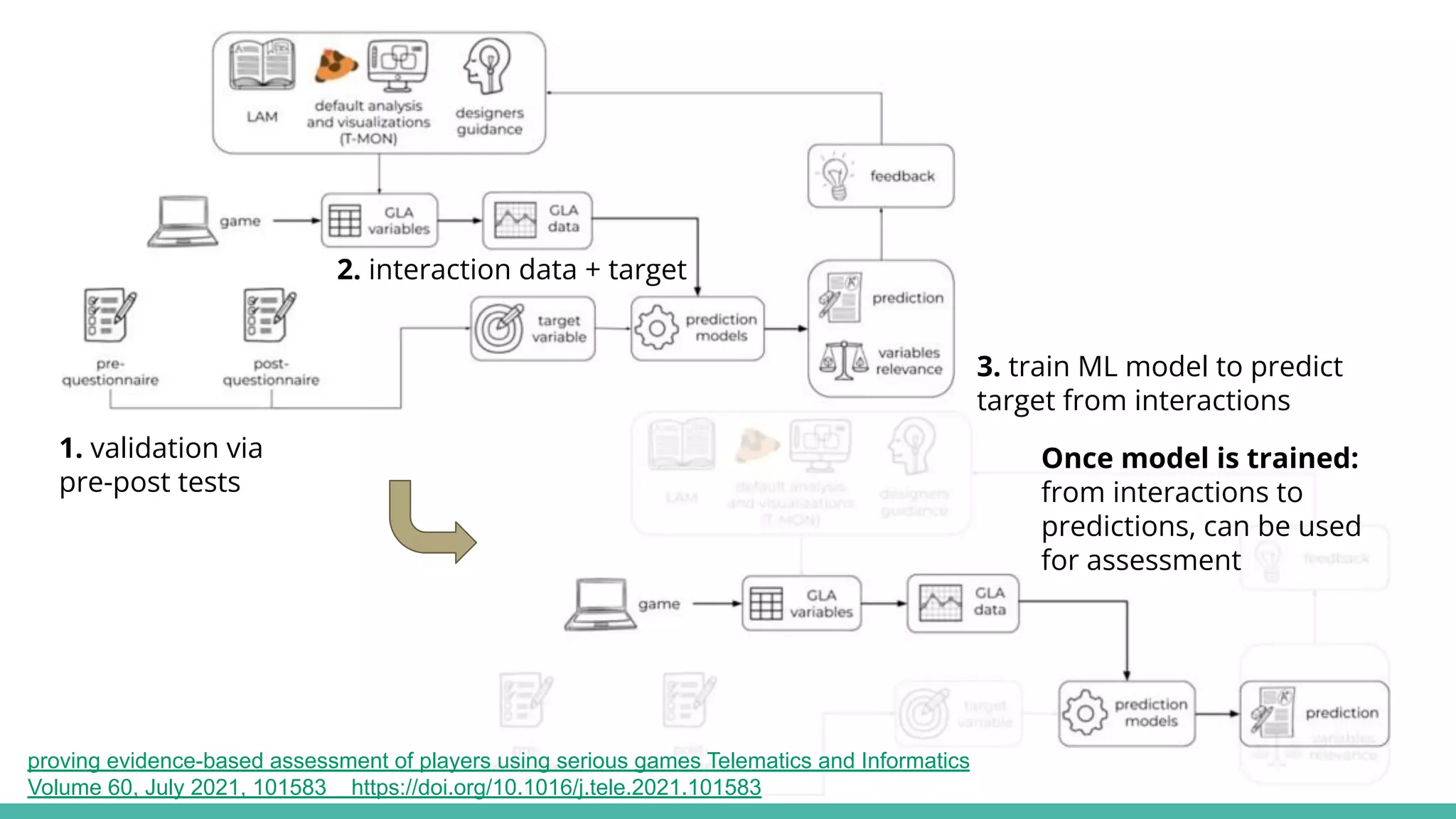
1. validation via
pre-post tests
2. interaction data + target
Once model is trained:
from interactions to
predictions, can be used
for assessment
3. train ML model to predict
target from interactions
proving evidence-based assessment of players using serious games Telematics and Informatics
Volume 60, July 2021, 101583 https://doi.org/10.1016/j.tele.2021.101583
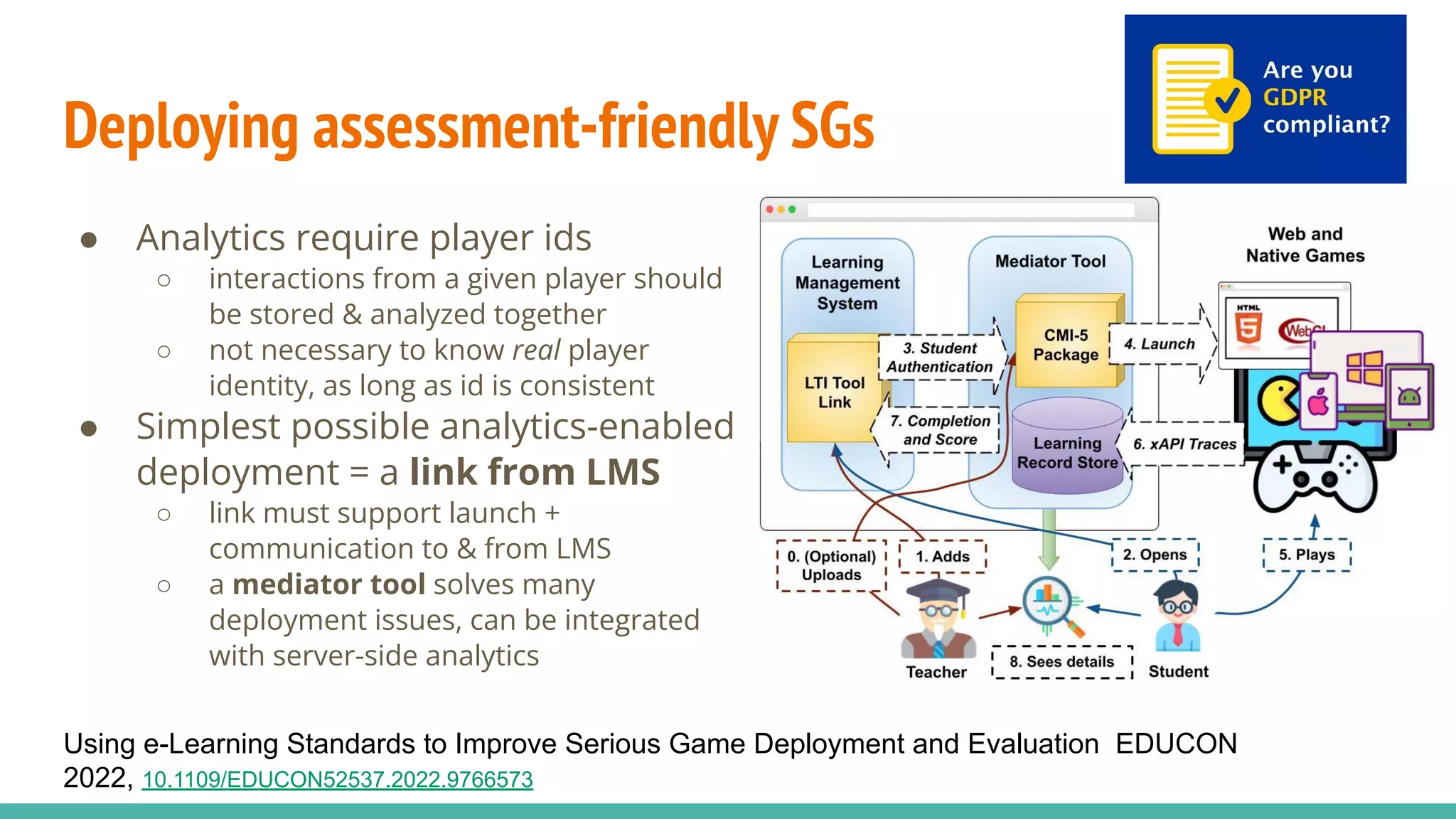
Deploying assessment-friendly SGs
● Analytics require player ids
○ interactions from a given player should
be stored & analyzed together
○ not necessary to know real player
identity, as long as id is consistent
● Simplest possible analytics-enabled
deployment = a link from LMS
○ link must support launch +
communication to & from LMS
○ a mediator tool solves many
deployment issues, can be integrated
with server-side analytics
Using e-Learning Standards to Improve Serious Game Deployment and Evaluation EDUCON
2022, 10.1109/EDUCON52537.2022.9766573
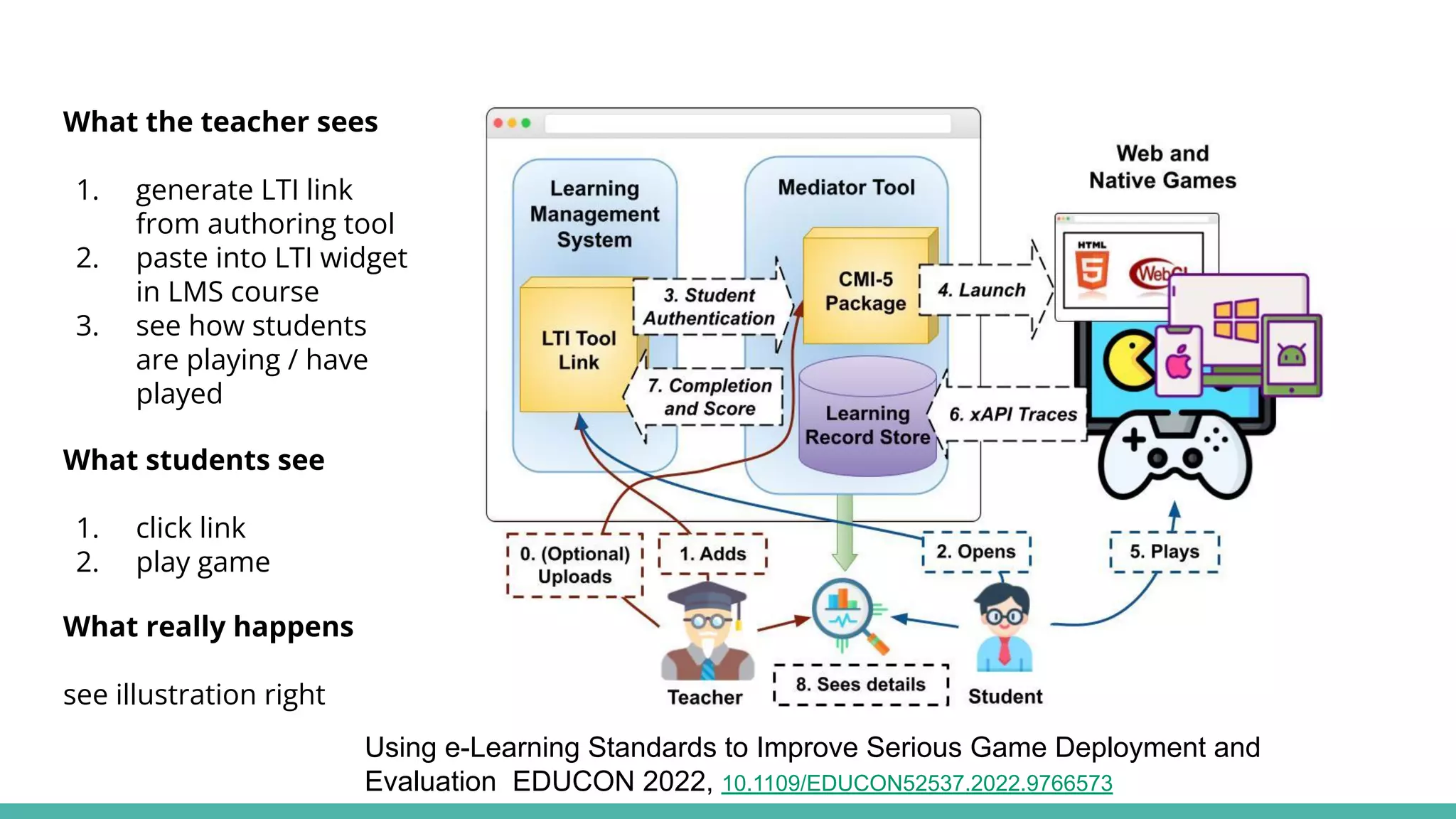
Using e-Learning Standards to Improve Serious Game Deployment and
Evaluation EDUCON 2022, 10.1109/EDUCON52537.2022.9766573
What the teacher sees
1. generate LTI link
from authoring tool
2. paste into LTI widget
in LMS course
3. see how students
are playing / have
played
What really happens
see illustration right
What students see
1. click link
2. play game
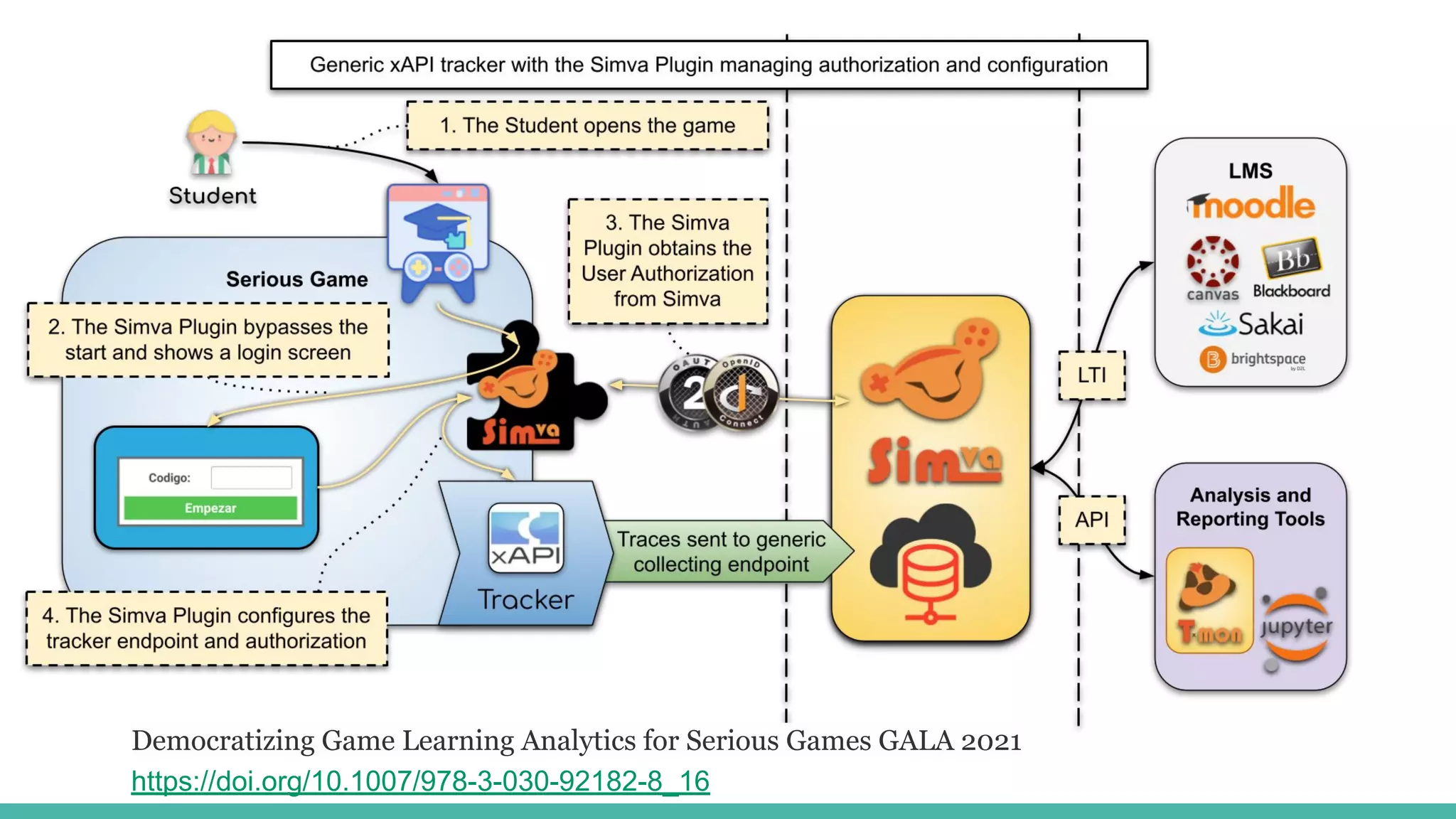
Democratizing Game Learning Analytics for Serious Games GALA 2021
https://doi.org/10.1007/978-3-030-92182-8_16
● Analytics as part of design
○ incremental improvement is better than
waterfall models, but improvement is
hard to track without analytics!
○ requires developers/designers to choose
in-game interactions to report, and
tracker component within each game
to report those interactions
○ requires tools to analyze results
● Analytics infrastructure
○ server-side component to validate,
store & retrieve interactions
○ analytics dashboards provide the
insights into collected interactions
○ infrastructure also for deployment,
validation, and finally assessment
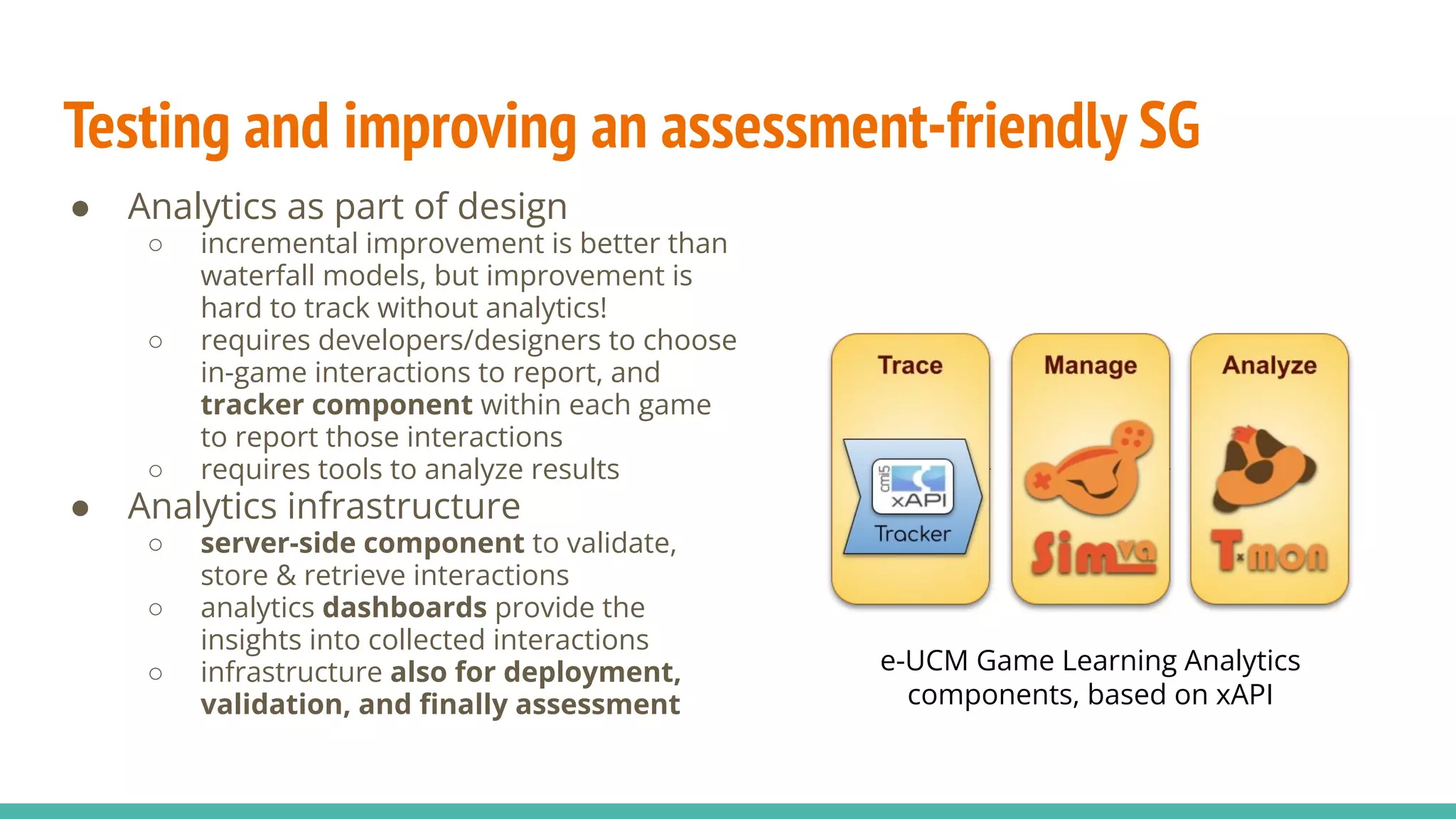
Testing and improving an assessment-friendly SG
e-UCM Game Learning Analytics
components, based on xAPI
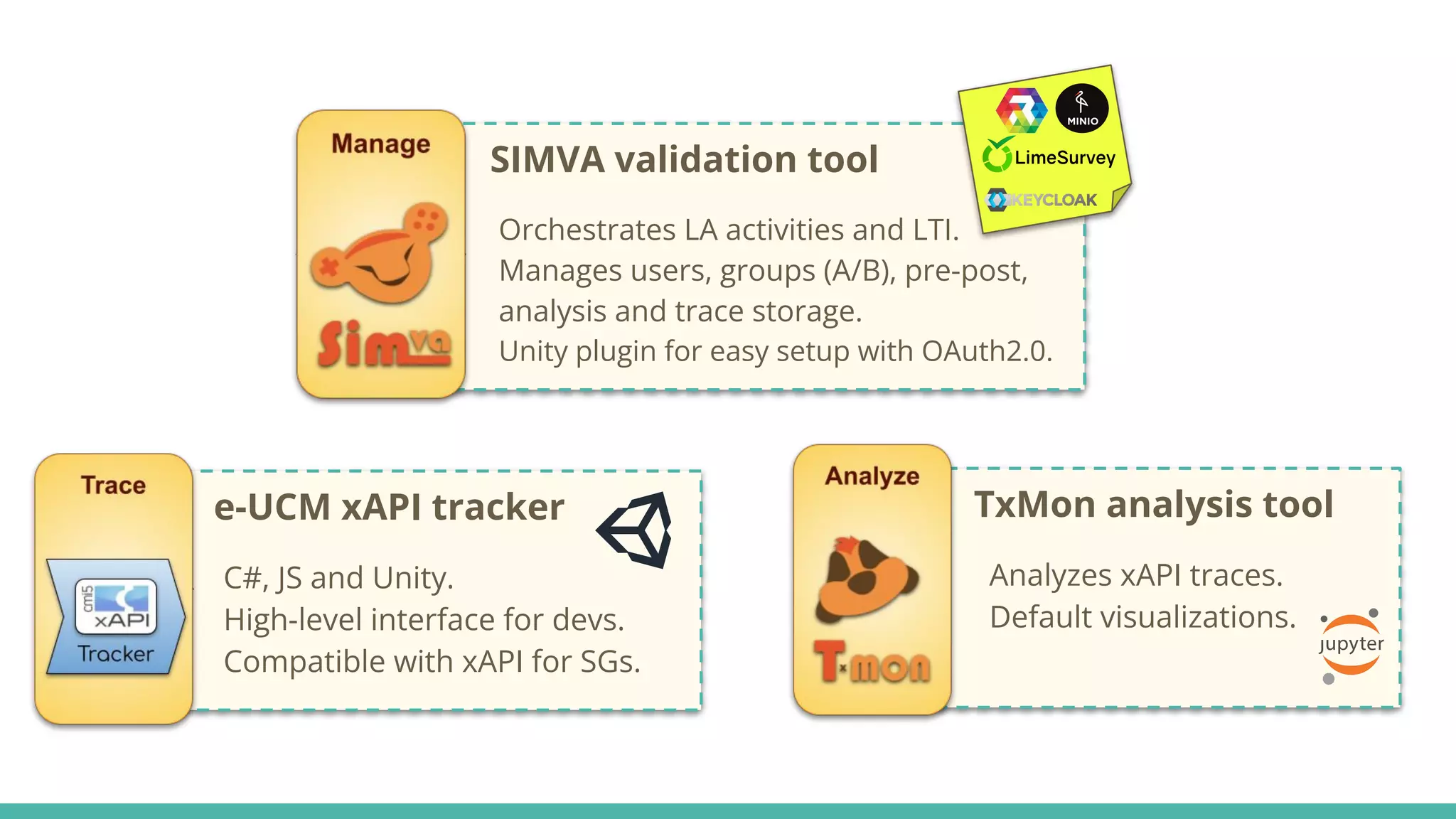
e-UCM xAPI tracker
● C#, JS and Unity.
● High-level interface for devs.
● Compatible with xAPI for SGs.
SIMVA validation tool
● Orchestrates LA activities and LTI.
● Manages users, groups (A/B), pre-post,
analysis and trace storage.
● Unity plugin for easy setup with OAuth2.0.
TxMon analysis tool
● Analyzes xAPI traces.
● Default visualizations.
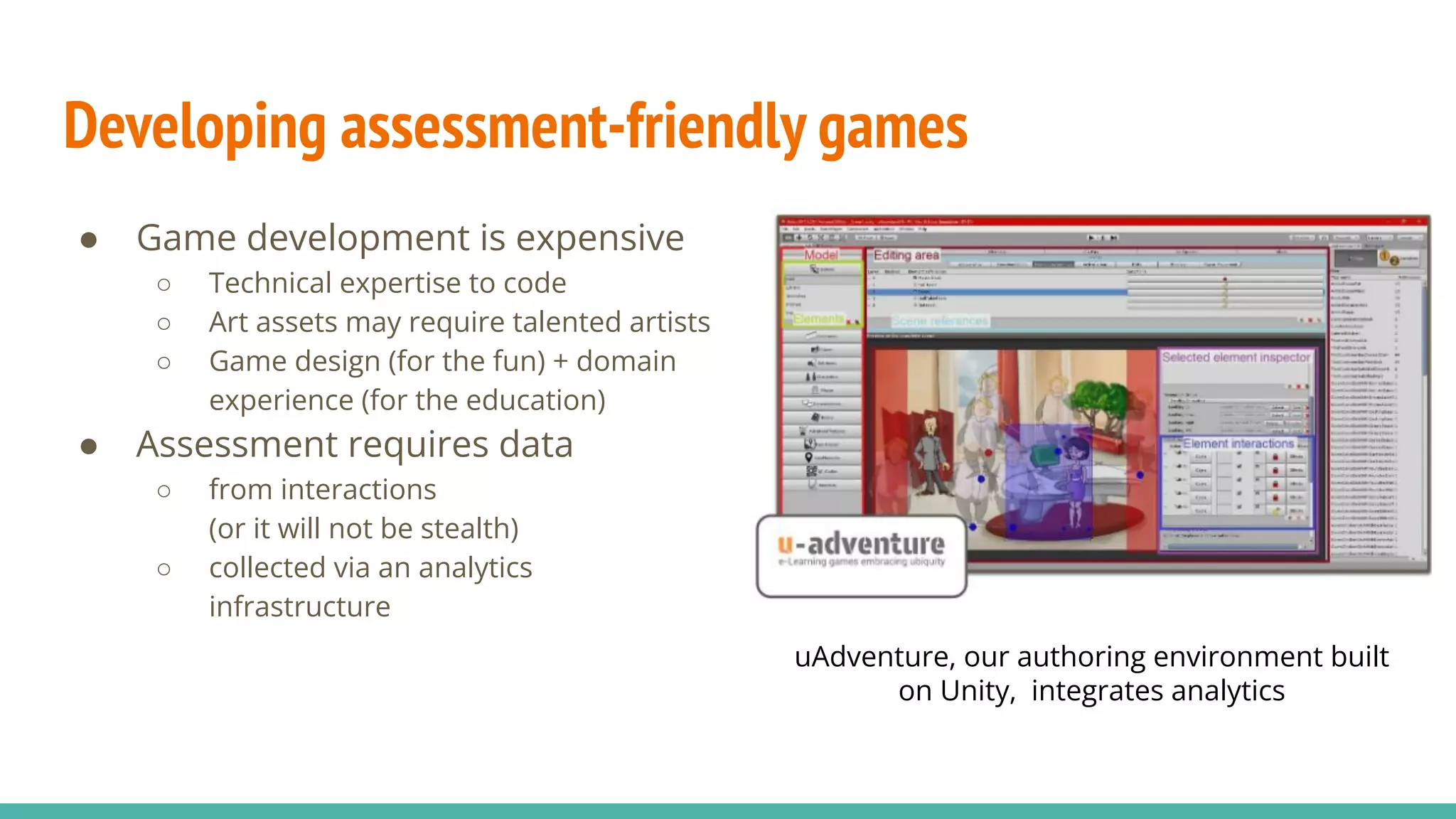
Developing assessment-friendly games
● Game development is expensive
○ Technical expertise to code
○ Art assets may require talented artists
○ Game design (for the fun) + domain
experience (for the education)
● Assessment requires data
○ from interactions
(or it will not be stealth)
○ collected via an analytics
infrastructure
uAdventure, our authoring environment built
on Unity, integrates analytics
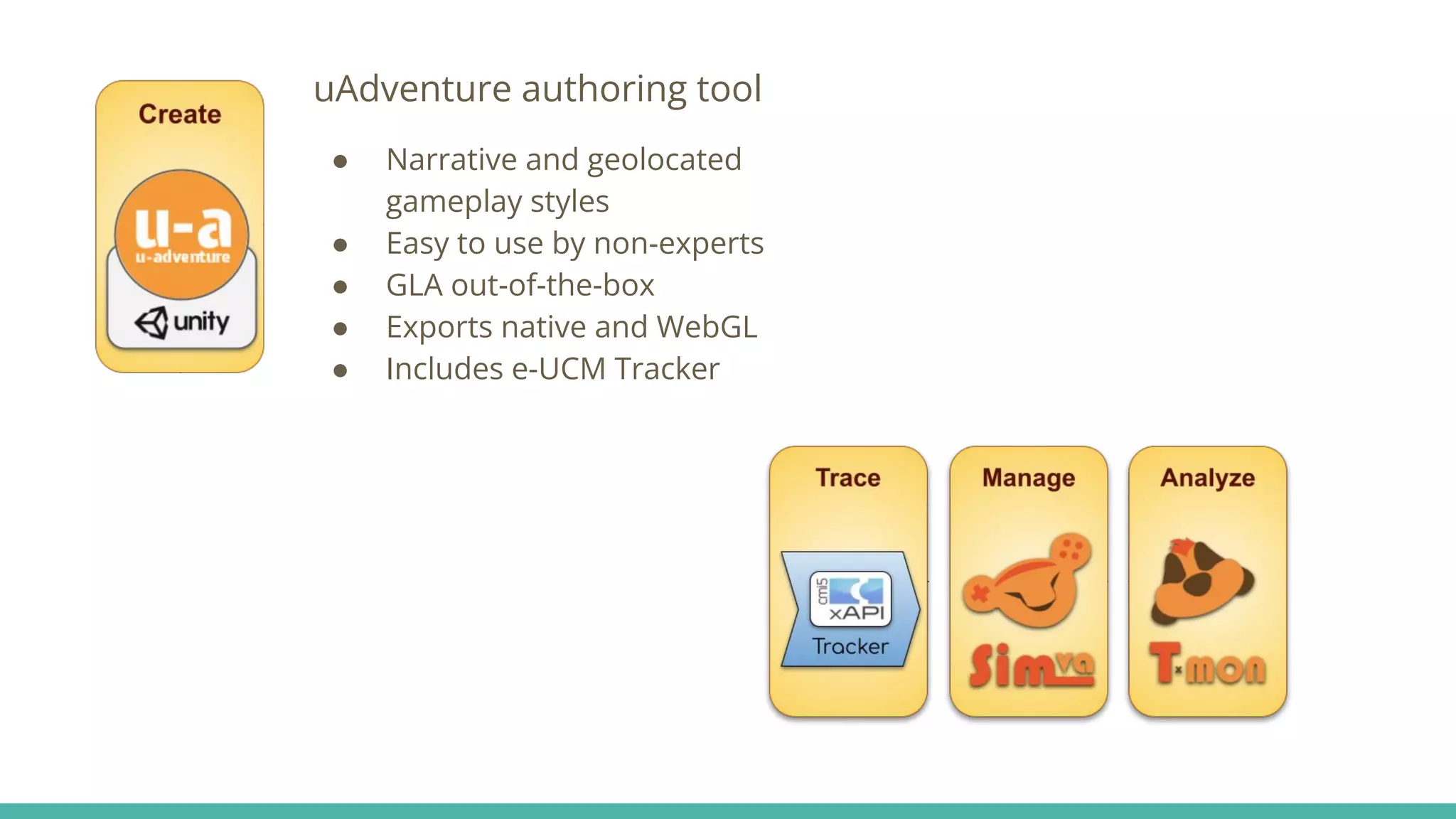
uAdventure authoring tool
● Narrative and geolocated
gameplay styles
● Easy to use by non-experts
● GLA out-of-the-box
● Exports native and WebGL
● Includes e-UCM Tracker
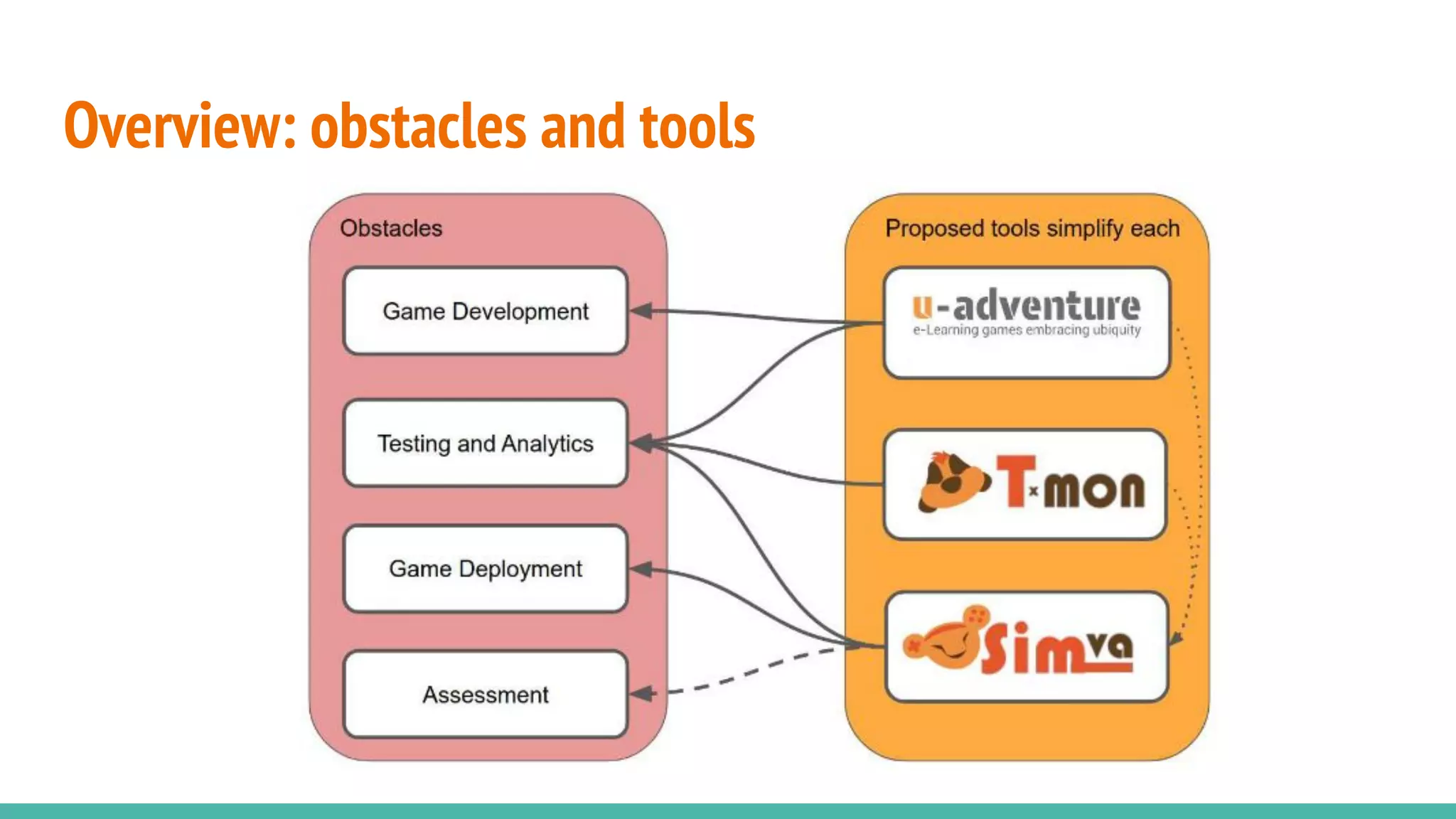
Overview: obstacles and tools
Next steps
● Serious Games can be a powerful method for student assessment in
complex issues (i.e. knowledge, awareness) and it is open to include AI
techniques
● Still complex but open software and standards could help in the process
● Assessment not yet fully integrated into Simva
● Building new module to
○ train a simple ML models from validation data
○ use trained models to provide predictions based on gameplay interactions
○ upload results as activity scores via LTI, making them available in host LMS
● Would close SG lifecycle, from authoring to evaluation
● All the technical solutions should take into account the ethical aspects
and comply with the privacy regulations (e.g. EU GDPR)
Thanks!
Contact: balta@fdi.ucm.es
This work has been partially funded by the Regional Government of Madrid (eMadrid S2018/TCS-4307, co-funded by the
European Structural Funds FSE and FEDER), by the Ministry of Education (PID2020-119620RB-I00) and by the
Telefónica-Complutense Chair on Digital Education and Serious Games.
https://github.com/e-ucm/uAdventure
https://github.com/e-ucm/simva
Our publications: https://www.e-ucm.es/publications/all

Bootstrapping serious games to assess learning through analytics - Baltasar Fernández-Manjón

  • 1.
    Bootstrapping serious gamesto assess learning through analytics Freire-Morán, Manuel; Calvo-Morata, Antonio; Martinez-Ortiz, Ivan; Fernández-Manjón, Baltasar balta@fdi.ucm.es Dept. of Software Engineering and Artificial Intelligence Complutense University of Madrid EDUCON 2023 | May 1-4 2023 | Salmiya, Kuwait
  • 2.
    Serious games forassessment Serious Games are effective at teaching, creating awareness, changing behaviours, … What obstacles remain to make them more useful for assessment? Development high costs must design for both fun & learning Testing & Analytics waterfall testing much worse than agile require infrastructure Deployment much harder to produce than other LMS activities must communicate SG, analytics & LMS Assessment intrusive exams… or validated games, analytics, & Machine Learning
  • 3.
    ● Validating agame: ○ ensures effectiveness at stated goal ○ typically via pre-post experiments ○ provides training data for assessment ○ can also collect player interactions, so that ● ML trained on validation data can predict learning from interactions ● Predicted learning without exam = stealth assessment ○ non-intrusive ○ does not break player immersion Serious games to assess learning Improving evidence-based assessment of players using serious games Telematics and Informatics Volume 60, July 2021, 101583 https://doi.org/10.1016/j.tele.2021.101583
  • 4.
    1. validation via pre-posttests 2. interaction data + target Once model is trained: from interactions to predictions, can be used for assessment 3. train ML model to predict target from interactions proving evidence-based assessment of players using serious games Telematics and Informatics Volume 60, July 2021, 101583 https://doi.org/10.1016/j.tele.2021.101583
  • 5.
    Deploying assessment-friendly SGs ●Analytics require player ids ○ interactions from a given player should be stored & analyzed together ○ not necessary to know real player identity, as long as id is consistent ● Simplest possible analytics-enabled deployment = a link from LMS ○ link must support launch + communication to & from LMS ○ a mediator tool solves many deployment issues, can be integrated with server-side analytics Using e-Learning Standards to Improve Serious Game Deployment and Evaluation EDUCON 2022, 10.1109/EDUCON52537.2022.9766573
  • 6.
    Using e-Learning Standardsto Improve Serious Game Deployment and Evaluation EDUCON 2022, 10.1109/EDUCON52537.2022.9766573 What the teacher sees 1. generate LTI link from authoring tool 2. paste into LTI widget in LMS course 3. see how students are playing / have played What really happens see illustration right What students see 1. click link 2. play game
  • 7.
    Democratizing Game LearningAnalytics for Serious Games GALA 2021 https://doi.org/10.1007/978-3-030-92182-8_16
  • 8.
    ● Analytics aspart of design ○ incremental improvement is better than waterfall models, but improvement is hard to track without analytics! ○ requires developers/designers to choose in-game interactions to report, and tracker component within each game to report those interactions ○ requires tools to analyze results ● Analytics infrastructure ○ server-side component to validate, store & retrieve interactions ○ analytics dashboards provide the insights into collected interactions ○ infrastructure also for deployment, validation, and finally assessment Testing and improving an assessment-friendly SG e-UCM Game Learning Analytics components, based on xAPI
  • 9.
    e-UCM xAPI tracker ●C#, JS and Unity. ● High-level interface for devs. ● Compatible with xAPI for SGs. SIMVA validation tool ● Orchestrates LA activities and LTI. ● Manages users, groups (A/B), pre-post, analysis and trace storage. ● Unity plugin for easy setup with OAuth2.0. TxMon analysis tool ● Analyzes xAPI traces. ● Default visualizations.
  • 10.
    Developing assessment-friendly games ●Game development is expensive ○ Technical expertise to code ○ Art assets may require talented artists ○ Game design (for the fun) + domain experience (for the education) ● Assessment requires data ○ from interactions (or it will not be stealth) ○ collected via an analytics infrastructure uAdventure, our authoring environment built on Unity, integrates analytics
  • 11.
    uAdventure authoring tool ●Narrative and geolocated gameplay styles ● Easy to use by non-experts ● GLA out-of-the-box ● Exports native and WebGL ● Includes e-UCM Tracker
  • 12.
  • 13.
    Next steps ● SeriousGames can be a powerful method for student assessment in complex issues (i.e. knowledge, awareness) and it is open to include AI techniques ● Still complex but open software and standards could help in the process ● Assessment not yet fully integrated into Simva ● Building new module to ○ train a simple ML models from validation data ○ use trained models to provide predictions based on gameplay interactions ○ upload results as activity scores via LTI, making them available in host LMS ● Would close SG lifecycle, from authoring to evaluation ● All the technical solutions should take into account the ethical aspects and comply with the privacy regulations (e.g. EU GDPR)
  • 14.
    Thanks! Contact: balta@fdi.ucm.es This workhas been partially funded by the Regional Government of Madrid (eMadrid S2018/TCS-4307, co-funded by the European Structural Funds FSE and FEDER), by the Ministry of Education (PID2020-119620RB-I00) and by the Telefónica-Complutense Chair on Digital Education and Serious Games. https://github.com/e-ucm/uAdventure https://github.com/e-ucm/simva Our publications: https://www.e-ucm.es/publications/all