Full Lifecycle Architecture for Serious Games:
Integrating Game Learning Analytics and a
Game Authoring Tool
Cristina Alonso-Fernandez, Dan C. Rotaru, Manuel Freire, Ivan Martinez-Ortiz,
Baltasar Fernandez-Manjon
Grupo e-UCM www.e-ucm.es
JCSG 2017, Universidad Politécnica de Valencia
Serious Games
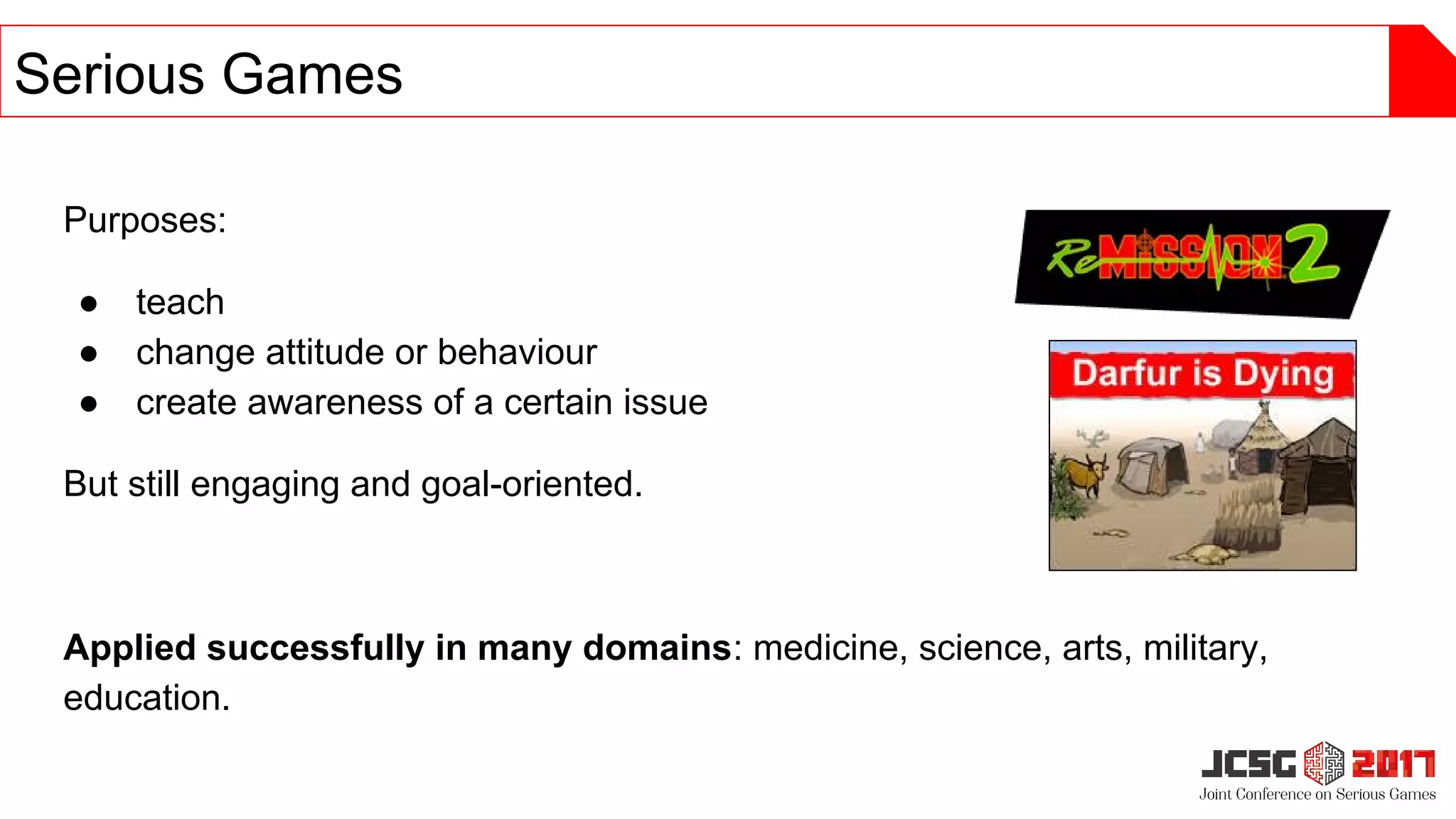
Purposes:
● teach
● change attitude or behaviour
● create awareness of a certain issue
But still engaging and goal-oriented.
Applied successfully in many domains: medicine, science, arts, military,
education.
Serious Games
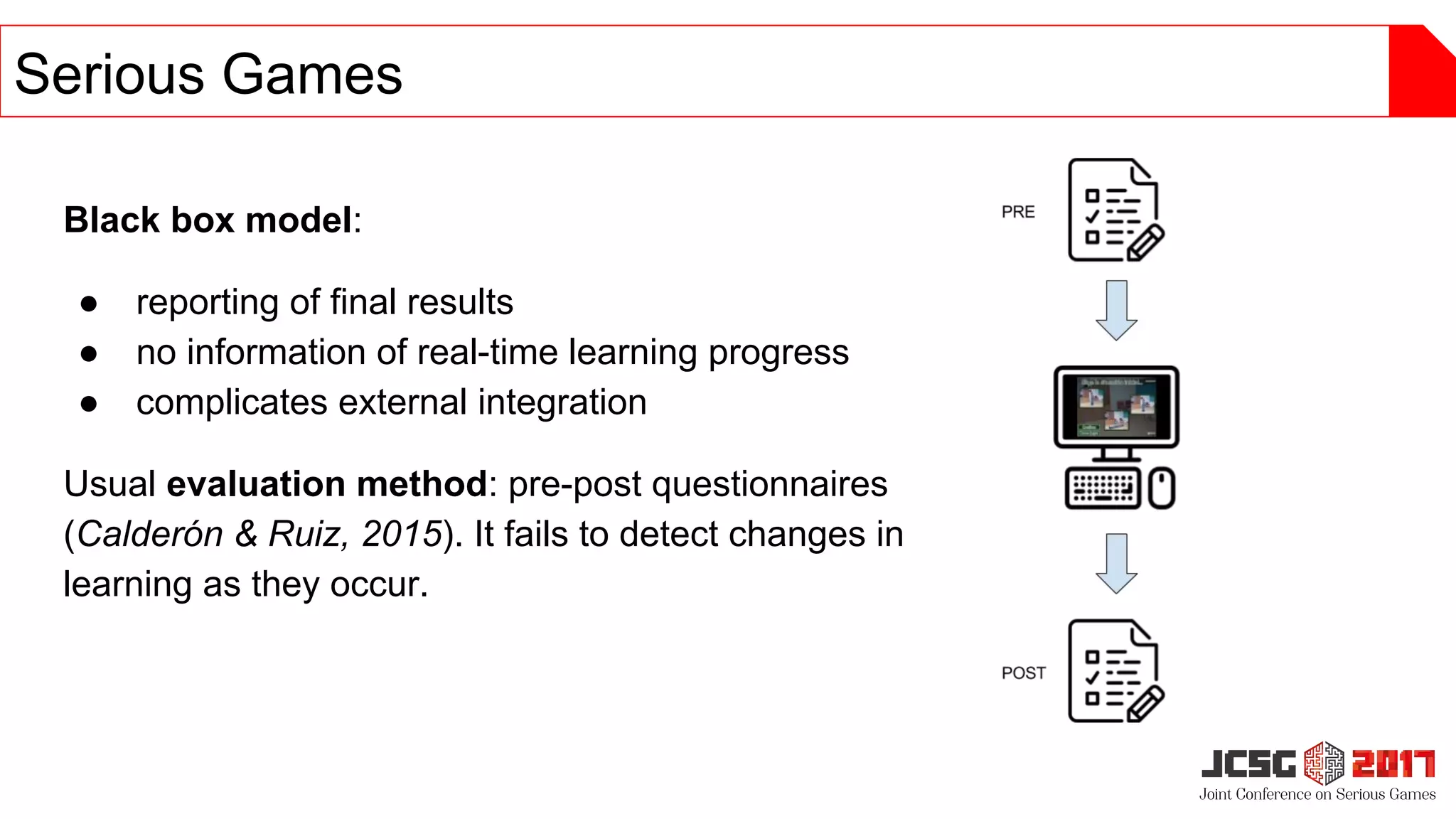
Black box model:
● reporting of final results
● no information of real-time learning progress
● complicates external integration
Usual evaluation method: pre-post questionnaires
(Calderón & Ruiz, 2015). It fails to detect changes in
learning as they occur.
Learning Analytics: “the measurement, collection, analysis and reporting of data
about learners and their contexts, for purposes of understanding and optimizing
learning and the environment in which it occurs” (Long & Siemens, 2011)
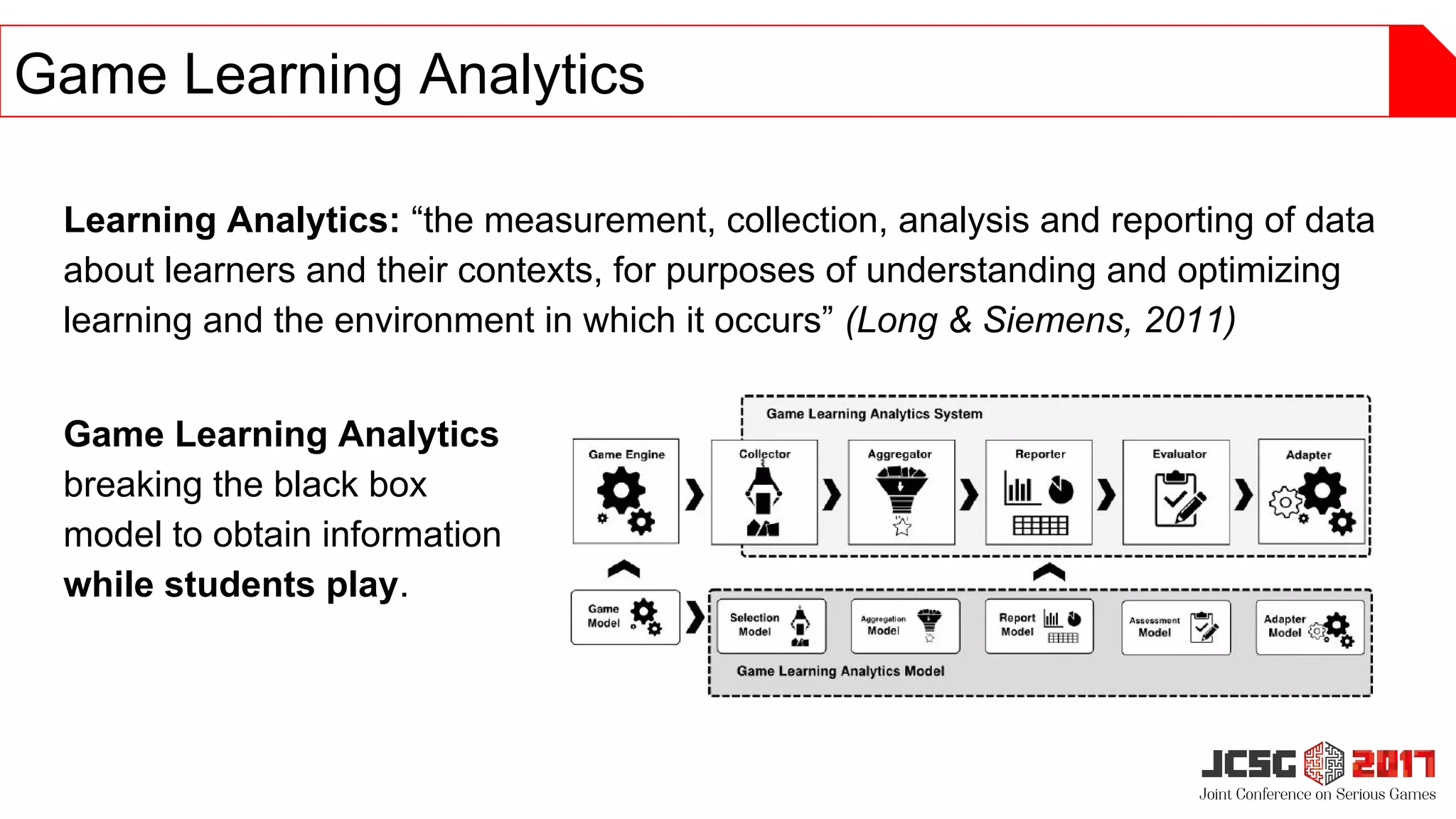
Game Learning Analytics
breaking the black box
model to obtain information
while students play.
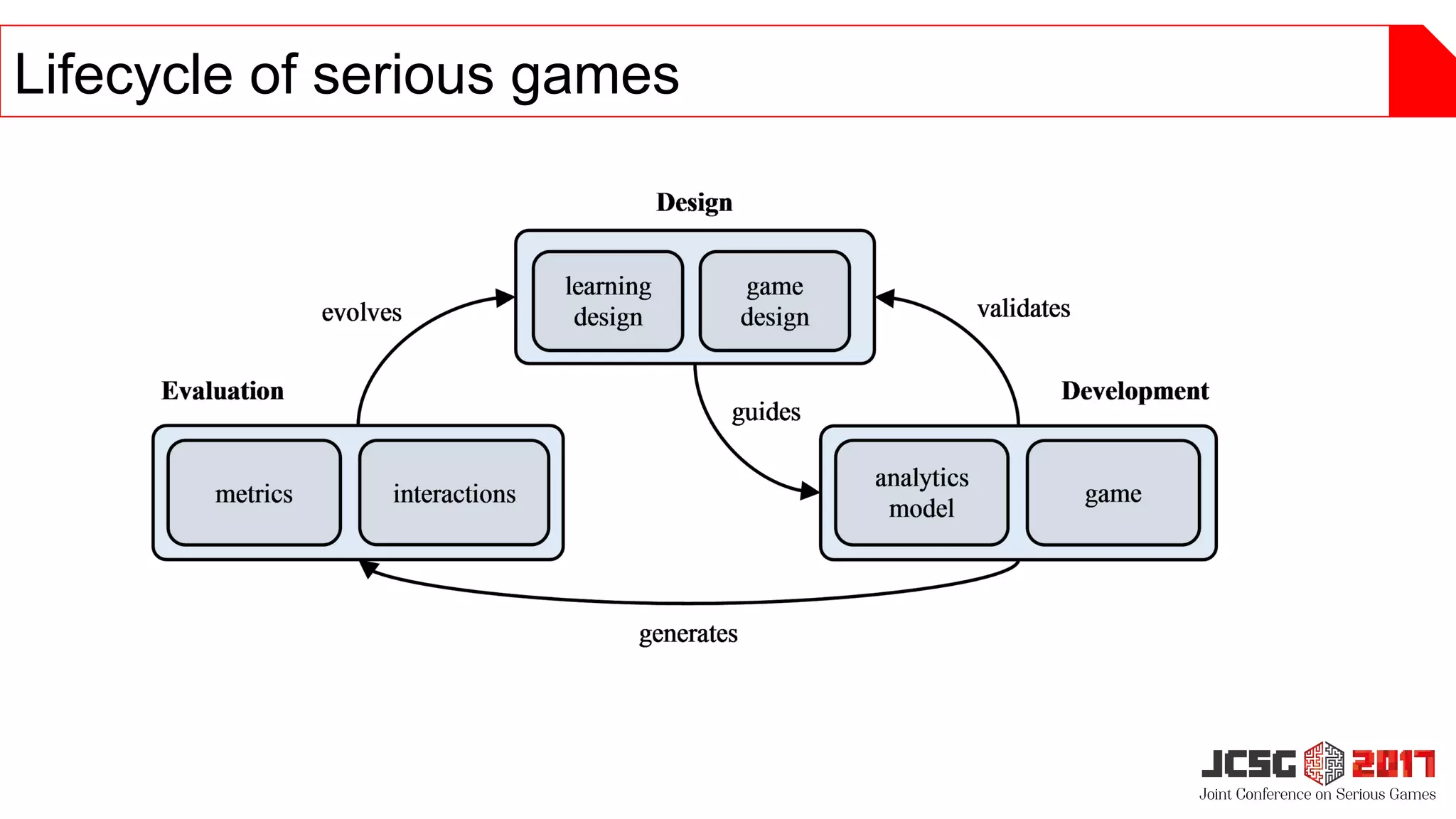
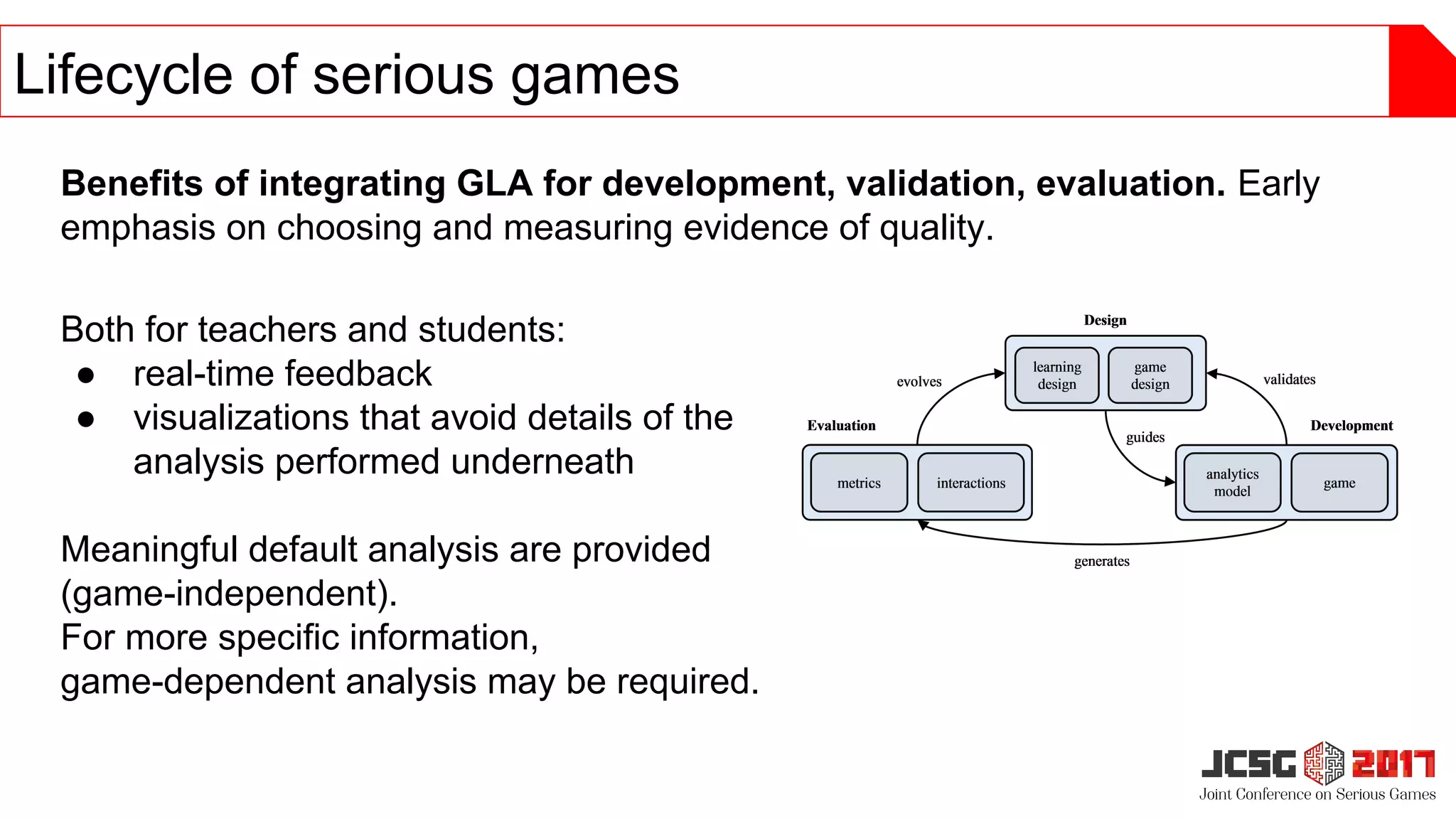
Lifecycle of serious games
Both for teachers and students:
● real-time feedback
● visualizations that avoid details of the
analysis performed underneath
Meaningful default analysis are provided
(game-independent).
For more specific information,
game-dependent analysis may be required.
Benefits of integrating GLA for development, validation, evaluation. Early
emphasis on choosing and measuring evidence of quality.
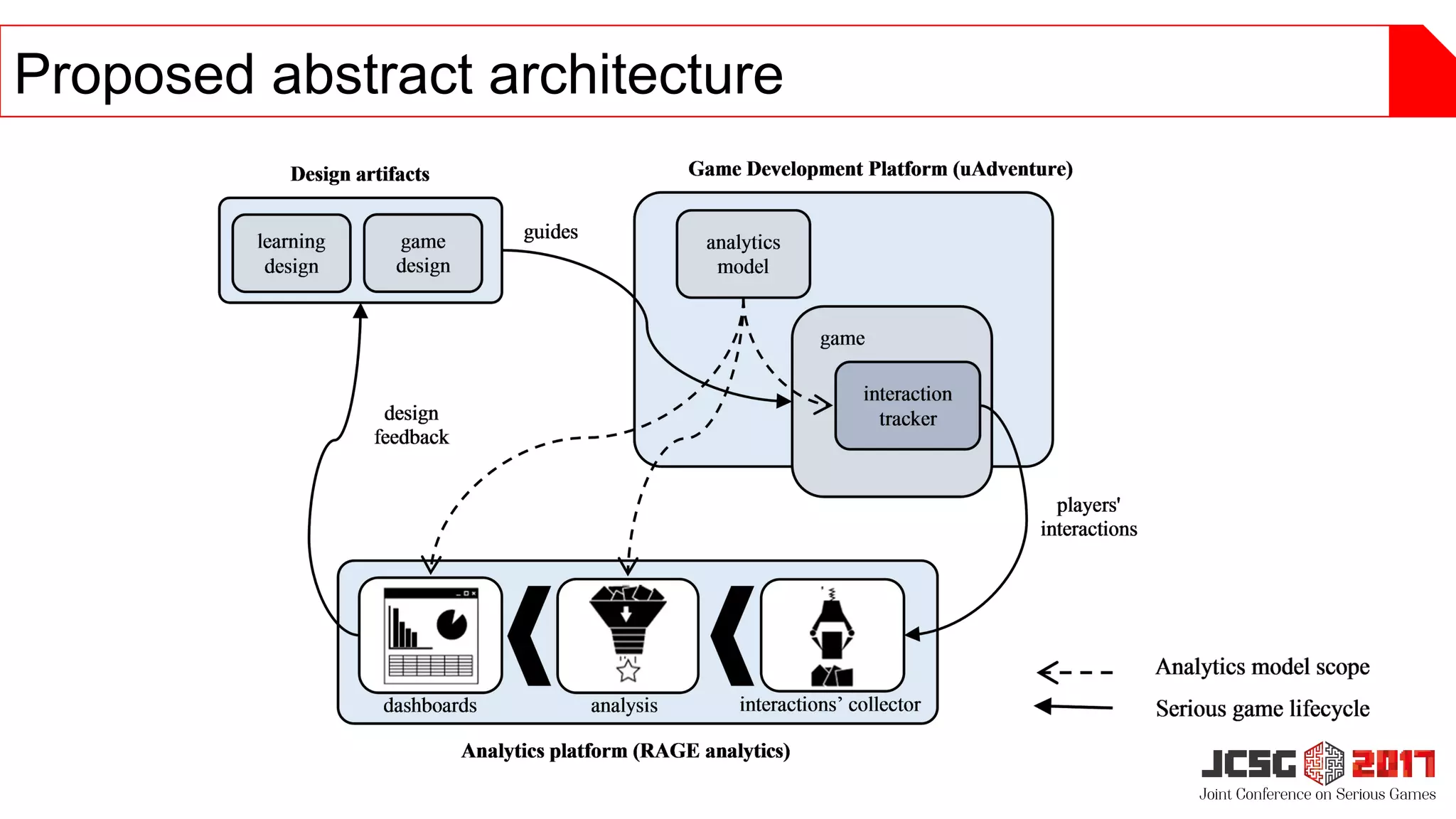
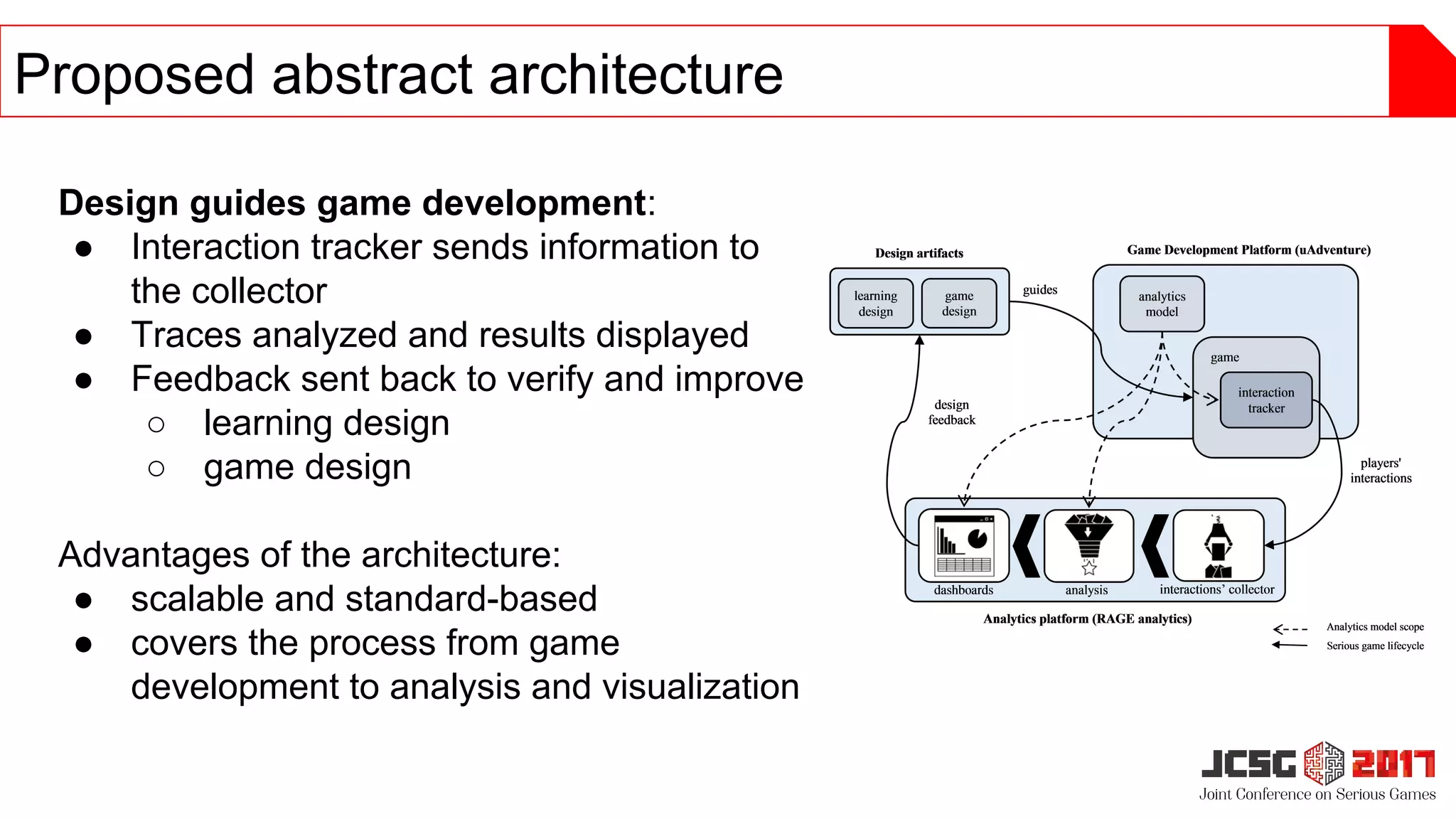
Proposed abstract architecture
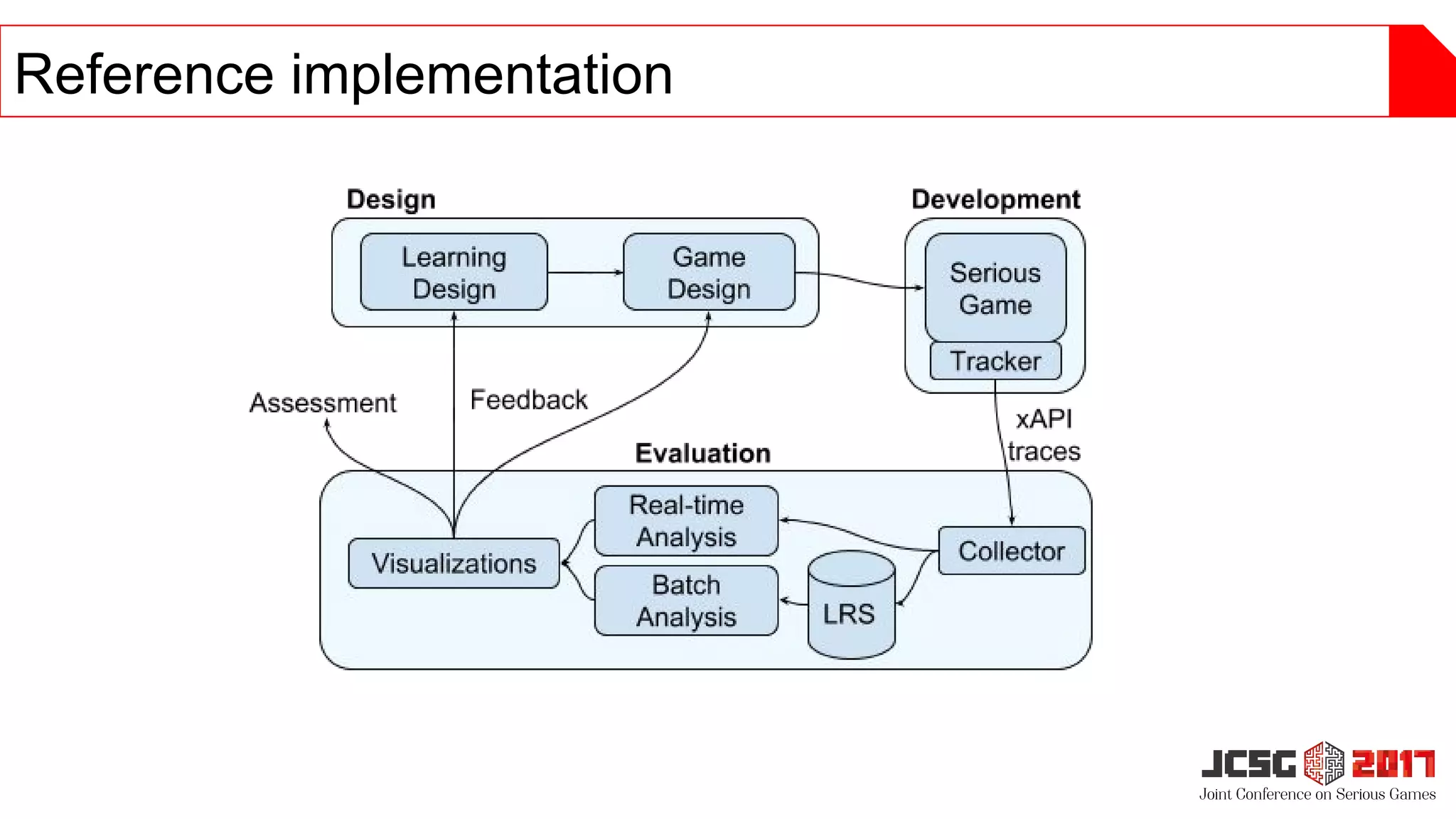
Design guides game development:
● Interaction tracker sends information to
the collector
● Traces analyzed and results displayed
● Feedback sent back to verify and improve
○ learning design
○ game design
Advantages of the architecture:
● scalable and standard-based
● covers the process from game
development to analysis and visualization
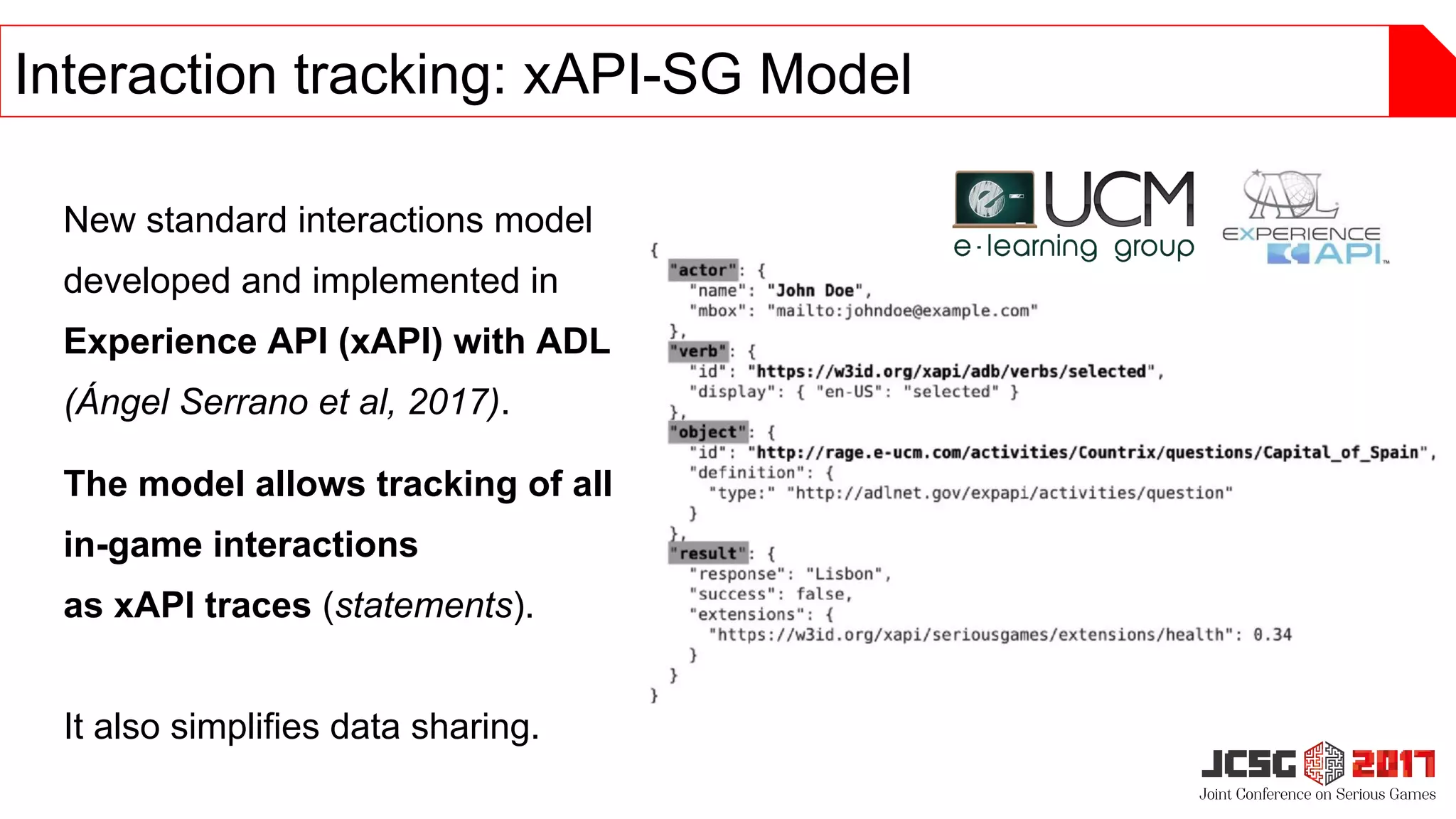
New standard interactions model
developed and implemented in
Experience API (xAPI) with ADL
(Ángel Serrano et al, 2017).
The model allows tracking of all
in-game interactions
as xAPI traces (statements).
It also simplifies data sharing.
Interaction tracking: xAPI-SG Model
Typically, integration of GLA with SGs is performed ad hoc,
with tracker and analytics models being external to the game
development platform.
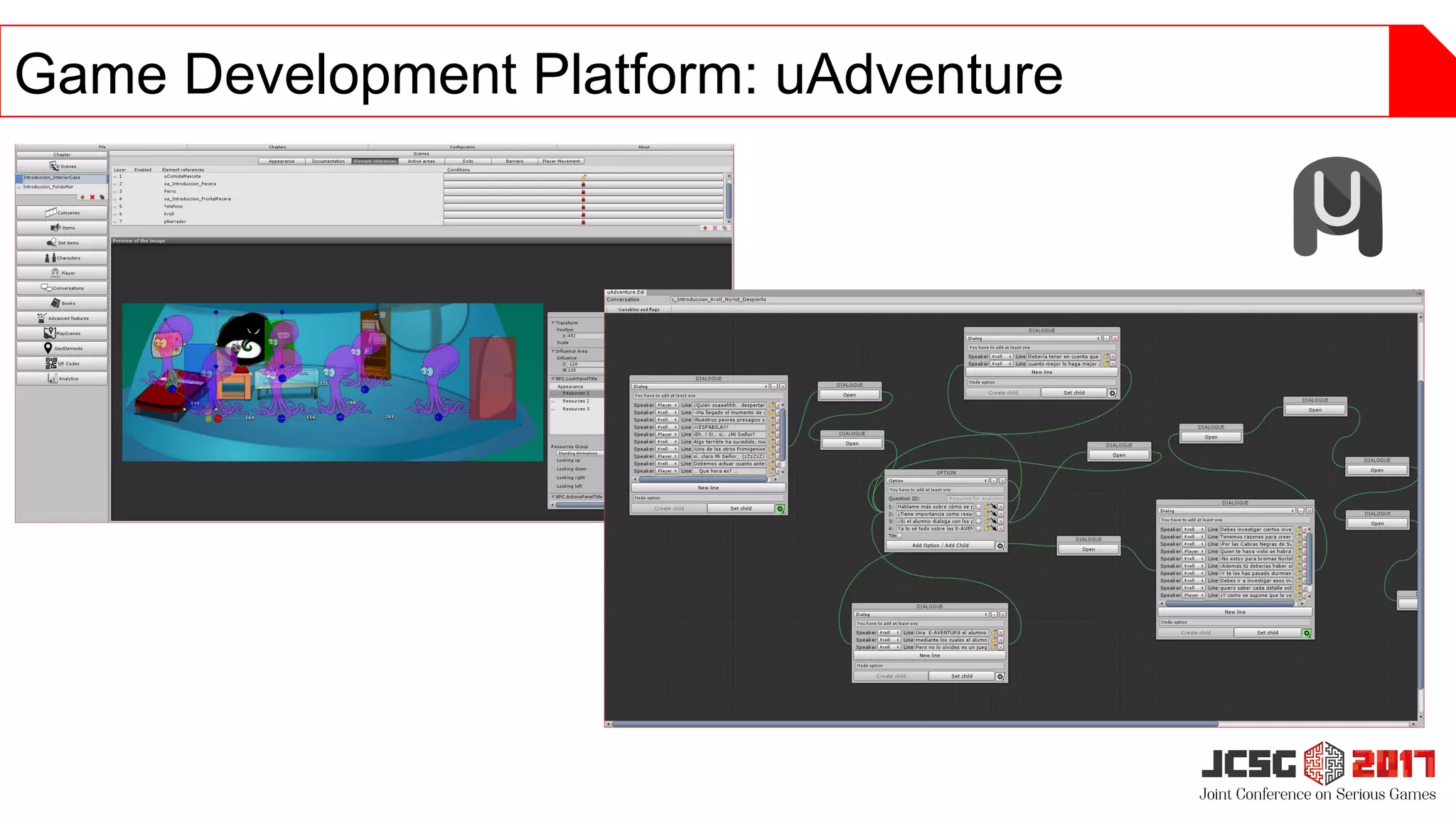
uAdventure platform: complete rewrite of eAdventure, built
on Unity3D.
uAdventure automatically integrates GLA in SGs, reducing
time and effort to integrate analytics.
Also available for geolocalized games.
Game Development Platform: uAdventure
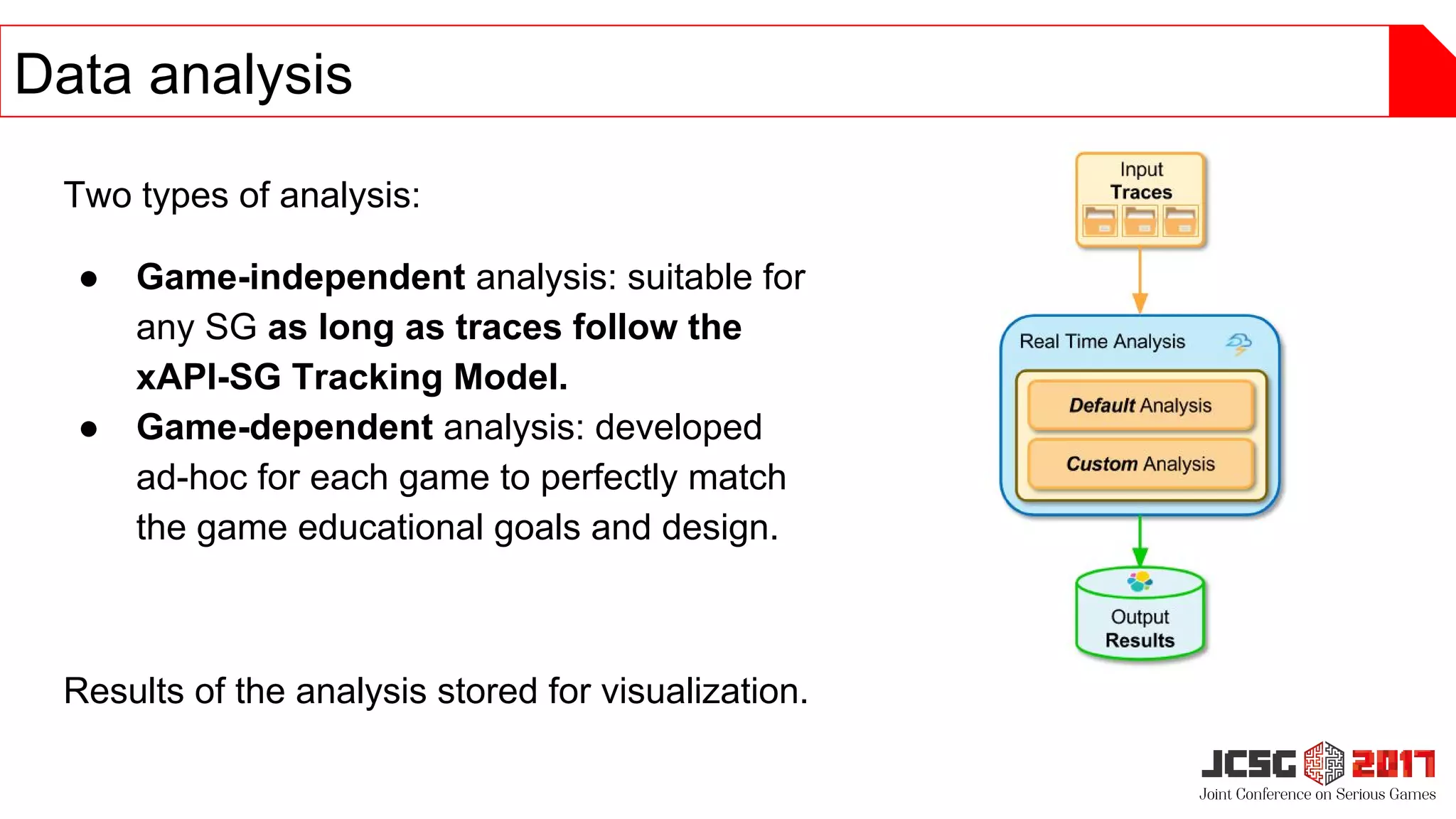
Two types of analysis:
● Game-independent analysis: suitable for
any SG as long as traces follow the
xAPI-SG Tracking Model.
● Game-dependent analysis: developed
ad-hoc for each game to perfectly match
the game educational goals and design.
Results of the analysis stored for visualization.
Data analysis
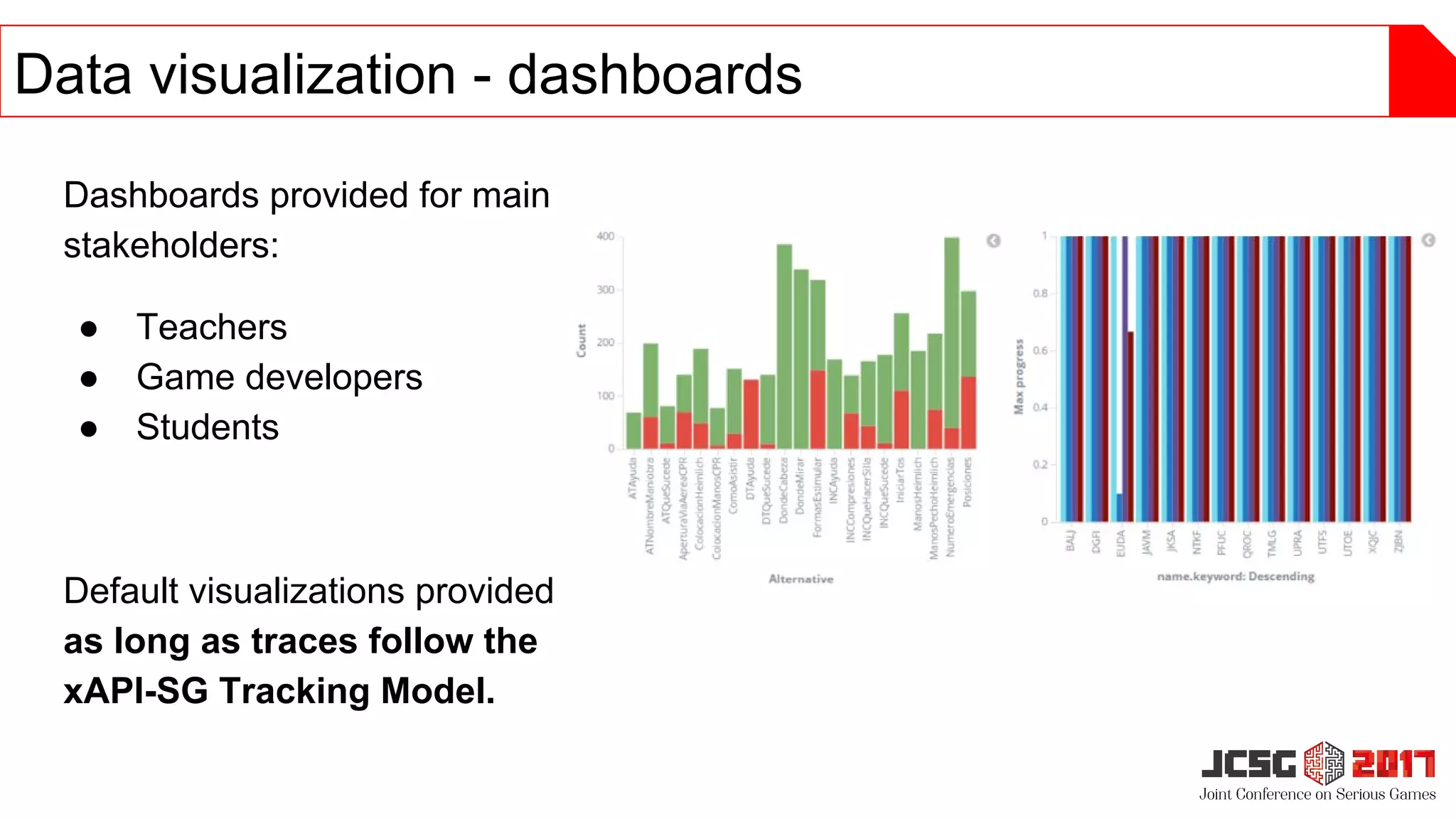
Dashboards provided for main
stakeholders:
● Teachers
● Game developers
● Students
Default visualizations provided
as long as traces follow the
xAPI-SG Tracking Model.
Data visualization - dashboards
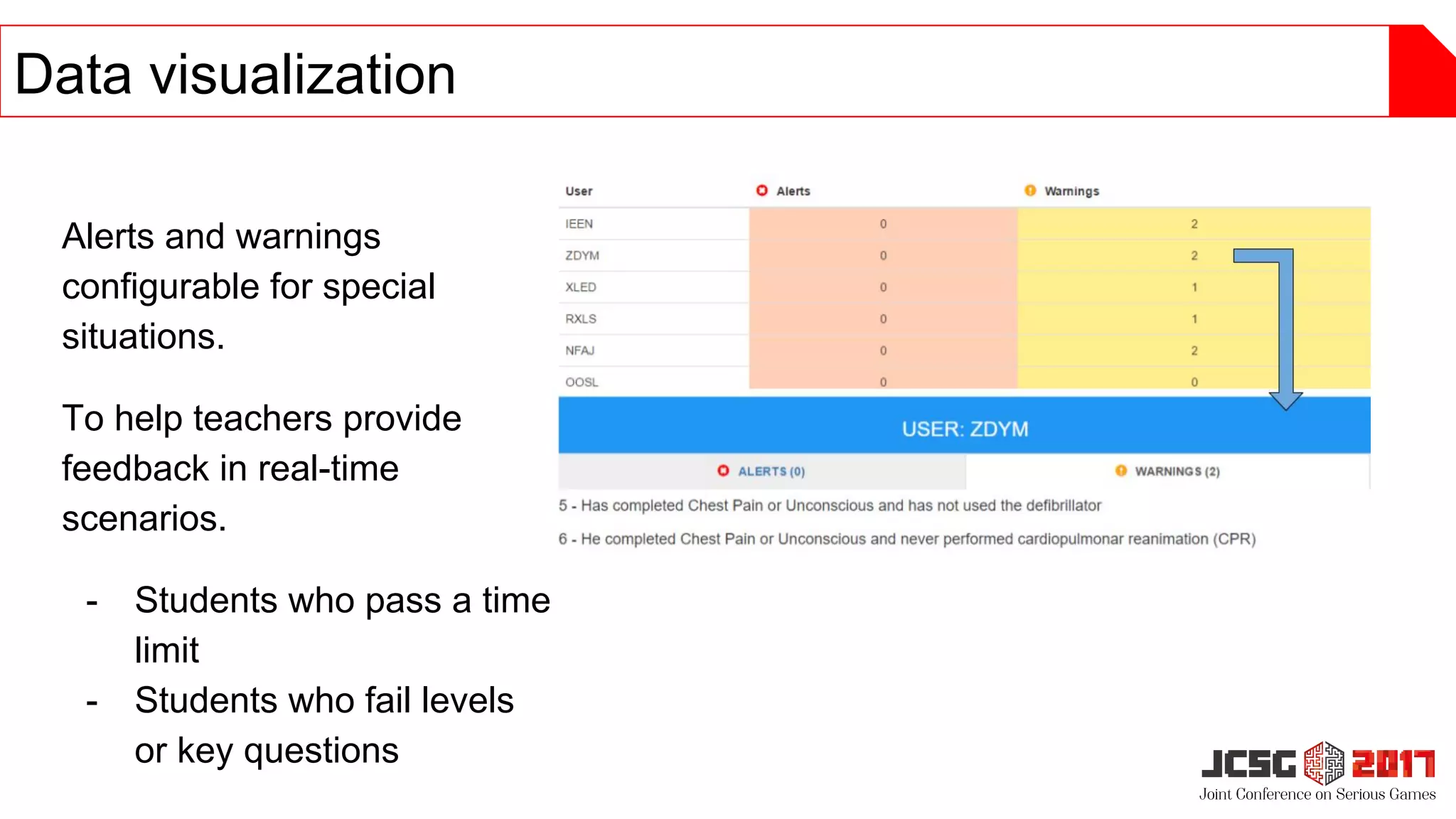
Alerts and warnings
configurable for special
situations.
To help teachers provide
feedback in real-time
scenarios.
- Students who pass a time
limit
- Students who fail levels
or key questions
Data visualization
Reference implementation
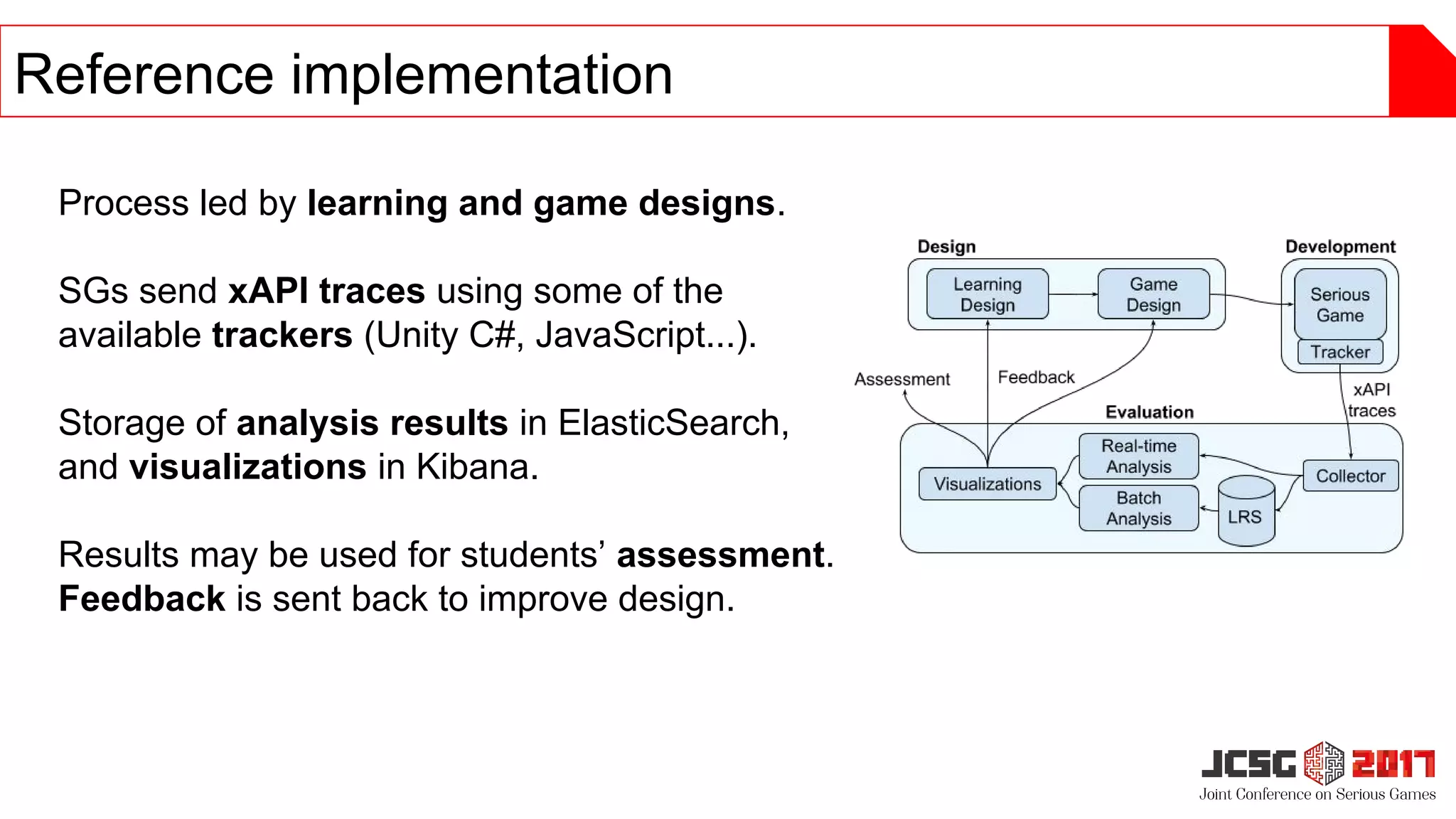
Process led by learning and game designs.
SGs send xAPI traces using some of the
available trackers (Unity C#, JavaScript...).
Storage of analysis results in ElasticSearch,
and visualizations in Kibana.
Results may be used for students’ assessment.
Feedback is sent back to improve design.
● GLA still performed mainly via ad-hoc solutions
Our standardized approach based on:
● Integration of analytics into game authoring tool (uAdventure)
● Use of standard xAPI-SG interaction model for trace collection
● Default set of analysis and visualizations for main stakeholders
Conclusions
System to be improved and extended as part of the H2020 SG-related project
RAGE and BEACONING.
Acknowledgments
● Manuel Freire, Ángel Serrano-Laguna, Borja Manero, Iván Martínez-Ortiz, Pablo Moreno-Ger,
Baltasar Fernández-Manjón (2016): Game Learning Analytics: Learning Analytics for Serious
Games. In Learning, Design, and Technology (pp. 1–29). Cham: Springer International Publishing.
http://doi.org/10.1007/978-3-319-17727-4_21-1.
● Ángel Serrano-Laguna, Iván Martínez-Ortiz, Jason Haag, Damon Regan, Andy Johnson, Baltasar
Fernández-Manjón (2017): Applying standards to systematize learning analytics in serious
games. Computer Standards & Interfaces 50 (2017) 116–123,
http://dx.doi.org/10.1016/j.csi.2016.09.014 [IF, 1,633, Q2 in COMPUTER SCIENCE, SOFTWARE
ENGINEERING].
Main references
Any questions?
● Mail: crisal03@ucm.es
● Google Scholar: https://scholar.google.es/citations?user=h2f9YIgAAAAJ&hl=es
● ResearchGate: https://www.researchgate.net/profile/Cristina_Alonso-Fernandez
● SlideShare: https://www.slideshare.net/CristinaAlonso58
Thank you!

Full Lyifecycle Architecture for Serious Games - JCSG 2017

  • 1.
    Full Lifecycle Architecturefor Serious Games: Integrating Game Learning Analytics and a Game Authoring Tool Cristina Alonso-Fernandez, Dan C. Rotaru, Manuel Freire, Ivan Martinez-Ortiz, Baltasar Fernandez-Manjon Grupo e-UCM www.e-ucm.es JCSG 2017, Universidad Politécnica de Valencia
  • 2.
    Serious Games Purposes: ● teach ●change attitude or behaviour ● create awareness of a certain issue But still engaging and goal-oriented. Applied successfully in many domains: medicine, science, arts, military, education.
  • 3.
    Serious Games Black boxmodel: ● reporting of final results ● no information of real-time learning progress ● complicates external integration Usual evaluation method: pre-post questionnaires (Calderón & Ruiz, 2015). It fails to detect changes in learning as they occur.
  • 4.
    Learning Analytics: “themeasurement, collection, analysis and reporting of data about learners and their contexts, for purposes of understanding and optimizing learning and the environment in which it occurs” (Long & Siemens, 2011) Game Learning Analytics Game Learning Analytics breaking the black box model to obtain information while students play.
  • 5.
  • 6.
    Lifecycle of seriousgames Both for teachers and students: ● real-time feedback ● visualizations that avoid details of the analysis performed underneath Meaningful default analysis are provided (game-independent). For more specific information, game-dependent analysis may be required. Benefits of integrating GLA for development, validation, evaluation. Early emphasis on choosing and measuring evidence of quality.
  • 7.
  • 8.
    Proposed abstract architecture Designguides game development: ● Interaction tracker sends information to the collector ● Traces analyzed and results displayed ● Feedback sent back to verify and improve ○ learning design ○ game design Advantages of the architecture: ● scalable and standard-based ● covers the process from game development to analysis and visualization
  • 9.
    New standard interactionsmodel developed and implemented in Experience API (xAPI) with ADL (Ángel Serrano et al, 2017). The model allows tracking of all in-game interactions as xAPI traces (statements). It also simplifies data sharing. Interaction tracking: xAPI-SG Model
  • 10.
    Typically, integration ofGLA with SGs is performed ad hoc, with tracker and analytics models being external to the game development platform. uAdventure platform: complete rewrite of eAdventure, built on Unity3D. uAdventure automatically integrates GLA in SGs, reducing time and effort to integrate analytics. Also available for geolocalized games. Game Development Platform: uAdventure
  • 11.
  • 12.
    Two types ofanalysis: ● Game-independent analysis: suitable for any SG as long as traces follow the xAPI-SG Tracking Model. ● Game-dependent analysis: developed ad-hoc for each game to perfectly match the game educational goals and design. Results of the analysis stored for visualization. Data analysis
  • 13.
    Dashboards provided formain stakeholders: ● Teachers ● Game developers ● Students Default visualizations provided as long as traces follow the xAPI-SG Tracking Model. Data visualization - dashboards
  • 14.
    Alerts and warnings configurablefor special situations. To help teachers provide feedback in real-time scenarios. - Students who pass a time limit - Students who fail levels or key questions Data visualization
  • 15.
  • 16.
    Reference implementation Process ledby learning and game designs. SGs send xAPI traces using some of the available trackers (Unity C#, JavaScript...). Storage of analysis results in ElasticSearch, and visualizations in Kibana. Results may be used for students’ assessment. Feedback is sent back to improve design.
  • 17.
    ● GLA stillperformed mainly via ad-hoc solutions Our standardized approach based on: ● Integration of analytics into game authoring tool (uAdventure) ● Use of standard xAPI-SG interaction model for trace collection ● Default set of analysis and visualizations for main stakeholders Conclusions
  • 18.
    System to beimproved and extended as part of the H2020 SG-related project RAGE and BEACONING. Acknowledgments
  • 19.
    ● Manuel Freire,Ángel Serrano-Laguna, Borja Manero, Iván Martínez-Ortiz, Pablo Moreno-Ger, Baltasar Fernández-Manjón (2016): Game Learning Analytics: Learning Analytics for Serious Games. In Learning, Design, and Technology (pp. 1–29). Cham: Springer International Publishing. http://doi.org/10.1007/978-3-319-17727-4_21-1. ● Ángel Serrano-Laguna, Iván Martínez-Ortiz, Jason Haag, Damon Regan, Andy Johnson, Baltasar Fernández-Manjón (2017): Applying standards to systematize learning analytics in serious games. Computer Standards & Interfaces 50 (2017) 116–123, http://dx.doi.org/10.1016/j.csi.2016.09.014 [IF, 1,633, Q2 in COMPUTER SCIENCE, SOFTWARE ENGINEERING]. Main references
  • 20.
    Any questions? ● Mail:crisal03@ucm.es ● Google Scholar: https://scholar.google.es/citations?user=h2f9YIgAAAAJ&hl=es ● ResearchGate: https://www.researchgate.net/profile/Cristina_Alonso-Fernandez ● SlideShare: https://www.slideshare.net/CristinaAlonso58 Thank you!