BACKGROUND
STUDY:
The Dramatic
Monologue
by
Vaibhav Atmaram Gangane
Kholeshwar College, Ambajogai
Monologue in poetry and
drama
2
▪ In poetry or in drama, dramatic monologue
is often a long speech given dramatically.
▪ Such speeches are seen throughout the
history of English literature.
▪ Elements of dramatic monologues can be
seen in the theater from ancient Greece
literature to romantic period, in the works of
William Wordsworth, John Keats and S. T.
Coleridge.
Monologue in poetry and
drama: Ancient Greece
3
▪ The Idylls of Theocritus, written in 3rd C.
BC. was acknowledged as a very primary
source of monologues, which includes long
speeches . (Dramatic in form)
▪ Ovid’s Heroides, 1st C. BC. is a collection of
letters or speeches attributed to various
figures from myth and literature.
▪ In ancient Greek literature, monologues
were often performed by female characters, Heroides
Monologue in poetry and
drama: Renaissance
4
▪ who look at the actions of their heroic men
from an emotional and domestic viewpoint.
▪ This talent for dramatizing emotion is
apparent in Ovid’s Love Lyrics and other
poems as well, which later became
influential throughout Europe during middle
ages and Renaissance.
▪ In English literature the early practitioner of
this phenomenon were Chaucer, The Earl of
Surrey, Spencer and Samuel Daniel etc.
Monologue in poetry and
drama: Shakespearean Age
5
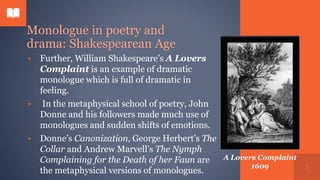
▪ Further, William Shakespeare’s A Lovers
Complaint is an example of dramatic
monologue which is full of dramatic in
feeling.
▪ In the metaphysical school of poetry, John
Donne and his followers made much use of
monologues and sudden shifts of emotions.
▪ Donne’s Canonization, George Herbert’s The
Collar and Andrew Marvell’s The Nymph
Complaining for the Death of her Faun are
the metaphysical versions of monologues.
A Lovers Complaint
1609
Monologue in poetry and
drama: Romantic Age
6
▪ While at the beginning of Romanticism, the
dramatic potential of the lyric took on new
importance.
▪ Several poets draw on the use of monologue
and dialogue in the traditional ballad.
▪ Ex. Wordsworth’s The Thorn, Coleridge’s
The Rime of the Ancient Mariner and
Keats’s La Belle Dame sans Merci.
Monologue in poetry and
drama: Victorian age
7
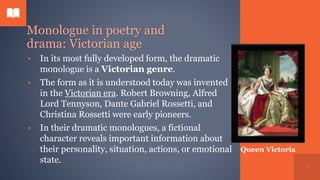
▪ In its most fully developed form, the dramatic
monologue is a Victorian genre.
▪ The form as it is understood today was invented
in the Victorian era. Robert Browning, Alfred
Lord Tennyson, Dante Gabriel Rossetti, and
Christina Rossetti were early pioneers.
▪ In their dramatic monologues, a fictional
character reveals important information about
their personality, situation, actions, or emotional
state.
Queen Victoria
Monologue in poetry and
drama: Modern age
8
▪ The form remained popular in the 20th century. In
the Modernist era, T. S. Eliot and Ezra Pound wrote
persona poems, including Eliot’s famous The Love Song
of J. Alfred Prufrock and Pound’s Personae, a
collection of short poems written in the voice of different
characters.
▪ In the 1950s and 1960s, Gwendolyn Brooks, John
Berryman, and Sylvia Plath all made notable contributions
by writing dramatic monologues that grappled with
subjects like the African American urban experience,
mental illness, addiction, and suicidal ideation.
“ ▪
9
What is
Dramatic
Monologue?
“ ▪
10
 It is a literary form where the
writer takes on the voice of a
character and speaks through
them. (without interruption)
 Within the poem’s/drama’s
framework, the speaker/character
reveals surprising information
about their character or situation
to an implied or explicit audience.
“ ▪
11
 It is a narrative sense of the
speaker’s history and psychological
insight into his character.
 A dramatic monologue is also
called a persona poem, and the
character speaking in the poem is
referred to as a “persona”.
▪ Monologue
▪ One character
addresses other
character. (speaking to
other characters
▪ There can be two types
of audience; the real
one and the audience
within the play.
▪ A long speech.
▪ Soliloquy
▪ The character is
addressing to him or
herself.
▪ No audience except
the audience sitting
in the theatre.
▪ A series of unspoken
reflections
▪ Used in drama
12
Monologue and Soliloquy
13
Soliloquy Monologue
“ ▪
14
What are the
characteristics
of Dramatic
Monologue?
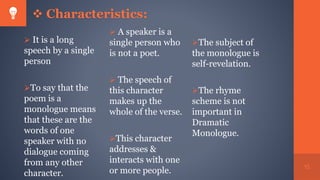
 Characteristics:
 It is a long
speech by a single
person
To say that the
poem is a
monologue means
that these are the
words of one
speaker with no
dialogue coming
from any other
character.
 A speaker is a
single person who
is not a poet.
 The speech of
this character
makes up the
whole of the verse.
This character
addresses &
interacts with one
or more people.
The subject of
the monologue is
self-revelation.
The rhyme
scheme is not
important in
Dramatic
Monologue.
15
Why Writers Use Dramatic
Monologues?
Purpose:
 To give insight into character’s
personality.
To indicate to the reader the
character’s background and
history.
 It adds theatrical qualities to
the poem.
16
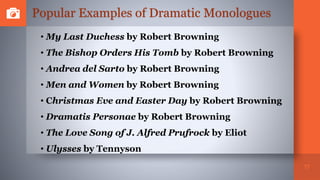
Popular Examples of Dramatic Monologues
17
• My Last Duchess by Robert Browning
• The Bishop Orders His Tomb by Robert Browning
• Andrea del Sarto by Robert Browning
• Men and Women by Robert Browning
• Christmas Eve and Easter Day by Robert Browning
• Dramatis Personae by Robert Browning
• The Love Song of J. Alfred Prufrock by Eliot
• Ulysses by Tennyson
Thanks!
18

Dramatic monologue

  • 1.
  • 2.
    Monologue in poetryand drama 2 ▪ In poetry or in drama, dramatic monologue is often a long speech given dramatically. ▪ Such speeches are seen throughout the history of English literature. ▪ Elements of dramatic monologues can be seen in the theater from ancient Greece literature to romantic period, in the works of William Wordsworth, John Keats and S. T. Coleridge.
  • 3.
    Monologue in poetryand drama: Ancient Greece 3 ▪ The Idylls of Theocritus, written in 3rd C. BC. was acknowledged as a very primary source of monologues, which includes long speeches . (Dramatic in form) ▪ Ovid’s Heroides, 1st C. BC. is a collection of letters or speeches attributed to various figures from myth and literature. ▪ In ancient Greek literature, monologues were often performed by female characters, Heroides
  • 4.
    Monologue in poetryand drama: Renaissance 4 ▪ who look at the actions of their heroic men from an emotional and domestic viewpoint. ▪ This talent for dramatizing emotion is apparent in Ovid’s Love Lyrics and other poems as well, which later became influential throughout Europe during middle ages and Renaissance. ▪ In English literature the early practitioner of this phenomenon were Chaucer, The Earl of Surrey, Spencer and Samuel Daniel etc.
  • 5.
    Monologue in poetryand drama: Shakespearean Age 5 ▪ Further, William Shakespeare’s A Lovers Complaint is an example of dramatic monologue which is full of dramatic in feeling. ▪ In the metaphysical school of poetry, John Donne and his followers made much use of monologues and sudden shifts of emotions. ▪ Donne’s Canonization, George Herbert’s The Collar and Andrew Marvell’s The Nymph Complaining for the Death of her Faun are the metaphysical versions of monologues. A Lovers Complaint 1609
  • 6.
    Monologue in poetryand drama: Romantic Age 6 ▪ While at the beginning of Romanticism, the dramatic potential of the lyric took on new importance. ▪ Several poets draw on the use of monologue and dialogue in the traditional ballad. ▪ Ex. Wordsworth’s The Thorn, Coleridge’s The Rime of the Ancient Mariner and Keats’s La Belle Dame sans Merci.
  • 7.
    Monologue in poetryand drama: Victorian age 7 ▪ In its most fully developed form, the dramatic monologue is a Victorian genre. ▪ The form as it is understood today was invented in the Victorian era. Robert Browning, Alfred Lord Tennyson, Dante Gabriel Rossetti, and Christina Rossetti were early pioneers. ▪ In their dramatic monologues, a fictional character reveals important information about their personality, situation, actions, or emotional state. Queen Victoria
  • 8.
    Monologue in poetryand drama: Modern age 8 ▪ The form remained popular in the 20th century. In the Modernist era, T. S. Eliot and Ezra Pound wrote persona poems, including Eliot’s famous The Love Song of J. Alfred Prufrock and Pound’s Personae, a collection of short poems written in the voice of different characters. ▪ In the 1950s and 1960s, Gwendolyn Brooks, John Berryman, and Sylvia Plath all made notable contributions by writing dramatic monologues that grappled with subjects like the African American urban experience, mental illness, addiction, and suicidal ideation.
  • 9.
  • 10.
    “ ▪ 10  Itis a literary form where the writer takes on the voice of a character and speaks through them. (without interruption)  Within the poem’s/drama’s framework, the speaker/character reveals surprising information about their character or situation to an implied or explicit audience.
  • 11.
    “ ▪ 11  Itis a narrative sense of the speaker’s history and psychological insight into his character.  A dramatic monologue is also called a persona poem, and the character speaking in the poem is referred to as a “persona”.
  • 12.
    ▪ Monologue ▪ Onecharacter addresses other character. (speaking to other characters ▪ There can be two types of audience; the real one and the audience within the play. ▪ A long speech. ▪ Soliloquy ▪ The character is addressing to him or herself. ▪ No audience except the audience sitting in the theatre. ▪ A series of unspoken reflections ▪ Used in drama 12 Monologue and Soliloquy
  • 13.
  • 14.
    “ ▪ 14 What arethe characteristics of Dramatic Monologue?
  • 15.
     Characteristics:  Itis a long speech by a single person To say that the poem is a monologue means that these are the words of one speaker with no dialogue coming from any other character.  A speaker is a single person who is not a poet.  The speech of this character makes up the whole of the verse. This character addresses & interacts with one or more people. The subject of the monologue is self-revelation. The rhyme scheme is not important in Dramatic Monologue. 15
  • 16.
    Why Writers UseDramatic Monologues? Purpose:  To give insight into character’s personality. To indicate to the reader the character’s background and history.  It adds theatrical qualities to the poem. 16
  • 17.
    Popular Examples ofDramatic Monologues 17 • My Last Duchess by Robert Browning • The Bishop Orders His Tomb by Robert Browning • Andrea del Sarto by Robert Browning • Men and Women by Robert Browning • Christmas Eve and Easter Day by Robert Browning • Dramatis Personae by Robert Browning • The Love Song of J. Alfred Prufrock by Eliot • Ulysses by Tennyson
  • 18.