CVE
• https://cyberthreatsummit.com/speakers.php
What is a CVE
• Common Vulnerabilities and Exposures (CVE®) is a list of common
identifiers for publicly known cyber security vulnerabilities.
• Use of "CVE Identifiers (CVE IDs)," which are assigned by CVE
Numbering Authorities (CNAs) from around the world,
• ensures confidence among parties when used to discuss or share information
about a unique software vulnerability,
• provides a baseline for tool evaluation, and
• enables data exchange for cyber security automation.
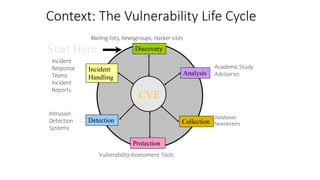
Context: The Vulnerability Life Cycle
CVE
Discovery
Mailing lists, Newsgroups, Hacker sites
Analysis
Academic Study
Advisories
Protection
Vulnerability Assessment Tools
Collection
Databases
Newsletters
Detection
Intrusion
Detection
Systems
Incident
Handling
Incident
Response
Teams
Incident
Reports
Start Here
Implications
• Difficult to correlate data across multiple organizations and tools
• E.g. IDS and assessment tools
• E.g. security tools and fix information
• Incident information
• Difficult to conduct a detailed comparison of tools or databases
• Vulnerabilities are counted differently
• Which is more comprehensive?
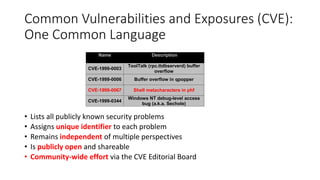
Common Vulnerabilities and Exposures (CVE):
One Common Language
• Lists all publicly known security problems
• Assigns unique identifier to each problem
• Remains independent of multiple perspectives
• Is publicly open and shareable
• Community-wide effort via the CVE Editorial Board
Name Description
CVE-1999-0003
ToolTalk (rpc.ttdbserverd) buffer
overflow
CVE-1999-0006 Buffer overflow in qpopper
CVE-1999-0067 Shell metacharacters in phf
CVE-1999-0344
Windows NT debug-level access
bug (a.k.a. Sechole)
Addressing Common Misconceptions of CVE
• Not a full-fledged vulnerability database
• Simplicity avoids competition, limits debate
• Intended for use by vulnerability database maintainers
• Not a taxonomy or classification scheme
• Focuses on vulnerabilities instead of attacks
• Does not cover activities such as port mapping
• Not just “vulnerabilities” in the classical sense
• Definitions of “vulnerability” vary greatly
• “Exposure” covers a broader notion of “vulnerability”
• Competing vendors are working together to adopt CVE
CVE Editorial Board
• Members from 25 different organizations including researchers, tool
vendors, response teams, and end users
• Mostly technical representatives
• Review and approve CVE entries
• Discuss issues related to CVE maintenance
• Monthly meetings (face-to-face or phone)
• Publicly viewable mailing list archives
Adding new entries
• Board member submits raw information to MITRE
• Submissions are grouped, refined, and proposed back to the Board as
candidates
• Form: CAN-YYYY-NNNN
• Strong likelihood of becoming CVE-YYYY-NNNN
• Delicate balance between timeliness and accuracy
• Board reviews and votes on candidates
• Accept, modify, recast, reject, reviewing
• If approved, the candidate becomes a CVE entry
• Entry is included in a subsequent CVE version
• Published on CVE web site
• Entries may later be modified or deprecated
CVE is:
• One name for one vulnerability or exposure
• One standardized description for each vulnerability or exposure
• A dictionary rather than a database
• How disparate databases and tools can "speak" the same language
• The way to interoperability and better security coverage
• A basis for evaluation among tools and databases
• Free for public download and use
• Industry-endorsed via the CVE Numbering Authorities, CVE Board,
and CVE-Compatible Products
Why CVE
• CVE was launched in 1999, as a government US program
• different metrics to state the number of vulnerabilities or exposures
they detected
• CVE is now the industry standard for vulnerability and exposure
names.
CVE Identifier
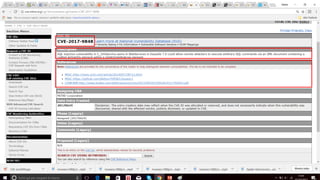
• CVE Identifiers (also referred to by the community as "CVE IDs," "CVE
entries," "CVE names," "CVE numbers," and "CVEs") are unique, common
identifiers for publicly known cyber security vulnerabilities.
• Each CVE Identifier includes the following:
• CVE identifier number with four or more digits in the sequence number portion of
the ID (i.e., "CVE-1999-0067", "CVE-2014-12345", "CVE-2016-7654321").
• Brief description of the security vulnerability or exposure.
• Any pertinent references (i.e., vulnerability reports and advisories).
• CVE Identifiers are used by information security product/service vendors and
researchers as a standard method for identifying vulnerabilities and for cross-
linking with other repositories that also use CVE Identifiers.
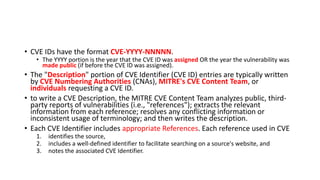
• CVE IDs have the format CVE-YYYY-NNNNN.
• The YYYY portion is the year that the CVE ID was assigned OR the year the vulnerability was
made public (if before the CVE ID was assigned).
• The "Description" portion of CVE Identifier (CVE ID) entries are typically written
by CVE Numbering Authorities (CNAs), MITRE's CVE Content Team, or
individuals requesting a CVE ID.
• to write a CVE Description, the MITRE CVE Content Team analyzes public, third-
party reports of vulnerabilities (i.e., "references"); extracts the relevant
information from each reference; resolves any conflicting information or
inconsistent usage of terminology; and then writes the description.
• Each CVE Identifier includes appropriate References. Each reference used in CVE
1. identifies the source,
2. includes a well-defined identifier to facilitate searching on a source's website, and
3. notes the associated CVE Identifier.
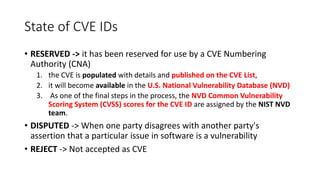
State of CVE IDs
• RESERVED -> it has been reserved for use by a CVE Numbering
Authority (CNA)
1. the CVE is populated with details and published on the CVE List,
2. it will become available in the U.S. National Vulnerability Database (NVD)
3. As one of the final steps in the process, the NVD Common Vulnerability
Scoring System (CVSS) scores for the CVE ID are assigned by the NIST NVD
team.
• DISPUTED -> When one party disagrees with another party's
assertion that a particular issue in software is a vulnerability
• REJECT -> Not accepted as CVE
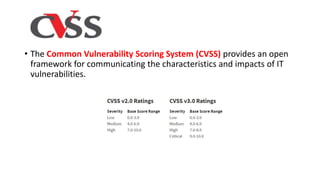
• The Common Vulnerability Scoring System (CVSS) provides an open
framework for communicating the characteristics and impacts of IT
vulnerabilities.

Common Vulnerabilities and Exposures details

  • 1.
  • 2.
  • 3.
    What is aCVE • Common Vulnerabilities and Exposures (CVE®) is a list of common identifiers for publicly known cyber security vulnerabilities. • Use of "CVE Identifiers (CVE IDs)," which are assigned by CVE Numbering Authorities (CNAs) from around the world, • ensures confidence among parties when used to discuss or share information about a unique software vulnerability, • provides a baseline for tool evaluation, and • enables data exchange for cyber security automation.
  • 6.
    Context: The VulnerabilityLife Cycle CVE Discovery Mailing lists, Newsgroups, Hacker sites Analysis Academic Study Advisories Protection Vulnerability Assessment Tools Collection Databases Newsletters Detection Intrusion Detection Systems Incident Handling Incident Response Teams Incident Reports Start Here
  • 7.
    Implications • Difficult tocorrelate data across multiple organizations and tools • E.g. IDS and assessment tools • E.g. security tools and fix information • Incident information • Difficult to conduct a detailed comparison of tools or databases • Vulnerabilities are counted differently • Which is more comprehensive?
  • 8.
    Common Vulnerabilities andExposures (CVE): One Common Language • Lists all publicly known security problems • Assigns unique identifier to each problem • Remains independent of multiple perspectives • Is publicly open and shareable • Community-wide effort via the CVE Editorial Board Name Description CVE-1999-0003 ToolTalk (rpc.ttdbserverd) buffer overflow CVE-1999-0006 Buffer overflow in qpopper CVE-1999-0067 Shell metacharacters in phf CVE-1999-0344 Windows NT debug-level access bug (a.k.a. Sechole)
  • 9.
    Addressing Common Misconceptionsof CVE • Not a full-fledged vulnerability database • Simplicity avoids competition, limits debate • Intended for use by vulnerability database maintainers • Not a taxonomy or classification scheme • Focuses on vulnerabilities instead of attacks • Does not cover activities such as port mapping • Not just “vulnerabilities” in the classical sense • Definitions of “vulnerability” vary greatly • “Exposure” covers a broader notion of “vulnerability” • Competing vendors are working together to adopt CVE
  • 10.
    CVE Editorial Board •Members from 25 different organizations including researchers, tool vendors, response teams, and end users • Mostly technical representatives • Review and approve CVE entries • Discuss issues related to CVE maintenance • Monthly meetings (face-to-face or phone) • Publicly viewable mailing list archives
  • 11.
    Adding new entries •Board member submits raw information to MITRE • Submissions are grouped, refined, and proposed back to the Board as candidates • Form: CAN-YYYY-NNNN • Strong likelihood of becoming CVE-YYYY-NNNN • Delicate balance between timeliness and accuracy • Board reviews and votes on candidates • Accept, modify, recast, reject, reviewing • If approved, the candidate becomes a CVE entry • Entry is included in a subsequent CVE version • Published on CVE web site • Entries may later be modified or deprecated
  • 12.
    CVE is: • Onename for one vulnerability or exposure • One standardized description for each vulnerability or exposure • A dictionary rather than a database • How disparate databases and tools can "speak" the same language • The way to interoperability and better security coverage • A basis for evaluation among tools and databases • Free for public download and use • Industry-endorsed via the CVE Numbering Authorities, CVE Board, and CVE-Compatible Products
  • 13.
    Why CVE • CVEwas launched in 1999, as a government US program • different metrics to state the number of vulnerabilities or exposures they detected • CVE is now the industry standard for vulnerability and exposure names.
  • 14.
    CVE Identifier • CVEIdentifiers (also referred to by the community as "CVE IDs," "CVE entries," "CVE names," "CVE numbers," and "CVEs") are unique, common identifiers for publicly known cyber security vulnerabilities. • Each CVE Identifier includes the following: • CVE identifier number with four or more digits in the sequence number portion of the ID (i.e., "CVE-1999-0067", "CVE-2014-12345", "CVE-2016-7654321"). • Brief description of the security vulnerability or exposure. • Any pertinent references (i.e., vulnerability reports and advisories). • CVE Identifiers are used by information security product/service vendors and researchers as a standard method for identifying vulnerabilities and for cross- linking with other repositories that also use CVE Identifiers.
  • 15.
    • CVE IDshave the format CVE-YYYY-NNNNN. • The YYYY portion is the year that the CVE ID was assigned OR the year the vulnerability was made public (if before the CVE ID was assigned). • The "Description" portion of CVE Identifier (CVE ID) entries are typically written by CVE Numbering Authorities (CNAs), MITRE's CVE Content Team, or individuals requesting a CVE ID. • to write a CVE Description, the MITRE CVE Content Team analyzes public, third- party reports of vulnerabilities (i.e., "references"); extracts the relevant information from each reference; resolves any conflicting information or inconsistent usage of terminology; and then writes the description. • Each CVE Identifier includes appropriate References. Each reference used in CVE 1. identifies the source, 2. includes a well-defined identifier to facilitate searching on a source's website, and 3. notes the associated CVE Identifier.
  • 16.
    State of CVEIDs • RESERVED -> it has been reserved for use by a CVE Numbering Authority (CNA) 1. the CVE is populated with details and published on the CVE List, 2. it will become available in the U.S. National Vulnerability Database (NVD) 3. As one of the final steps in the process, the NVD Common Vulnerability Scoring System (CVSS) scores for the CVE ID are assigned by the NIST NVD team. • DISPUTED -> When one party disagrees with another party's assertion that a particular issue in software is a vulnerability • REJECT -> Not accepted as CVE
  • 17.
    • The CommonVulnerability Scoring System (CVSS) provides an open framework for communicating the characteristics and impacts of IT vulnerabilities.