STAKEHOLDER Fact Finding Methods
Fact Finding Methods Conduct interviews and discussion with users Distribute and collect stakeholder questionnaires Review existing reports, forms, and procedure descriptions
Fact Finding Methods Observe business processes and workflows Build prototypes Conduct JAD ( Joint Application Development ) sessions RAD ( Rapid Application Development)
  Fact Finding Methods Interviews Questionnaires Review Documentation Observation Prototypes JAD sessions RAD
Interviews Primary technique for fact finding and information gathering Most effective way to understand business functions and business rules Usually requires multiple sessions
Interviews Usually conducted with customers/clients/users Clients are not always able to express their requirements clearly    it is up to the analyst to ask the right questions to help the client express their requirements
Interviews We are going to concentrate on interview techniques;  the rest of the slides explain the other methods for fact finding
Conducting effective interviews Determine who you are going to interview Know what information that stakeholder can provide for you Prepare for the interview Conduct the interview Follow up on the interview
Determine who you are going to interview Can be standard (business) or technical (technology adopters) users Standard users provide the functional and data requirements Technical (technology adopters) users provide the technical and data requirements
Determine who you are going to interview Can be standard (business) or technical (technology adopters) users in your business area or the other business areas that communicate with yours
Styles of Interviews Structured Interview Formal style Requires significant preparation Unstructured Interview Informal No pre-determined questions or objectives
Structured Interview Preparing for the interview Establish the objectives for the interview Have a clear agenda Prepared in advance with a list of open and closed ended questions Set the time and location for the interview Inform all participants of the objective, time and location
Questions Should allow you to keep on track and avoid getting off topic during the interview Can be prepared from any of the following: Observations made when existing form and reports may have been reviewed Observations made when reviewing the strategic, tactical or operational plans Observations made when observing employees doing current job tasks Keep length of questions reasonable (15-20 words or less)
Questions Phrase questions to avoid misunderstandings - use simple terms and wording Do not ask questions that give clues to expected answers Avoid asking two questions in one Do not ask questions that can raise concerns about job security or other negative issues
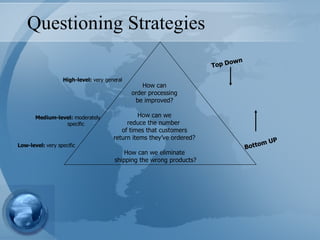
Questioning Strategies How can order processing be improved? How can we reduce the number  of times that customers return items they’ve ordered? How can we eliminate shipping the wrong products? High-level:  very general Medium-level:  moderately specific Low-level:  very specific Top Down Bottom UP
Questions Open ended questions Encourages unstructured responses and generates discussion Useful when you need to understand a larger process or to draw out opinions or suggestions from the person being interviewed
Questions Closed ended questions Limited or restricted response – a simple definitive answer Used to get information that is more specific or when you need to verify facts
Sample interview questions Open-ended What do you think about the current system? How do you decide what type of marketing campaigns to run? Closed-ended How do customers place orders? How many orders to you receive a day?
Structured Interview Conduct the interview Dress appropriately; Arrive on time Welcome the participants; introduce the attendees; state the objective and agenda Ask permission if you want to tape record the interview Ask questions from script
Structured Interview Conduct the interview Listen closely to the interviewee and encourage them to expand on key points Take thorough notes Identify and document unanswered questions At end of interview, review outstanding questions that require follow up Set date and time for the next, follow-up interview
Fact Finding Methods Interviews Questionnaires Review Documentation Observation Prototypes JAD sessions RAD
Questionnaires A document which contains a number of questions Can be paper form or electronic form (email or web-based) Allows the analyst to collect information from a large number of people People outside the organization (I.e. customers) Business users spread across a large geographic area
Questionnaires Limited and specific information from a large number of stakeholders Preliminary insight Not well suited for gathering detailed information Open-ended questions vs. close-ended questions
Questionnaires Similar process to interviewing Determine who will receive the questionnaire Design the questionnaire Determine objective of questionnaire Design questions Follow up questionnaire
Questionnaires Determine who will receive the questionnaire Select a sample audience who are representative of an entire group Assume 30-50% return rate for paper and email questionnaires Assume a 5-30% return rate for web-based questionnaires
Questionnaires Design the Questionnaire Clearly state the following in the questionnaire: The purpose of the questionnaire Why the respondent was selected to receive the questionnaire When the questionnaire is to be returned
Questionnaires Design the Questionnaire Let the respondent know when/where they can see the accumulated questionnaire responses Consider providing an inducement to have the respondent complete the questionnaire (I.e. a pen)
Questionnaires Design the Questionnaire Keep the questionnaire brief and user friendly Provide clear instructions on how to complete the questionnaire Arrange the questions in a logical order; going from easy to more complex topics
Questionnaires Design the Questionnaire Phrase questions to avoid misunderstandings, use simple terms and wording Do not ask questions that give clues to expected answers Avoid asking two questions in one Limit the use of open ended questions that will be difficult to tabulate
Questionnaires Design the Questionnaire Do not ask questions that can raise concerns about job security or other negative issues Include a section at the end of the questionnaire for general comments Test the questionnaire whenever possible on a small test group before finalizing it
Review Existing Reports, Forms,  and Procedure Descriptions Purposes Preliminary understanding of processes Guidelines / visual cues to guide interviews Identify business rules, discrepancies, and redundancies Be cautious of outdated material
Reviewing existing documentation Most beneficial to new employees or consultants hired to work on a project Types of documentation that is reviewed: Company reports Organization charts Policy and Procedures manuals Job Descriptions Documentation of existing systems
Reviewing existing documentation Allows the analyst to get an understanding of the organization prior to meeting with employees Allows the analyst to prepare questions for either interviews or questionnaires (other fact finding techniques)
Observation An effective way to gather requirements if obtaining complete information was not effective through other fact finding techniques (I.e. interviews and questionnaires) Or An effective way to verify information gathered from other fact finding sources (such as interviews)
Observation Observation can be done by having the analyst observe the client from a distance (without actually interrupting the client) or by actually doing the work of the client
Observation Should be carried out for a period of time and at different time intervals, not just once, so that the analyst can observe different workloads and to ensure that what the client does is consistent over different periods of time
Observation Allows the analyst to follow an entire process from start to finish Can upset the client if they feel threatened by new activity going on around them – the client may behave differently from what they normally do
Prototypes A demonstration system Represents a graphical user interface Simulates system behavior for various events Any data displayed on a GUI screen is hard-coded; not retrieved from a database Constructed to visualize the system Allows the customer to provide feedback An effective way to gather requirements for a new system Supports JAD or RAD type sessions
Other Methods Joint Application Development (JAD) A series of workshops that bring together all stakeholders (users and systems personnel)
Other Methods Joint Application Development (JAD) Consists of the following types of attendees: Facilitator: the person who conducts the meeting and keeps it on track (generally the analyst) Note taker: the person who records the information for the session Clients/Customers/Users: the people who communicate the requirements, take decisions and approve the project Developers: the people who are part of the development team and need to gather information
Other Methods Joint Application Development (JAD) Takes advantage of the group dynamics Increased productivity May require more than one session One session may last a few hours, several days or several weeks
Other Methods Rapid Application Development (RAD) An approach to software development where the system solution is delivered – fast Most appropriate for systems which are not the organization’s core business Example:  Xtreme Programming
Other Methods Rapid Application Development (RAD) Can result in: Inconsistent GUI designs Poorly documented systems Software that is difficult to maintain

S T A K E H O L D E R Fact Finding

  • 1.
  • 2.
    Fact Finding MethodsConduct interviews and discussion with users Distribute and collect stakeholder questionnaires Review existing reports, forms, and procedure descriptions
  • 3.
    Fact Finding MethodsObserve business processes and workflows Build prototypes Conduct JAD ( Joint Application Development ) sessions RAD ( Rapid Application Development)
  • 4.
    FactFinding Methods Interviews Questionnaires Review Documentation Observation Prototypes JAD sessions RAD
  • 5.
    Interviews Primary techniquefor fact finding and information gathering Most effective way to understand business functions and business rules Usually requires multiple sessions
  • 6.
    Interviews Usually conductedwith customers/clients/users Clients are not always able to express their requirements clearly  it is up to the analyst to ask the right questions to help the client express their requirements
  • 7.
    Interviews We aregoing to concentrate on interview techniques; the rest of the slides explain the other methods for fact finding
  • 8.
    Conducting effective interviewsDetermine who you are going to interview Know what information that stakeholder can provide for you Prepare for the interview Conduct the interview Follow up on the interview
  • 9.
    Determine who youare going to interview Can be standard (business) or technical (technology adopters) users Standard users provide the functional and data requirements Technical (technology adopters) users provide the technical and data requirements
  • 10.
    Determine who youare going to interview Can be standard (business) or technical (technology adopters) users in your business area or the other business areas that communicate with yours
  • 11.
    Styles of InterviewsStructured Interview Formal style Requires significant preparation Unstructured Interview Informal No pre-determined questions or objectives
  • 12.
    Structured Interview Preparingfor the interview Establish the objectives for the interview Have a clear agenda Prepared in advance with a list of open and closed ended questions Set the time and location for the interview Inform all participants of the objective, time and location
  • 13.
    Questions Should allowyou to keep on track and avoid getting off topic during the interview Can be prepared from any of the following: Observations made when existing form and reports may have been reviewed Observations made when reviewing the strategic, tactical or operational plans Observations made when observing employees doing current job tasks Keep length of questions reasonable (15-20 words or less)
  • 14.
    Questions Phrase questionsto avoid misunderstandings - use simple terms and wording Do not ask questions that give clues to expected answers Avoid asking two questions in one Do not ask questions that can raise concerns about job security or other negative issues
  • 15.
    Questioning Strategies Howcan order processing be improved? How can we reduce the number of times that customers return items they’ve ordered? How can we eliminate shipping the wrong products? High-level: very general Medium-level: moderately specific Low-level: very specific Top Down Bottom UP
  • 16.
    Questions Open endedquestions Encourages unstructured responses and generates discussion Useful when you need to understand a larger process or to draw out opinions or suggestions from the person being interviewed
  • 17.
    Questions Closed endedquestions Limited or restricted response – a simple definitive answer Used to get information that is more specific or when you need to verify facts
  • 18.
    Sample interview questionsOpen-ended What do you think about the current system? How do you decide what type of marketing campaigns to run? Closed-ended How do customers place orders? How many orders to you receive a day?
  • 19.
    Structured Interview Conductthe interview Dress appropriately; Arrive on time Welcome the participants; introduce the attendees; state the objective and agenda Ask permission if you want to tape record the interview Ask questions from script
  • 20.
    Structured Interview Conductthe interview Listen closely to the interviewee and encourage them to expand on key points Take thorough notes Identify and document unanswered questions At end of interview, review outstanding questions that require follow up Set date and time for the next, follow-up interview
  • 21.
    Fact Finding MethodsInterviews Questionnaires Review Documentation Observation Prototypes JAD sessions RAD
  • 22.
    Questionnaires A documentwhich contains a number of questions Can be paper form or electronic form (email or web-based) Allows the analyst to collect information from a large number of people People outside the organization (I.e. customers) Business users spread across a large geographic area
  • 23.
    Questionnaires Limited andspecific information from a large number of stakeholders Preliminary insight Not well suited for gathering detailed information Open-ended questions vs. close-ended questions
  • 24.
    Questionnaires Similar processto interviewing Determine who will receive the questionnaire Design the questionnaire Determine objective of questionnaire Design questions Follow up questionnaire
  • 25.
    Questionnaires Determine whowill receive the questionnaire Select a sample audience who are representative of an entire group Assume 30-50% return rate for paper and email questionnaires Assume a 5-30% return rate for web-based questionnaires
  • 26.
    Questionnaires Design theQuestionnaire Clearly state the following in the questionnaire: The purpose of the questionnaire Why the respondent was selected to receive the questionnaire When the questionnaire is to be returned
  • 27.
    Questionnaires Design theQuestionnaire Let the respondent know when/where they can see the accumulated questionnaire responses Consider providing an inducement to have the respondent complete the questionnaire (I.e. a pen)
  • 28.
    Questionnaires Design theQuestionnaire Keep the questionnaire brief and user friendly Provide clear instructions on how to complete the questionnaire Arrange the questions in a logical order; going from easy to more complex topics
  • 29.
    Questionnaires Design theQuestionnaire Phrase questions to avoid misunderstandings, use simple terms and wording Do not ask questions that give clues to expected answers Avoid asking two questions in one Limit the use of open ended questions that will be difficult to tabulate
  • 30.
    Questionnaires Design theQuestionnaire Do not ask questions that can raise concerns about job security or other negative issues Include a section at the end of the questionnaire for general comments Test the questionnaire whenever possible on a small test group before finalizing it
  • 31.
    Review Existing Reports,Forms, and Procedure Descriptions Purposes Preliminary understanding of processes Guidelines / visual cues to guide interviews Identify business rules, discrepancies, and redundancies Be cautious of outdated material
  • 32.
    Reviewing existing documentationMost beneficial to new employees or consultants hired to work on a project Types of documentation that is reviewed: Company reports Organization charts Policy and Procedures manuals Job Descriptions Documentation of existing systems
  • 33.
    Reviewing existing documentationAllows the analyst to get an understanding of the organization prior to meeting with employees Allows the analyst to prepare questions for either interviews or questionnaires (other fact finding techniques)
  • 34.
    Observation An effectiveway to gather requirements if obtaining complete information was not effective through other fact finding techniques (I.e. interviews and questionnaires) Or An effective way to verify information gathered from other fact finding sources (such as interviews)
  • 35.
    Observation Observation canbe done by having the analyst observe the client from a distance (without actually interrupting the client) or by actually doing the work of the client
  • 36.
    Observation Should becarried out for a period of time and at different time intervals, not just once, so that the analyst can observe different workloads and to ensure that what the client does is consistent over different periods of time
  • 37.
    Observation Allows theanalyst to follow an entire process from start to finish Can upset the client if they feel threatened by new activity going on around them – the client may behave differently from what they normally do
  • 38.
    Prototypes A demonstrationsystem Represents a graphical user interface Simulates system behavior for various events Any data displayed on a GUI screen is hard-coded; not retrieved from a database Constructed to visualize the system Allows the customer to provide feedback An effective way to gather requirements for a new system Supports JAD or RAD type sessions
  • 39.
    Other Methods JointApplication Development (JAD) A series of workshops that bring together all stakeholders (users and systems personnel)
  • 40.
    Other Methods JointApplication Development (JAD) Consists of the following types of attendees: Facilitator: the person who conducts the meeting and keeps it on track (generally the analyst) Note taker: the person who records the information for the session Clients/Customers/Users: the people who communicate the requirements, take decisions and approve the project Developers: the people who are part of the development team and need to gather information
  • 41.
    Other Methods JointApplication Development (JAD) Takes advantage of the group dynamics Increased productivity May require more than one session One session may last a few hours, several days or several weeks
  • 42.
    Other Methods RapidApplication Development (RAD) An approach to software development where the system solution is delivered – fast Most appropriate for systems which are not the organization’s core business Example: Xtreme Programming
  • 43.
    Other Methods RapidApplication Development (RAD) Can result in: Inconsistent GUI designs Poorly documented systems Software that is difficult to maintain