Tourism & Hospitality Geography Climate & Tourism
Objectives Understand the climatic elements and explain how these affect the various types of recreational tourism. Be able to describe the distribution of world climates and their significance for tourism. Understand the world climate zones and tourism.
What is the weather to us?  How can the climate affect our plans and activities? Even with air-conditioning, climate control, most of the tourist experience happens outdoors Most of the recreation we participate in is weather dependent .
We and the Weather Climate usually determines the duration of the holiday season. We also need to cope with seasonal demands Services Products This creates the problem of seasonality, both in profitability and employment But this climate-tourism relationship is changing.
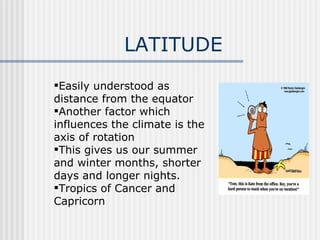
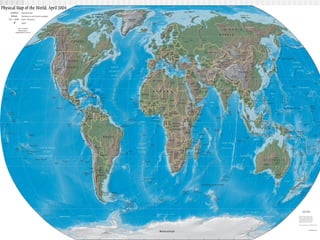
LATITUDE Easily understood as distance from the equator Another factor which influences the climate is the axis of rotation This gives us our summer and winter months, shorter days and longer nights. Tropics of Cancer and Capricorn
Tropic of Cancer Egypt Saudi Arabia United Arab Emirates Oman capital city Muscat  India Bangladesh
Tropics of Capricorn Brazil  Australia Madagascar South Africa
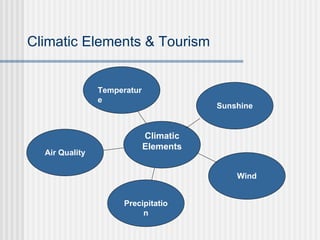
Climatic Elements & Tourism Temperature Climatic Elements Sunshine Precipitation Air Quality Wind
Temperature The climate element which has greatest influence on tourist activity & the type of clothing worn. Suitability of the activities to the weather at a particular place. For example, water sports are essentially warm weather activities. Air and humidity effect the weather.
Sunshine The effect of sunshine is particularly important at the seaside. The safe length of exposure to the sun will depend on the holiday-maker’s skin type and the strength of suntan preparations. Skiers and mountain climbers at high altitudes risk sunburn since the air is clear and sunlight reflected from snow and bare rock. The growing incidence of skin cancer was worrying health authorities, and sunbathing will loose its popularity.
Wind Influenced in their direction and strength by the gradient between high and low pressure areas, by the Earth’s rotation, and topography. A knowledge of the winds is essential for the sailors. The effects of winds; Sea breezes, more comfortable temperature Frostbite, strong wind and low temperature The wind-chill factor, the major constraint on outdoor recreations
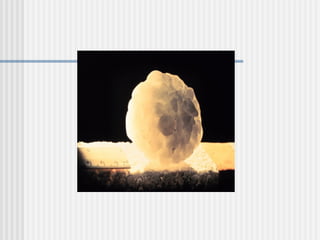
Precipitation Various forms of precipitation; rain, hail  (water ice/stones),  sleet  (mix of snow and rain/frozen rain ) and snow. Can be seen as the constraint for activities, but depends on its intensity, duration, and seasonal distribution. (“wet” and “dry” seasons) Snow can be an expensive hazard for transport, or as a valuable recreational resource. It contributes to winter sports activities, which benefits to remote mountain communities, but also led to environmental degradation.
 
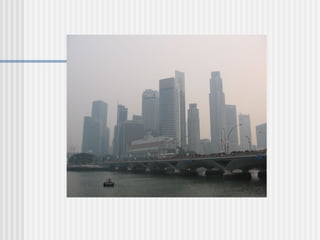
Air Quality The monitoring of air quality is increasingly crucial. Environmental issues & pollutions; Emission of sulphur dioxide from “smock-stack” industries. Smog, or severe air pollution are particularly common in regions, which inhibit air movement. The unpleasant cocktail of gases poisons the air, reducing the visibility, blighting vegetation, eroding historical monuments and threatening the health of people. Acid rain have degraded forests and lakes.
Air Quality Could effect outdoor activities Seen as an unhealthy threat Reduces visibility Motor vehicles, transportation running on fossil fuel.
 
World Climate Zones Tropical Climates The humid climates that have no winter season. Located near the equator Temperature (humidity/warmth) are high and rainfall is heavy Can be divided into two groups; Tropical Rainforest Closest to the equator. Has rainfall all year. Ex: Hawaii, Tropical Savanna Distinct dry season. Ex: Caribbean, Mexico, Africa Miami, Florida
World Climate Zones Dry Climates Consists of the deserted areas Deserts, areas that are very dry, with less than then inches of rain per year. Steppe are semi-arid climates (low amount of rainfall), receiving from eight to sixteen inches of rain per year. Steppe has greater amount of vegetation (green surface) than the true desert. Saharan atlas.
World Climate Zones Mesothermal Humid Climates Occupy the middle latitudes. Found of the margins of continents in the middle latitudes. The temperatures are either warmer because of the latitude, or moderated by the water and winds on the west coasts of continents. Can be divided into 3 groups; Mediterranean Marine West Coast Humid subtropical
World Climate Zones The Mediterranean Hot temperatures reaching in the summer, dropping during mild winters. by hot, dry summers and cool, wet winters  Ideal summer tourist destination Southern California & Southern Europe, all Mediterranean sea areas.
World Climate Zones The Marine West Coast climate Has relatively moderate temperatures all year. No dry season, quite humid all year. Examples: London, England; Paris, France; Seattle, Washington
World Climate Zones The Humid Subtropical Climate Has hot summer and chilly mild winters It receives between 25 to 50 inches of rain yearly, and is humid, which affects the comfort level for people. The fall is the best time to visit places with such climates. Ex: American South – Atlanta, Charleston, Orlando, Florida Cities.
World Climate Zones Microthermal Humid Climates (little heat with more snowy winters) Also in the middle latitudes Have cooler winters than the mesothermal humid climates Also known as Humid Continental Climates Cold, snowy winters, alternate with warm, humid summer conditions Ex: Chicago, Moscow, and Beijing Spring and fall are ideal times to visit places in these climates. Vegetation characterized by mid-latitude forests. Autumn colors in New England typify the beauty of places.
World Climate Zones Polar climates Include subarctic, tundra, and icecap climates. Tourism is associated with hunting, fishing, camping, and naturalist-related activities like animal geography. The Arctic and Antarctica Tourism is limited and restricted to a very short season.
Conclusion Climate is one of the key factors influencing tourism development and holiday travel. Factors of climate strongly influence particular types of recreational activity. Climate is subject to change, and so that the tour operators and tourism generally will have to adapt.
 

4 Climate & Tourism[1]

  • 1.
    Tourism & HospitalityGeography Climate & Tourism
  • 2.
    Objectives Understand theclimatic elements and explain how these affect the various types of recreational tourism. Be able to describe the distribution of world climates and their significance for tourism. Understand the world climate zones and tourism.
  • 3.
    What is theweather to us? How can the climate affect our plans and activities? Even with air-conditioning, climate control, most of the tourist experience happens outdoors Most of the recreation we participate in is weather dependent .
  • 4.
    We and theWeather Climate usually determines the duration of the holiday season. We also need to cope with seasonal demands Services Products This creates the problem of seasonality, both in profitability and employment But this climate-tourism relationship is changing.
  • 5.
    LATITUDE Easily understoodas distance from the equator Another factor which influences the climate is the axis of rotation This gives us our summer and winter months, shorter days and longer nights. Tropics of Cancer and Capricorn
  • 6.
    Tropic of CancerEgypt Saudi Arabia United Arab Emirates Oman capital city Muscat India Bangladesh
  • 7.
    Tropics of CapricornBrazil Australia Madagascar South Africa
  • 8.
    Climatic Elements &Tourism Temperature Climatic Elements Sunshine Precipitation Air Quality Wind
  • 9.
    Temperature The climateelement which has greatest influence on tourist activity & the type of clothing worn. Suitability of the activities to the weather at a particular place. For example, water sports are essentially warm weather activities. Air and humidity effect the weather.
  • 10.
    Sunshine The effectof sunshine is particularly important at the seaside. The safe length of exposure to the sun will depend on the holiday-maker’s skin type and the strength of suntan preparations. Skiers and mountain climbers at high altitudes risk sunburn since the air is clear and sunlight reflected from snow and bare rock. The growing incidence of skin cancer was worrying health authorities, and sunbathing will loose its popularity.
  • 11.
    Wind Influenced intheir direction and strength by the gradient between high and low pressure areas, by the Earth’s rotation, and topography. A knowledge of the winds is essential for the sailors. The effects of winds; Sea breezes, more comfortable temperature Frostbite, strong wind and low temperature The wind-chill factor, the major constraint on outdoor recreations
  • 12.
    Precipitation Various formsof precipitation; rain, hail (water ice/stones), sleet (mix of snow and rain/frozen rain ) and snow. Can be seen as the constraint for activities, but depends on its intensity, duration, and seasonal distribution. (“wet” and “dry” seasons) Snow can be an expensive hazard for transport, or as a valuable recreational resource. It contributes to winter sports activities, which benefits to remote mountain communities, but also led to environmental degradation.
  • 13.
  • 14.
    Air Quality Themonitoring of air quality is increasingly crucial. Environmental issues & pollutions; Emission of sulphur dioxide from “smock-stack” industries. Smog, or severe air pollution are particularly common in regions, which inhibit air movement. The unpleasant cocktail of gases poisons the air, reducing the visibility, blighting vegetation, eroding historical monuments and threatening the health of people. Acid rain have degraded forests and lakes.
  • 15.
    Air Quality Couldeffect outdoor activities Seen as an unhealthy threat Reduces visibility Motor vehicles, transportation running on fossil fuel.
  • 16.
  • 17.
    World Climate ZonesTropical Climates The humid climates that have no winter season. Located near the equator Temperature (humidity/warmth) are high and rainfall is heavy Can be divided into two groups; Tropical Rainforest Closest to the equator. Has rainfall all year. Ex: Hawaii, Tropical Savanna Distinct dry season. Ex: Caribbean, Mexico, Africa Miami, Florida
  • 18.
    World Climate ZonesDry Climates Consists of the deserted areas Deserts, areas that are very dry, with less than then inches of rain per year. Steppe are semi-arid climates (low amount of rainfall), receiving from eight to sixteen inches of rain per year. Steppe has greater amount of vegetation (green surface) than the true desert. Saharan atlas.
  • 19.
    World Climate ZonesMesothermal Humid Climates Occupy the middle latitudes. Found of the margins of continents in the middle latitudes. The temperatures are either warmer because of the latitude, or moderated by the water and winds on the west coasts of continents. Can be divided into 3 groups; Mediterranean Marine West Coast Humid subtropical
  • 20.
    World Climate ZonesThe Mediterranean Hot temperatures reaching in the summer, dropping during mild winters. by hot, dry summers and cool, wet winters Ideal summer tourist destination Southern California & Southern Europe, all Mediterranean sea areas.
  • 21.
    World Climate ZonesThe Marine West Coast climate Has relatively moderate temperatures all year. No dry season, quite humid all year. Examples: London, England; Paris, France; Seattle, Washington
  • 22.
    World Climate ZonesThe Humid Subtropical Climate Has hot summer and chilly mild winters It receives between 25 to 50 inches of rain yearly, and is humid, which affects the comfort level for people. The fall is the best time to visit places with such climates. Ex: American South – Atlanta, Charleston, Orlando, Florida Cities.
  • 23.
    World Climate ZonesMicrothermal Humid Climates (little heat with more snowy winters) Also in the middle latitudes Have cooler winters than the mesothermal humid climates Also known as Humid Continental Climates Cold, snowy winters, alternate with warm, humid summer conditions Ex: Chicago, Moscow, and Beijing Spring and fall are ideal times to visit places in these climates. Vegetation characterized by mid-latitude forests. Autumn colors in New England typify the beauty of places.
  • 24.
    World Climate ZonesPolar climates Include subarctic, tundra, and icecap climates. Tourism is associated with hunting, fishing, camping, and naturalist-related activities like animal geography. The Arctic and Antarctica Tourism is limited and restricted to a very short season.
  • 25.
    Conclusion Climate isone of the key factors influencing tourism development and holiday travel. Factors of climate strongly influence particular types of recreational activity. Climate is subject to change, and so that the tour operators and tourism generally will have to adapt.
  • 26.