Tourism & Hospitality Geography The Geography of Demand for Tourism
Objectives Explain the term “tourist demand” Understand the travel propensity Identify the determinants of demand for tourism Appreciate the main barriers to travel which lead to suppressed demand.
The Demand for Tourism Tourist demand is defined as the total number of persons who travel, or wish to travel, to use tourist facilities and services at places away from their places of work or residence.
No Demand Effective Demand Suppressed Demand Tourism Demand
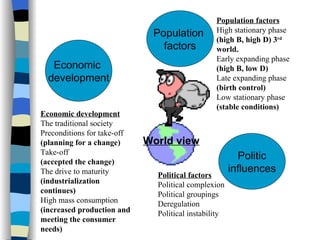
Economic  development Politic influences Population  factors Political factors Political complexion Political groupings Deregulation Political instability Economic development The traditional society Preconditions for take-off (planning for a change) Take-off (accepted the change) The drive to maturity (industrialization continues) High mass consumption (increased production and meeting the consumer needs) Population factors High stationary phase  (high B, high D) 3 rd  world.  Early expanding phase  (high B, low D) Late expanding phase  (birth control) Low stationary phase (stable conditions) World view
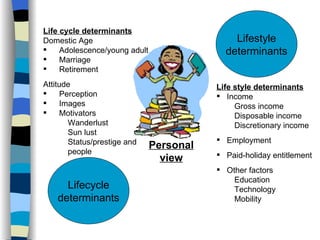
Lifecycle determinants Lifestyle determinants Life style determinants Income Gross income Disposable income Discretionary income Employment Paid-holiday entitlement Other factors Education Technology Mobility  Life cycle determinants Domestic Age Adolescence/young adult Marriage Retirement Attitude Perception Images Motivators  Wanderlust Sun lust Status/prestige and  people Personal view
Expense of travel Lack of time Physical limitations Family circumstances Lack of interest Tourism is an unobtainable luxury for majority, thus 5 major reasons have been identified:
Demand of tourism is made up not only of those who participate but also those who do not travel for some reason. World and personal views as the stimulation for people to travel. Basically, demand for tourism is  concentrated into developed  countries and predominates among  those with high discretionary  incomes. Conclusion

2 Tourism Demand

  • 1.
    Tourism & HospitalityGeography The Geography of Demand for Tourism
  • 2.
    Objectives Explain theterm “tourist demand” Understand the travel propensity Identify the determinants of demand for tourism Appreciate the main barriers to travel which lead to suppressed demand.
  • 3.
    The Demand forTourism Tourist demand is defined as the total number of persons who travel, or wish to travel, to use tourist facilities and services at places away from their places of work or residence.
  • 4.
    No Demand EffectiveDemand Suppressed Demand Tourism Demand
  • 5.
    Economic developmentPolitic influences Population factors Political factors Political complexion Political groupings Deregulation Political instability Economic development The traditional society Preconditions for take-off (planning for a change) Take-off (accepted the change) The drive to maturity (industrialization continues) High mass consumption (increased production and meeting the consumer needs) Population factors High stationary phase (high B, high D) 3 rd world. Early expanding phase (high B, low D) Late expanding phase (birth control) Low stationary phase (stable conditions) World view
  • 6.
    Lifecycle determinants Lifestyledeterminants Life style determinants Income Gross income Disposable income Discretionary income Employment Paid-holiday entitlement Other factors Education Technology Mobility Life cycle determinants Domestic Age Adolescence/young adult Marriage Retirement Attitude Perception Images Motivators Wanderlust Sun lust Status/prestige and people Personal view
  • 7.
    Expense of travelLack of time Physical limitations Family circumstances Lack of interest Tourism is an unobtainable luxury for majority, thus 5 major reasons have been identified:
  • 8.
    Demand of tourismis made up not only of those who participate but also those who do not travel for some reason. World and personal views as the stimulation for people to travel. Basically, demand for tourism is concentrated into developed countries and predominates among those with high discretionary incomes. Conclusion