An organization capability refers to the way
systems and people in the organization work
together to get things done. The way leaders
foster shared mindsets, orchestrate talent,
encourage speed of change, collaborate across
boundaries, and learn and hold each other
accountable define the company's culture and
leadership edge.
 An organization capability refers to the way its people and
systems work together. A company's culture is defined by how
management fosters talent, mindsets, and collaboration.
 Social and technical competencies and capabilities intersect
in different ways. Organization capabilities such a talent
management, collaboration, and accountability interact with
and bring together all parts of the company.
 shows four types of capabilities: essential capabilities,
business necessity capabilities, strategic support capabilities,
and advantage capabilities. These are all necessary, in
different degrees, to the running of a business.
Organizational capabilities are rather stable; they do not
change rapidly. Organizational capabilities give a firm
its distinctive competitive edge, because they have been
applied and further developed over a longer period of
time. The emphasis is on the accumulation of
organizational capabilities and the fact that the options
for further development at each point of time are sharply
constrained by the heritage of the past.
 The fact that capabilities are firm specific makes them
particularly valuable,
 because they are of a tacit nature and therefore difficult
to transfer and to imitate.
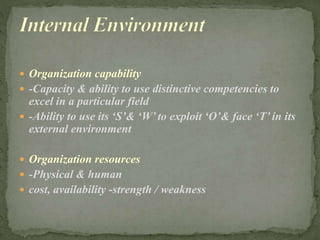
 Organization capability
 -Capacity & ability to use distinctive competencies to
excel in a particular field
 -Ability to use its ‘S’& ‘W’ to exploit ‘O’& face ‘T’ in its
external environment
 Organization resources
 -Physical & human
 cost, availability -strength / weakness
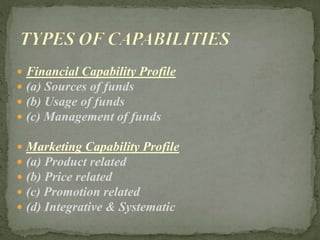
 Financial Capability Profile
 (a) Sources of funds
 (b) Usage of funds
 (c) Management of funds
 Marketing Capability Profile
 (a) Product related
 (b) Price related
 (c) Promotion related
 (d) Integrative & Systematic
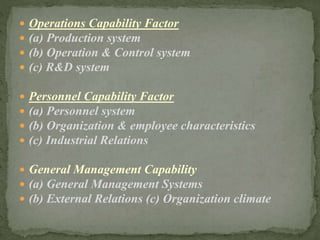
 Operations Capability Factor
 (a) Production system
 (b) Operation & Control system
 (c) R&D system
 Personnel Capability Factor
 (a) Personnel system
 (b) Organization & employee characteristics
 (c) Industrial Relations
 General Management Capability
 (a) General Management Systems
 (b) External Relations (c) Organization climate
 Financial Capability
 Bajaj -Cash Management
 LIC -Centralized payment, decentralized collection
 Reliance -high investor confidence
 Marketing Capability
 Hindustan Lever -Distribution Channel
 IDBI/ICICI Bank -Wide variety of services.
 Tata -Company / Product image.
 Operations Capability
 Lakshmi machine works -absorb imported technology
 Balmer & Lawrie -R&D -New specialty chemicals
 Personnel Capability
 Apollo tyres –Industrial relations problem.
 General management capability
 Malayalam Manaroma –fourth largest selling
newspaper in India.
 Unchallenged leadership -Unified, stable
Best edited & most professionally produced .
A company not only pursues specific economic aims, it
can also be viewed as an adaptive organic system
affected by the social characteristics of its participants
as well as by the varied pressures imposed by its
environment. On the one hand, companies represent a
system of vested interests and they are confronted with
different demands particularly from employees,
customers and investors.
 Long-term conflicts between various asset holders can result
in poor social performance, which can threaten not only the
achievement of economic aims but also the survival of the
company.
 companies represent societal institutions; they have a public
responsibility for problems resulting from their activities such
as unemployment, transportation problems, environmental
impacts or health damages and they have to legitimize their
decision-making processes.
 Coping with various societal demands and being pressured to
legitimize decision-making processes can be defined as a
organizational problem.
 we can argue that companies have to deal with a
number of organizational problems in a broader sense
to achieve competitive strength, including not only
economic but also social and ecological aspects.
 differentiating between four key organizational
problems: using available resources most effectively to
produce the characteristic output, creating and
acquiring new resources in order to extent and improve
the characteristic output, balancing vested interests of
various stakeholders, and fulfilling societal demands.
 Analyzing the relationships between firms’
organizational capabilities and the regional/national
environment is seen as a key target of empirical research
. On the one hand the question arises how
environmental factors influence companies’ attempt to
develop, maintain and advance their organizational
capabilities. On the other hand, the understanding of
capability creation and maintenance within firms is
fundamental to the understanding of economic and
social progress on the regional or national level .
Capability research, it can be concluded, is far from
satisfying; a lot more conceptual as well as empirical
work needs to be done in the future.

Internal organization

  • 2.
    An organization capabilityrefers to the way systems and people in the organization work together to get things done. The way leaders foster shared mindsets, orchestrate talent, encourage speed of change, collaborate across boundaries, and learn and hold each other accountable define the company's culture and leadership edge.
  • 3.
     An organizationcapability refers to the way its people and systems work together. A company's culture is defined by how management fosters talent, mindsets, and collaboration.  Social and technical competencies and capabilities intersect in different ways. Organization capabilities such a talent management, collaboration, and accountability interact with and bring together all parts of the company.  shows four types of capabilities: essential capabilities, business necessity capabilities, strategic support capabilities, and advantage capabilities. These are all necessary, in different degrees, to the running of a business.
  • 4.
    Organizational capabilities arerather stable; they do not change rapidly. Organizational capabilities give a firm its distinctive competitive edge, because they have been applied and further developed over a longer period of time. The emphasis is on the accumulation of organizational capabilities and the fact that the options for further development at each point of time are sharply constrained by the heritage of the past.
  • 5.
     The factthat capabilities are firm specific makes them particularly valuable,  because they are of a tacit nature and therefore difficult to transfer and to imitate.
  • 6.
     Organization capability -Capacity & ability to use distinctive competencies to excel in a particular field  -Ability to use its ‘S’& ‘W’ to exploit ‘O’& face ‘T’ in its external environment  Organization resources  -Physical & human  cost, availability -strength / weakness
  • 7.
     Financial CapabilityProfile  (a) Sources of funds  (b) Usage of funds  (c) Management of funds  Marketing Capability Profile  (a) Product related  (b) Price related  (c) Promotion related  (d) Integrative & Systematic
  • 8.
     Operations CapabilityFactor  (a) Production system  (b) Operation & Control system  (c) R&D system  Personnel Capability Factor  (a) Personnel system  (b) Organization & employee characteristics  (c) Industrial Relations  General Management Capability  (a) General Management Systems  (b) External Relations (c) Organization climate
  • 9.
     Financial Capability Bajaj -Cash Management  LIC -Centralized payment, decentralized collection  Reliance -high investor confidence
  • 10.
     Marketing Capability Hindustan Lever -Distribution Channel  IDBI/ICICI Bank -Wide variety of services.  Tata -Company / Product image.  Operations Capability  Lakshmi machine works -absorb imported technology  Balmer & Lawrie -R&D -New specialty chemicals
  • 11.
     Personnel Capability Apollo tyres –Industrial relations problem.  General management capability  Malayalam Manaroma –fourth largest selling newspaper in India.  Unchallenged leadership -Unified, stable Best edited & most professionally produced .
  • 12.
    A company notonly pursues specific economic aims, it can also be viewed as an adaptive organic system affected by the social characteristics of its participants as well as by the varied pressures imposed by its environment. On the one hand, companies represent a system of vested interests and they are confronted with different demands particularly from employees, customers and investors.
  • 13.
     Long-term conflictsbetween various asset holders can result in poor social performance, which can threaten not only the achievement of economic aims but also the survival of the company.  companies represent societal institutions; they have a public responsibility for problems resulting from their activities such as unemployment, transportation problems, environmental impacts or health damages and they have to legitimize their decision-making processes.  Coping with various societal demands and being pressured to legitimize decision-making processes can be defined as a organizational problem.
  • 14.
     we canargue that companies have to deal with a number of organizational problems in a broader sense to achieve competitive strength, including not only economic but also social and ecological aspects.  differentiating between four key organizational problems: using available resources most effectively to produce the characteristic output, creating and acquiring new resources in order to extent and improve the characteristic output, balancing vested interests of various stakeholders, and fulfilling societal demands.
  • 15.
     Analyzing therelationships between firms’ organizational capabilities and the regional/national environment is seen as a key target of empirical research . On the one hand the question arises how environmental factors influence companies’ attempt to develop, maintain and advance their organizational capabilities. On the other hand, the understanding of capability creation and maintenance within firms is fundamental to the understanding of economic and social progress on the regional or national level . Capability research, it can be concluded, is far from satisfying; a lot more conceptual as well as empirical work needs to be done in the future.