Improving the candidate experience
           in recruiting


          © Dr.
              John Sullivan
        www.drjohnsullivan.com
Topics I will cover today

1. Defining the “candidate experience” (CE)

2. Negative impacts if you get it wrong

3. Action steps to improve your candidate experience


                                                  2
A quick definition of…
“the candidate experience”?


                              3
A quick definition
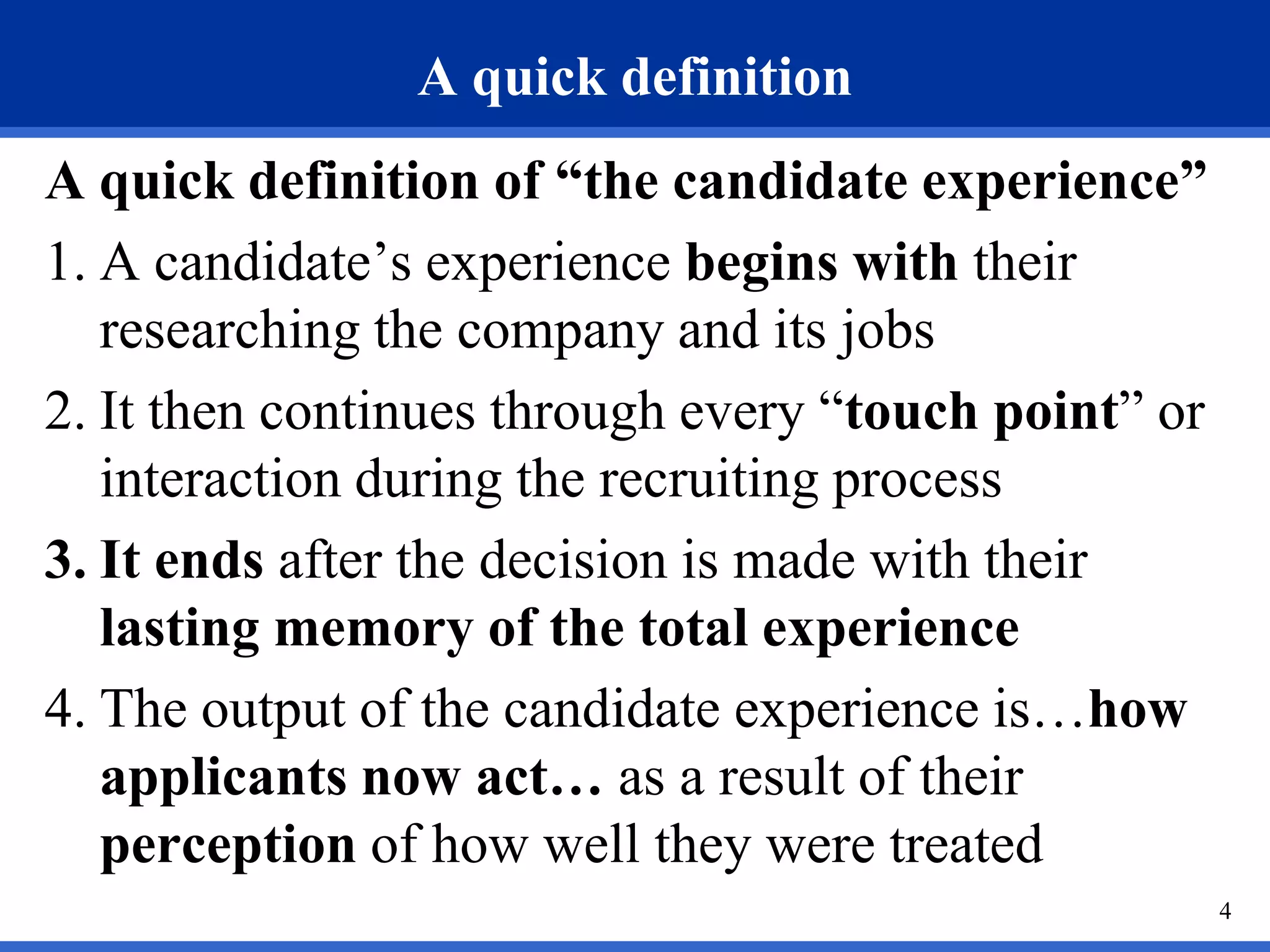
A quick definition of “the candidate experience”
1. A candidate’s experience begins with their
   researching the company and its jobs
2. It then continues through every “touch point” or
   interaction during the recruiting process
3. It ends after the decision is made with their
   lasting memory of the total experience
4. The output of the candidate experience is…how
   applicants now act… as a result of their
   perception of how well they were treated
                                                      4
The benchmark firms to study
Benchmark firms

1. Zappos

2. DaVita

3. Microsoft

4. Facebook

  What makes their candidate experience good?   5
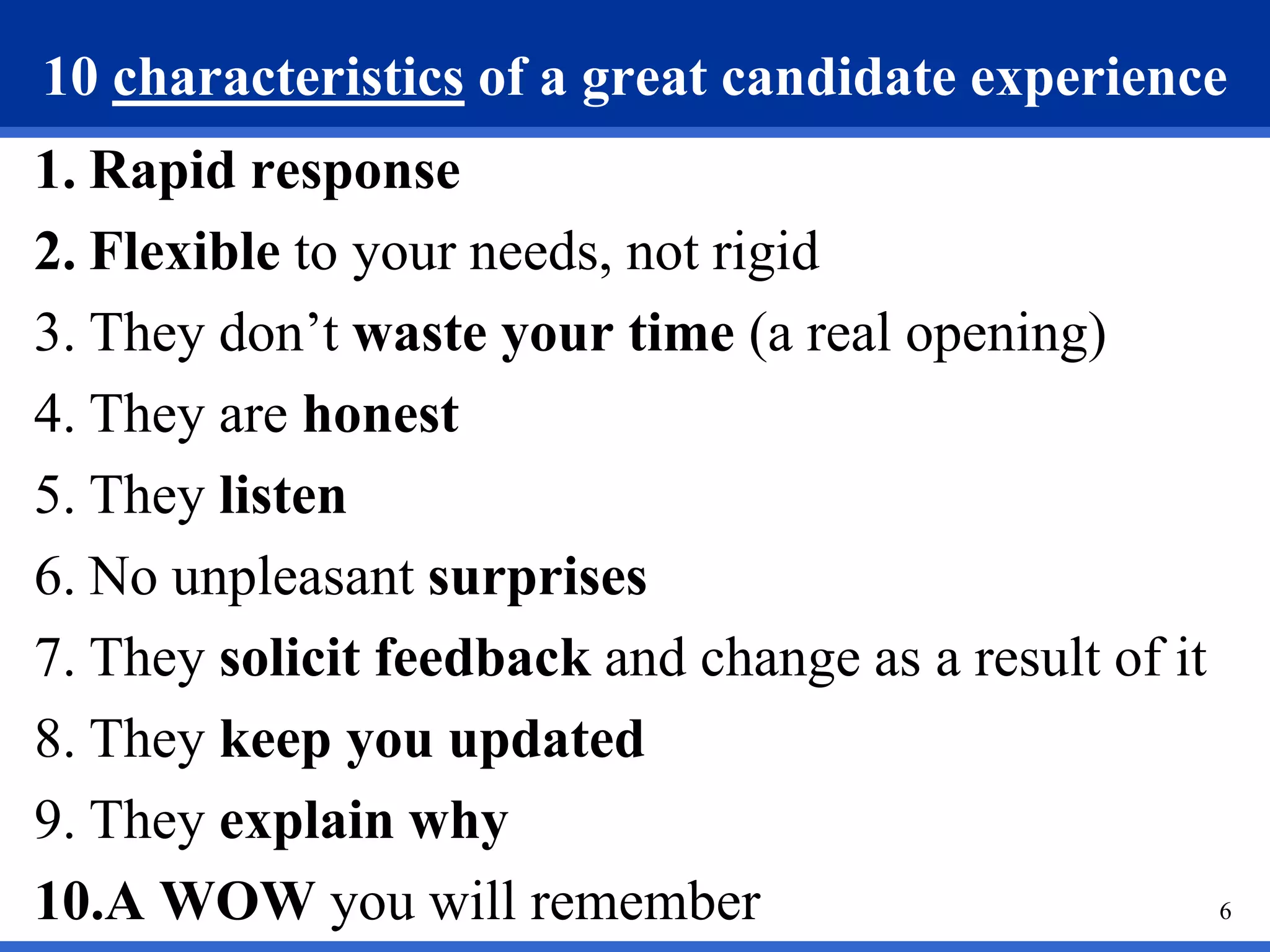
10 characteristics of a great candidate experience
1. Rapid response
2. Flexible to your needs, not rigid
3. They don’t waste your time (a real opening)
4. They are honest
5. They listen
6. No unpleasant surprises
7. They solicit feedback and change as a result of it
8. They keep you updated
9. They explain why
10.A WOW you will remember                            6
Why should recruiters and their managers
 care about “the candidate experience”?


                                           7
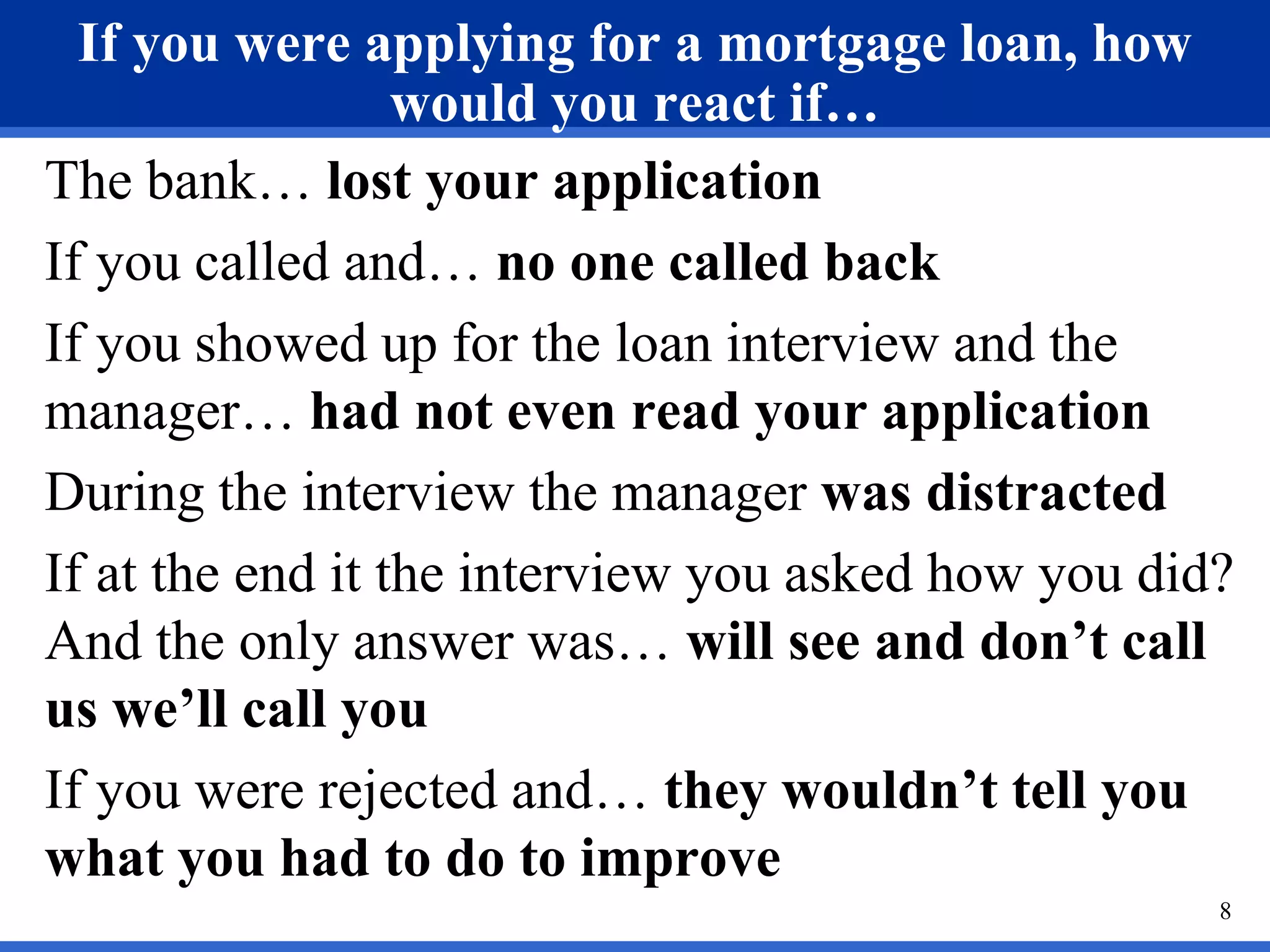
If you were applying for a mortgage loan, how
                  would you react if…
The bank… lost your application
If you called and… no one called back
If you showed up for the loan interview and the
manager… had not even read your application
During the interview the manager was distracted
If at the end it the interview you asked how you did?
And the only answer was… will see and don’t call
us we’ll call you
If you were rejected and… they wouldn’t tell you
what you had to do to improve
                                                    8
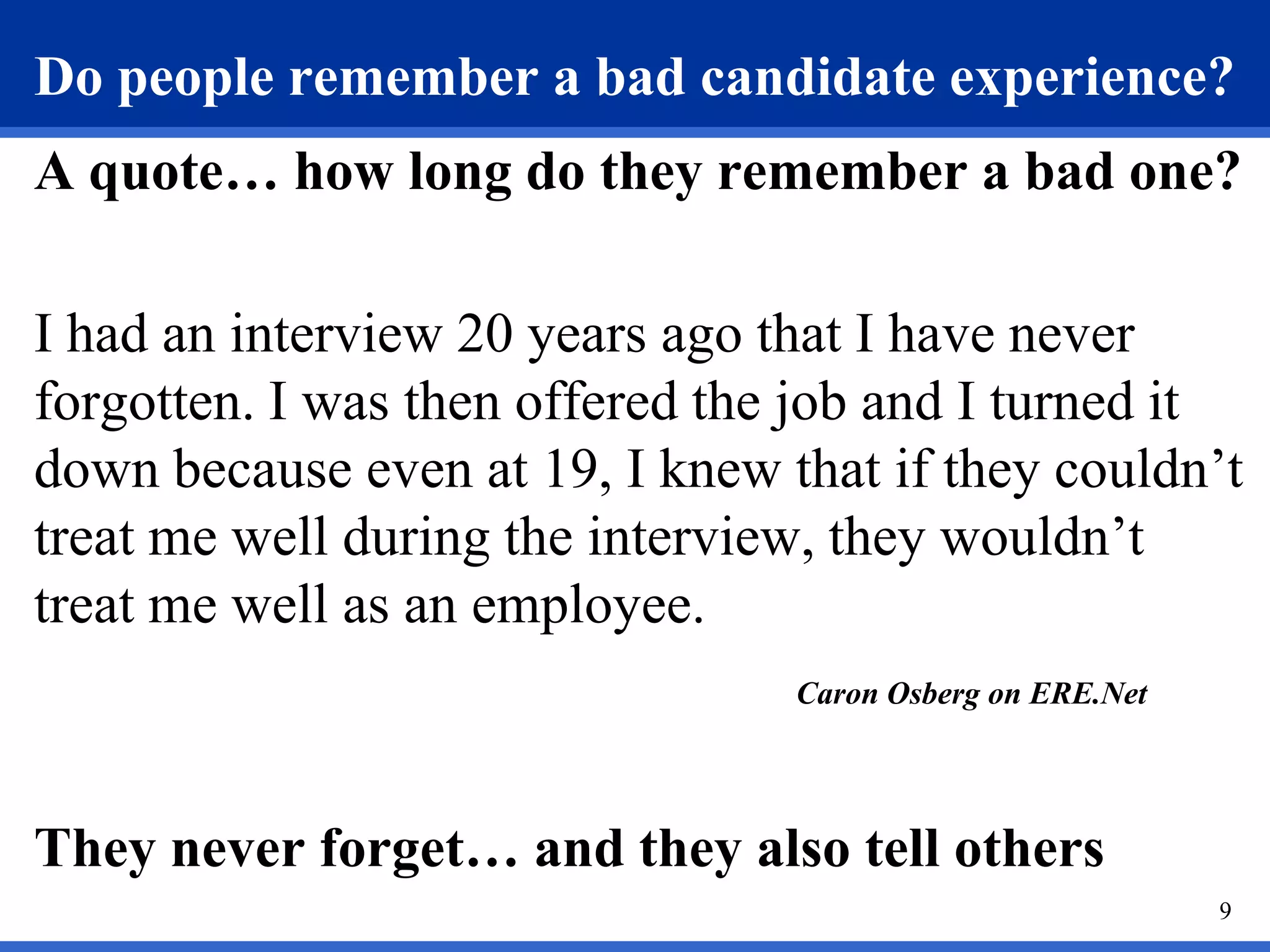
Do people remember a bad candidate experience?
A quote… how long do they remember a bad one?

I had an interview 20 years ago that I have never
forgotten. I was then offered the job and I turned it
down because even at 19, I knew that if they couldn’t
treat me well during the interview, they wouldn’t
treat me well as an employee.
                                 Caron Osberg on ERE.Net


They never forget… and they also tell others
                                                           9
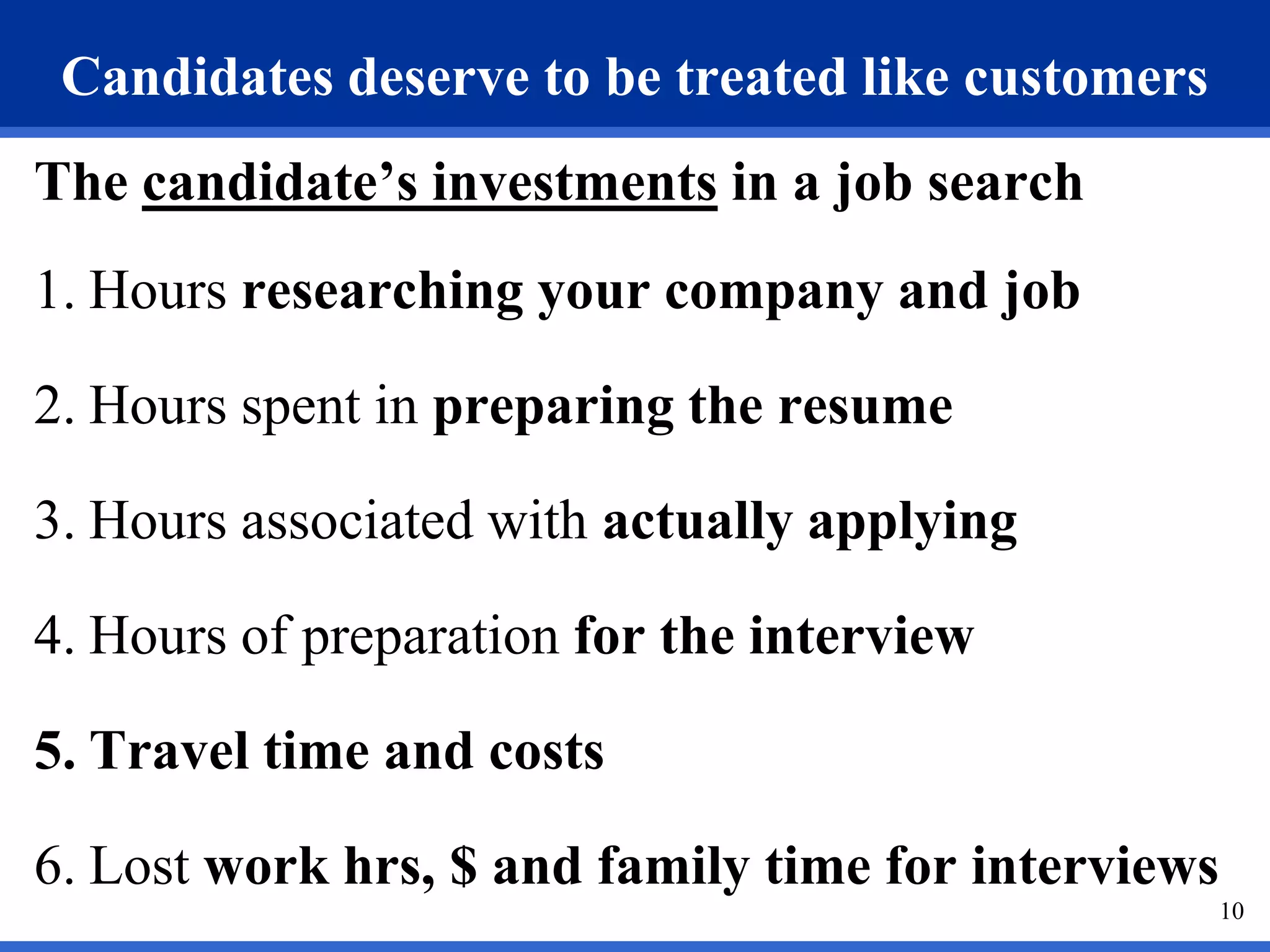
Candidates deserve to be treated like customers
The candidate’s investments in a job search
1. Hours researching your company and job

2. Hours spent in preparing the resume

3. Hours associated with actually applying

4. Hours of preparation for the interview

5. Travel time and costs

6. Lost work hrs, $ and family time for interviews
                                                     10
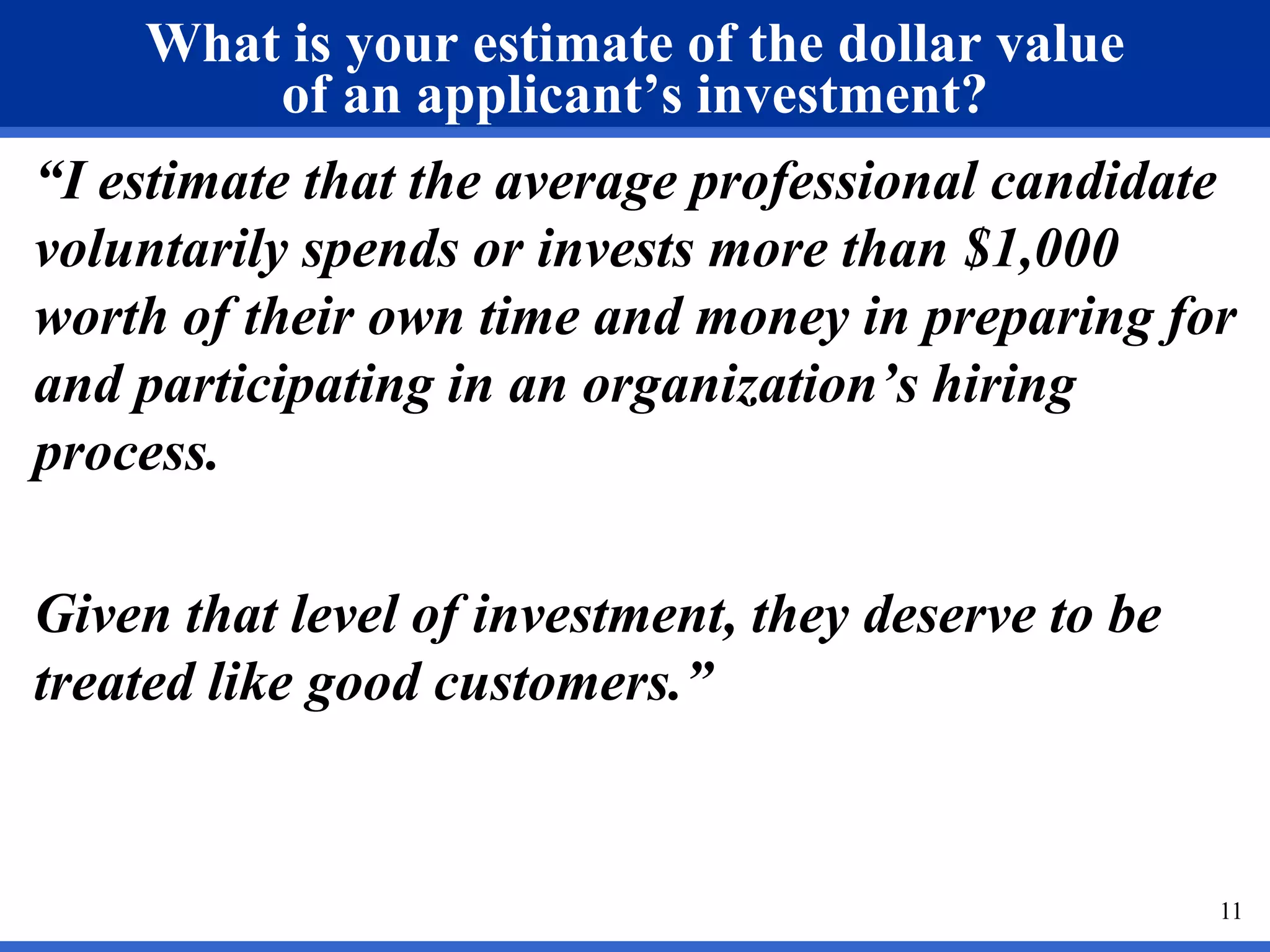
What is your estimate of the dollar value
        of an applicant’s investment?
“I estimate that the average professional candidate
voluntarily spends or invests more than $1,000
worth of their own time and money in preparing for
and participating in an organization’s hiring
process.

Given that level of investment, they deserve to be
treated like good customers.”


                                                     11
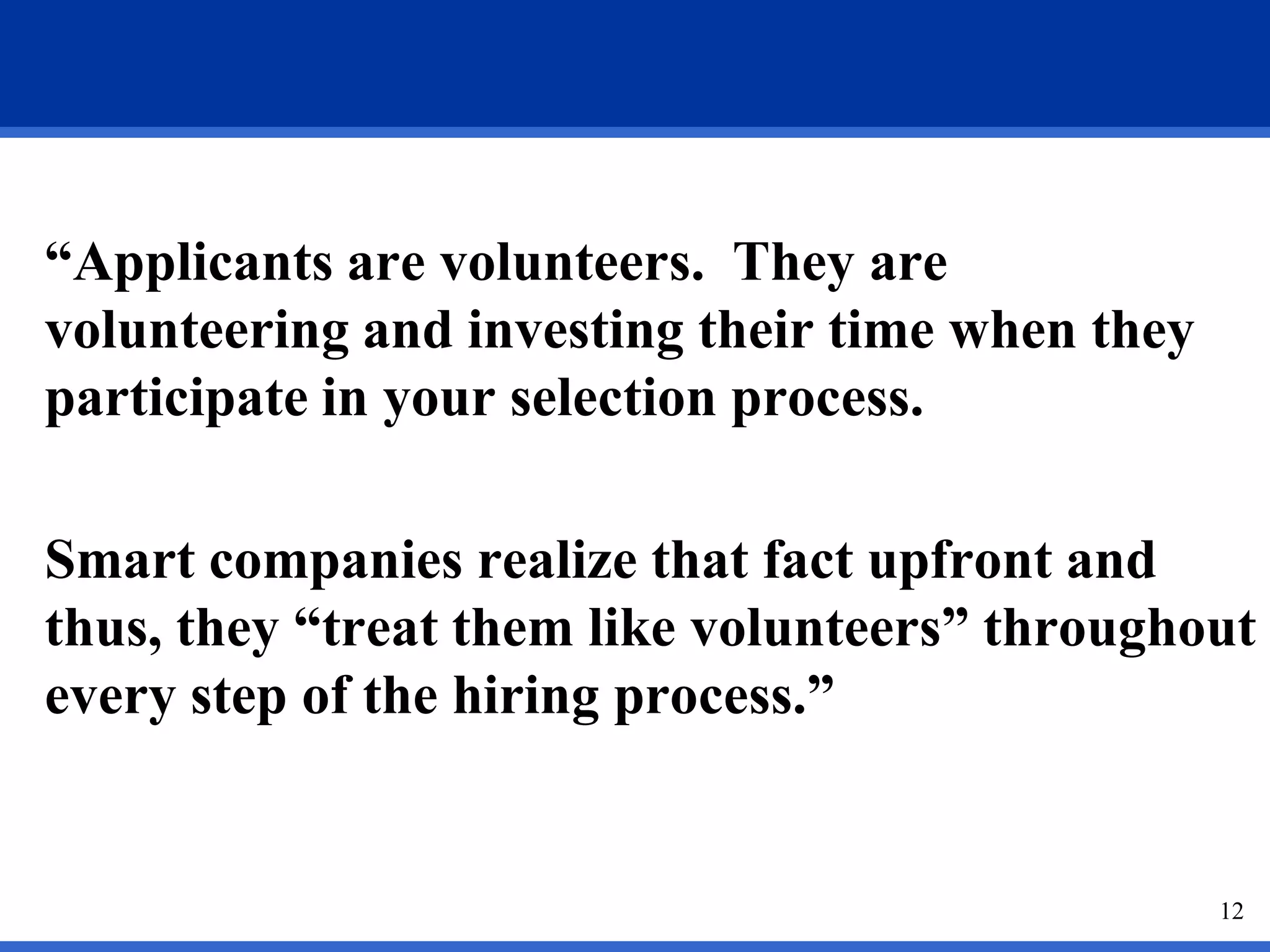
“Applicants are volunteers. They are
volunteering and investing their time when they
participate in your selection process.

Smart companies realize that fact upfront and
thus, they “treat them like volunteers” throughout
every step of the hiring process.”


                                                  12
The key lesson to learn is that…
when any applicant makes a heavy investment in
              a selection process…
  you must proportionately raise the level of
      customer service and the “candidate
                   experience”


                                             13
Why focus on the “candidate experience”?


What % of your prospects/ candidates… are also
        current or potential customers?


                                             14
Now shifting to the possible negative impacts
     of the bad candidate experience


    Why should an individual recruiter
   care about the candidate experience?


                                                15
Reasons why recruiters should care
Impacts on individual recruiters may include:
1. The #1 reason why candidates reject offers is…
2. The loss of top candidates - the greatest impact
   will be on those in the highest demand, including
   top performers, innovators and game changers
   that can simply remain at their current job
3. Mid-process dropouts – frustrated individuals
   that do not see their “job switch criteria” being
   met or that encounter one of their “knockout
   factors” will simply drop out (lie to you why?)
                                                  16
Reasons why recruiters should care
Impacts on individual recruiters may include:
4. A loss of return candidates – finalists that would
   have been hired (if a super strong candidate wasn't
   in the final candidate mix), will likely never
   reapply. Neither will “soon to be qualified”
   candidates that were rejected merely because they
   didn’t have quite enough experience
5. The loss of applicants due to word-of-mouth –
   friends, family and colleagues of a poorly treated
   applicant/ candidate will now never apply
   themselves                                         17
8 reasons why recruiters should care
Impacts on individual recruiters may include:
6. Loss of referrals – you will see an increased
   recruiter workload when many employees will
   simply stop” doing some of your work” (making
   referrals) once they hear how their highly
   regarded colleagues were treated

7. Higher interview drop out rates due to
   scheduling – because employed candidates can’t
   easily schedule during normal work hours
                                                    18
8 reasons why recruiters should care
Impacts on individual recruiters may include:
8. More hiring mistakes – confused, tired ,
   surprised and frustrated applicants just don't
   perform as well during interviews. Bad hires
   means that later on you’ll just have to rehire
   for the position


                                                    19
Now let’s shift to…
broader impacts on the entire recruiting function


                                               20
Reasons why recruiting managers should care
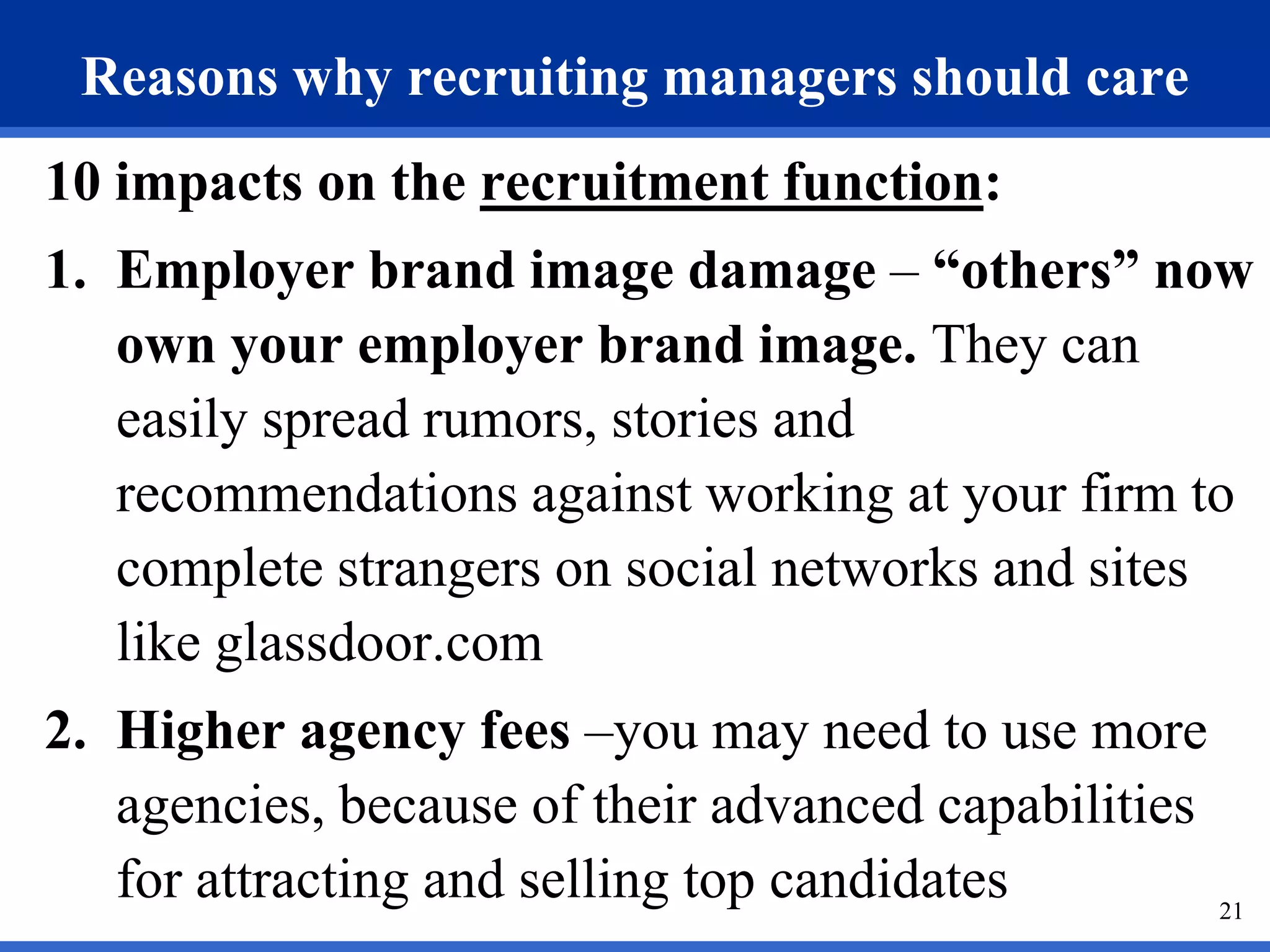
10 impacts on the recruitment function:
1. Employer brand image damage – “others” now
   own your employer brand image. They can
   easily spread rumors, stories and
   recommendations against working at your firm to
   complete strangers on social networks and sites
   like glassdoor.com
2. Higher agency fees –you may need to use more
   agencies, because of their advanced capabilities
   for attracting and selling top candidates        21
Reasons why recruiting managers should care
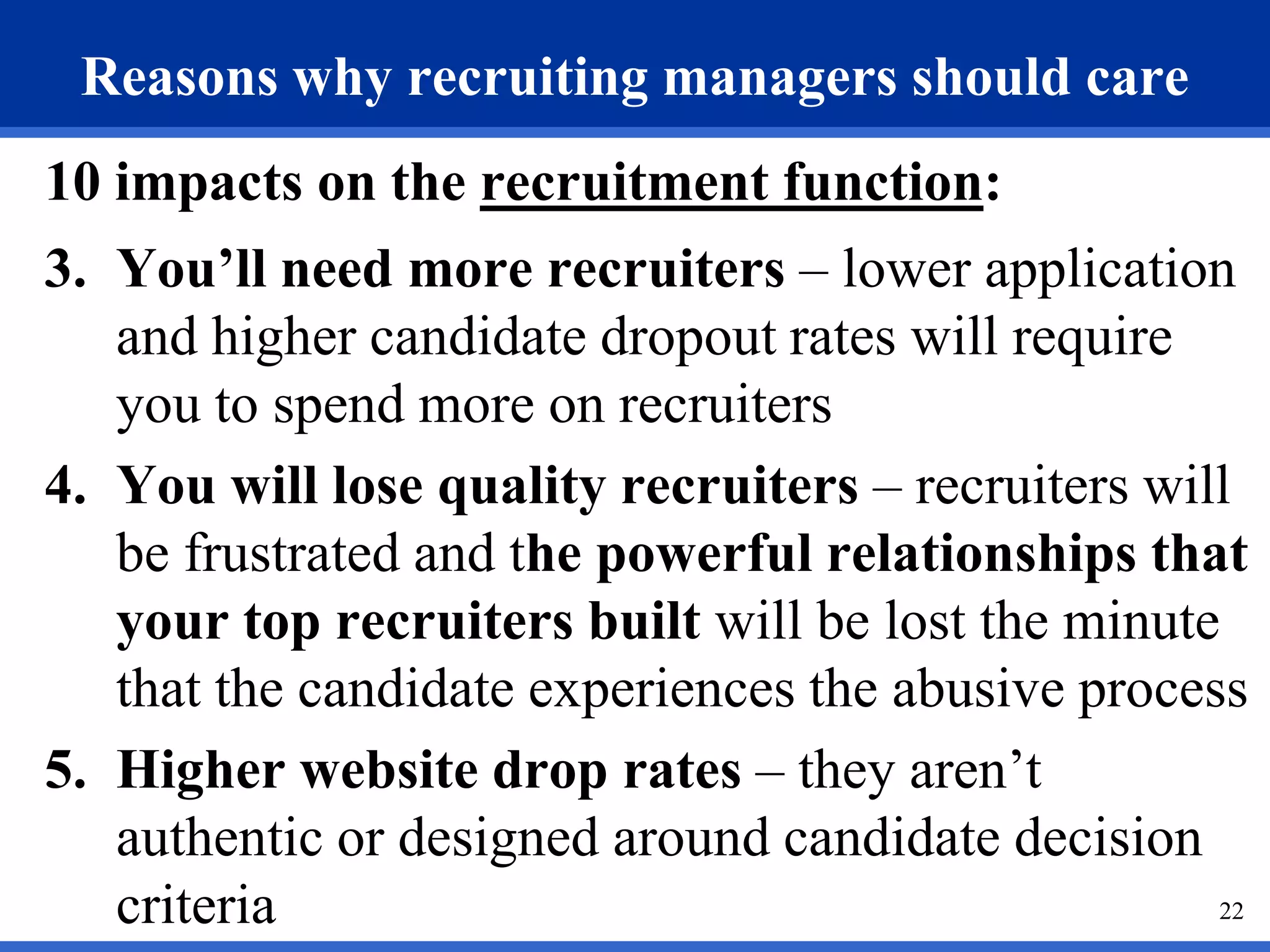
10 impacts on the recruitment function:
3. You’ll need more recruiters – lower application
   and higher candidate dropout rates will require
   you to spend more on recruiters
4. You will lose quality recruiters – recruiters will
   be frustrated and the powerful relationships that
   your top recruiters built will be lost the minute
   that the candidate experiences the abusive process
5. Higher website drop rates – they aren’t
   authentic or designed around candidate decision
   criteria                                         22
Reasons why recruiting managers should care
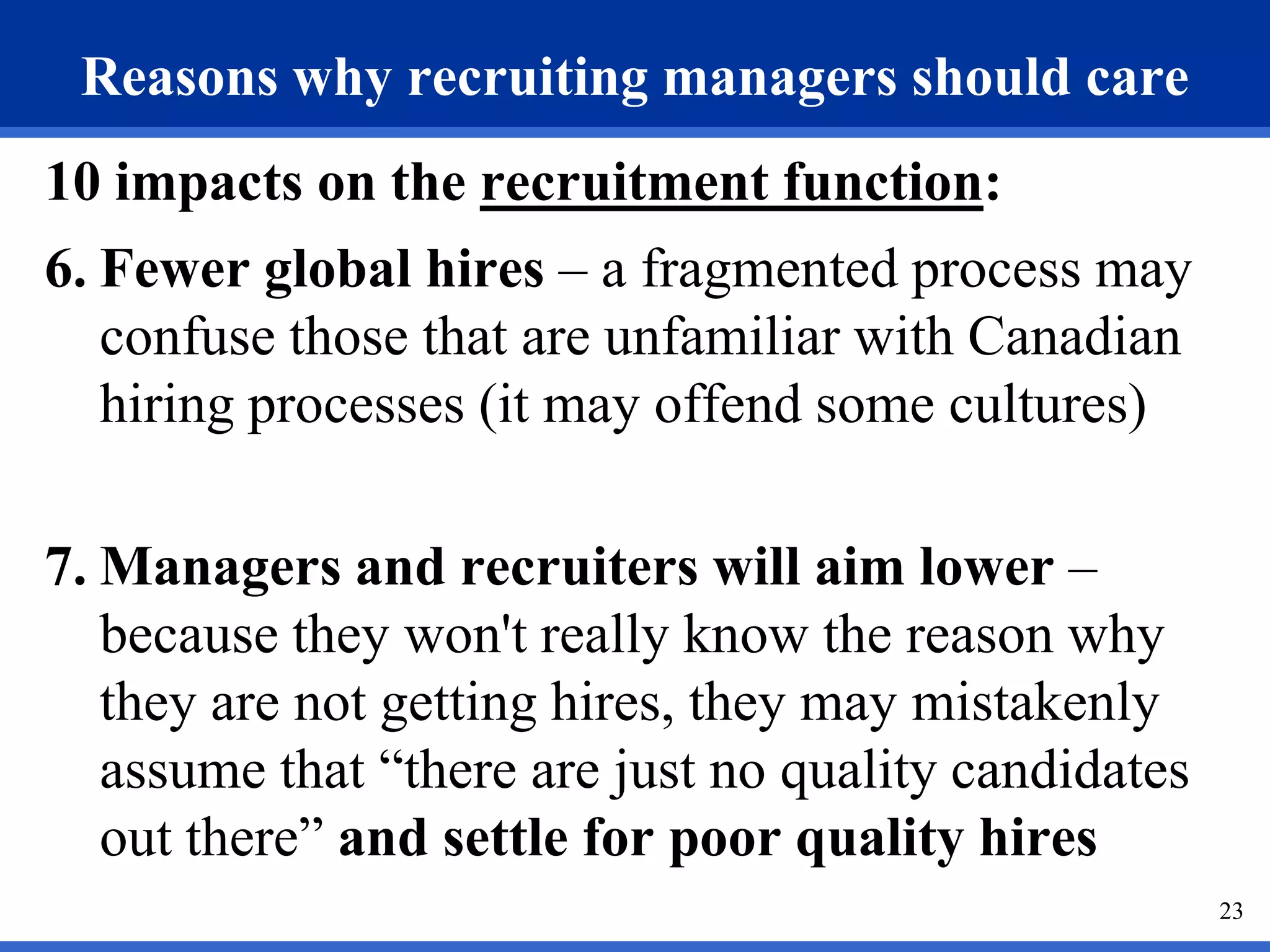
10 impacts on the recruitment function:
6. Fewer global hires – a fragmented process may
   confuse those that are unfamiliar with Canadian
   hiring processes (it may offend some cultures)

7. Managers and recruiters will aim lower –
   because they won't really know the reason why
   they are not getting hires, they may mistakenly
   assume that “there are just no quality candidates
   out there” and settle for poor quality hires
                                                       23
Reasons why recruiting managers should care
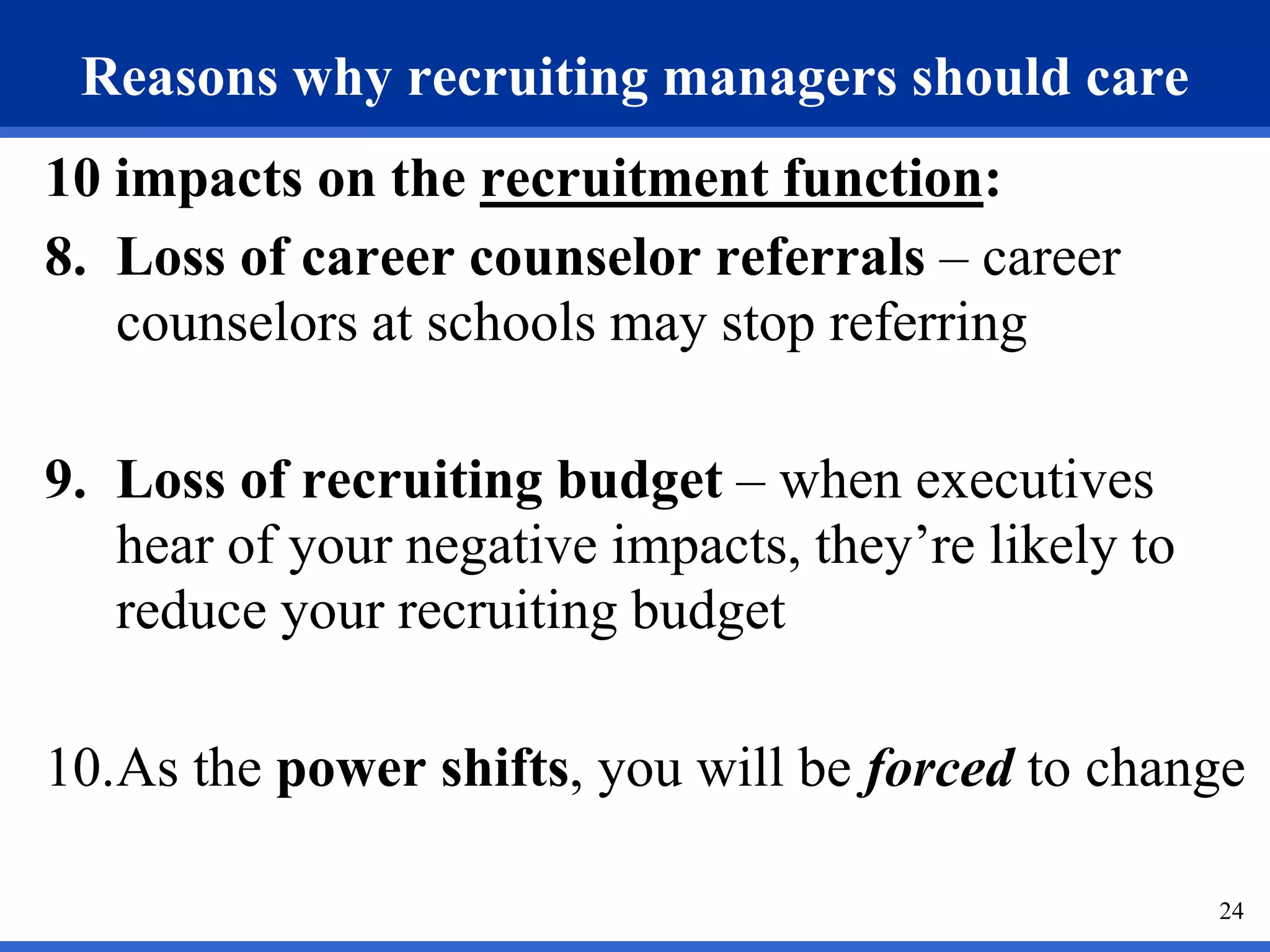
10 impacts on the recruitment function:
8. Loss of career counselor referrals – career
   counselors at schools may stop referring

9. Loss of recruiting budget – when executives
   hear of your negative impacts, they’re likely to
   reduce your recruiting budget

10.As the power shifts, you will be forced to change

                                                      24
And finally…
the business impacts of a bad candidate experience


                                                25
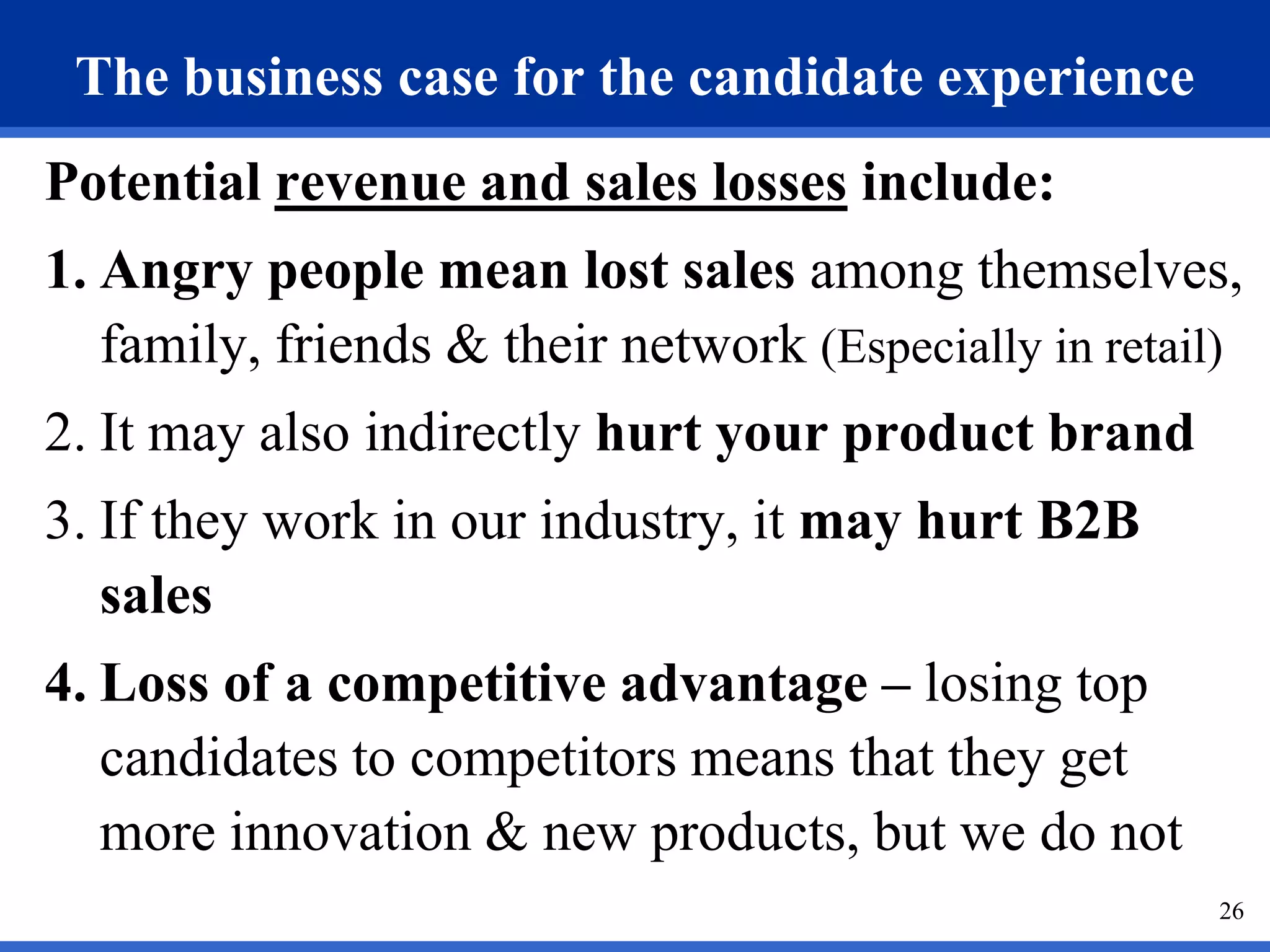
The business case for the candidate experience
Potential revenue and sales losses include:
1. Angry people mean lost sales among themselves,
   family, friends & their network (Especially in retail)
2. It may also indirectly hurt your product brand
3. If they work in our industry, it may hurt B2B
   sales
4. Loss of a competitive advantage – losing top
   candidates to competitors means that they get
   more innovation & new products, but we do not
                                                       26
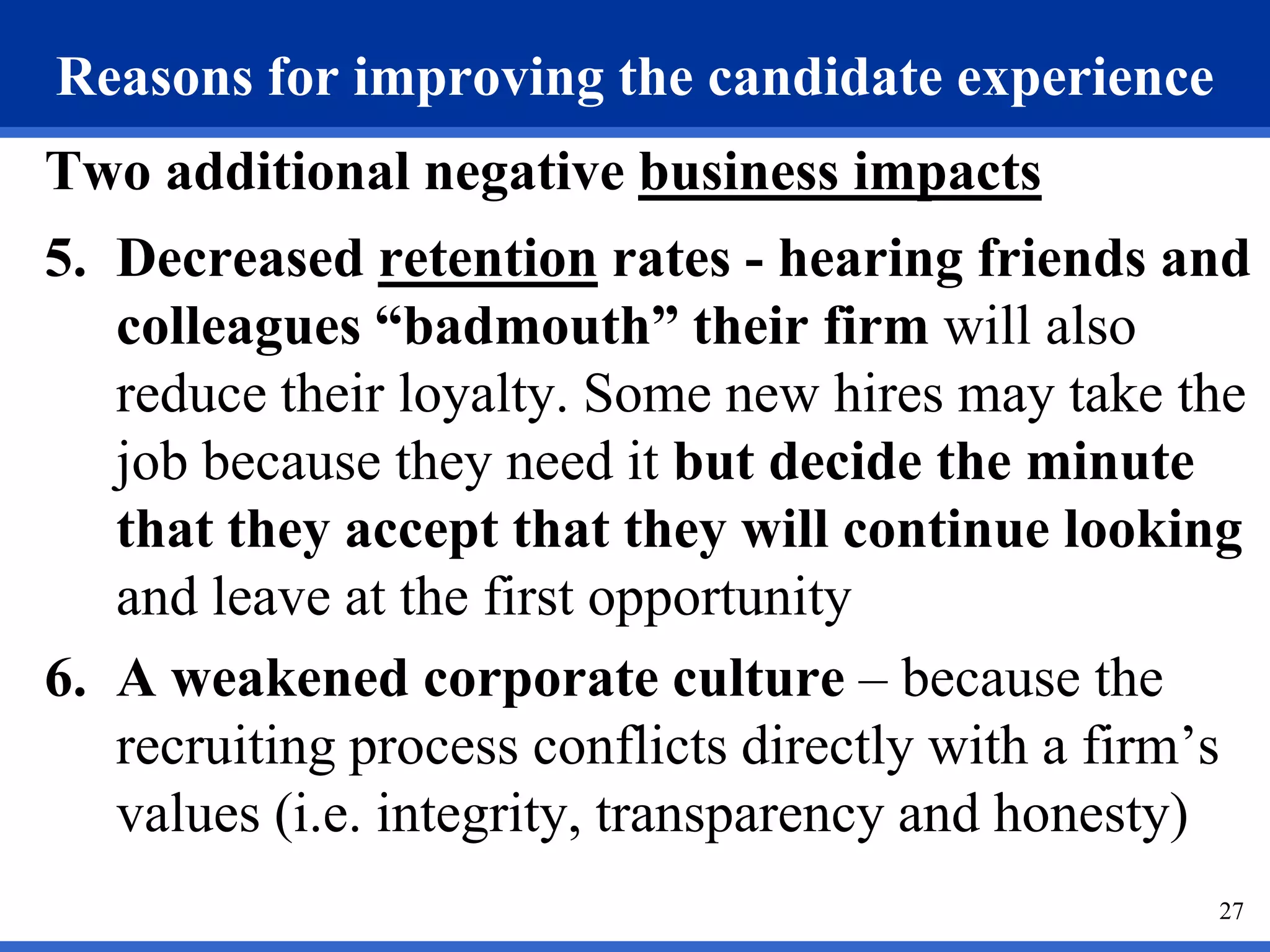
Reasons for improving the candidate experience
Two additional negative business impacts
5. Decreased retention rates - hearing friends and
   colleagues “badmouth” their firm will also
   reduce their loyalty. Some new hires may take the
   job because they need it but decide the minute
   that they accept that they will continue looking
   and leave at the first opportunity
6. A weakened corporate culture – because the
   recruiting process conflicts directly with a firm’s
   values (i.e. integrity, transparency and honesty)
                                                    27
Having a bad candidate experience could soon get
        much more painful with sidewiki >


                                               28
What if anyone could add comments
to your displayed webpage (sidewiki)


                                       29
During what steps of the recruiting process
do most candidate experience problems occur?


                                               30
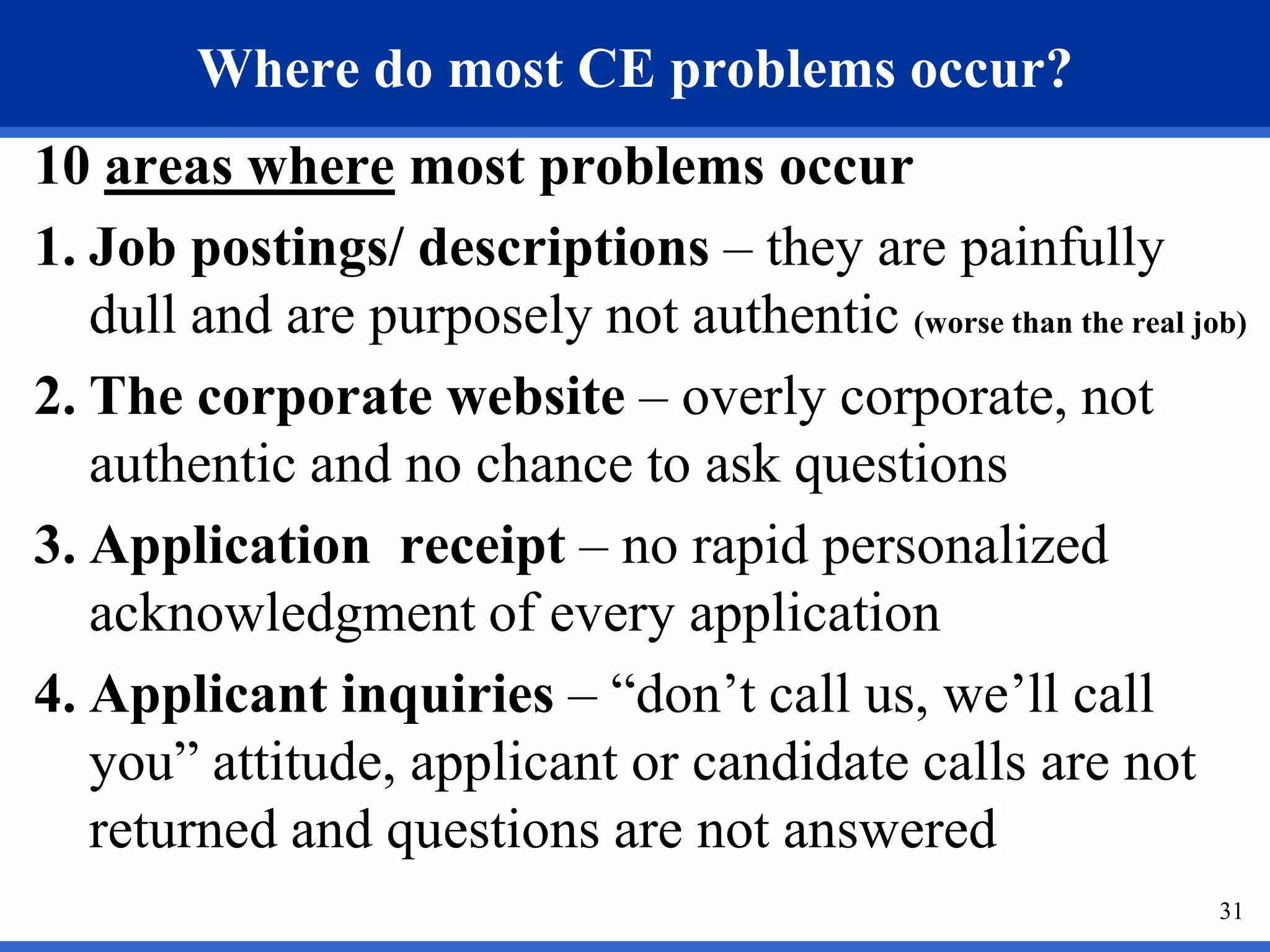
Where do most CE problems occur?
10 areas where most problems occur
1. Job postings/ descriptions – they are painfully
   dull and are purposely not authentic (worse than the real job)
2. The corporate website – overly corporate, not
   authentic and no chance to ask questions
3. Application receipt – no rapid personalized
   acknowledgment of every application
4. Applicant inquiries – “don’t call us, we’ll call
   you” attitude, applicant or candidate calls are not
   returned and questions are not answered
                                                               31
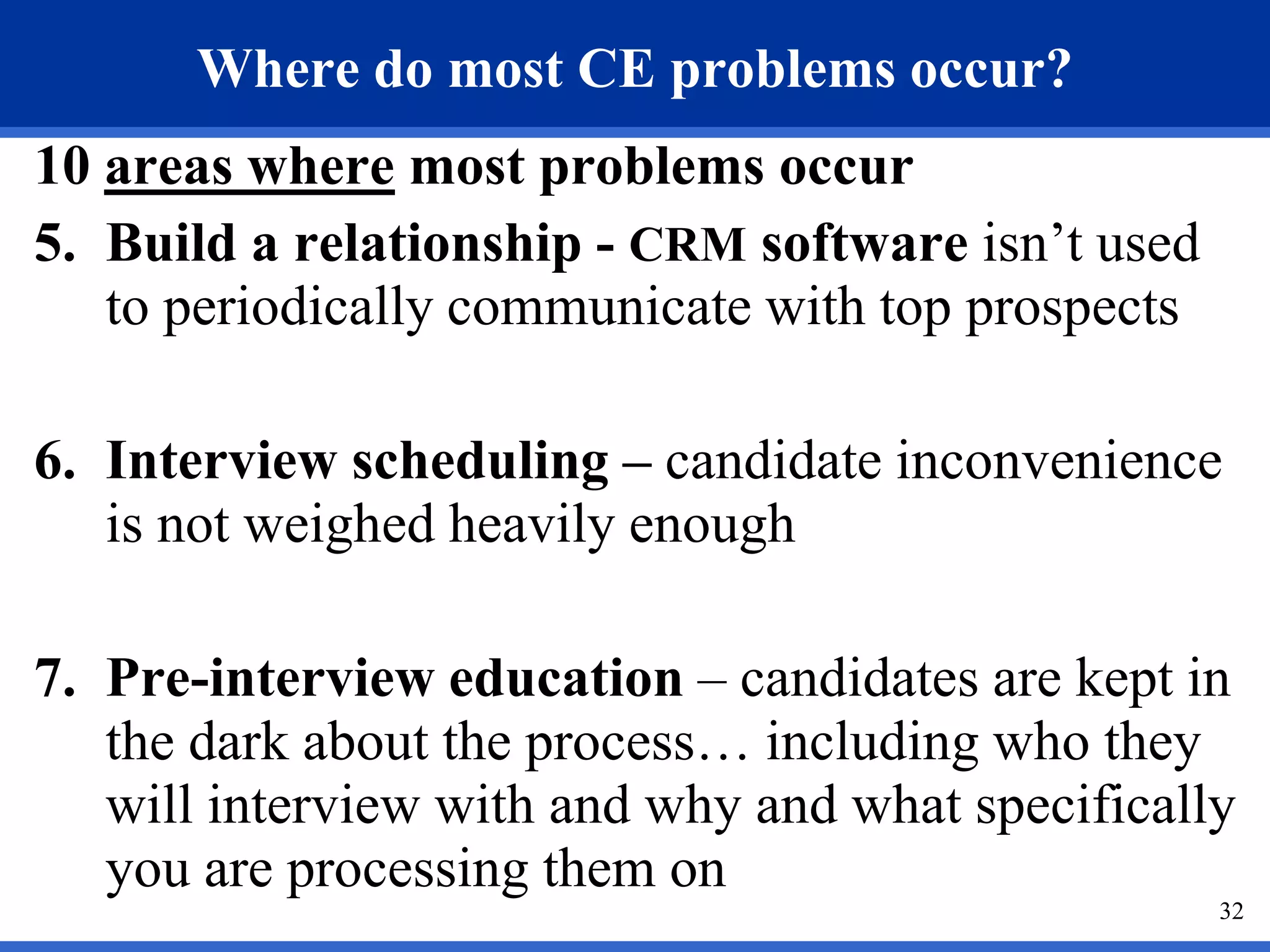
Where do most CE problems occur?
10 areas where most problems occur
5. Build a relationship - CRM software isn’t used
   to periodically communicate with top prospects

6. Interview scheduling – candidate inconvenience
   is not weighed heavily enough

7. Pre-interview education – candidates are kept in
   the dark about the process… including who they
   will interview with and why and what specifically
   you are processing them on
                                                    32
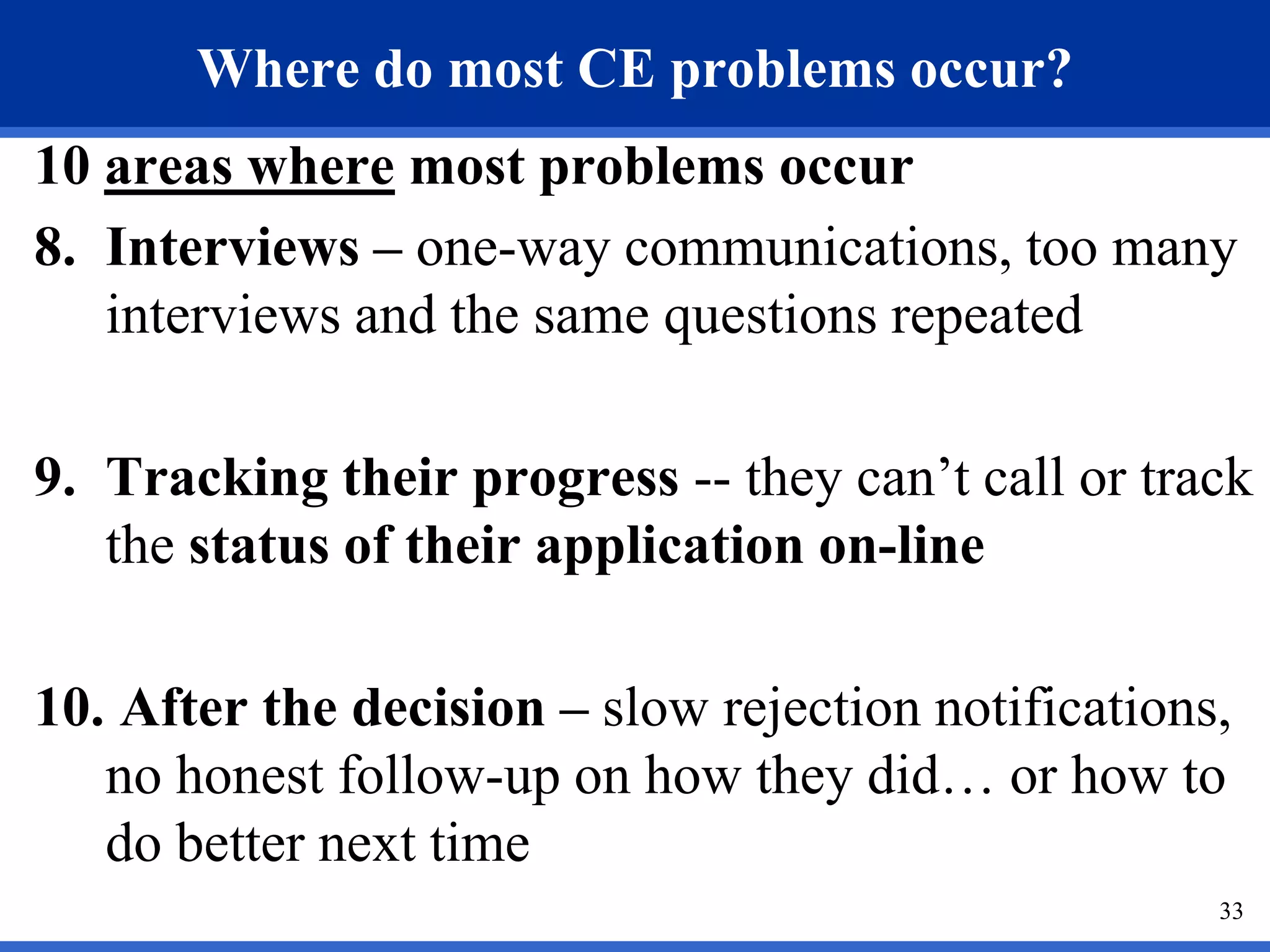
Where do most CE problems occur?
10 areas where most problems occur
8. Interviews – one-way communications, too many
   interviews and the same questions repeated

9. Tracking their progress -- they can’t call or track
   the status of their application on-line

10. After the decision – slow rejection notifications,
   no honest follow-up on how they did… or how to
   do better next time
                                                     33
And finally, some things to do


                                 34
There are 3 possible CE outputs to aim for
3 possible results of a candidate experience include
1.You created employer brand ambassadors – the
  ultimate output, at this level applicants and
  candidates become your evangelists and a referral
  source
2.You created neutrals – At this level, they say little
  & soon forget the experience
3.You created lifelong enemies – At this level, they
  become a lifelong enemy and they proactively
  spread the word against you                       35
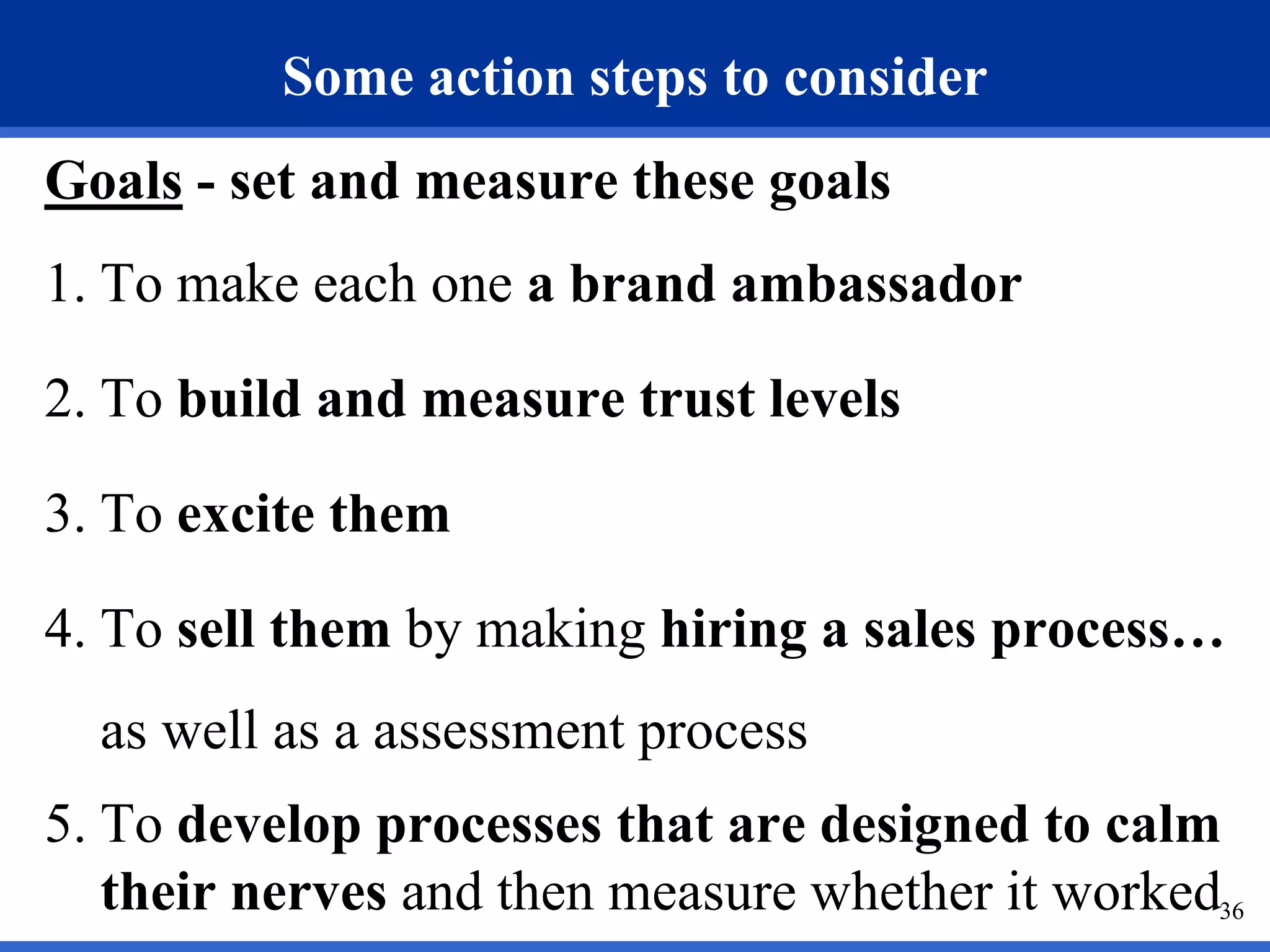
Some action steps to consider
Goals - set and measure these goals
1. To make each one a brand ambassador

2. To build and measure trust levels

3. To excite them

4. To sell them by making hiring a sales process…
  as well as a assessment process
5. To develop processes that are designed to calm
   their nerves and then measure whether it worked36
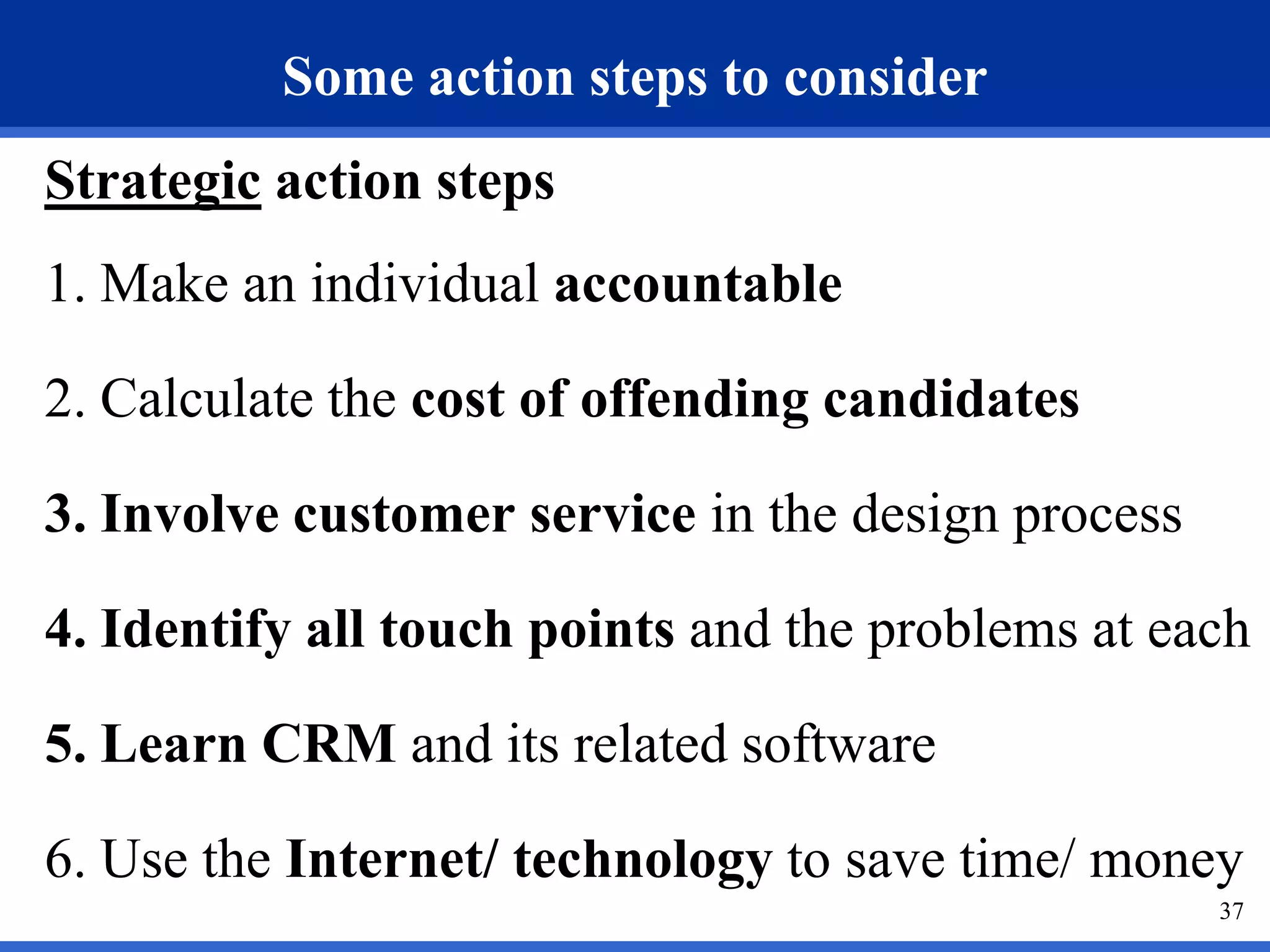
Some action steps to consider
Strategic action steps
1. Make an individual accountable

2. Calculate the cost of offending candidates

3. Involve customer service in the design process

4. Identify all touch points and the problems at each

5. Learn CRM and its related software

6. Use the Internet/ technology to save time/ money
                                                    37
Some action steps to consider
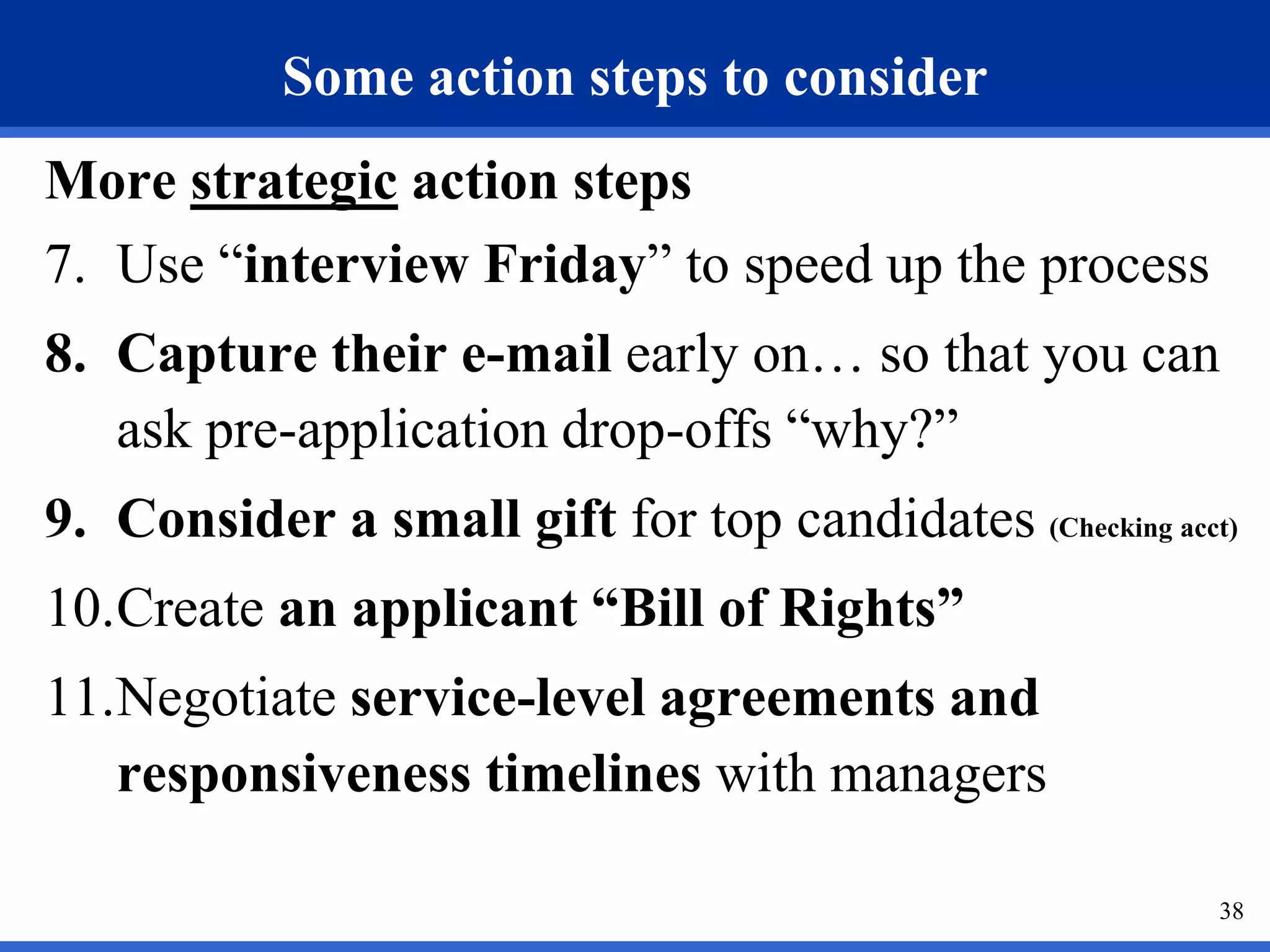
More strategic action steps
7. Use “interview Friday” to speed up the process
8. Capture their e-mail early on… so that you can
   ask pre-application drop-offs “why?”
9. Consider a small gift for top candidates (Checking acct)
10.Create an applicant “Bill of Rights”
11.Negotiate service-level agreements and
   responsiveness timelines with managers

                                                          38
Some action steps to consider
Limit the # of applicants that you must be nice to
1. Proactively reduce the number of applicants
   that have no real chance (list absolute
   minimums, list knockout factors, list success rates
   etc.)

2. Prioritize jobs and focus on the critical ones

3. Search your own customer database to identify
   which individual applicants are also customers
                                                 39
   and then prioritize them
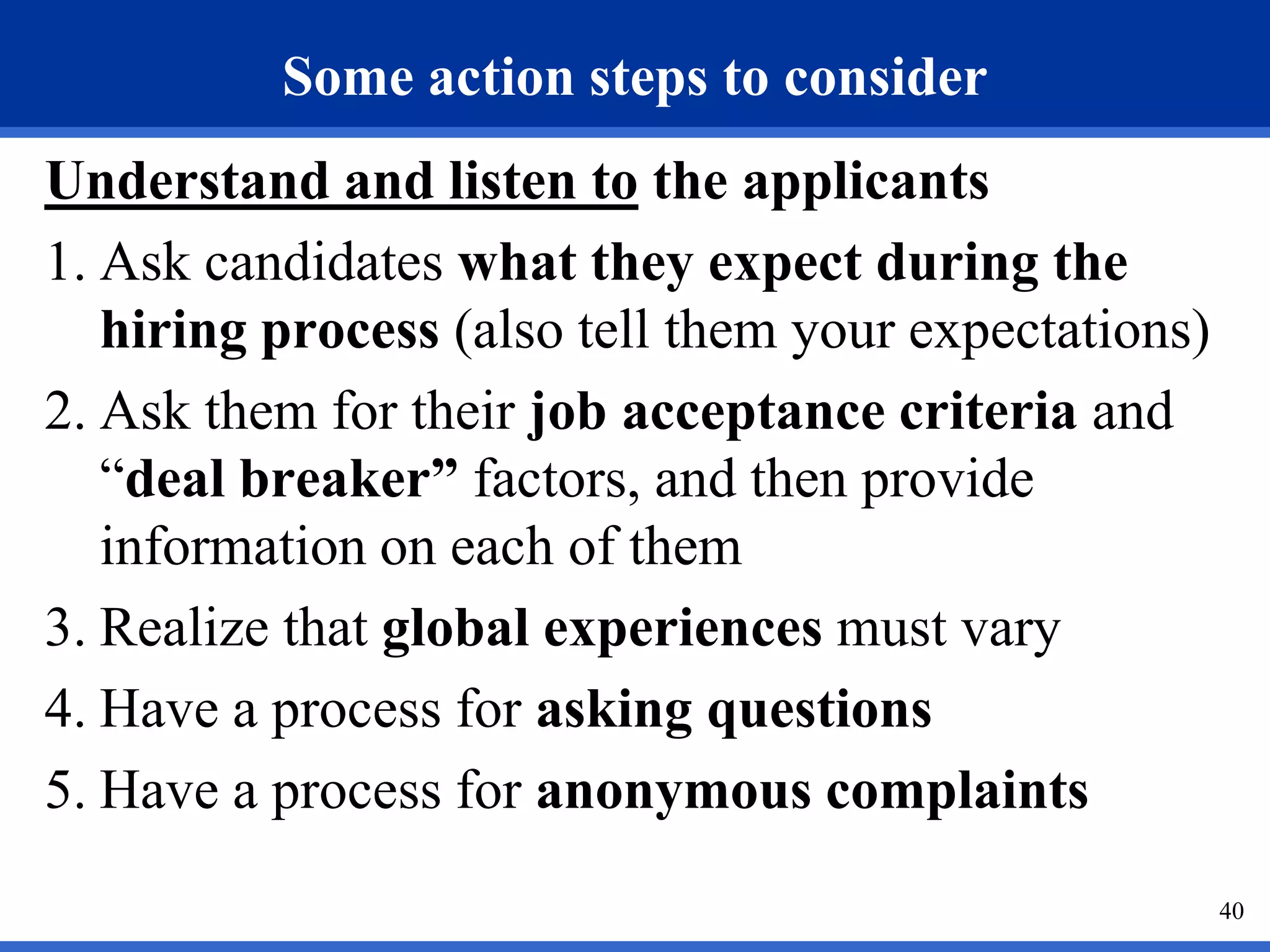
Some action steps to consider
Understand and listen to the applicants
1. Ask candidates what they expect during the
   hiring process (also tell them your expectations)
2. Ask them for their job acceptance criteria and
   “deal breaker” factors, and then provide
   information on each of them
3. Realize that global experiences must vary
4. Have a process for asking questions
5. Have a process for anonymous complaints
                                                       40
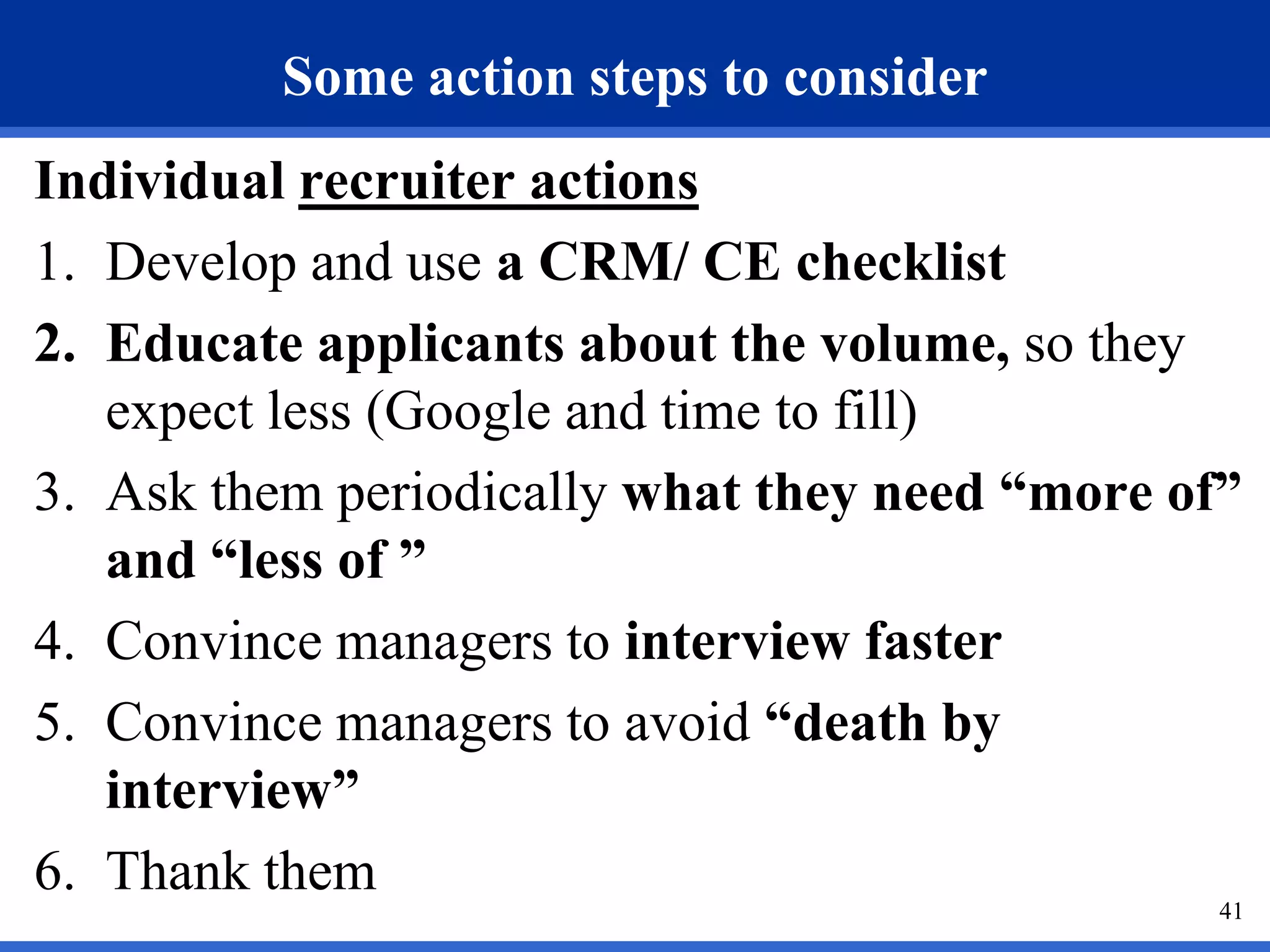
Some action steps to consider
Individual recruiter actions
1. Develop and use a CRM/ CE checklist
2. Educate applicants about the volume, so they
   expect less (Google and time to fill)
3. Ask them periodically what they need “more of”
   and “less of ”
4. Convince managers to interview faster
5. Convince managers to avoid “death by
   interview”
6. Thank them
                                                41
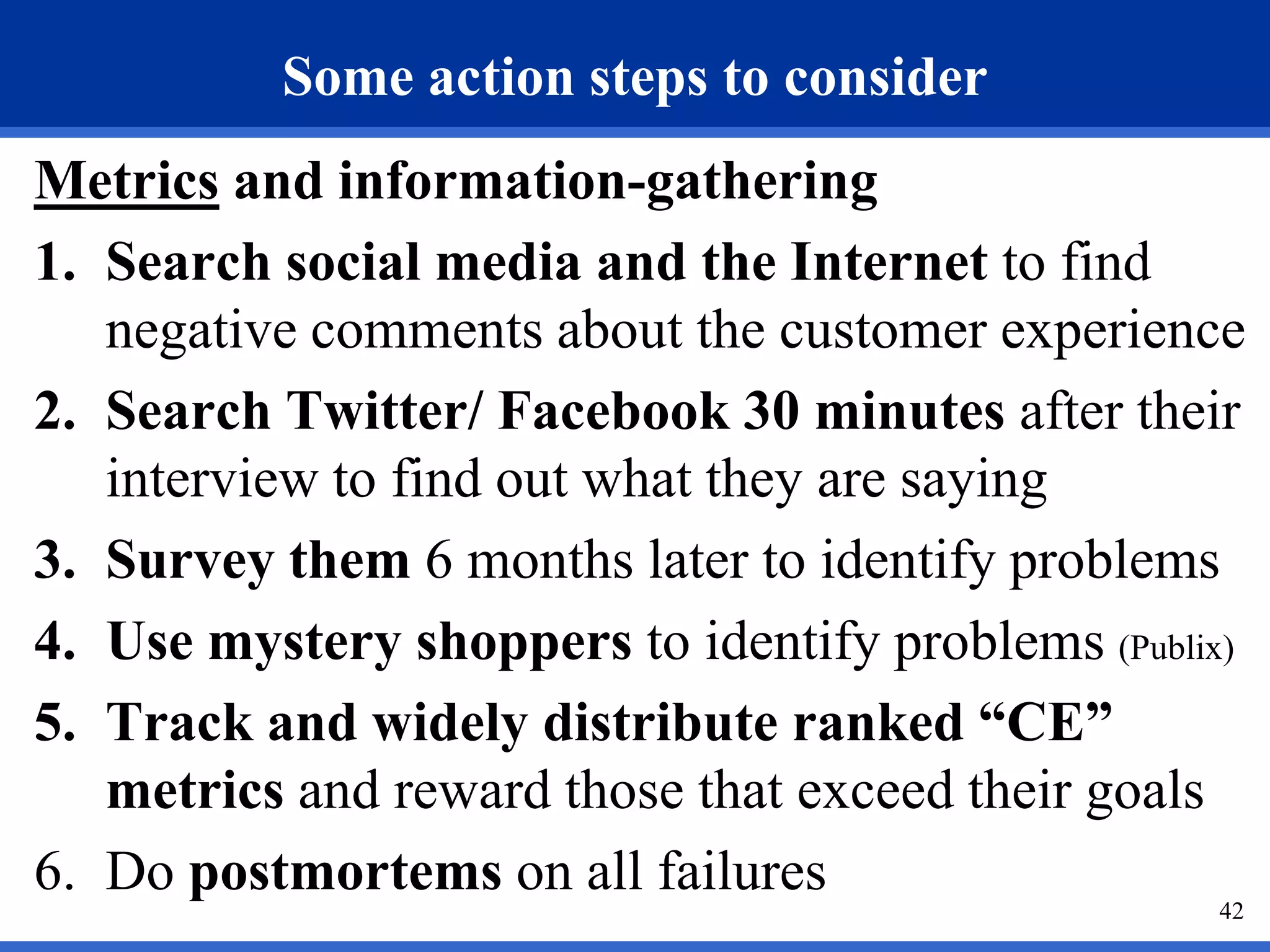
Some action steps to consider
Metrics and information-gathering
1. Search social media and the Internet to find
   negative comments about the customer experience
2. Search Twitter/ Facebook 30 minutes after their
   interview to find out what they are saying
3. Survey them 6 months later to identify problems
4. Use mystery shoppers to identify problems (Publix)
5. Track and widely distribute ranked “CE”
   metrics and reward those that exceed their goals
6. Do postmortems on all failures
                                                   42
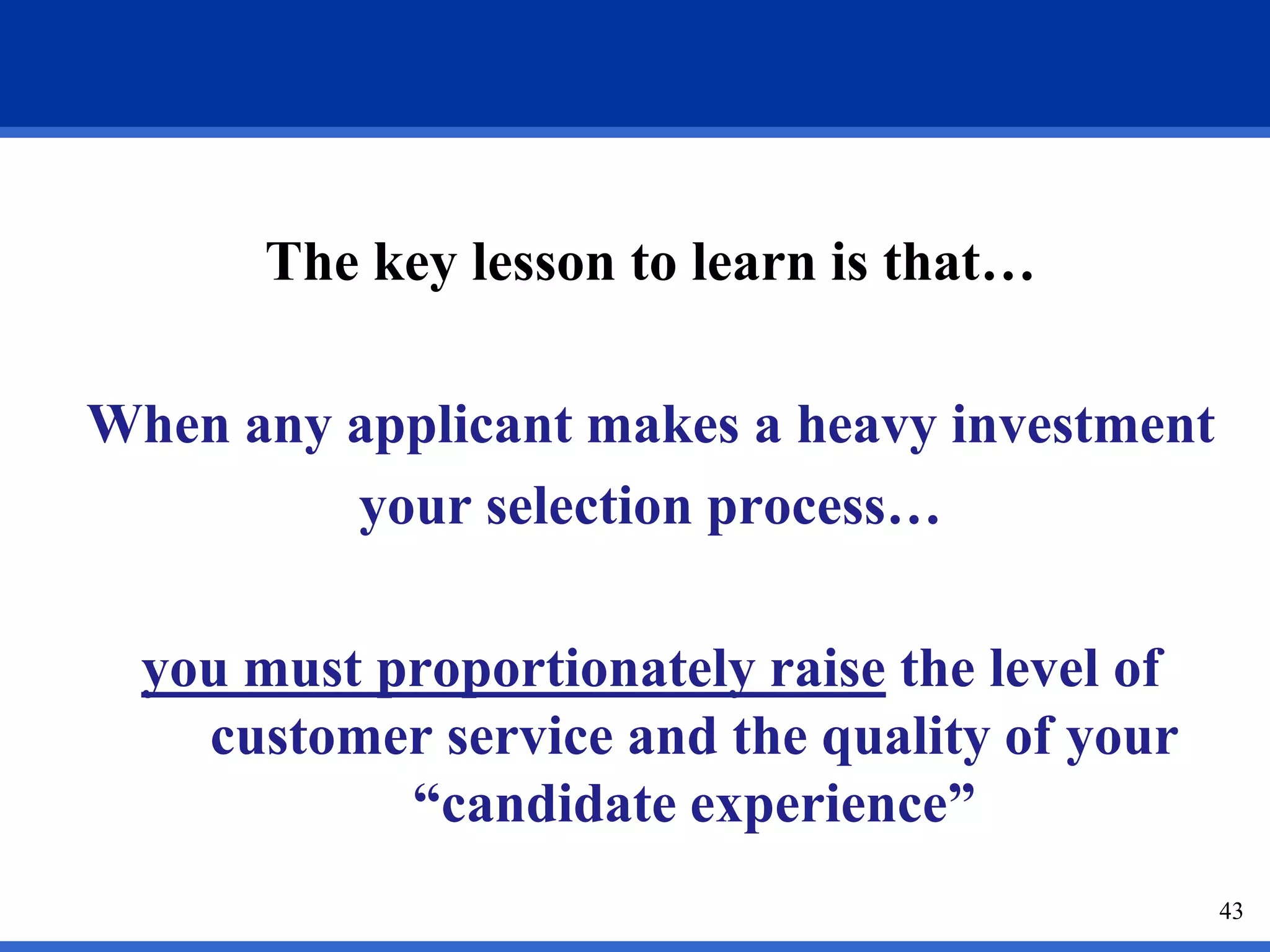
The key lesson to learn is that…

When any applicant makes a heavy investment
         your selection process…

  you must proportionately raise the level of
    customer service and the quality of your
            “candidate experience”
                                                43
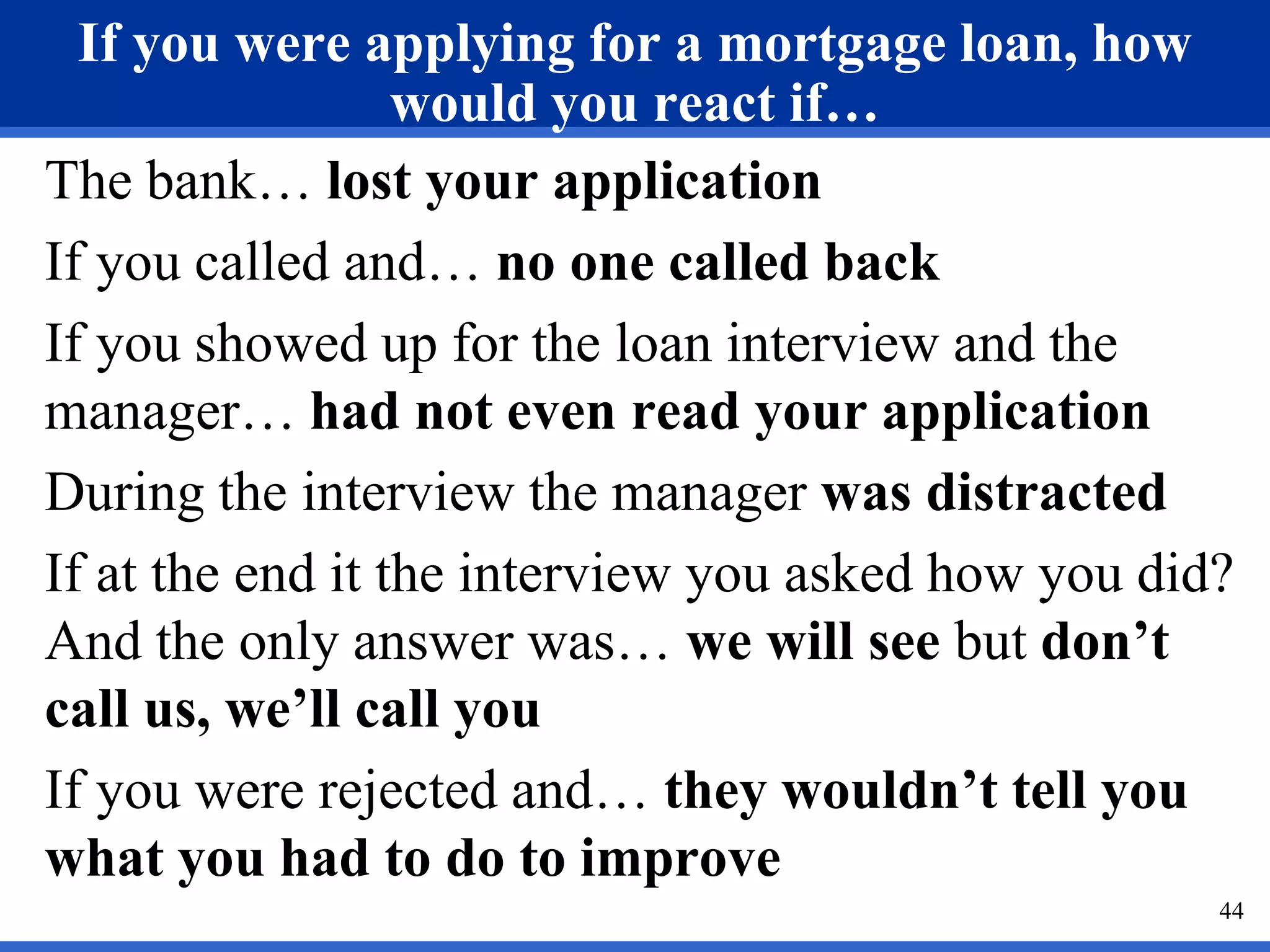
If you were applying for a mortgage loan, how
                  would you react if…
The bank… lost your application
If you called and… no one called back
If you showed up for the loan interview and the
manager… had not even read your application
During the interview the manager was distracted
If at the end it the interview you asked how you did?
And the only answer was… we will see but don’t
call us, we’ll call you
If you were rejected and… they wouldn’t tell you
what you had to do to improve
                                                    44
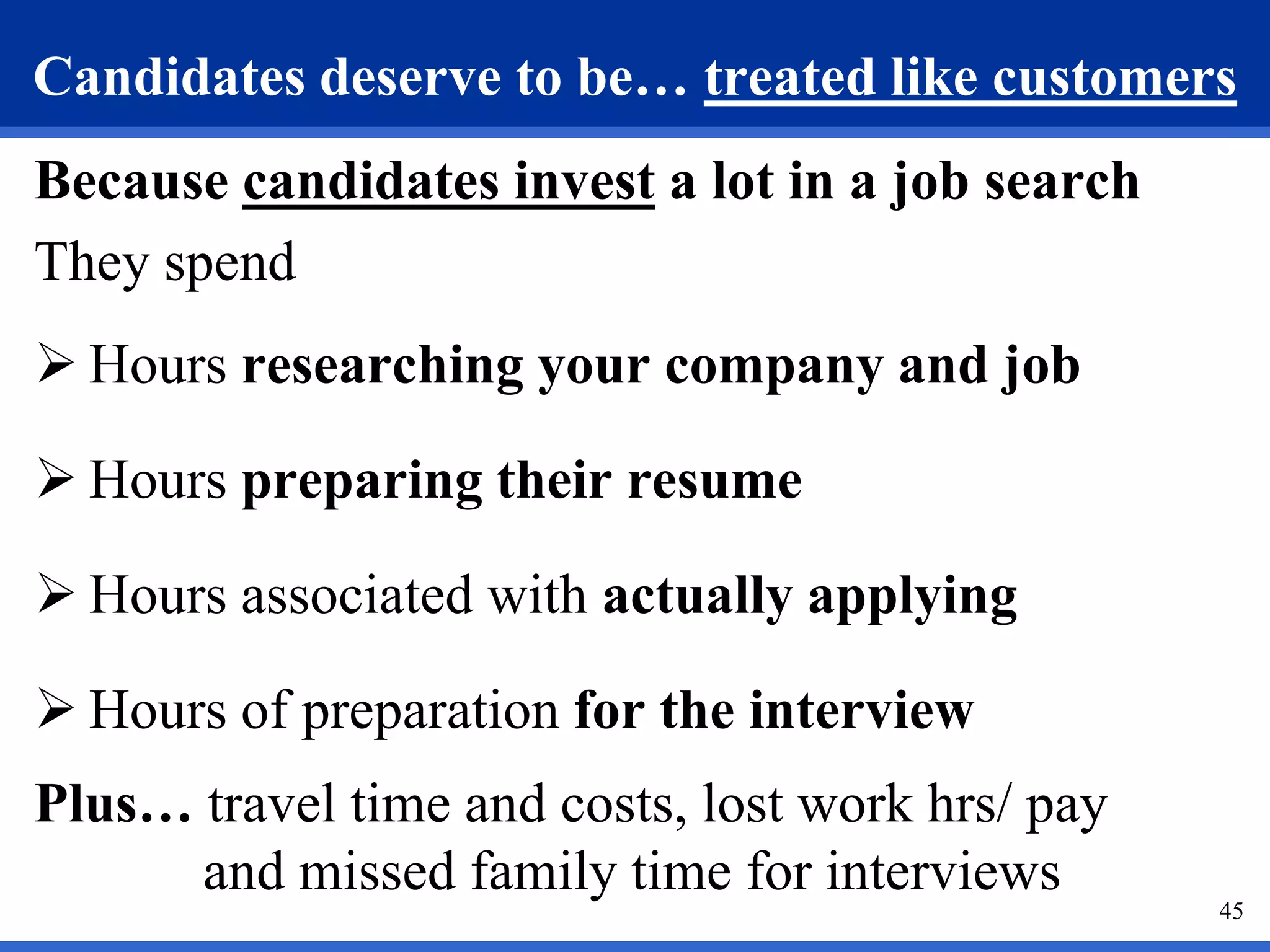
Candidates deserve to be… treated like customers
Because candidates invest a lot in a job search
They spend
 Hours researching your company and job

 Hours preparing their resume

 Hours associated with actually applying

 Hours of preparation for the interview
Plus… travel time and costs, lost work hrs/ pay
      and missed family time for interviews
                                                  45
During what steps of the recruiting process
do most candidate experience problems occur?


                                               46
Where do most CE problems occur?
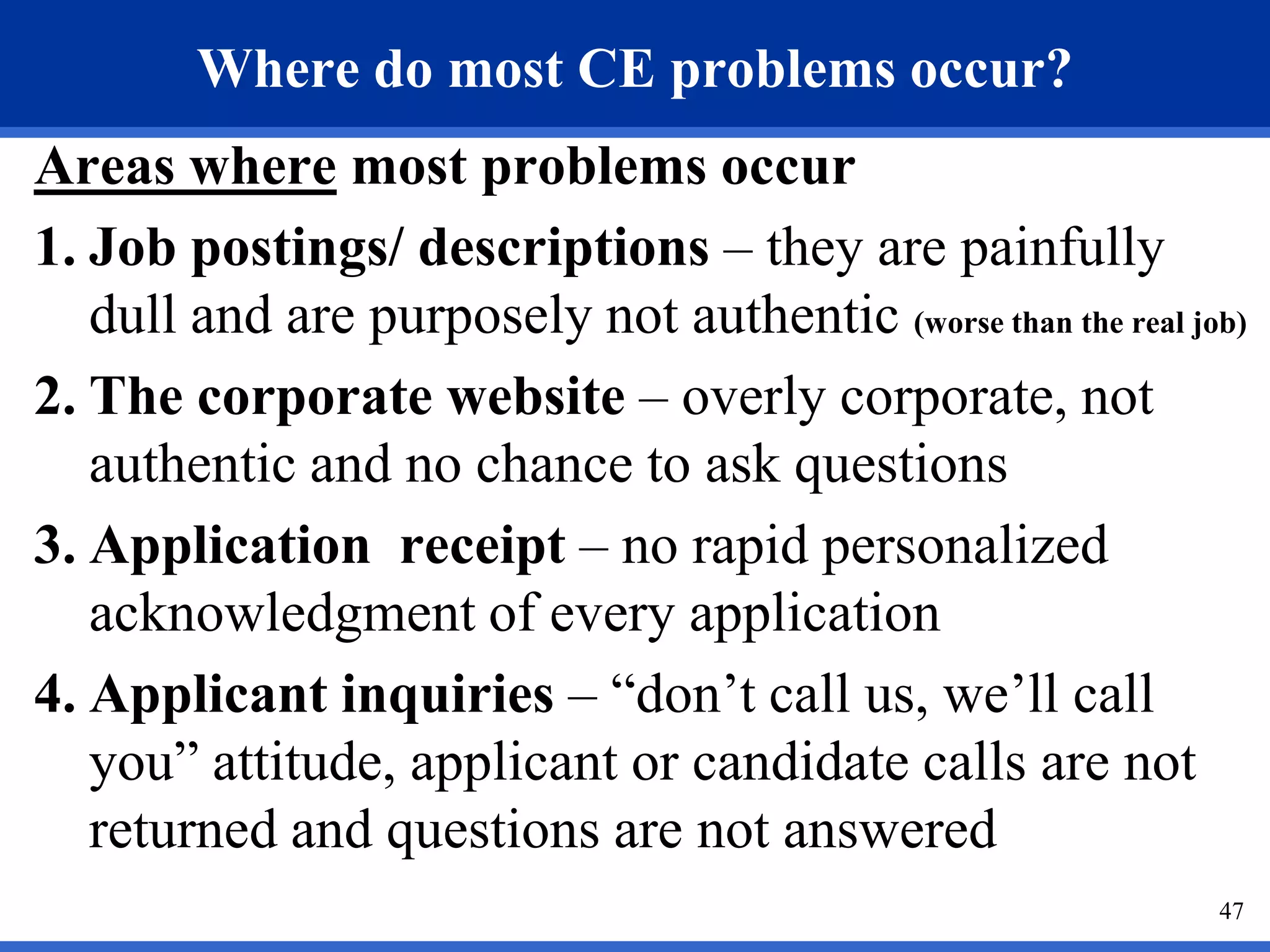
Areas where most problems occur
1. Job postings/ descriptions – they are painfully
   dull and are purposely not authentic (worse than the real job)
2. The corporate website – overly corporate, not
   authentic and no chance to ask questions
3. Application receipt – no rapid personalized
   acknowledgment of every application
4. Applicant inquiries – “don’t call us, we’ll call
   you” attitude, applicant or candidate calls are not
   returned and questions are not answered
                                                               47
Where do most CE problems occur?
10 areas where most problems occur
5.The relationship building process - CRM
  software isn’t used to periodically communicate
  and build trust with top prospects

6.Interview scheduling – candidate inconvenience is
  not weighed heavily enough

7.Pre-interview education – candidates are kept in
  the dark about the process… including who they
  will interview with and why and what specifically
  you are processing them on                        48
Where do most CE problems occur?
10 areas where most problems occur
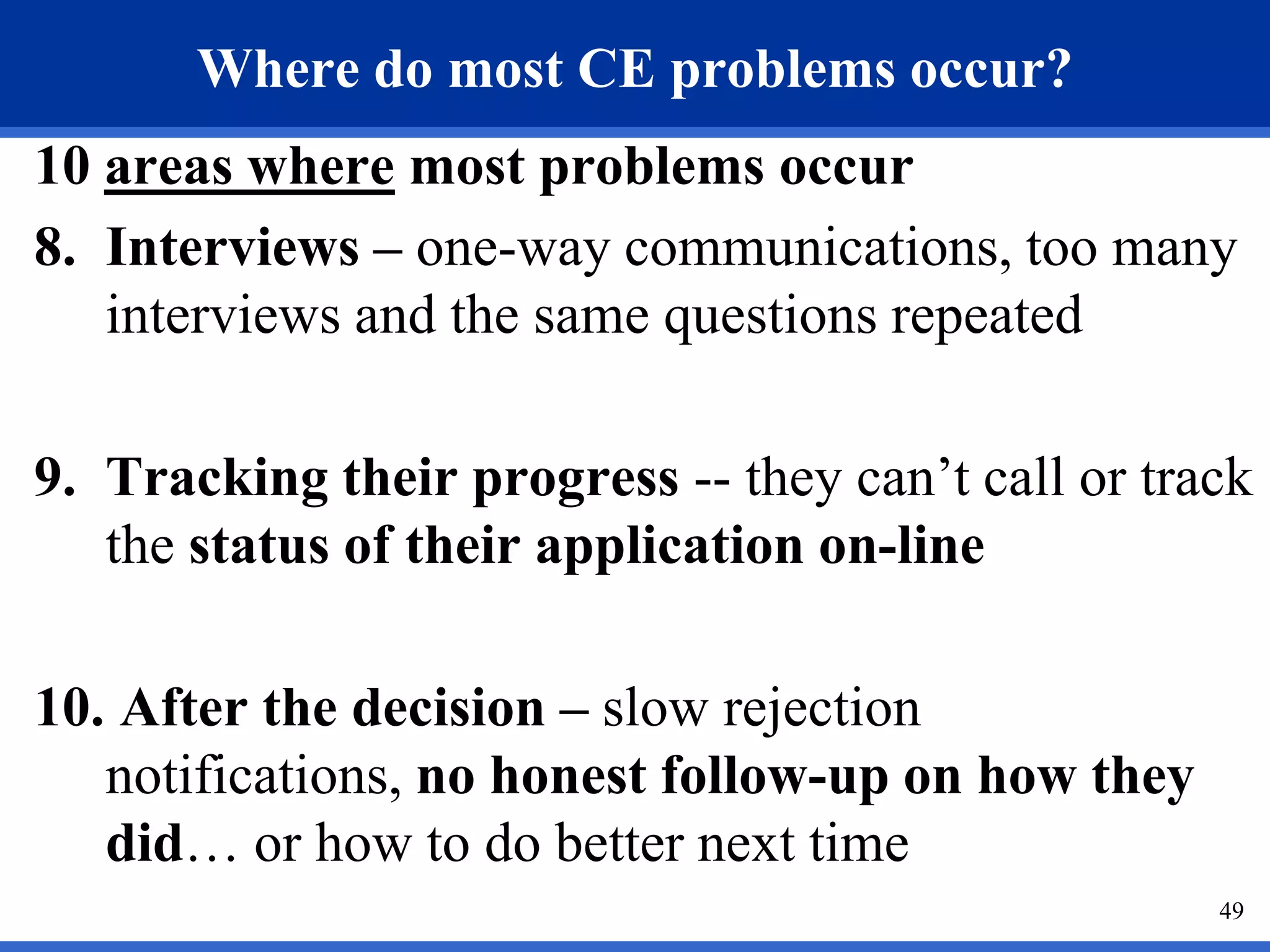
8. Interviews – one-way communications, too many
   interviews and the same questions repeated

9. Tracking their progress -- they can’t call or track
   the status of their application on-line

10. After the decision – slow rejection
   notifications, no honest follow-up on how they
   did… or how to do better next time
                                                    49

Improving the candidate experience

  • 1.
    Improving the candidateexperience in recruiting © Dr. John Sullivan www.drjohnsullivan.com
  • 2.
    Topics I willcover today 1. Defining the “candidate experience” (CE) 2. Negative impacts if you get it wrong 3. Action steps to improve your candidate experience 2
  • 3.
    A quick definitionof… “the candidate experience”? 3
  • 4.
    A quick definition Aquick definition of “the candidate experience” 1. A candidate’s experience begins with their researching the company and its jobs 2. It then continues through every “touch point” or interaction during the recruiting process 3. It ends after the decision is made with their lasting memory of the total experience 4. The output of the candidate experience is…how applicants now act… as a result of their perception of how well they were treated 4
  • 5.
    The benchmark firmsto study Benchmark firms 1. Zappos 2. DaVita 3. Microsoft 4. Facebook What makes their candidate experience good? 5
  • 6.
    10 characteristics ofa great candidate experience 1. Rapid response 2. Flexible to your needs, not rigid 3. They don’t waste your time (a real opening) 4. They are honest 5. They listen 6. No unpleasant surprises 7. They solicit feedback and change as a result of it 8. They keep you updated 9. They explain why 10.A WOW you will remember 6
  • 7.
    Why should recruitersand their managers care about “the candidate experience”? 7
  • 8.
    If you wereapplying for a mortgage loan, how would you react if… The bank… lost your application If you called and… no one called back If you showed up for the loan interview and the manager… had not even read your application During the interview the manager was distracted If at the end it the interview you asked how you did? And the only answer was… will see and don’t call us we’ll call you If you were rejected and… they wouldn’t tell you what you had to do to improve 8
  • 9.
    Do people remembera bad candidate experience? A quote… how long do they remember a bad one? I had an interview 20 years ago that I have never forgotten. I was then offered the job and I turned it down because even at 19, I knew that if they couldn’t treat me well during the interview, they wouldn’t treat me well as an employee. Caron Osberg on ERE.Net They never forget… and they also tell others 9
  • 10.
    Candidates deserve tobe treated like customers The candidate’s investments in a job search 1. Hours researching your company and job 2. Hours spent in preparing the resume 3. Hours associated with actually applying 4. Hours of preparation for the interview 5. Travel time and costs 6. Lost work hrs, $ and family time for interviews 10
  • 11.
    What is yourestimate of the dollar value of an applicant’s investment? “I estimate that the average professional candidate voluntarily spends or invests more than $1,000 worth of their own time and money in preparing for and participating in an organization’s hiring process. Given that level of investment, they deserve to be treated like good customers.” 11
  • 12.
    “Applicants are volunteers.They are volunteering and investing their time when they participate in your selection process. Smart companies realize that fact upfront and thus, they “treat them like volunteers” throughout every step of the hiring process.” 12
  • 13.
    The key lessonto learn is that… when any applicant makes a heavy investment in a selection process… you must proportionately raise the level of customer service and the “candidate experience” 13
  • 14.
    Why focus onthe “candidate experience”? What % of your prospects/ candidates… are also current or potential customers? 14
  • 15.
    Now shifting tothe possible negative impacts of the bad candidate experience Why should an individual recruiter care about the candidate experience? 15
  • 16.
    Reasons why recruitersshould care Impacts on individual recruiters may include: 1. The #1 reason why candidates reject offers is… 2. The loss of top candidates - the greatest impact will be on those in the highest demand, including top performers, innovators and game changers that can simply remain at their current job 3. Mid-process dropouts – frustrated individuals that do not see their “job switch criteria” being met or that encounter one of their “knockout factors” will simply drop out (lie to you why?) 16
  • 17.
    Reasons why recruitersshould care Impacts on individual recruiters may include: 4. A loss of return candidates – finalists that would have been hired (if a super strong candidate wasn't in the final candidate mix), will likely never reapply. Neither will “soon to be qualified” candidates that were rejected merely because they didn’t have quite enough experience 5. The loss of applicants due to word-of-mouth – friends, family and colleagues of a poorly treated applicant/ candidate will now never apply themselves 17
  • 18.
    8 reasons whyrecruiters should care Impacts on individual recruiters may include: 6. Loss of referrals – you will see an increased recruiter workload when many employees will simply stop” doing some of your work” (making referrals) once they hear how their highly regarded colleagues were treated 7. Higher interview drop out rates due to scheduling – because employed candidates can’t easily schedule during normal work hours 18
  • 19.
    8 reasons whyrecruiters should care Impacts on individual recruiters may include: 8. More hiring mistakes – confused, tired , surprised and frustrated applicants just don't perform as well during interviews. Bad hires means that later on you’ll just have to rehire for the position 19
  • 20.
    Now let’s shiftto… broader impacts on the entire recruiting function 20
  • 21.
    Reasons why recruitingmanagers should care 10 impacts on the recruitment function: 1. Employer brand image damage – “others” now own your employer brand image. They can easily spread rumors, stories and recommendations against working at your firm to complete strangers on social networks and sites like glassdoor.com 2. Higher agency fees –you may need to use more agencies, because of their advanced capabilities for attracting and selling top candidates 21
  • 22.
    Reasons why recruitingmanagers should care 10 impacts on the recruitment function: 3. You’ll need more recruiters – lower application and higher candidate dropout rates will require you to spend more on recruiters 4. You will lose quality recruiters – recruiters will be frustrated and the powerful relationships that your top recruiters built will be lost the minute that the candidate experiences the abusive process 5. Higher website drop rates – they aren’t authentic or designed around candidate decision criteria 22
  • 23.
    Reasons why recruitingmanagers should care 10 impacts on the recruitment function: 6. Fewer global hires – a fragmented process may confuse those that are unfamiliar with Canadian hiring processes (it may offend some cultures) 7. Managers and recruiters will aim lower – because they won't really know the reason why they are not getting hires, they may mistakenly assume that “there are just no quality candidates out there” and settle for poor quality hires 23
  • 24.
    Reasons why recruitingmanagers should care 10 impacts on the recruitment function: 8. Loss of career counselor referrals – career counselors at schools may stop referring 9. Loss of recruiting budget – when executives hear of your negative impacts, they’re likely to reduce your recruiting budget 10.As the power shifts, you will be forced to change 24
  • 25.
    And finally… the businessimpacts of a bad candidate experience 25
  • 26.
    The business casefor the candidate experience Potential revenue and sales losses include: 1. Angry people mean lost sales among themselves, family, friends & their network (Especially in retail) 2. It may also indirectly hurt your product brand 3. If they work in our industry, it may hurt B2B sales 4. Loss of a competitive advantage – losing top candidates to competitors means that they get more innovation & new products, but we do not 26
  • 27.
    Reasons for improvingthe candidate experience Two additional negative business impacts 5. Decreased retention rates - hearing friends and colleagues “badmouth” their firm will also reduce their loyalty. Some new hires may take the job because they need it but decide the minute that they accept that they will continue looking and leave at the first opportunity 6. A weakened corporate culture – because the recruiting process conflicts directly with a firm’s values (i.e. integrity, transparency and honesty) 27
  • 28.
    Having a badcandidate experience could soon get much more painful with sidewiki > 28
  • 29.
    What if anyonecould add comments to your displayed webpage (sidewiki) 29
  • 30.
    During what stepsof the recruiting process do most candidate experience problems occur? 30
  • 31.
    Where do mostCE problems occur? 10 areas where most problems occur 1. Job postings/ descriptions – they are painfully dull and are purposely not authentic (worse than the real job) 2. The corporate website – overly corporate, not authentic and no chance to ask questions 3. Application receipt – no rapid personalized acknowledgment of every application 4. Applicant inquiries – “don’t call us, we’ll call you” attitude, applicant or candidate calls are not returned and questions are not answered 31
  • 32.
    Where do mostCE problems occur? 10 areas where most problems occur 5. Build a relationship - CRM software isn’t used to periodically communicate with top prospects 6. Interview scheduling – candidate inconvenience is not weighed heavily enough 7. Pre-interview education – candidates are kept in the dark about the process… including who they will interview with and why and what specifically you are processing them on 32
  • 33.
    Where do mostCE problems occur? 10 areas where most problems occur 8. Interviews – one-way communications, too many interviews and the same questions repeated 9. Tracking their progress -- they can’t call or track the status of their application on-line 10. After the decision – slow rejection notifications, no honest follow-up on how they did… or how to do better next time 33
  • 34.
    And finally, somethings to do 34
  • 35.
    There are 3possible CE outputs to aim for 3 possible results of a candidate experience include 1.You created employer brand ambassadors – the ultimate output, at this level applicants and candidates become your evangelists and a referral source 2.You created neutrals – At this level, they say little & soon forget the experience 3.You created lifelong enemies – At this level, they become a lifelong enemy and they proactively spread the word against you 35
  • 36.
    Some action stepsto consider Goals - set and measure these goals 1. To make each one a brand ambassador 2. To build and measure trust levels 3. To excite them 4. To sell them by making hiring a sales process… as well as a assessment process 5. To develop processes that are designed to calm their nerves and then measure whether it worked36
  • 37.
    Some action stepsto consider Strategic action steps 1. Make an individual accountable 2. Calculate the cost of offending candidates 3. Involve customer service in the design process 4. Identify all touch points and the problems at each 5. Learn CRM and its related software 6. Use the Internet/ technology to save time/ money 37
  • 38.
    Some action stepsto consider More strategic action steps 7. Use “interview Friday” to speed up the process 8. Capture their e-mail early on… so that you can ask pre-application drop-offs “why?” 9. Consider a small gift for top candidates (Checking acct) 10.Create an applicant “Bill of Rights” 11.Negotiate service-level agreements and responsiveness timelines with managers 38
  • 39.
    Some action stepsto consider Limit the # of applicants that you must be nice to 1. Proactively reduce the number of applicants that have no real chance (list absolute minimums, list knockout factors, list success rates etc.) 2. Prioritize jobs and focus on the critical ones 3. Search your own customer database to identify which individual applicants are also customers 39 and then prioritize them
  • 40.
    Some action stepsto consider Understand and listen to the applicants 1. Ask candidates what they expect during the hiring process (also tell them your expectations) 2. Ask them for their job acceptance criteria and “deal breaker” factors, and then provide information on each of them 3. Realize that global experiences must vary 4. Have a process for asking questions 5. Have a process for anonymous complaints 40
  • 41.
    Some action stepsto consider Individual recruiter actions 1. Develop and use a CRM/ CE checklist 2. Educate applicants about the volume, so they expect less (Google and time to fill) 3. Ask them periodically what they need “more of” and “less of ” 4. Convince managers to interview faster 5. Convince managers to avoid “death by interview” 6. Thank them 41
  • 42.
    Some action stepsto consider Metrics and information-gathering 1. Search social media and the Internet to find negative comments about the customer experience 2. Search Twitter/ Facebook 30 minutes after their interview to find out what they are saying 3. Survey them 6 months later to identify problems 4. Use mystery shoppers to identify problems (Publix) 5. Track and widely distribute ranked “CE” metrics and reward those that exceed their goals 6. Do postmortems on all failures 42
  • 43.
    The key lessonto learn is that… When any applicant makes a heavy investment your selection process… you must proportionately raise the level of customer service and the quality of your “candidate experience” 43
  • 44.
    If you wereapplying for a mortgage loan, how would you react if… The bank… lost your application If you called and… no one called back If you showed up for the loan interview and the manager… had not even read your application During the interview the manager was distracted If at the end it the interview you asked how you did? And the only answer was… we will see but don’t call us, we’ll call you If you were rejected and… they wouldn’t tell you what you had to do to improve 44
  • 45.
    Candidates deserve tobe… treated like customers Because candidates invest a lot in a job search They spend  Hours researching your company and job  Hours preparing their resume  Hours associated with actually applying  Hours of preparation for the interview Plus… travel time and costs, lost work hrs/ pay and missed family time for interviews 45
  • 46.
    During what stepsof the recruiting process do most candidate experience problems occur? 46
  • 47.
    Where do mostCE problems occur? Areas where most problems occur 1. Job postings/ descriptions – they are painfully dull and are purposely not authentic (worse than the real job) 2. The corporate website – overly corporate, not authentic and no chance to ask questions 3. Application receipt – no rapid personalized acknowledgment of every application 4. Applicant inquiries – “don’t call us, we’ll call you” attitude, applicant or candidate calls are not returned and questions are not answered 47
  • 48.
    Where do mostCE problems occur? 10 areas where most problems occur 5.The relationship building process - CRM software isn’t used to periodically communicate and build trust with top prospects 6.Interview scheduling – candidate inconvenience is not weighed heavily enough 7.Pre-interview education – candidates are kept in the dark about the process… including who they will interview with and why and what specifically you are processing them on 48
  • 49.
    Where do mostCE problems occur? 10 areas where most problems occur 8. Interviews – one-way communications, too many interviews and the same questions repeated 9. Tracking their progress -- they can’t call or track the status of their application on-line 10. After the decision – slow rejection notifications, no honest follow-up on how they did… or how to do better next time 49