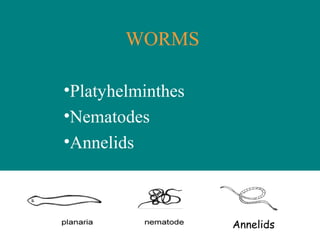
WORMS
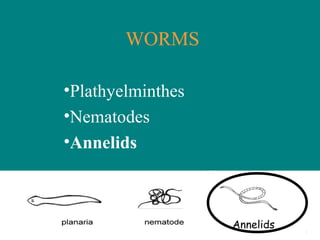
•Platyhelminthes
•Nematodes
•Annelids
Annelids
WORMS
•Platyhelminthes
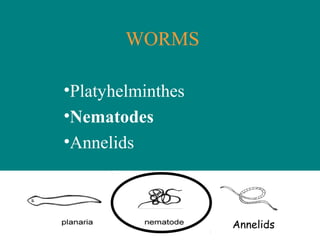
•Nematodes
•Annelids
Annelids
Nematodes
What must I learn?
• Round worms: Cylindrical and soft body with tapered end,
not divided in segments.
• Most of them are free-living but some are parasitic and
responsible for many diseases. (Pinworm, anisakis, trichina)
• No respiratory system.
Nematodes
• Pinworms
– Adults reside in the large intestine.
– Enter humans by being eaten.
• Dracunculus
• Hookworms
– Adults live in the small intestine of humans.
– Enter host through the skin, usually between the toes. That makes you want to
walk around barefoot, doesn’t it?
• Anisakis
• Trichina
– Live in humans & other omnivores (like piggys)
– Adults live in the small intestine of it’s host; larvae encyst in the stomach and
skeletal tissue (ouch!). Enter host by being eaten.
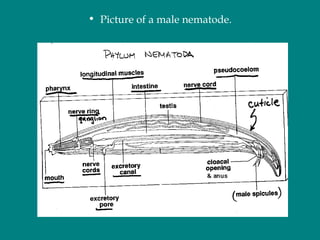
• Picture of a male nematode.
M O V E M E N T
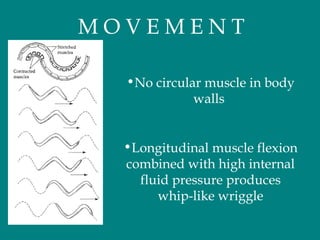
•No circular muscle in body
walls
•Longitudinal muscle flexion
combined with high internal
fluid pressure produces
whip-like wriggle
WORMS
•Plathyelminthes
•Nematodes
•Annelids
Annelids
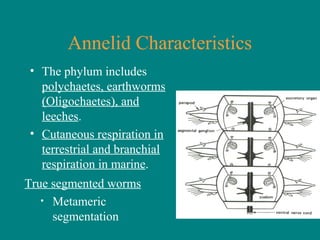
Annelid Characteristics
• The phylum includes
polychaetes, earthworms
(Oligochaetes), and
leeches.
• Cutaneous respiration in
terrestrial and branchial
respiration in marine.
True segmented worms
• Metameric
segmentation
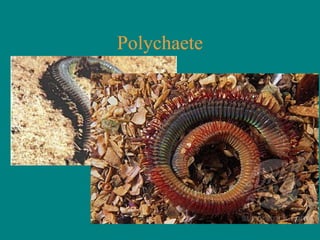
Polychaete
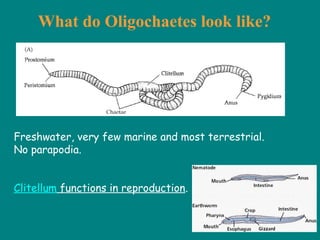
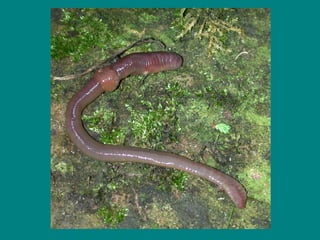
What do Oligochaetes look like?
Freshwater, very few marine and most terrestrial.
No parapodia.
Clitellum functions in reproduction.
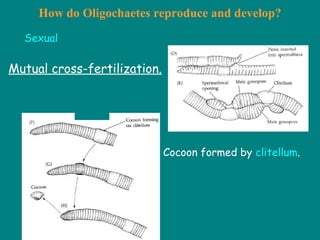
How do Oligochaetes reproduce and develop?
Sexual
Mutual cross-fertilization.
Cocoon formed by clitellum.
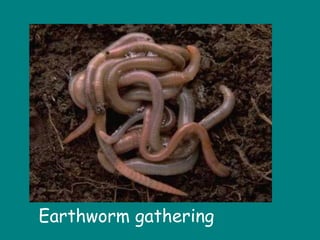
Earthworm gathering
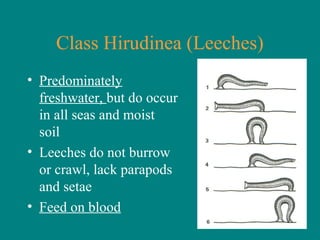
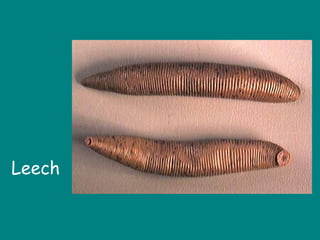
Class Hirudinea (Leeches)
• Predominately
freshwater, but do occur
in all seas and moist
soil
• Leeches do not burrow
or crawl, lack parapods
and setae
• Feed on blood
Leech

4 5 nematodes and annelids

Editor's Notes