COMPONENTS OF SOIL
By
Dr. Mohan Raj C
1
Soil definition :
 Soil refers to the loose Surface of the earth as
identified from the Original rocks and minerals from
which it is derived through weathering process.
 Weathering Process – To break down the rocks and
mineral into Soil.
2
Soil Definition:
 Soil Science Society of America (1970)
 Soil is the unconsolidated mineral mater on the surface of
the earth that has been subjected to and Influenced by
genetic and environment factors of parent material,
climate (Including moisture and temperature effects)
macro and microorganisms and topography all affecting
over a period of time and producing a product that is
"soil“ that differs from the material from which it is
derived in many physical, chemical, biological and
morphological properties and characteristics.
3
 Soil Science-
 The Science dealing with soil as a natural resource on
the surface of the earth, including Pedology (Soil
genesis, Classification and mapping), Physical,
Chemical, biological and Fertility properties of Soil
and these properties in relation to their management
for crop production.
 Soil physics-Involves the study of Physical Properties.
 Edaphology - Soil as a medium for plant growth
4
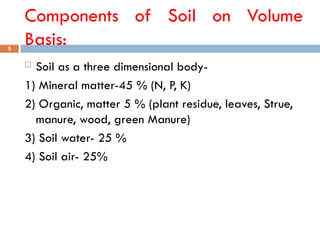
Components of Soil on Volume
Basis:
 Soil as a three dimensional body-
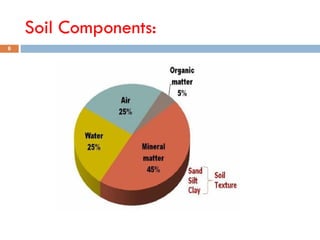
1) Mineral matter-45 % (N, P, K)
2) Organic, matter 5 % (plant residue, leaves, Strue,
manure, wood, green Manure)
3) Soil water- 25 %
4) Soil air- 25%
5
Soil Components:
6
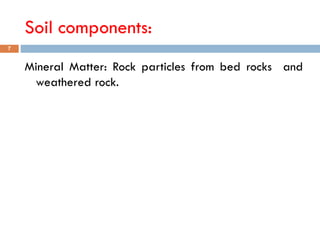
Soil components:
Mineral Matter: Rock particles from bed rocks and
weathered rock.
7
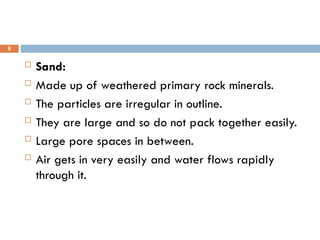
 Sand:
 Made up of weathered primary rock minerals.
 The particles are irregular in outline.
 They are large and so do not pack together easily.
 Large pore spaces in between.
 Air gets in very easily and water flows rapidly
through it.
8
 Silt :
 Particles are smaller than sand.
 Smaller pore spaces.
 More difficult to drain.
 Unlike clay particles, silt does not flocculate.
9
 Clay:
 Very small indeed.
 Secondary minerals (chemically altered by
weathering) – chemical weathering (hydration,
hydrolysis and dissolution) causes the original
mineral matter to degrade into its chemical
constituents – mainly silicon, aluminium, iron,
magnesium, potassium and calcium. Once released,
they recrystallize to form ‘secondary minerals’.
10
Clay
 Large surface area (they can hold more water)
although the pore spaces are tiny.
 Negatively charged (which means they attract
positively charged cations – such as calcium,
magnesium, hydrogen, aluminium, potassium).
 Clay has a capacity for water retention and will
expand on being wetted and shrinking on drying.
11
Soil components;
Soil water: Present in pore space. Provides a pool of
dissolved nutrients that are readily available for
plant uptake. It is important to maintain proper
level of soil moisture.
Soil air: Found in pore spaces between rock grain
Nitrogen, Co2 & oxygen.
12
Organic material :
 Humus : a black sticky gel produced from decaying
leaves and animals
 Living organism: earthworms , beetles , fungi,
bacteria.
13

Soil definition -Components ofthe soil .ppt

  • 1.
  • 2.
    Soil definition : Soil refers to the loose Surface of the earth as identified from the Original rocks and minerals from which it is derived through weathering process.  Weathering Process – To break down the rocks and mineral into Soil. 2
  • 3.
    Soil Definition:  SoilScience Society of America (1970)  Soil is the unconsolidated mineral mater on the surface of the earth that has been subjected to and Influenced by genetic and environment factors of parent material, climate (Including moisture and temperature effects) macro and microorganisms and topography all affecting over a period of time and producing a product that is "soil“ that differs from the material from which it is derived in many physical, chemical, biological and morphological properties and characteristics. 3
  • 4.
     Soil Science- The Science dealing with soil as a natural resource on the surface of the earth, including Pedology (Soil genesis, Classification and mapping), Physical, Chemical, biological and Fertility properties of Soil and these properties in relation to their management for crop production.  Soil physics-Involves the study of Physical Properties.  Edaphology - Soil as a medium for plant growth 4
  • 5.
    Components of Soilon Volume Basis:  Soil as a three dimensional body- 1) Mineral matter-45 % (N, P, K) 2) Organic, matter 5 % (plant residue, leaves, Strue, manure, wood, green Manure) 3) Soil water- 25 % 4) Soil air- 25% 5
  • 6.
  • 7.
    Soil components: Mineral Matter:Rock particles from bed rocks and weathered rock. 7
  • 8.
     Sand:  Madeup of weathered primary rock minerals.  The particles are irregular in outline.  They are large and so do not pack together easily.  Large pore spaces in between.  Air gets in very easily and water flows rapidly through it. 8
  • 9.
     Silt : Particles are smaller than sand.  Smaller pore spaces.  More difficult to drain.  Unlike clay particles, silt does not flocculate. 9
  • 10.
     Clay:  Verysmall indeed.  Secondary minerals (chemically altered by weathering) – chemical weathering (hydration, hydrolysis and dissolution) causes the original mineral matter to degrade into its chemical constituents – mainly silicon, aluminium, iron, magnesium, potassium and calcium. Once released, they recrystallize to form ‘secondary minerals’. 10
  • 11.
    Clay  Large surfacearea (they can hold more water) although the pore spaces are tiny.  Negatively charged (which means they attract positively charged cations – such as calcium, magnesium, hydrogen, aluminium, potassium).  Clay has a capacity for water retention and will expand on being wetted and shrinking on drying. 11
  • 12.
    Soil components; Soil water:Present in pore space. Provides a pool of dissolved nutrients that are readily available for plant uptake. It is important to maintain proper level of soil moisture. Soil air: Found in pore spaces between rock grain Nitrogen, Co2 & oxygen. 12
  • 13.
    Organic material : Humus : a black sticky gel produced from decaying leaves and animals  Living organism: earthworms , beetles , fungi, bacteria. 13